


This article was automatically translated from the original Turkish version.
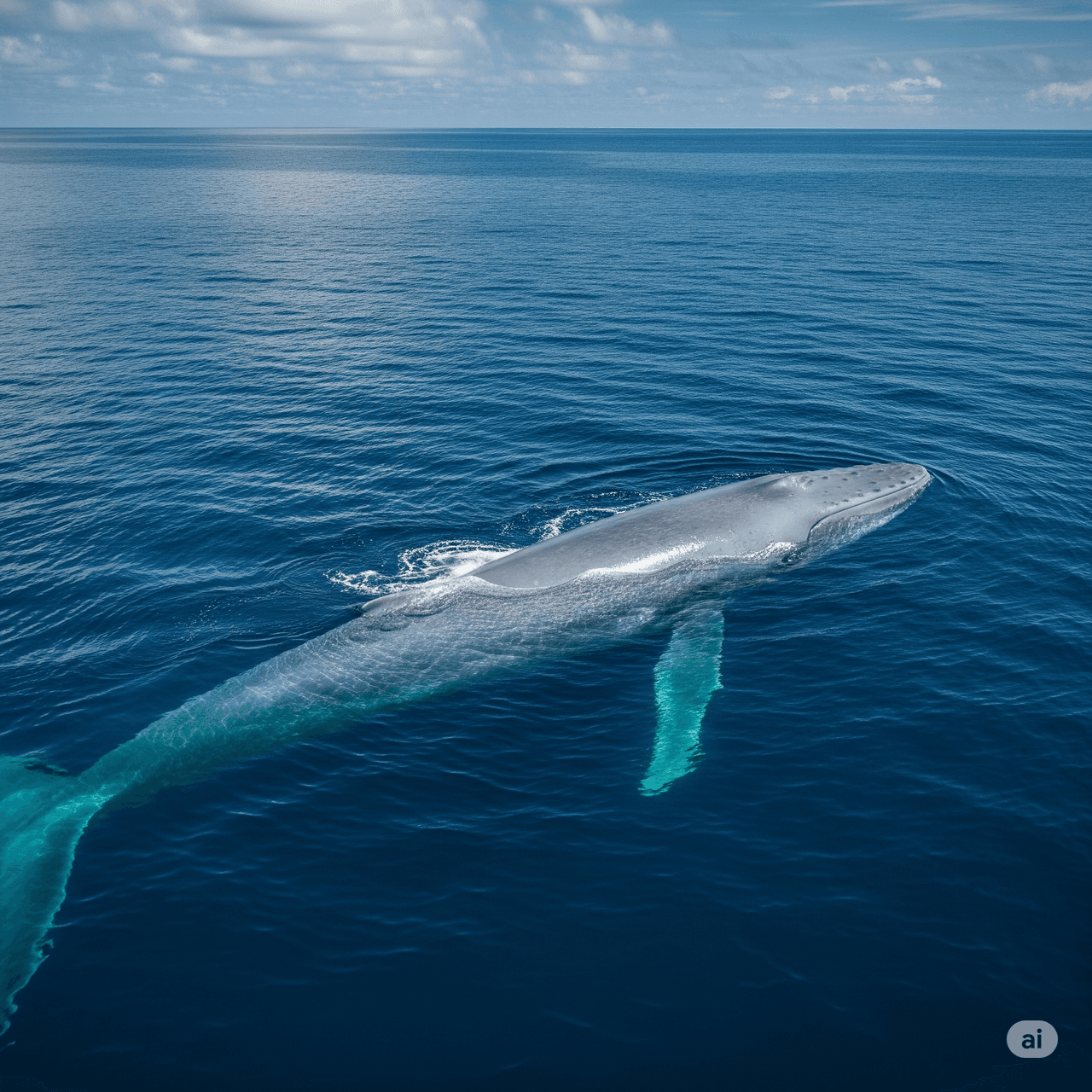
Scientific Name | Balaenoptera musculus | ||||||||
|---|---|---|---|---|---|---|---|---|---|
Common Name | Blue Whale | ||||||||
Family | Balaenopteridae | ||||||||
Size | Average 24-30 metres | ||||||||
Weight | Approximately 150 tonnes | ||||||||
Habitat | Cold and temperate oceans | ||||||||
Diet | Krill and small plankton | ||||||||
Migration | Seasonal long-distance migrations | ||||||||
Conservation Status | Hunting ban in place Under protection | ||||||||
Notable Features | Largest animal Producing low-frequency sounds Optimized feeding | ||||||||
The blue whale is known as the largest animal species on Earth and belongs to the Balaenopteridae family among marine mammals. Unique in size and weight, this species primarily inhabits the open waters of the oceans and plays a vital ecological role in various marine ecosystems. Blue whales are the focus of scientific research due to their complex migration routes, distinctive feeding strategies, and acoustic communication abilities. Their historical and contemporary distribution, population densities, movements, and behaviors provide valuable data for marine biology and conservation science.
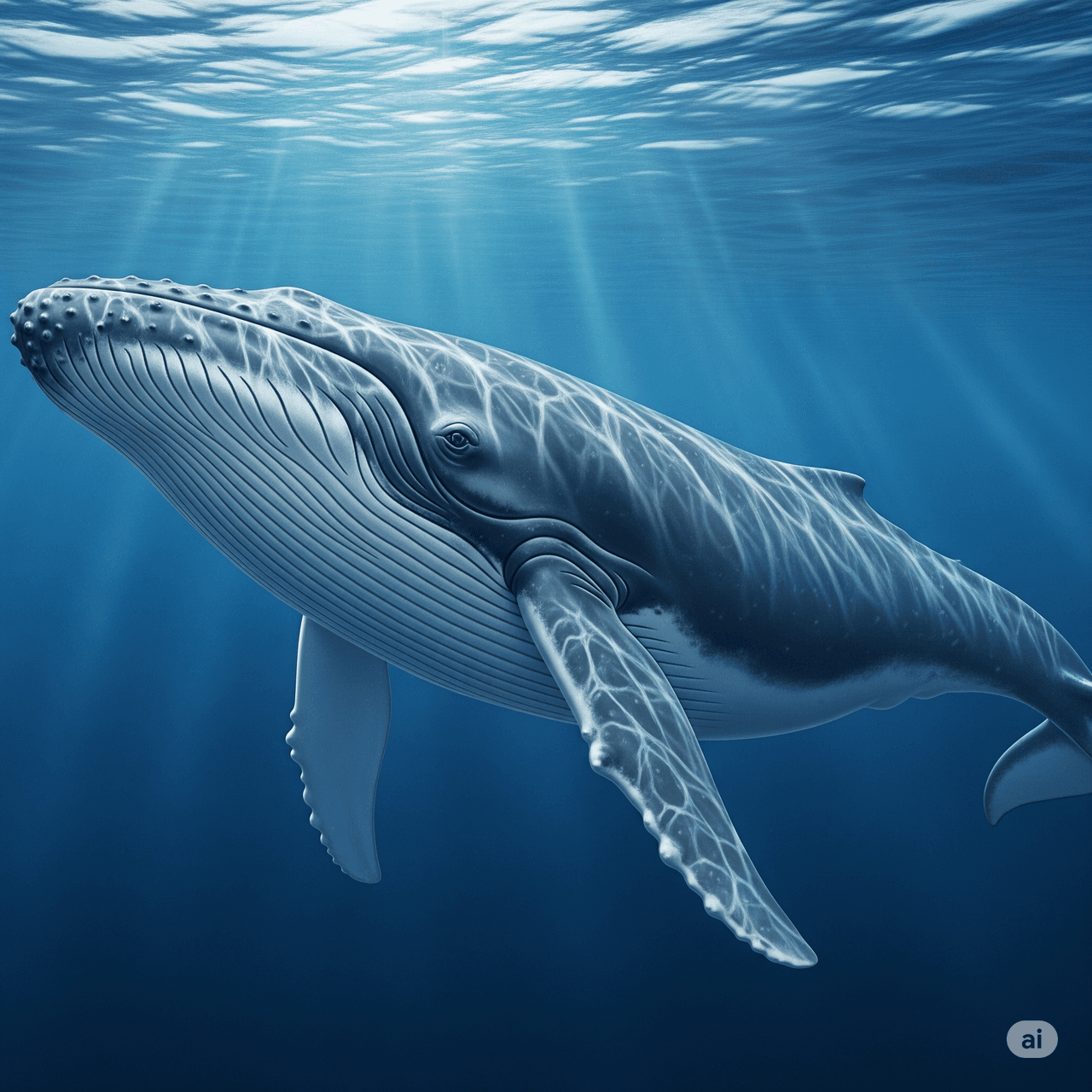
Mavi Balina (Yapay Zeka Tarafından Oluşturulmuştur)
Blue whales are unparalleled in the animal kingdom, reaching an average length of 24 to 30 meters and weights of up to 150 tonnes. Their body structure is hydrodynamic; their slender, elongated body, flippers, and broad tail enable them to achieve high speeds in water. Their skin is typically bluish-gray in color and can vary in hue depending on sunlight and water conditions. Along the head region, several parallel lines run along the length of the upper jaw, a defining physical feature of the blue whale.
Blue whales generally inhabit cold and temperate ocean waters on a global scale, with populations distributed across vast areas such as the Southern Hemisphere and the northern Indian Ocean. Historically widespread worldwide, the distribution of blue whales declined significantly due to intense hunting during the 20th century. Today, certain regional populations are protected. These populations move across wide areas ranging from coastal regions to the open ocean, migrating in response to variations in ocean temperature and food availability for feeding and breeding purposes.
The feeding habits of blue whales focus primarily on krill, small crustacean zooplankton. This species meets its energy needs by consuming vast quantities of krill. Their feeding strategies include optimized behaviors that balance oxygen consumption with energy gain. Blue whales feed in areas with high plankton density, especially in coastal upwelling zones. During feeding, they perform deep dives to gather krill beneath the surface. This behavior forms a critical link in the marine food chain.
Blue whales communicate using low-frequency sounds that can travel vast distances through the marine environment. These acoustic signals are used for intraspecific communication and likely for navigation. Their acoustic properties provide important insights into their social structure and are employed by scientists to track whale movements. Blue whales are generally solitary in social structure; however, temporary groups have been observed during feeding and breeding periods.
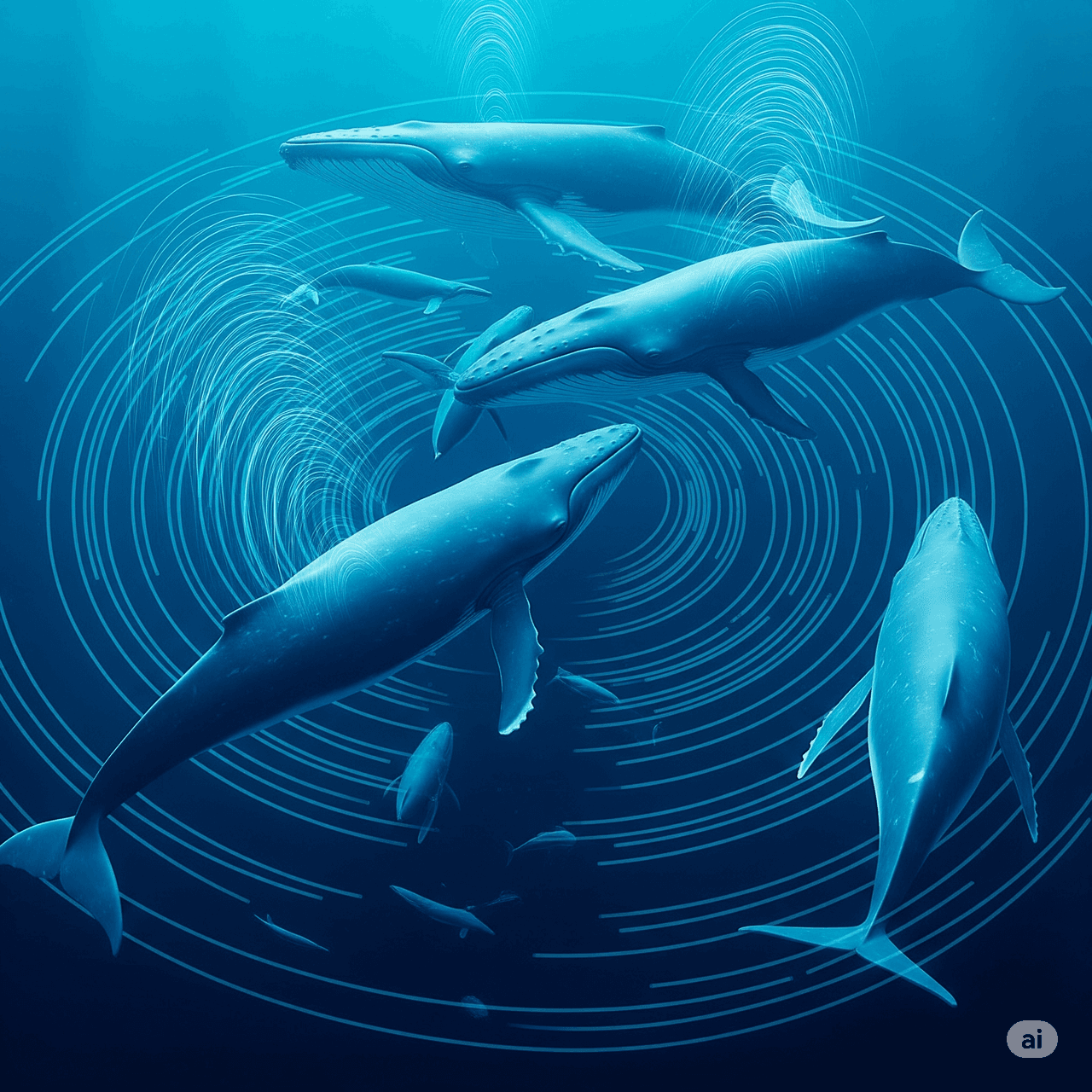
Okyanusta Akustik İletişim (Yapay Zeka Tarafından Oluşturulmuştur)
Blue whales are migratory species that travel long distances seasonally. These migrations occur between breeding and feeding grounds. Populations in the Northern and Southern Hemispheres move according to annual cycles. Migration routes are determined by ocean temperatures, food sources, and the location of breeding areas. During migration, the whales’ navigational abilities are supported by magnetic field detection and acoustic communication. These movements are critical for the conservation and management of whale populations.
Blue whales suffered severe population declines during the 20th century due to overhunting. International conservation efforts led to a ban on whaling, allowing populations to partially recover. However, they still face ongoing threats including ship strikes, marine pollution, noise pollution, and climate change, all of which affect their habitats and survival. Continued research and international cooperation remain essential for the species’ long-term viability.
Scientific studies on the biology, ecology, and behavior of blue whales provide essential data for their conservation. Analysis of marine sounds, satellite tracking, and direct observation techniques offer detailed information on their distribution, movements, and social structures. These studies are critical for understanding the species’ life cycle and developing effective conservation strategies. Additionally, new findings are emerging regarding the impact of blue whales on marine ecosystems and their role in biological diversity.
Branch, T. A., Stafford, K. M., Palacios, D. M., Allison, C., Bannister, J. L., Burton, C. L. K., Cabrera, E., Carlson, C. A., Vernazzani, B. G., Gill, P. C., Hucke‐gaete, R., Jenner, K. C. S., Jenner, M. M., Matsuoka, K., Mikhalev, Y. A., Miyashita, T., Morrice, M. G., Nishiwaki, S., Sturrock, V. J., . . . Warneke, R. M. (2007). Past and present distribution, densities and movements of blue whales Balaenoptera musculus in the Southern Hemisphere and northern Indian Ocean. *Mammal Review*, *37*(2), 116–175.https://doi.org/10.1111/j.1365-2907.2007.00106.x
Cummings, W. C., & Thompson, P. O. (1971). Underwater Sounds from the Blue Whale, Balaenoptera musculus. *The Journal of the Acoustical Society of America*, *50*(4B), 1193–1198.https://doi.org/10.1121/1.1912752
Gill, P. C. (2023). A blue whale (Balaenoptera musculus) feeding ground in a southern Australian coastal upwelling zone. *IWC Journal of Cetacean Research and Management*, 4(2), 179–184.https://doi.org/10.47536/jcrm.v4i2.854
Hazen, E. L., Friedlaender, A. S., & Goldbogen, J. A. (2015). Blue whales (Balaenoptera musculus) optimize foraging efficiency by balancing oxygen use and energy gain as a function of prey density. *Science Advances*, *1*(9).https://doi.org/10.1126/sciadv.1500469
Ramp, C., Bérubé, M., Hagen, W., & Sears, R. (2006). Survival of adult blue whales Balaenoptera musculus in the Gulf of St. Lawrence, Canada. *Marine Ecology Progress Series*, 319, 287–295.https://doi.org/10.3354/meps319287
Reilly, S. B., & Thayer, V. G. (1990). BLUE WHALE (BALAENOPTERA MUSCULUS) DISTRIBUTION IN THE EASTERN TROPICAL PACIFIC. *Marine Mammal Science*, *6*(4), 265–277.https://doi.org/10.1111/j.1748-7692.1990.tb00357.x
Zonn, I. S., Kostianoy, A. G., & Semenov, A. V. (2016). Blue Whale (Balaenoptera musculus). In *Springer eBooks* (pp. 54–55).https://doi.org/10.1007/978-3-319-24237-8_82

Scientific Name | Balaenoptera musculus | ||||||||
|---|---|---|---|---|---|---|---|---|---|
Common Name | Blue Whale | ||||||||
Family | Balaenopteridae | ||||||||
Size | Average 24-30 metres | ||||||||
Weight | Approximately 150 tonnes | ||||||||
Habitat | Cold and temperate oceans | ||||||||
Diet | Krill and small plankton | ||||||||
Migration | Seasonal long-distance migrations | ||||||||
Conservation Status | Hunting ban in place Under protection | ||||||||
Notable Features | Largest animal Producing low-frequency sounds Optimized feeding | ||||||||
No Discussion Added Yet
Start discussion for "Blue whale (Balaenoptera musculus)" article
Morphology and Physical Characteristics
Distribution and Habitat
Feeding and Ecological Role
Acoustic Communication and Social Behavior
Migration and Movements
Conservation Status and Human Impacts
Scientific Research and Observations