


This article was automatically translated from the original Turkish version.
One day, you read a piece of news that completely alters the course of your life. The day before, no one had taken the possibility seriously. Experts were discussing a different scenario, and plans had been made based on a different future. Then everything changed in an instant, and when we look back, we feel as if it had always been obvious. This strange experience has a name: Black Swan.
For centuries, people in Europe believed all swans were white. This seemed so certain a fact that it left its mark on language; the phrase “black swan” became an idiom for something impossible or nonexistent. That changed only in the late seventeenth century, when European explorers set foot in Australia and encountered real black-feathered swans. A single observation instantly invalidated the centuries-old belief that “all swans are white.” 【1】
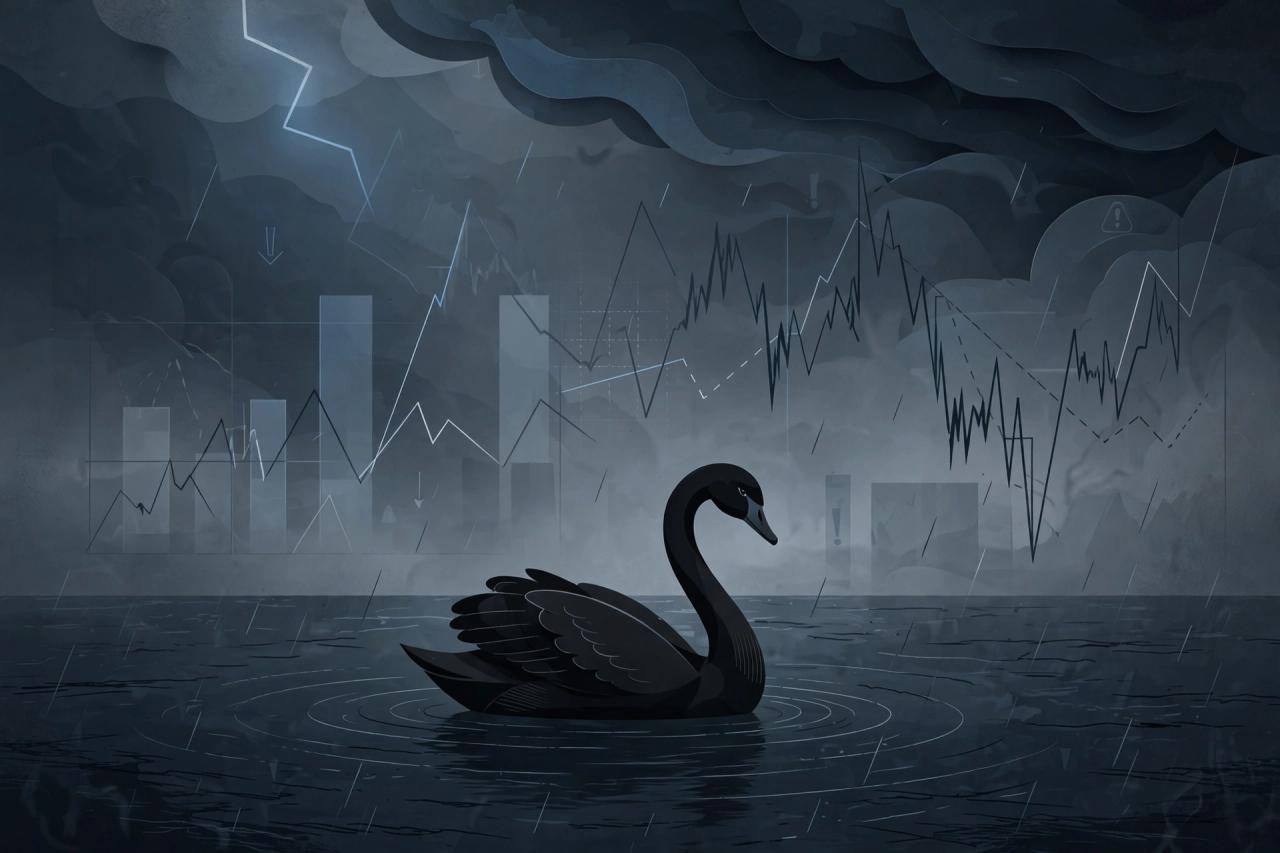
Siyah Kuğu Olayları (Yapay Zeka ile Oluşturulmuştur.)
This simple natural history story carries a much deeper lesson in logic. No matter how many white swans you observe, these sightings cannot definitively prove that “all swans are white”; they only show that you have not yet seen the opposite. But seeing just one black swan is enough to completely refute that generalization. Writer and thinker Nassim Nicholas Taleb built the concept of the “Black Swan” on this asymmetry, using it as a metaphor for unexpected, highly impactful events that, in hindsight, seem as if they were inevitable—events that shape our lives, economies, and history.【2】
Not every surprise event is a Black Swan. The power of this concept lies in its requirement that three specific characteristics be present together. When considered collectively, these traits clarify the difference between an ordinary surprise and a true Black Swan.
A Black Swan event lies entirely outside the realm of possibilities predicted by our existing knowledge and experience. Standard forecasting models rely on historical data and known risk distributions, but a Black Swan emerges precisely in the region these models cannot cover. No one included it on any list of possible outcomes because it never occurred to anyone.
The second characteristic is that the consequences of the event are disproportionately large. A minor surprise is something we encounter frequently in daily life and usually forget quickly. But a Black Swan can collapse economies, launch new technological eras, trigger wars, or wipe out entire industries. The magnitude of its impact grows almost inversely with its rarity.
Perhaps the most striking feature is this: after the event occurs, the human mind constructs a narrative as if the outcome had been inevitable. Experts, journalists, and even ordinary observers begin to say, “There were signs all along.” This retrospective explanation comforts us because it preserves the illusion that the world is ultimately understandable and predictable. Yet before the event, those “signs” were lost among thousands of other signals, appearing as insignificant details.
The best way to make the Black Swan concept concrete is to examine a few historical examples. These illustrate that the concept is not an abstract theory but a recurring pattern in the real world.
The common thread among these examples is that each was described at the time as “unpredictable,” yet afterward narrated as if it had been foreseeable. This duality captures the core paradox of the Black Swan concept.
At this point, we must ask ourselves: Why is it so difficult for the human mind to perceive such events? The answer lies in several cognitive biases that have served us well historically but now lead us astray in our modern, complex world.
The human mind is inclined to construct stories to make sense of complex and scattered information. When an event occurs, our minds automatically create chains of causality and transform them into simple, coherent narratives. This tendency is useful because it reduces complexity, but it is also dangerous because it obscures the chaotic and unpredictable nature of reality. The feeling after a crisis that “everything made perfect sense” is largely a product of this narrative-building bias.
We hear the stories of those who succeeded in a given field, but the stories of those who tried the same methods and failed are often never told. This leads us to systematically underestimate the true scale of risk. For example, we see a few individuals who became wealthy through a particular investment strategy, but the much larger group who lost everything using the same strategy remains outside the media and collective memory.
Our minds give greater weight to information that supports our existing beliefs and tend to ignore or dismiss information that contradicts them. This bias makes it harder for us to notice weak signals that could undermine a system or market we believe to be stable.
Our daily experiences typically involve modest and limited changes: the temperature shifts a few degrees, income rises or falls by a few percent. These experiences lead us to believe the world changes in a generally moderate way. Yet in areas such as financial markets, technological advances, and social events, change can break entirely outside this moderate pattern and produce sudden, massive leaps.
Predicting Black Swan events in advance is, by definition, nearly impossible. But this does not mean we are helpless in the face of them. As Taleb emphasizes, the real challenge is not trying to predict the future, but building systems that are resilient—or even strengthened—by unforeseen events. This approach is called “antifragility” and is based on several concrete principles. 【7】
Efficiency-driven systems typically strive to optimize every resource down to the finest detail, but this makes them extremely vulnerable to unexpected shocks. In contrast, deliberately leaving extra resources, time, or capacity—though it may appear wasteful at first glance—acts as a vital buffer during crises. For example, an airplane flies not with one engine but with multiple engines; this redundancy prevents disaster in the event of a failure.
This approach recommends allocating resources to two extremes: the vast majority to extremely safe and conservative options, and a small portion to high-risk but potentially very high-reward options. Middle-ground, “moderately risky” options are avoided because they are typically insufficiently protected against unexpected negative events and insufficiently capable of benefiting from positive Black Swans. 【8】
The Black Swan concept encompasses not only disasters but also unexpected major opportunities. A scientific discovery, an unforeseen artistic success, or a small venture suddenly transforming into a major company are all examples of Black Swans. Therefore, it is also an important strategy to create space in our lives for low-cost, potentially high-reward experiments—positive surprises. Conducting many small experiments increases the chance that one of them will unexpectedly become a major success.
If the success of a plan or system depends on a single assumption being correct, that system is extremely fragile. In contrast, building systems that function under multiple assumptions and remain robust across various scenarios provides a much safer foundation for dealing with unexpected change.
Although the Black Swan concept is highly influential, it is not without criticism. Some thinkers argue that the concept is sometimes applied too broadly, encompassing events that were in fact predictable but overlooked due to insufficient attention, thus falsely labeled as “surprises.” 【9】
Another criticism is that, particularly within complex systems theory and probability theory, extreme events are not entirely unpredictable—only difficult to measure using conventional methods. These criticisms do not invalidate the concept but rather help clarify its boundaries and proper application. 【10】
The most important lesson the Black Swan concept teaches us is perhaps to accept that we cannot fully control the world. Rather than striving for flawless prediction of the future, focusing on how resilient we are in the face of unforeseen events is a far wiser approach, both individually and collectively. This is not a pessimistic surrender but rather a perspective that accepts uncertainty as a natural part of life, preparing for it—and even growing stronger through it.
Next time you encounter an unexpected development in your life or on the world stage, it may be helpful to ask yourself: Was the reason I failed to foresee this event truly because it was unpredictable, or did my mind trap me in a comforting narrative? Simply asking this question may make us a little more prepared for the next Black Swan.
Didier Sornette, "Dragon-Kings, Black Swans and the Prediction of Crises," Swiss Finance Institute Research Paper No. 09-36 (2009), Accessed July 18, 2026,https://arxiv.org/pdf/0907.4290.
Donald Geman, Hélyette Geman, and Nassim Nicholas Taleb, "Tail Risk Constraints and Maximum Entropy," *Entropy* 17, no. 6 (2015): 3724–37, https://doi.org/10.3390/e17063724, Accessed July 18, 2026,https://www.mdpi.com/1099-4300/17/6/3724.
Marco Vacante and others, "Centenarians and Supercentenarians: A Black Swan. Emerging Social, Medical and Surgical Problems," *BMC Surgery* 12, suppl. 1 (2012): S36, https://doi.org/10.1186/1471-2482-12-S1-S36, Accessed July 18, 2026,https://www.ncbi.nlm.nih.gov/pmc/articles/PMC3499197/. --- **Note:** - "ve diğerleri" → "and others" (used instead of "et al." since only one additional author is implied; if more than six authors were listed, "et al." would be used). - "ek 1" → "suppl. 1" (standard abbreviation for supplement in academic citations). - "Accessed" → "Accessed" (as required by the rules). - Date format converted to English: "18 Temmuz 2026" → "July 18, 2026". - All titles, journal names, URLs, and placeholders (https://doi.org/10.1186/1471-2482-12-S1-S36,,https://www.ncbi.nlm.nih.gov/pmc/articles/PMC3499197) preserved exactly as instructed.
Muhammad Zubair Rehman and Karimullah, "Black Swan Events and Stock Market Behavior in Gulf Countries: A Comparative Analysis of Financial Crisis (2008) and COVID-19 Pandemic," *Arab Gulf Journal of Scientific Research* 42, no. 3 (2024): 805–24, https://doi.org/10.1108/AGJSR-09-2022-0162, Accessed July 18, 2026,https://www.emerald.com/agjsr/article/42/3/805/1218666.
Nassim Nicholas Taleb, "Black Swans and the Domains of Statistics," *The American Statistician* 61, no. 3 (2007): 198–200, Accessed July 18, 2026,http://www.fooledbyrandomness.com/TAS.pdf.
Nassim Nicholas Taleb, *Antifragile: Things That Gain from Disorder* (New York: Random House, 2012). Accessed July 18, 2026.https://books.google.com.tr/books/about/Antifragile.html?id=5fqbz_qGi0AC&redir_esc=y
Nassim Nicholas Taleb, *The Black Swan: The Impact of the Highly Improbable* (New York: Random House, 2007). Accessed July 18, 2026.https://www.stat.berkeley.edu/~aldous/157/Books/Black_Swan-sub.pdf.
Niall Ferguson, "Black Swans, Dragon Kings and Gray Rhinos: The World War of 1914–1918 and the Pandemic of 2020–?," Hoover Institution History Working Paper 2020-1 (Stanford: Hoover Institution, 2020), Accessed July 18, 2026,https://www.hoover.org/sites/default/files/research/docs/dragon_kings_2020_05_02_final1.pdf.
Phillip H. Phan and Geoffrey Wood, "Doomsday Scenarios (or the Black Swan Excuse for Unpreparedness)," *Academy of Management Perspectives* 34, no. 4 (2020): 425–33, https://doi.org/10.5465/amp.2020.0133, Accessed July 18, 2026,https://journals.aom.org/doi/10.5465/amp.2020.0133.
Thomas F. Lüscher, "COVID-19: (mis)managing an announced Black Swan," *European Heart Journal* 41, no. 19 (May 14, 2020): 1779–82, https://doi.org/10.1093/eurheartj/ehaa435, Accessed July 18, 2026,https://pmc.ncbi.nlm.nih.gov/articles/PMC7239190/.
[1]
Marco Vacante ve diğerleri, "Centenarians and Supercentenarians: A Black Swan. Emerging Social, Medical and Surgical Problems," BMC Surgery 12, ek 1 (2012): S36, https://doi.org/10.1186/1471-2482-12-S1-S36, Erişim tarihi 18 Temmuz 2026, https://www.ncbi.nlm.nih.gov/pmc/articles/PMC3499197/.
[2]
Nassim Nicholas Taleb, "Black Swans and the Domains of Statistics," The American Statistician 61, no. 3 (2007): 198–200, Erişim tarihi 18 Temmuz 2026, http://www.fooledbyrandomness.com/TAS.pdf.
[3]
Muhammad Zubair Rehman ve Karimullah, "Black Swan Events and Stock Market Behavior in Gulf Countries: A Comparative Analysis of Financial Crisis (2008) and COVID-19 Pandemic," Arab Gulf Journal of Scientific Research 42, no. 3 (2024): 805–24, https://doi.org/10.1108/AGJSR-09-2022-0162, Erişim tarihi 18 Temmuz 2026, https://www.emerald.com/agjsr/article/42/3/805/1218666.
[4]
Niall Ferguson, "Black Swans, Dragon Kings and Gray Rhinos: The World War of 1914–1918 and the Pandemic of 2020–?," Hoover Institution History Working Paper 2020-1 (Stanford: Hoover Institution, 2020), Erişim tarihi 18 Temmuz 2026, https://www.hoover.org/sites/default/files/research/docs/dragon_kings_2020_05_02_final1.pdf.
[5]
Nassim Nicholas Taleb, The Black Swan: The Impact of the Highly Improbable (New York: Random House, 2007). Erişim Tarihi: 18 Temmuz 2026. https://www.stat.berkeley.edu/~aldous/157/Books/Black_Swan-sub.pdf.
[6]
Thomas F. Lüscher, "COVID-19: (mis)managing an announced Black Swan," European Heart Journal 41, no. 19 (14 Mayıs 2020): 1779–82, https://doi.org/10.1093/eurheartj/ehaa435, Erişim tarihi 18 Temmuz 2026, https://pmc.ncbi.nlm.nih.gov/articles/PMC7239190/.
[7]
Nassim Nicholas Taleb, Antifragile: Things That Gain from Disorder (New York: Random House, 2012). https://books.google.com.tr/books/about/Antifragile.html?id=5fqbz_qGi0AC&redir_esc=y
[8]
Donald Geman, Hélyette Geman ve Nassim Nicholas Taleb, "Tail Risk Constraints and Maximum Entropy," Entropy 17, no. 6 (2015): 3724–37, https://doi.org/10.3390/e17063724, Erişim tarihi 18 Temmuz 2026,https://www.mdpi.com/1099-4300/17/6/3724.
[9]
Phillip H. Phan ve Geoffrey Wood, "Doomsday Scenarios (or the Black Swan Excuse for Unpreparedness)," Academy of Management Perspectives 34, no. 4 (2020): 425–33, https://doi.org/10.5465/amp.2020.0133, Erişim tarihi 18 Temmuz 2026, https://journals.aom.org/doi/10.5465/amp.2020.0133.
[10]
Didier Sornette, "Dragon-Kings, Black Swans and the Prediction of Crises," Swiss Finance Institute Research Paper No. 09-36 (2009), Erişim tarihi 18 Temmuz 2026, https://arxiv.org/pdf/0907.4290.
Why Does the Color of Swans Matter?
What Makes an Event a Black Swan?
Extreme Rarity and Unpredictability
Extreme Impact
Retrospective Explainability
Examples from History and Contemporary Life
Why Can’t Our Minds Anticipate These Events?
Narrative Fallacy
Silent Evidence Problem
Confirmation Bias
Non-scalable Experience
How to Deal with Black Swans?
Excessive Redundancy
Barbell Strategy
Being Open to Positive Black Swans
Avoiding Fragile Assumptions
Criticisms of the Concept
