


This article was automatically translated from the original Turkish version.
Bernoulli's equation is a fundamental principle in fluid mechanics and aerodynamics, of paramount importance for understanding fluid dynamics and applying them in engineering contexts. This equation not only explains various fluid behaviors in the physical world but also forms the basis for a wide range of engineering solutions spanning aviation, automotive design, water engineering, and energy production. By examining the relationship between fluid velocity, pressure, and energy, Bernoulli's equation provides a critical theoretical framework for these fields.
In his 1738 work Hydrodynamica, Daniel Bernoulli mathematically described the motion of fluids and the principle of energy conservation. His work established a fundamental relationship: pressure decreases in regions where fluid velocity increases, and pressure increases where velocity decreases. This equation is based on a conservation principle showing that the energy of a fluid can transform between different forms. Bernoulli's equation is expressed as:
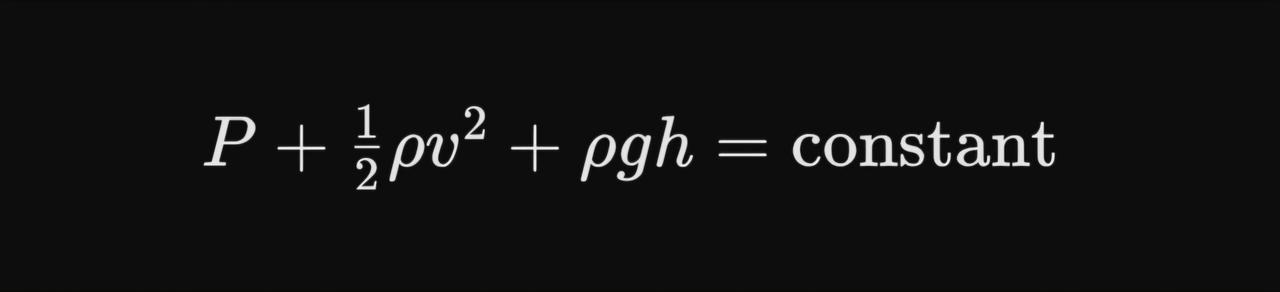
Where:
P: Fluid pressure,
ρ: Fluid density,
v: Fluid velocity,
g: Acceleration due to gravity,
h: Height.
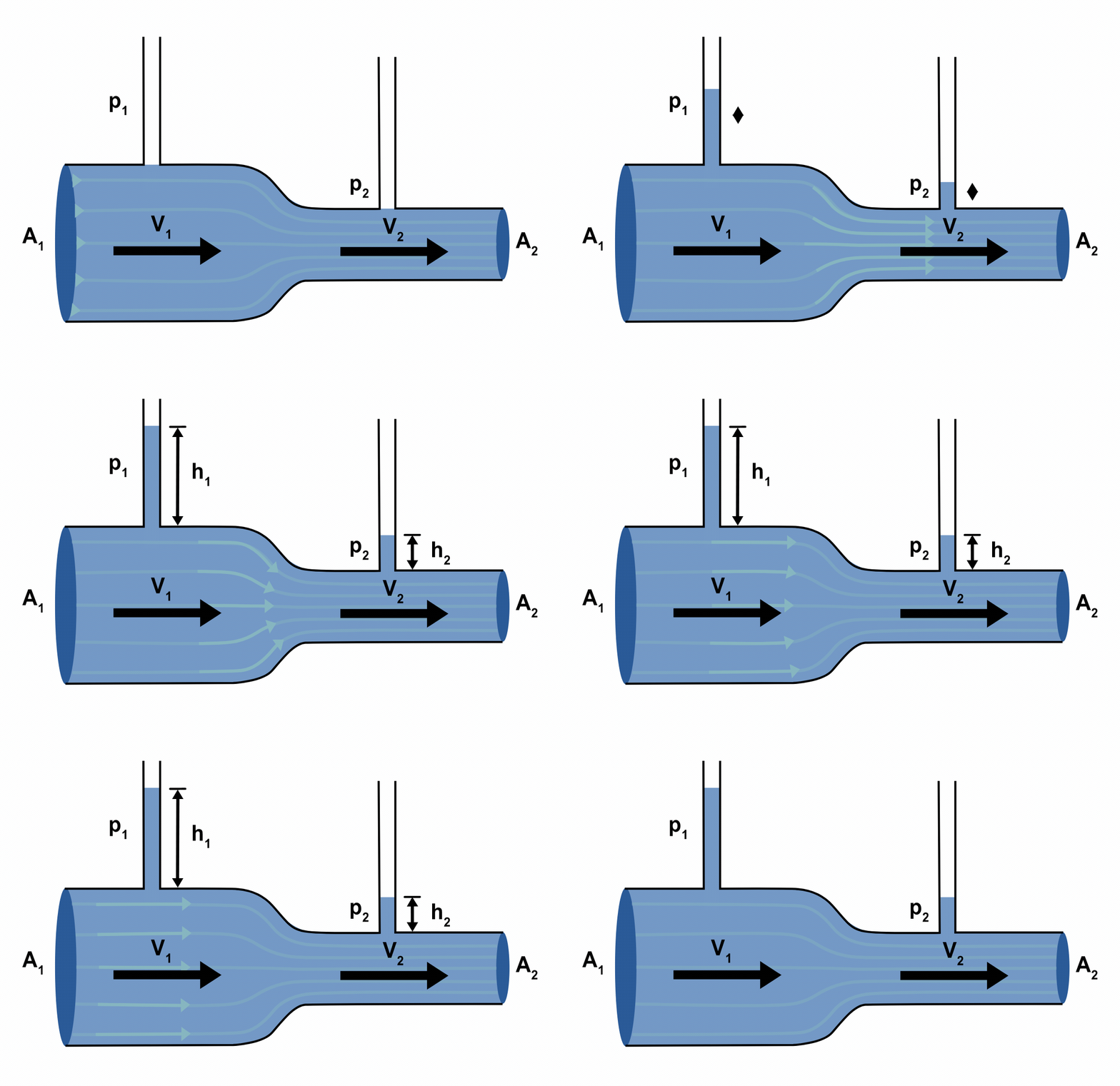
This equation explains how three forms of energy—pressure energy, kinetic energy, and potential energy—interconvert. Bernoulli's equation helps us understand how a fluid's velocity, pressure, and energy are interrelated through calculations applied to fluid systems.
class=\
Bernoulli's equation builds upon earlier studies of fluid mechanics dating back to antiquity. The behavior of fluids was examined by various ancient Greek philosophers, but modern fluid dynamics only began to develop its mathematical foundations in the 17th century. During this period, the contributions of scientists such as Isaac Newton and Gottfried Leibniz to calculus enabled more accurate modeling of fluid motion. However, Bernoulli went beyond these theories by applying the principle of energy conservation to fluid dynamics and laying the groundwork for the relationship between fluid velocity, pressure, and density.
When Daniel Bernoulli developed this equation, fluid mechanics had not yet fully taken shape as a discipline. Thus, Bernoulli's equation served both as a theoretical expression of fluid energy balance and as a principle confirmed by physical observations. His work was revolutionary in fluid mechanics because, at the time, the scientific community lacked a clear understanding of how fluids move. Bernoulli's formulation not only aligned with experimental data of his era but has also been validated by numerous subsequent experimental studies.
Bernoulli's equation has extensive applications in engineering. First and foremost, it is crucial in aerospace engineering. Aircraft wings are designed based on Bernoulli's principle. The air moving over the upper surface of a wing travels faster than the air beneath it. This difference in velocity results in lower pressure on the upper surface and higher pressure on the lower surface. This pressure differential generates lift, enabling the aircraft to remain airborne. The application of this principle in aerodynamic wing design is one of the foundational pillars of aerospace engineering.
Bernoulli's equation is also vital in automotive engineering, water engineering, and civil engineering. For example, liquid flow in pipelines can be calculated using Bernoulli's equation. As a liquid moves through a pipe at a certain velocity, its pressure changes, and this change helps determine energy losses within the system. Similarly, in water systems and fluid-powered devices, Bernoulli's principle enables the design of efficient systems.
The energy sector also features significant applications of Bernoulli's equation. Turbines and pump systems rely on this equation to manage fluid velocity and pressure. The efficient operation of these systems in energy production is achieved through calculations based on Bernoulli's theoretical framework.
One of the most well-known applications of Bernoulli's equation is the lift force on aircraft wings. Air moves faster over the top surface of a wing while moving more slowly beneath it. According to Bernoulli's principle, increased velocity on the upper surface reduces pressure, while lower velocity on the lower surface increases pressure. This pressure difference generates an upward lift force on the wing.
However, explaining lift force solely through Bernoulli's principle can be misleading. This phenomenon is also related to reaction forces caused by the deflection of airflow. According to Newton's third law of motion, when a fluid strikes a surface, it exerts a reaction force on that surface. This reaction force is directed by the aerodynamic properties of the wing, producing lift. Therefore, both Bernoulli's and Newton's theories contribute to the generation of lift force.
Bernoulli's equation applies only to ideal fluids and flows with constant density. In the real world, factors such as viscosity, friction forces, and changes in density must be considered. These factors can limit the accuracy of Bernoulli's equation. For instance, aerodynamic calculations for an aircraft wing cannot be fully explained using Bernoulli's equation alone. The viscosity of air, molecular motion, and environmental factors must also be accounted for.
Moreover, theories such as the "equal transit time" fallacy, which misinterpret Bernoulli's equation, do not reflect actual airflow behavior. Such misconceptions underscore the importance of applying Bernoulli's formulation correctly—not just theoretically but also practically.
Bernoulli's equation is an essential theoretical tool in fluid mechanics and its engineering applications. The equations developed by Bernoulli are used across diverse fields, from aircraft design to energy production and from pipeline systems to automotive engineering. However, there are limitations and misconceptions that must be carefully considered when applying Bernoulli's equation. In modern engineering, alongside Bernoulli's theory, parameters such as fluid viscosity and environmental factors must also be taken into account. It is a fact that when correctly applied, this equation provides solutions to engineering problems, and these principles are increasingly applied across more areas of engineering practice with each passing day.
efluids.com, Bernoulli Equation
www.grc.nasa.gov, Bernoulli and Newton
www.grc.nasa.gov, aeronautics, Bernoulli Equation

Bernoulli's Equation and Fundamental Principles
Historical Development of Bernoulli's Equation
Importance of Bernoulli's Equation in Engineering
Bernoulli and Lift Force
Misconceptions and Limitations of Bernoulli's Equation