


This article was automatically translated from the original Turkish version.
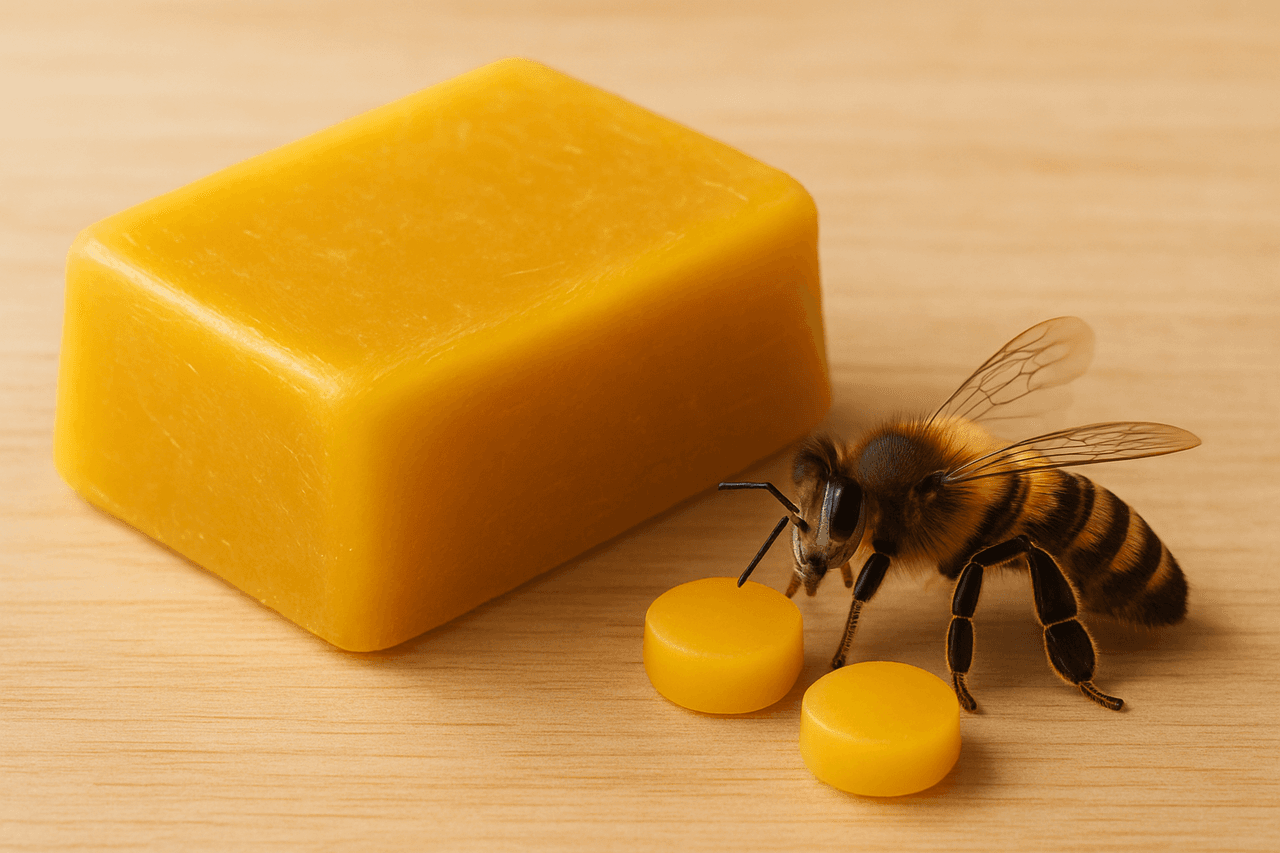
Beeswax (generated by artificial intelligence)
Origin | Secretory glands of honeybees (Apis mellifera) | ||||||||
|---|---|---|---|---|---|---|---|---|---|
Main Function | Comb construction, brood rearing, honey storage | ||||||||
Color Range | Varies from white to yellow, brown, and greenish tones | ||||||||
Main Chemical Classes | Esters, fatty acids, hydrocarbons | ||||||||
Melting Point | Approximately 62–65°C | ||||||||
Density | Approximately 0.95 g/cm³ (at 20°C) | ||||||||
Solubility | Insoluble in water, partially soluble in organic solvents such as ether, benzene, and chloroform | ||||||||
Beeswax is a natural, oily, and moldable substance secreted by specialized wax glands located on the underside of the abdomens of honeybees (particularly Apis mellifera). Bees use this material to construct honeycombs, store honey, preserve pollen, and rear their brood. Beeswax is a vital product that forms the structural foundation of the bee colony. Chemically, it has a complex composition consisting primarily of esters of long-chain fatty acids and alcohols, along with hydrocarbons and small amounts of other components. Since ancient times, humans have used beeswax for various purposes, notably as a key natural raw material in cosmetics, medicine, food, and candle making.
Beeswax production is the result of complex physiological processes and collective behaviors of honeybees. Beeswax is secreted only by young worker bees (approximately 12 to 20 days old) through four pairs of wax glands located on the underside of their abdomens. These glands convert the sugars from consumed honey into the fatty substances used to produce wax. The wax secretion emerges from the glands as small, transparent flakes. Each wax flake weighs about one milligram. Bees manipulate these flakes using their mouthparts (mandibles) and legs, kneading and heating them before shaping them into the desired form. The softened wax is then used to construct hexagonal honeycomb cells. It is estimated that bees must consume approximately 8 to 10 kilograms of honey to produce one kilogram of beeswax, demonstrating that beeswax production is an energy-intensive process. The rate of beeswax production varies depending on the size of the hive, the health of the colony, and the intensity of the honey flow.
Beeswax is a natural material with distinctive physical properties that largely determine its applications.
These physical properties have made beeswax a versatile natural material and a preferred substance in various industrial and household applications.
Beeswax is a chemically complex mixture estimated to contain over 300 different components. Its composition may vary slightly depending on the bee species, plant sources collected, and even geographic region. However, its main components are generally as follows:
This complex and rich chemical structure determines the diverse physical and biological properties of beeswax and enables its use in various industrial applications. The proportions of its components may vary depending on its source and degree of purification.
Beeswax has been a valuable natural product used by humanity for thousands of years across a wide range of fields. Its physical and chemical properties have endowed it with an extensive spectrum of applications.
Beeswax is a popular ingredient in skin care products due to its moisturizing, protective, and emulsifying properties.
Beeswax is used in pharmaceutical formulations as a carrier, thickener, or protective agent.
Beeswax is used in food products as a glazing agent, coating material, or natural additive.
Beeswax has been the preferred material for candle making for centuries.
Beeswax continues to maintain its importance in modern industry due to its natural structure and versatile properties, remaining a valuable raw material as a sustainable resource.
Albayrak, S., & Albayrak, S. "Propolis: Doğal Antimikrobiyal Madde." Ankara Eczacılık Fakültesi Dergisi 37, no. 3 (2008): 201-215.https://dergipark.org.tr/tr/download/article-file/424388
Bogdanov, S. *Beeswax: Production, Composition, Use and Contamination*. Bee Product Science, 2009.https://www.researchgate.net/publication/304012435_Beeswax_Production_Properties_Composition_Control.
Fratini, Filippo, Giovanni Cilia, Barbara Turchi, and Antonio Felicioli. "Beeswax: A minireview of its antimicrobial activity and its application in medicine." *Asian Pacific Journal of Tropical Medicine* (2016).https://www.sciencedirect.com/science/article/pii/S1995764516301407?via%3Dihub.
Kumova, Ulviye. "Önemli Bir Arı Ürünü: Propolis." *Uludağ Arıcılık Dergisi* 2, no. 2 (2002): 10–24.https://dergipark.org.tr/en/pub/uluaricilik/issue/53703/162642

Beeswax (generated by artificial intelligence)
Origin | Secretory glands of honeybees (Apis mellifera) | ||||||||
|---|---|---|---|---|---|---|---|---|---|
Main Function | Comb construction, brood rearing, honey storage | ||||||||
Color Range | Varies from white to yellow, brown, and greenish tones | ||||||||
Main Chemical Classes | Esters, fatty acids, hydrocarbons | ||||||||
Melting Point | Approximately 62–65°C | ||||||||
Density | Approximately 0.95 g/cm³ (at 20°C) | ||||||||
Solubility | Insoluble in water, partially soluble in organic solvents such as ether, benzene, and chloroform | ||||||||
Production
Physical Properties
Chemical Composition
Applications
Cosmetics and Personal Care
Pharmaceuticals and Pharmacy
Food Industry
Candle Making
Art and Crafts
Other Applications