


This article was automatically translated from the original Turkish version.
+1 More
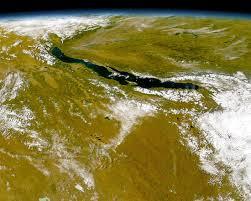
Baykal Lake
Earth | Siberia Russia | ||||||||
|---|---|---|---|---|---|---|---|---|---|
Main Inputs | Selenga, Barguzin, Ust-Angara | ||||||||
Main Outputs | Angara | ||||||||
Basin Countries | Russia, Mongolia | ||||||||
Lake Baikal is a freshwater lake located in Eastern Siberia, notable for both its geological and biological significance. It is estimated to have formed approximately 25 to 30 million years ago and is therefore regarded as one of the oldest lakes on Earth. With a depth of 1,642 metres, it is the deepest lake in the world. It holds the largest volume of freshwater on the planet, with a water volume of 23,615 km³. Approximately 20–23 percent of the world’s unfrozen freshwater is contained in Lake Baikal. With a surface area of 31,722 km², it ranks as the seventh largest lake in the world.
The lake is of great importance due to its biological diversity. Around 2,600 animal species and 1,000 plant species inhabit Lake Baikal, more than 80 percent of which are endemic, meaning they are found nowhere else on Earth. This characteristic makes Lake Baikal one of the most remarkable examples among freshwater ecosystems. In 1996, Lake Baikal was designated a UNESCO World Heritage Site by the United Nations Educational, Scientific and Cultural Organization.
Lake Baikal lies between the Irkutsk Oblast and the Republic of Buryatia in northeastern Central Asia, Russia. The lake is situated at an elevation of 455.5 metres above sea level and measures 636 kilometres in length with a width ranging from 25 to 80 kilometres. Its shoreline extends for approximately 1,800 kilometres.
The lake sits atop the Baikal Rift System, an active tectonic rift. The Earth’s crust here is expanding at a rate of about 4 millimetres per year. Earthquakes and hot springs are occasionally observed along the fault lines of this system. The lake is divided into three main basins: Northern, Central and Southern. The Academician Ridge and the Buguldeika Saddle form boundaries between these basins.
The lakebed is covered in places by sedimentary layers up to 7 kilometres thick, with the rift floor lying approximately 8–11 kilometres below the surface, forming the deepest continental depression on Earth. The lake is surrounded by mountains. To the north lie the Baikal Mountains, to the northeast the Barguzin Range, and to the west the Primorsky Range. There are 27 islands within the lake, the largest of which is Olkhon Island, measuring 72 kilometres in length and one of the largest lake islands in the world.
Lake Baikal is fed by more than 330 rivers, the main ones being the Selenga, Barguzin, Upper Angara, Turka, Sarma and Snejnaya. The lake drains exclusively through the Angara River.
Lake Baikal is one of the clearest freshwater lakes in the world. During winter, water clarity in open areas can reach 30–40 metres, while in summer it typically ranges from 5 to 8 metres. The oxygen content of the water is very high, even at its deepest points. This distinguishes Lake Baikal from stratified lakes such as the Black Sea.
Surface temperature varies significantly throughout the year. The lake is ice-covered for four to five months during winter and early spring. Ice thickness generally ranges from 0.5 to 1.4 metres, reaching over 2 metres in some areas. During this period, surface water is slightly below 0 °C, while at depths of 200–250 metres the temperature is 3.5–3.8 °C. From May to June, as surface ice melts, the upper layers down to 300 metres become uniformly around 4 °C (isothermal condition). In summer, surface temperatures can reach 16 °C, and in shallow southern bays up to 20–24 °C. Temperature decreases with depth during this season. In autumn, the surface cools again, and from October to November a second isothermal period occurs. Below 300 metres, temperature remains constant throughout the year, varying between 3.1 and 3.4 °C.
Over the past 50 years, surface temperatures have increased by approximately 1.5 °C and the duration of ice cover has shortened. Subsurface heat sources, around 50 °C, do not significantly affect the lake’s overall temperature but have been observed in areas such as Frolikha Bay, Kukuisky Canyon and the Selenga Delta.
Lake Baikal is frequently subject to storms in summer and autumn, with wave heights reaching up to 4.5 metres.
The surrounding area and shoreline of Lake Baikal feature a highly diverse aquatic and semi-aquatic vegetation. Over 1,000 plant species have been identified. The Common Cattail (Cirsium palustre) is widespread in marshes and reed beds around the lake. This species has historically dominated Juncus subnodulosus/Cirsium palustre fen habitats shaped by Holocene agricultural practices.
The ecological role of the Common Cattail extends beyond vegetation, as it serves as a host for numerous pollinators and larvae. Its flowers are visited by more than 39 insect species, and the larvae of genera such as Cheilosia and Agapanthia feed on this plant.
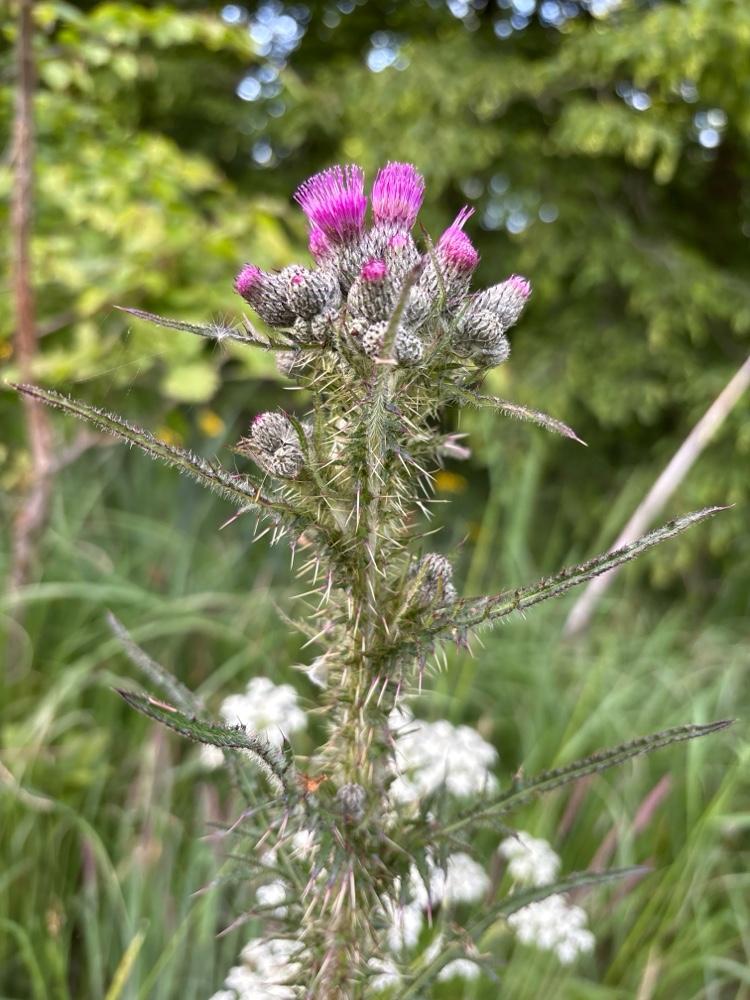
Bataklık Devedikeni (Cirsium vulgare) (Observation)
Submerged macrophytes are mostly found in shallow bays. Genera such as Ceratophyllum, Myriophyllum, Potamogeton and Sparganium have been recorded. Green algae (particularly Draparnaldioides, Tetraspora and Ulothrix) and approximately 400 species of siliceous algae (diatoms) are common in the lake. Half of these diatom species are endemic.
Although fewer than 65 native fish species inhabit Lake Baikal, more than half are endemic. The golomyanka fish (Comephorus baicalensis and C. dybowskii), deepwater sculpins and other Baikal-specific bottom-dwelling fish live only in this lake. Golomyanka fish inhabit depths of 100–500 metres and are the deepest-living freshwater fish in the world. They constitute the primary food source for the Baikal seal and form the largest biomass of fish in the lake.
The omul (Coregonus migratorius) is a unique and commercially important fish of the lake. In addition, C. baicalensis, the Baikal sturgeon (Acipenser baerii baicalensis), and the Baikal white and black graylings (Thymallus baikalensis and T. brevipinnis) are also endemic.
The Baikal seal (Pusa sibirica) is the lake’s only mammal. It spends its entire life cycle in the lake and can dive to depths of up to 400 metres. Its population numbers between 80,000 and 100,000 individuals. It gives birth in dens dug into snow and ice, feeds primarily on golomyanka fish, and uses its thick blubber layer and powerful foreflippers to break holes in the ice.
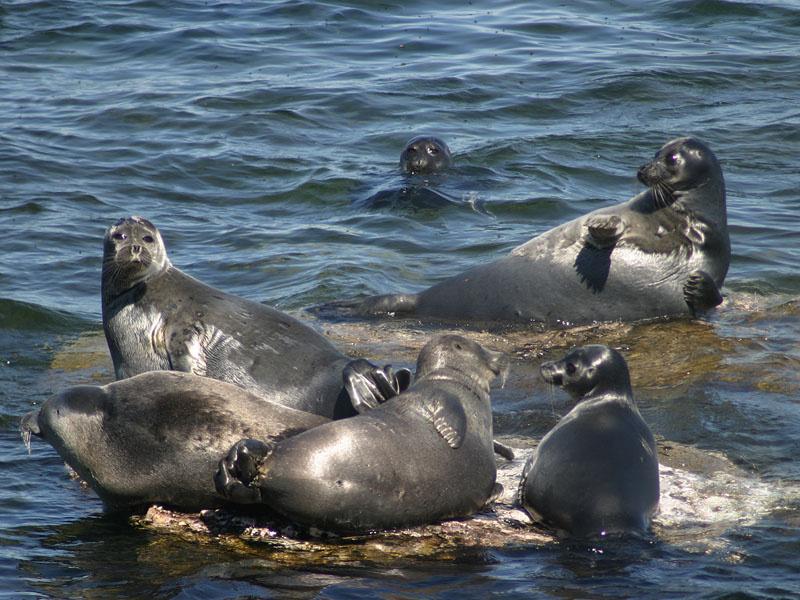
Baykal Foku (Pusa Sibirica) (Observation)
The most abundant animal in the lake is Epischura baicalensis, a species that makes up 80–90 percent of the zooplankton and is estimated to filter the entire lake volume once every 23 years. Amphipods (over 350 species) show great diversity, especially in genera such as Macrohectopus, Acanthogammarus and Brachyuropus. Some amphipod species can grow up to 7 centimetres in length.
About 150 species of freshwater molluscs have been identified, of which 117 are endemic. More than 30 species of bivalves occur in the lake, half of which are endemic. There are approximately 200 species of oligochaete worms and over 140 endemic flatworm species. Eighteen sponge species are found in Lake Baikal, the most common being Lubomirskia baicalensis, Baykalospongia bacillifera and B. intermedia.
Arzhannikov, S.G., A.V. Ivanov, A.V. Arzhannikova, E.I. Demonterova, J.D. Jansen, F. Preusser, V.S. Kamenetsky, and M.B. Kamenetsky. "Catastrophic Events in the Quaternary Outflow History of Lake Baikal." Earth-Science Reviews 177 (2018): 76–113. Accessed May 5, 2025.https://doi.org/10.1016/j.earscirev.2017.11.011
Freshwater Ecoregions of the World. "Lake Baikal." Accessed May 5, 2025.https://www.feow.org/ecoregions/details/606.
Helfferich, Carla. "The Oddities of Lake Baikal." Accessed May 5, 2025.
Kravchinsky, Vadim A., Mikhail A. Krainov, Michael E. Evans, John A. Peck, John W. King, Mikhail I. Kuzmin, Hideo Sakai, Takayoshi Kawai, and Douglas F. Williams. "Magnetic Record of Lake Baikal Sediments: Chronological and Paleoclimatic Implications for the Last 6.7 Myr." *Palaeogeography, Palaeoclimatology, Palaeoecology* 195, no. 3–4 (2003): 281–298. Accessed May 5, 2025.https://doi.org/10.1016/S0031-0182(03)00362-6
Observation International and local partners. "Observation International ve yerel ortaklar." Accessed [insert date in English format].
Observation International and local partners. "Observation.org dataset, *Pusa sibirica*." Accessed May 5, 2025.https://observation.org/species/80616/
U.S. Geological Survey. "Lake Baikal – A Touchstone for Global Change and Rift Studies." Accessed May 5, 2025.https://pubs.usgs.gov/fs/baikal/.
UNESCO. "Lake Baikal." Accessed May 5, 2025.https://whc.unesco.org/en/list/754/.

Baykal Lake
Earth | Siberia Russia | ||||||||
|---|---|---|---|---|---|---|---|---|---|
Main Inputs | Selenga, Barguzin, Ust-Angara | ||||||||
Main Outputs | Angara | ||||||||
Basin Countries | Russia, Mongolia | ||||||||
Geography
Water Properties (Hydrography)
Vegetation
Animal Community