


This article was automatically translated from the original Turkish version.
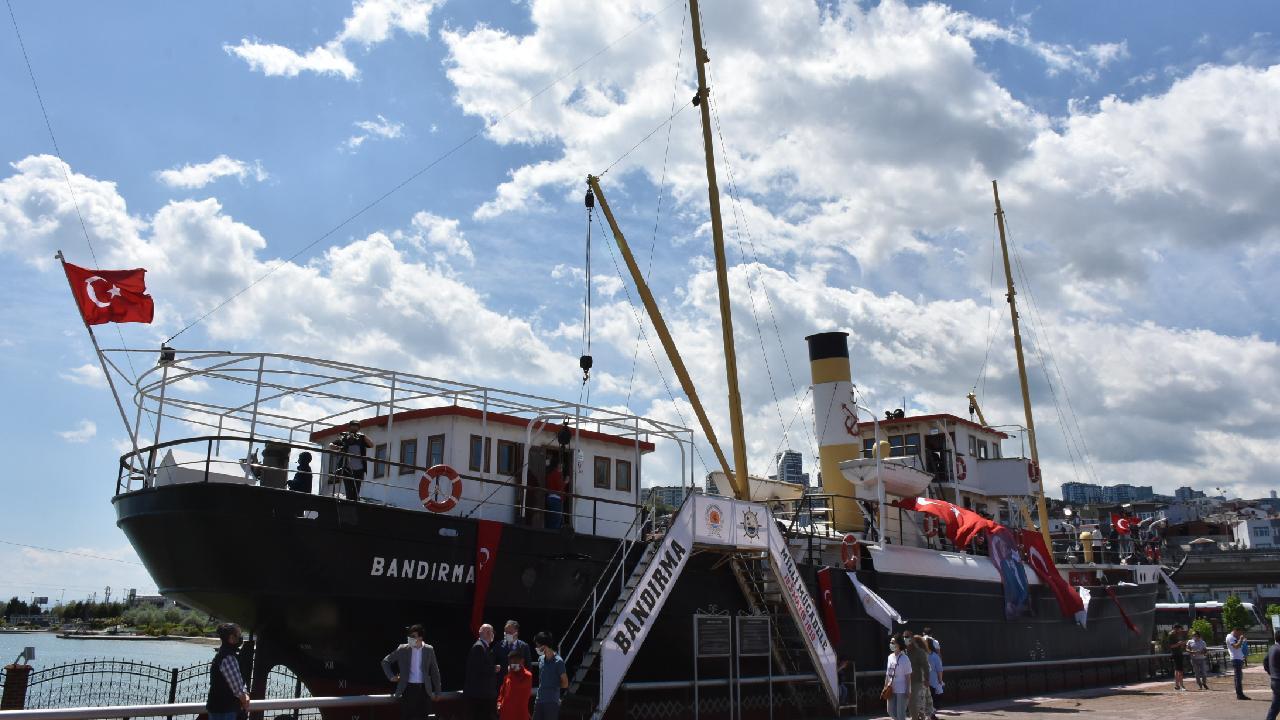
Bandırma Steamship
First Names | Trocadero Kymi Panderma | ||||||||
|---|---|---|---|---|---|---|---|---|---|
Place of Production | Glasgow Scotland (1878) | ||||||||
Technical Specifications | The passenger and cargo steamship built in 1878 underwent various name changes. | ||||||||
Location | Samsun Canik District Bandırma Steamship Museum | ||||||||
Historical Significance | The Bandırma Steamship is a symbol of Mustafa Kemal Pasha's landing in Samsun in 1919 which initiated the War of Independence. | ||||||||
Replica | The museum ship built in 2001 was opened to visitors as a one-to-one replica of the Bandırma Steamship. | ||||||||
19 May 1919, Turk nation’s struggle for independence is commemorated as its beginning. The process leading to this date encompasses a period marked by the Ottoman Empire’s defeat in the First World War and the accelerated disintegration of the empire following the signing of the Treaty of Sèvres. 19 May 1919 marks the beginning of the foundation of the Turkish War of Independence.
Mustafa Kemal Pasha and his comrades’ journey from Istanbul to Samsun is one phase of this struggle. The Bandırma Vessel, which departed Istanbul on 16 May 1919, arrived in Samsun on 19 May and contributed to the resistance movement against the occupying forces in Anatolia. This voyage of the Bandırma Vessel signifies the initial stage of the independence struggle.
After arriving in Samsun, Mustafa Kemal Pasha began organizing the independence struggle and took steps to strengthen resistance movements across various regions of Anatolia. These developments constituted the beginning of the War of Independence.
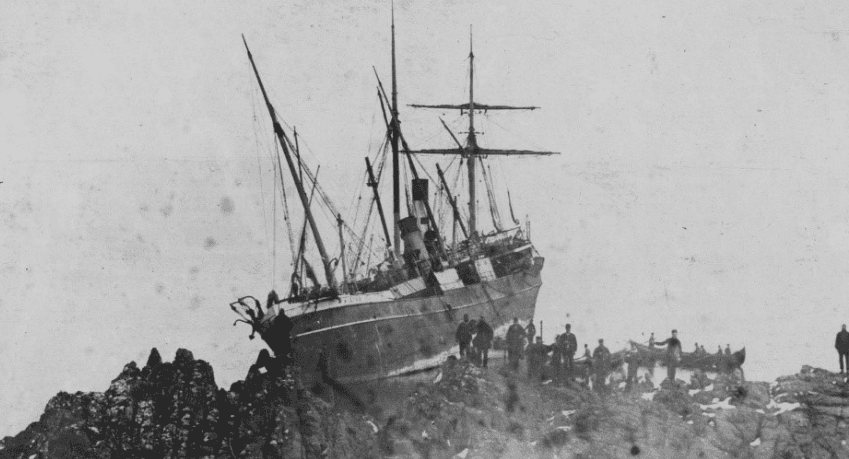
Bandırma Vessel at Anchor (Source: T.C. SAMSUN GOVERNORSHIP)
Following the signing of the Armistice of Mudros, Istanbul was occupied by the Allied Powers, and its strategic points came under the control of foreign military forces. In this context, the Kız Kulesi was converted by the British into a military outpost to control the passage of the Straits. All ships departing Istanbul toward the Black Sea were stopped there and searched by British officers. This surveillance made travel from Istanbul to Anatolia extremely risky.
On 16 May 1919, as the Bandırma Vessel departed Istanbul for Samsun, it was subjected to inspection at the Kız Kulesi. Had the mission under Mustafa Kemal Pasha’s command been detected and blocked by the British, history might have taken a very different course. However, since no irregularities were found during the search, passage was permitted and the vessel continued on its route.
On 30 April 1919, a decree signed by Ottoman Sultan Vahdettin appointed Mustafa Kemal Pasha as Inspector of the 9th Army. This appointment granted him authority to ensure security in the eastern provinces, oversee the collection of weapons, and maintain public order. This authority provided a suitable foundation for the independence struggle; Mustafa Kemal Pasha utilized it to organize the population.
On the afternoon of 16 May 1919, the Bandırma Vessel departed Istanbul and passed through the Bosphorus to begin its journey to the Black Sea. After passing the British checkpoint, the vessel was again stopped by a British warship near Tekirdağ and subjected to a second inspection. Again, since no obstacles were found, the journey continued and the vessel reached the waters of Samsun on the morning of 19 May 1919.
At that time, Samsun had no pier or port, so the Bandırma Vessel anchored offshore, and Mustafa Kemal Pasha and his delegation disembarked onto land using small rowboats. The disembarkation point was the Tütün Pier in Samsun. This pier has since become one of the symbolic locations of the process.
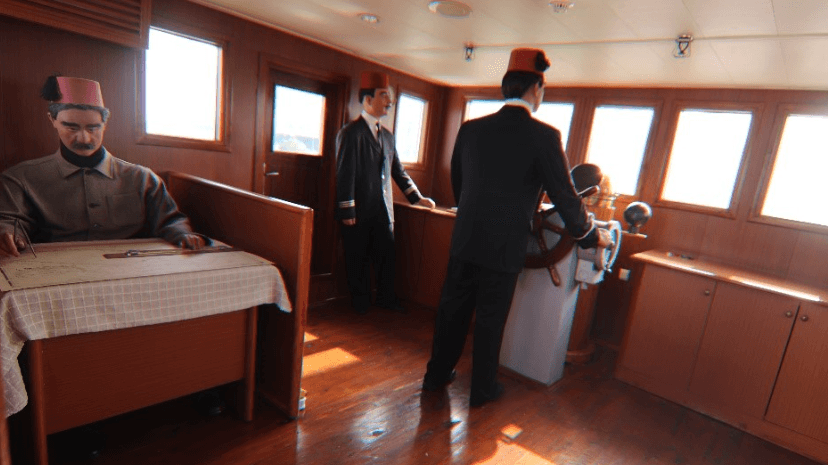
Statues of Captain İsmail Hakkı (Durusu) Bey, Assistant Captain Üsküdarlı Tahsin Bey, and Cipher Clerk İsmail Bey (Source: T.C. SAMSUN GOVERNORSHIP)
The Bandırma Vessel was built in 1878 at the McIntyre & Co. shipyard in Glasgow, Scotland. Originally named “Trocadero,” the vessel was renamed “Kymi” in 1880 and began operating under the Greek flag. In 1891, after running aground on rocks, it was salvaged and brought to Istanbul. In 1894, it was purchased by the Ottoman State and incorporated into the İdare-i Mahsusa, beginning service under the name “Bandırma.” In 1910, it was transferred to the Ottoman Directorate of Navigation.
The vessel, which served for postal, cargo, and passenger transport along the coasts of the Marmara, Black Sea, and Aegean, was old and worn. It had no first-class cabins, and its living quarters were cramped and uncomfortable.
After the proclamation of the Republic, the vessel was transferred to the Turkish Directorate of Navigation and was taken out of service in 1924. In 1925, it was sold to a Turkish shipowner and subsequently scrapped.
To preserve the historical significance of the Bandırma Vessel, the Samsun Governorship initiated a project to construct a replica. Following a decision by the Samsun Provincial Council on 23 November 1999, the project was implemented through cooperation between the Samsun Provincial Special Administration and the Samsun Metropolitan Municipality. The replica was completed on 15 April 2001 and opened to the public as a museum on 18 May 2003 at the Doğupark location in Samsun.
The Bandırma Vessel Museum was constructed to the same dimensions as the original vessel. In 2005, the museum was transferred to the Samsun Metropolitan Municipality and operates under the Directorate of Culture and Social Affairs.
The Bandırma Vessel and National Struggle Park Open-Air Museum is a structure established to convey the historical journey of the Bandırma Vessel. It is located at the Doğupark location in Samsun and presents various elements of the era through its exhibits.
Inside the museum vessel, the cabin used by Mustafa Kemal Atatürk during his journey, the meeting hall, the radio room, and the officers’ cabins have been arranged. Wax statues of his comrades who accompanied him on the voyage are displayed within the vessel. On the deck, period-appropriate figures and ship equipment are exhibited.
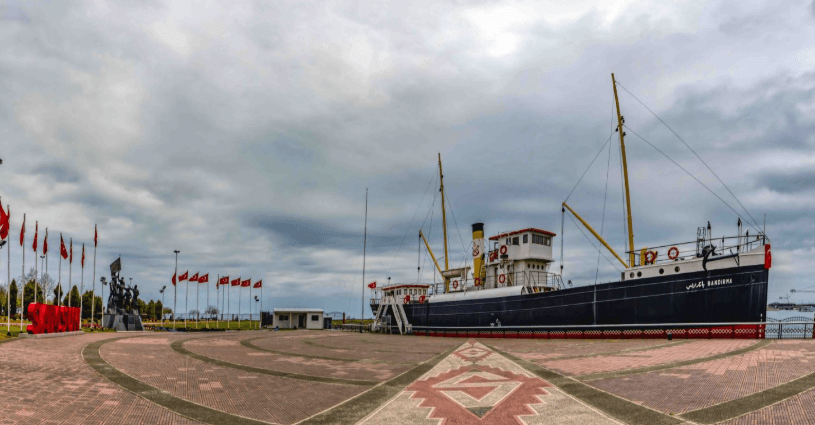
Bandırma Vessel (Source: Culture Portal)
In the open-air museum area, ten bronze reliefs depicting the stages of the Turkish War of Independence are exhibited. These reliefs narrate significant historical events from the beginning of the war to the proclamation of the Republic in an artistic style. The scenes depicted include the Amasya Circular, the Erzurum and Sivas Congresses, the Battle of Sakarya, and the Great Offensive among other critical phases.
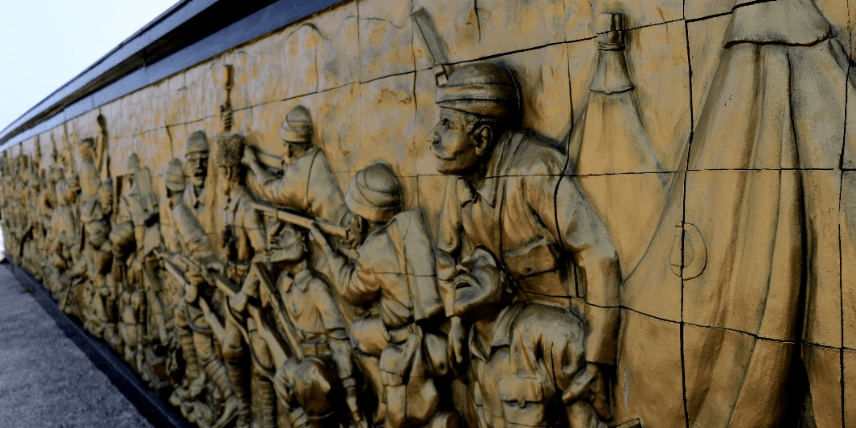
Ceramic Reliefs (Source: Culture Portal)
Within the park, a monument representing Mustafa Kemal Atatürk and eighteen bronze statues of his comrades are displayed. These statues reflect the identities of individuals and embody the collective spirit of the National Struggle. Each figure has been designed with historical accuracy, reflecting the military uniforms and postures of the period.
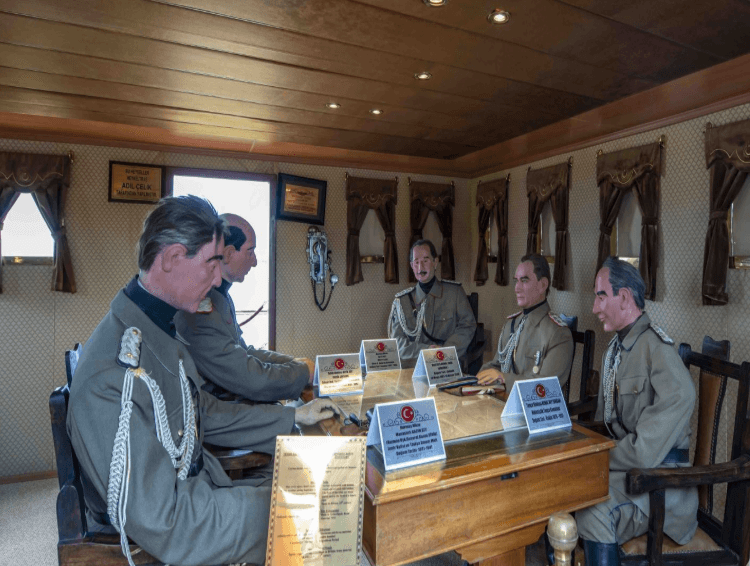
Wax Statues in the Cabin (Source: Culture Portal)
The 1919 Panorama, located within the museum, is a large-scale panoramic display that vividly recreates the urban fabric, harbor area, and daily life of Samsun in 1919. This three-dimensional work enables visitors to directly experience the atmosphere of the era, transforming historical events from abstract narratives into tangible visual experiences.
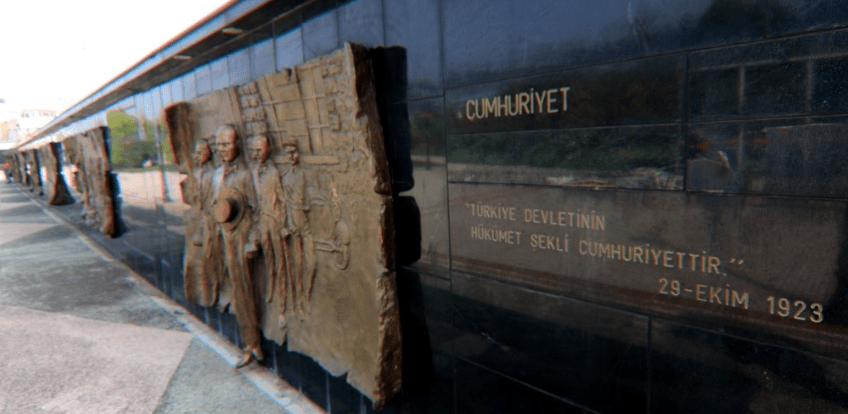
Nine bronze reliefs representing the years of the liberation struggle initiated by Mustafa Kemal Atatürk after his arrival in Samsun on 19 May 1919 and the circulars he issued (Source: T.C. SAMSUN GOVERNORSHIP)
Integrated into the museum complex, the Path to Liberation is a symbolic route representing the independence movement that began in Samsun and spread across Anatolia. Along the path, relief panels present the stages of the National Struggle through both written information and sculptural imagery. Visitors walk this path step by step, gaining a sense of living through history.
The park also features a Martyrs’ Inscription listing the names of heroes who lost their lives during the National Struggle and a monument dedicated to them. This monumental structure aims to preserve historical memory and offers visitors a reflective space imbued with emotion.
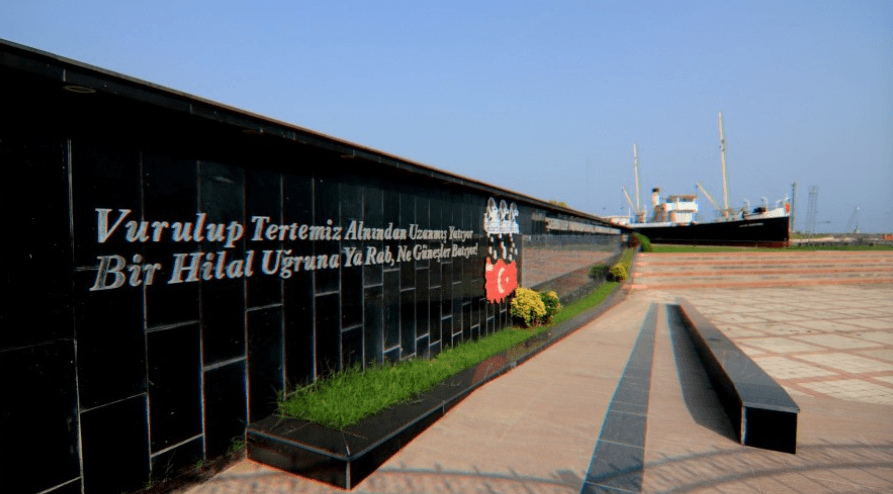
Martyrs’ Inscription of Samsun (Source: T.C. SAMSUN GOVERNORSHIP)
The amphitheater in the open-air museum is used for historical presentations, ceremonies, documentary screenings, and official commemorative programs. The ceremony ground hosts official celebrations with protocol and public participation on important occasions such as 19 May, the Commemoration of Atatürk, Youth and Sports Day.
The indoor exhibition halls within the complex are equipped with documents, photographs, maps, personal belongings, and multimedia content from the period. Additionally, a visual chronology of Atatürk’s arrival in Samsun is presented, providing educational guidance services to visitors. Event spaces are designed to host temporary exhibitions, educational workshops, and cultural activities.
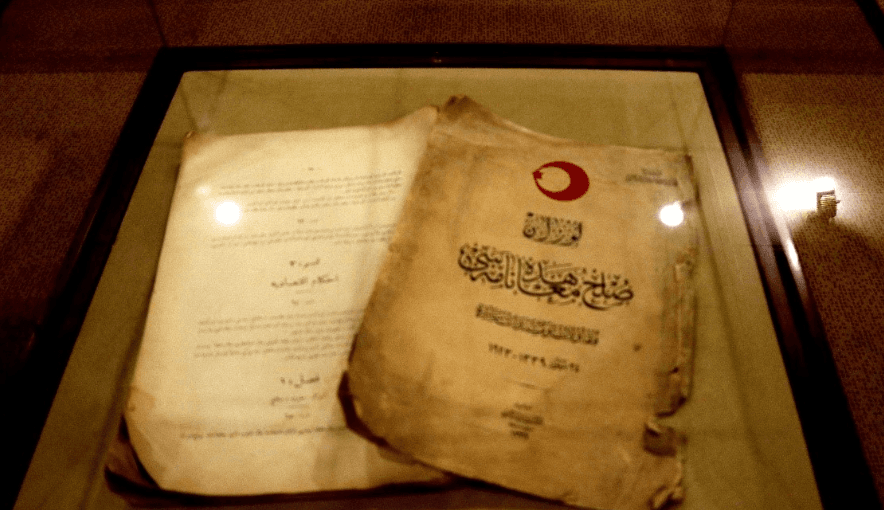
Original Ottoman-language print of the Treaty of Lausanne, published in 1923 by the Ministry of Foreign Affairs (Source: T.C. SAMSUN GOVERNORSHIP)
Bandırma Vessel and National Struggle Park Open-Air Museum is located in the Doğupark area within the Canik district of Samsun. The museum operates under the responsibility of the Samsun Metropolitan Municipality and is open to visitors every day of the year. Entry is permitted during designated hours and requires a ticket.
Address: Doğupark, Bandırma Vessel and National Struggle Park, Canik / Samsun
Opening Hours: 09.00 – 17.00 (subject to change according to summer and winter schedules.)
Days Open: Every day of the week (open on official holidays)
Admission Fee: The museum admission fee is determined by the Samsun Metropolitan Municipality, with discounted rates for students, teachers, and visitors over 65 years of age.
Visitors are permitted to take photographs within the museum grounds. However, professional photography and special shoot requests require prior permission from the municipality. Guided tours are provided for visitors, particularly for student groups, accompanied by historical explanations.
The journey between 16 and 19 May 1919 constitutes the first physical step in the establishment process of the Republic of Türkiye.
Bandırma Gemi Müzesi. "Bandırma Gemi Müze Ziyaretçilerini Milli Mücadele Dönemine Götürüyor." Anadolu Ajansı, April 10, 2023.https://www.aa.com.tr/tr/kultur/bandirma-gemi-muze-ziyaretcilerini-milli-mucadele-donemine-goturuyor/3223053. Accessed April 18, 2025.
Bandırma Gemi Müzesi.” Kültür Portalı, Kültür ve Turizm Bakanlığı. Accessed April 18, 2025.
Bandırma Gemi Müzesi.” Samsun İl Kültür ve Turizm Müdürlüğü. Accessed April 18, 2025.
ÖzBey, Veysel. "Türk Kurtuluş Savaşı Anıt ve Müze Gemileri." SAVSAD Savunma ve Savaş Araştırmaları Dergisi. Accessed April 18, 2025.
“Bandırma Vapuru Tarihçesi ve Bandırma Gemi Müze.” Samsun Valiliği. Accessed April 18, 2025.

Bandırma Steamship
First Names | Trocadero Kymi Panderma | ||||||||
|---|---|---|---|---|---|---|---|---|---|
Place of Production | Glasgow Scotland (1878) | ||||||||
Technical Specifications | The passenger and cargo steamship built in 1878 underwent various name changes. | ||||||||
Location | Samsun Canik District Bandırma Steamship Museum | ||||||||
Historical Significance | The Bandırma Steamship is a symbol of Mustafa Kemal Pasha's landing in Samsun in 1919 which initiated the War of Independence. | ||||||||
Replica | The museum ship built in 2001 was opened to visitors as a one-to-one replica of the Bandırma Steamship. | ||||||||
No Discussion Added Yet
Start discussion for "Bandırma Ship Museum" article
The Situation in Istanbul After the Armistice of Mudros and the Mission of the Bandırma Vessel
Mustafa Kemal Pasha’s Appointment as Inspector of the 9th Army
Departure of the Bandırma Vessel from Istanbul and Its Journey Route
Technical Specifications and Ownership Changes of the Bandırma Vessel
Decommissioning and Dismantling of the Bandırma Vessel
Construction of the Bandırma Vessel Replica and Its Conversion into a Museum
Exhibited Elements in the Bandırma Vessel and National Struggle Park Open-Air Museum
Bandırma Vessel Replica
Ten Bronze Reliefs
Atatürk Monument and Bronze Statues of National Struggle Heroes
1919 Panorama
Path to Liberation and Relief Panel Road
Martyrs’ Inscription and Martyrs’ Monument
Amphitheater and Ceremony Ground
Indoor Exhibition Halls and Event Spaces
Visit Information