


This article was automatically translated from the original Turkish version.
+1 More
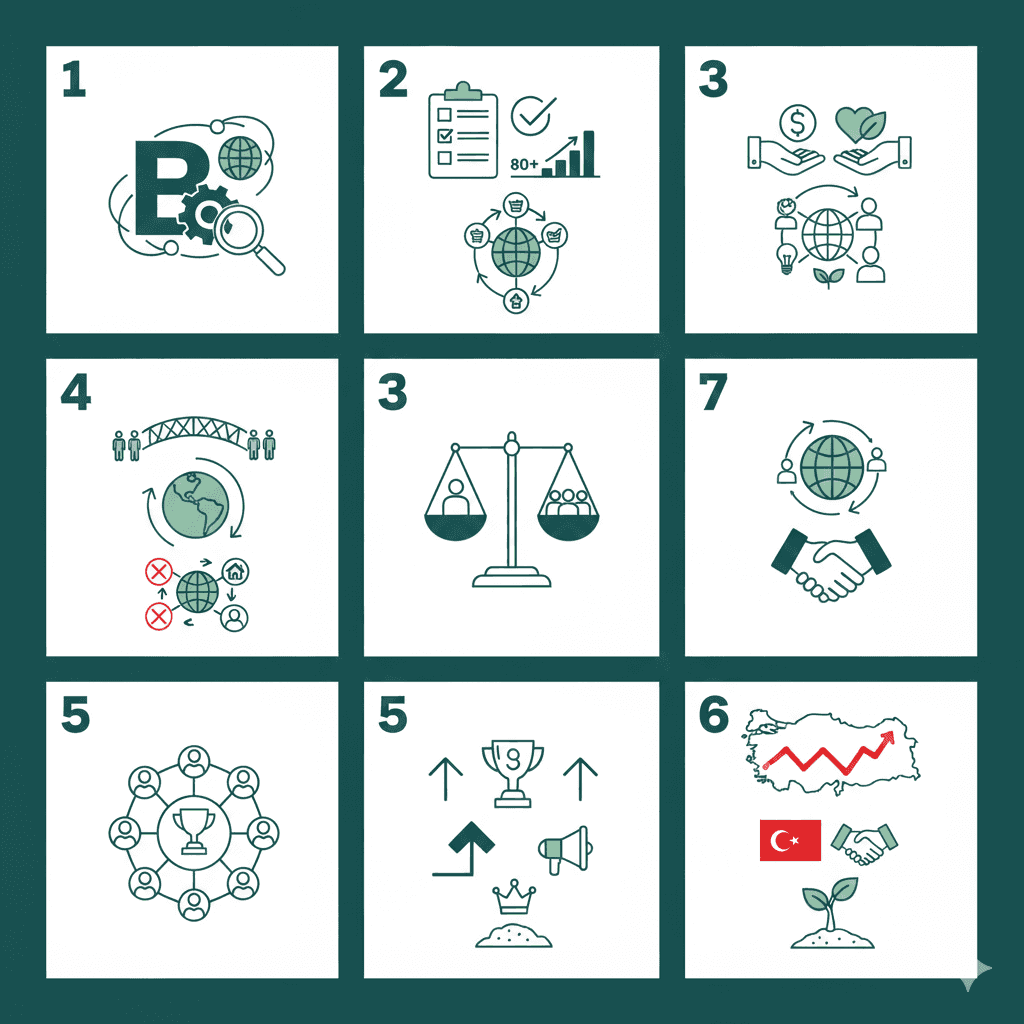
B Corp Certification (Generated by Artificial Intelligence.)
Official Name | B Corp Certification | ||||||||
|---|---|---|---|---|---|---|---|---|---|
Issuing Organization | Establishment of B Lab (B Corporation Laboratory) | ||||||||
Evaluation Tool | B Impact Assessment | ||||||||
Required Score | At least 80 points out of 200 | ||||||||
Evaluation Areas | Employees, Community, Customers, Environment and Governance | ||||||||
The B Corp Certification is a global ethical label issued by the nonprofit organization B Lab, confirming that for-profit companies meet specific standards in social and environmental performance, accountability, and transparency. These organizations, whose primary aim is to create social impact beyond economic profit, are known as Benefit Corporations and distinguish themselves from other social enterprises by the mandatory reporting and certification of their impact. Companies that earn the certification are recognized as hybrid organizations that integrate ethical, social, and environmental goals into their corporate core alongside financial success.
The process of obtaining B Corp Certification involves a rigorous audit procedure requiring companies to meet both performance and legal criteria. This process is assessed through the B Impact Assessment (BIA), a tool that measures an organization’s overall impact on its stakeholders. To be eligible for certification, companies must score at least 80 out of 200 points on the BIA. 【1】 The assessment examines the company’s model’s impact across five key areas: Employees, Community, Customers, Environment, and Governance. Organizations that accept certification commit to applying the same level of diligence to their social and environmental performance as they do to their financial performance.
B Corp-certified companies, due to their hybrid structure that integrates sustainability goals with financial objectives, typically pursue dual purposes. For these companies, certification plays a central role in enhancing their external reputation among investors, customers, and consumers. Additionally, this certification enables businesses to concretize their missions and serve as models for other organizations seeking to generate similar benefits. Benefit corporations aim to use the B Corp certification strategically to foster collaboration and attract social impact investors.
It is well established that B Corp Certification influences corporate performance across multiple dimensions. While findings suggest that certification has no significant short-term impact on companies’ financial performance or growth, most B Corps experience positive, non-financial strategic outcomes after certification. 【2】 When examining long-term effects, research has found that certification positively influences revenue growth, with this effect strengthening over time. Due to the structure of the audit process, the B Corp Certification holds the potential to send a reliable signal to stakeholders about the company’s sustainable nature.
The foundational concept of the Benefit Corporation challenges the traditional corporate model’s principle of shareholder primacy. Companies that obtain certification commit to integrating social and environmental goals into their corporate core and assume legal responsibility toward these objectives. This legal obligation extends the fiduciary duty of management not only to shareholders but also to a broader stakeholder group including employees, suppliers, communities, and the environment, representing a transition to a multi-fiduciary structure. This legal requirement enables executives to make decisions in the interest of stakeholders without being pressured solely toward profit maximization and allows corporate governance mechanisms to be restructured to serve this dual purpose.
Beyond enhancing a company’s market reputation, the B Corp Certification provides various non-financial strategic advantages. Certification integrates businesses into a global B Corp ecosystem composed of other companies that share social and environmental responsibility. Within this ecosystem, companies gain opportunities to form partnerships, learn from peers through knowledge sharing, and conduct benchmarking. Furthermore, certified status positively influences employee recruitment and retention rates, enhances organizational reputation, and increases brand awareness among both consumers and the media.
The impacts of B Corp Certification typically emerge gradually over time and require a long-term perspective. Empirical studies show that the positive effect of certification on revenue growth intensifies as more time passes after certification. Research on Benefit Corporations in Türkiye has revealed that these companies use the B Corp Certification primarily to concretize their missions and act as guides for other businesses that embrace ethical business models (Erbil and Ergin Demirdağ 2017, 140). Turkish companies also view the certification as a strategic tool to develop collaboration networks and attract social impact investors who aim to generate social impact.
Erbil, Cihat, and Gülfiz Ergin Demirdağ. “Sosyal İşletmecilik Biçimi Olarak Fayda Şirketleri: Türkiye’deki B Corp Sertifikalı İşletmeler Üzerinden Bir Değerlendirme.” *Üçüncü Sektör Sosyal Ekonomi* 52, no. 2 (2017): 140–155.https://tisej.com/arsiv/2017/52/2/140-155.pdf
Paelman, Valerie, Philippe Van Cauwenberge, and Heidi Vander Bauwhede. “The Impact of B Corp Certification on Growth.” Sustainability 13, no. 13 (2021): 7191.https://www.mdpi.com/2071-1050/13/13/7191
Richardson, Andrea and Eleanor O’Higgins. “Corporation Certification Advantages: Impacts on Performance and Development.” *Business & Professional Ethics Journal* (2018). In press. ISSN 0277-2027.https://eprints.lse.ac.uk/90889/1/O%27Higgins_Corporation-certification-advantages.pdf
Villela Garcia, M., Bulgacov, S., & Morgan, G. (2019). "B Corp certification and its impact on organizations over time." Journal of Business Ethics, Article 2019. Advance online publication.https://research-information.bris.ac.uk/ws/portalfiles/portal/218468158/Accepted_Manuscript_11_11_2019.pdf
[1]
Richardson, Andrea ve Eleanor O’Higgins. “Corporation Certification Advantages: Impacts on Performance and Development,”Business & Professional Ethics Journal (2018), In press, sayfa 2, ISSN 0277-2027. https://eprints.lse.ac.uk/90889/1/O%27Higgins_Corporation-certification-advantages.pdf
[2]
Richardson, Andrea ve Eleanor O’Higgins. “Corporation Certification Advantages: Impacts on Performance and Development,”Business & Professional Ethics Journal (2018), In press, sayfa 3, ISSN 0277-2027. https://eprints.lse.ac.uk/90889/1/O%27Higgins_Corporation-certification-advantages.pdf

B Corp Certification (Generated by Artificial Intelligence.)
Official Name | B Corp Certification | ||||||||
|---|---|---|---|---|---|---|---|---|---|
Issuing Organization | Establishment of B Lab (B Corporation Laboratory) | ||||||||
Evaluation Tool | B Impact Assessment | ||||||||
Required Score | At least 80 points out of 200 | ||||||||
Evaluation Areas | Employees, Community, Customers, Environment and Governance | ||||||||
No Discussion Added Yet
Start discussion for "B Corp Certification (Benefit Corporation)" article
Certification Process and Scope
Hybrid Nature and Objectives of Benefit Corporations
Impact of Certification on Corporate Performance
Legal Structure and Accountability
Strategic Advantages and Corporate Ecosystem
Long-Term Impact Dynamics and the Case of Türkiye