


This article was automatically translated from the original Turkish version.
Ayvalık
District Center | Ayvalık District Center | ||||||||
|---|---|---|---|---|---|---|---|---|---|
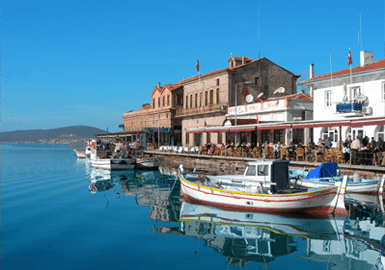
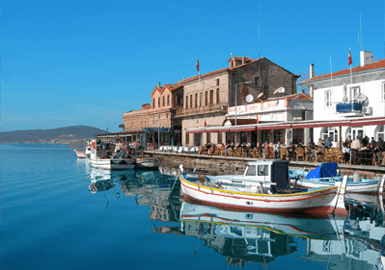
Ayvalık is an important district in northwestern Türkiye, within the province of Balıkesir, notable for its tourism and historical significance. Located at the westernmost point of Balıkesir on the coast of the Aegean Sea, Ayvalık has been a major center of trade and maritime activity since the Ottoman period and strengthened its economic structure in the 19th century through olive oil production. During winter months, Ayvalık has a relatively small town population, but experiences a significant increase in population during summer months due to tourism. This region, which has served as a home to various civilizations throughout history, has been on UNESCO’s Temporary World Heritage List since 2017. 【1】
In antiquity, the Ayvalık Islands were known as Hekatonisa. The largest of these islands, Nesos (today known as Cunda or Alibey Island), was named after Apollo. In this region, also known as the Islands of Apollo, important ancient settlements besides Nesos included Chalkis, Pordoselene, and Kydonia. Ancient sources frequently mention Chalkis, Pordoselene, and Nasos, while the most significant known information about Kydonia comes from the Roman writer Pliny, who recorded the presence of a famous hot spring there. Chalkis and Pordoselene eventually disappeared, but Kydonia and Nesos survived as modern-day Ayvalık and Cunda (Alibey Island).
Although extensive archaeological excavation has not been conducted in the area believed to be ancient Kydonia, ceramic fragments recovered from the region bear traces of the Hellenistic (330–30 BCE) and Roman (30 BCE–395 CE) periods. Archaeologists believe the city reached its peak during the Roman era and gradually lost its importance during the Byzantine period. Over time, settlement shifted toward the foothills of İlkkurşun Hill in Ayvalık, making it the region’s center.
During the Byzantine Empire, Ayvalık gained importance as one of its religious centers. The Church of Taxiarchis and monasteries in the region were constructed during this period and became significant religious structures. In the Byzantine era, Ayvalık occupied a strategic position for maritime trade.
During the Ottoman Empire, Ayvalık began to take its present form between 1430 and 1440. The town was initially built on a hill overlooking the harbor, and during Ottoman campaigns against the Eastern Roman Empire, a naval base was established on Alibey Island. Over time, as Greek populations settled in the region, the town rapidly developed and became a commercial center under Ottoman rule.
The earliest document mentioning Ayvalık in Ottoman archives is a decree from 1772, believed to have been issued by Cezayirli Hasan Pasha, who returned from the 1770 Battle of Çeşme and later became grand vizier. From 1789 onward, Ayvalık became one of the autonomous regions in Ottoman territory where non-Muslims lived. However, following the Greek Uprising of 1821, autonomy ended and the region was depopulated; in 1840 it was reorganized as a district under the Karesi Sanjak. Although some Greeks were permitted to return, Ayvalık never fully regained its former vitality.
According to Ottoman population censuses of the 19th century, in 1891 the town’s population of 21,666 consisted of 21,486 Greeks and 180 Turks. By the early 20th century, Ayvalık had grown into a city of 30,000 inhabitants, with trade linked to Europe. Products such as olive oil, beeswax, wine, and soap were exported, while sugar, coffee, wool, and cotton fabrics were imported. Consulates from France and Austria-Hungary operated in the town, and financial institutions such as the Ottoman Bank and the Bank of Athens were active.
Following the participation of Ayvalık’s Greek population in the Greek War of Independence in 1821, the Ottoman administration largely depopulated the region. Although some Greeks were later permitted to return, the town never fully regained its former vibrancy.
Under the terms of the Treaty of Lausanne, the 1923 population exchange resulted in the migration of Ayvalık’s Greek population to Greece, while Turkish populations from various parts of Anatolia were resettled in the region. This migration created major changes in Ayvalık’s demographic and cultural structure.
After the proclamation of the Republic, Ayvalık continued as a coastal town whose economy relied on agriculture and fishing. Beginning in the 1980s, the development of tourism transformed the region’s economic structure, making tourism one of its primary livelihood sources. In 2017, Ayvalık was added to UNESCO’s Temporary World Heritage List.
Ayvalık is an Aegean coastal district of Balıkesir Province in Türkiye, located directly opposite the island of Lesbos. The region is rich in pine forests and olive groves. To the west lies the Aegean Sea, to the northeast lies Gömeç, and to the south lie the districts of Dikili and Bergama, which belong to İzmir Province. Ayvalık’s coastline is deeply indented with headlands and coves that form natural harbors. The district’s coastline along the Aegean Sea is approximately 34 kilometers long.
Known for natural beauties such as Şeytan Sofrası, Ayvalık is separated from the Greek island of Lesbos in the northern Aegean by the Lesbos Strait. The town of Lesbos, the administrative center of the island, is visible to the naked eye from Ayvalık.
Ayvalık lies under the influence of the Mediterranean climate, with hot and dry summers and mild, rainy winters. Average summer temperatures range between 24–34 °C, while winter conditions are mild. Westerly imbat winds cool the district during summer, and meltem winds are also observed in certain periods. Cool breezes from the direction of Mount Kaz are occasionally felt in the district. 【2】
Ayvalık is a region composed of numerous islands of varying sizes. The district includes 22 islands. The largest of these, Alibey (Cunda) Island, has been connected by bridges since 1964 to Lale Island and from there to the district center. One of these bridges holds the distinction of being Türkiye’s first strait bridge. In 1995, a decision was made to designate all Ayvalık islands except Alibey Island as a national park, prohibiting settlement on them.
One of the islands with historical and touristic significance is Tımarhane Island. During the Ottoman period, it is said that Greeks from Ayvalık who consumed excessive alcohol were sent to this island to sober up under its strong winds. For this reason, the island gradually became known as Tımarhane Island. Additionally, many small islands such as Kaşık, Poyraz, Kamış, Büyükkuruada, and Güvercinada are among Ayvalık’s natural attractions. 【3】
Ayvalık has a small coastal town population during winter months, but experiences a significant population increase during summer due to tourism. With the arrival of seasonal residents and tourists, the population temporarily multiplies several times over. As of 2025, the population stands at 75,126. 【4】
Ayvalık’s economy is largely based on agriculture and tourism. The most widespread agricultural activity in the district is olive cultivation, with approximately 70% of the land covered by olive groves. Of the 110 million olive trees in Türkiye, approximately 2.5 million are located within Ayvalık’s boundaries. Olives are not only a food source but also a crucial raw material for soap and olive oil industries. Local industrial facilities focus on olive oil and soap production. In addition, crops such as cotton, pine nuts, and mandarins are also cultivated. The Kozak grape grown in Bağyüzü Village is one of the region’s well-known products. In recent years, turfanda vegetable farming and Kozak pine honey production have also gained importance.
Fishing is another cornerstone of Ayvalık’s economy. Due to its Aegean coastline, fishing is highly developed in the district. Local fish restaurants are popular destinations for both residents and tourists.
Tourism is one of the most dynamic sectors of Ayvalık’s economy. Natural beauty, historical structures, and coastal tourism play significant roles. Natural viewpoints such as Şeytan Sofrası attract both local and international tourists, while the historic Greek houses and buildings in Ayvalık’s center contribute to cultural tourism. Sea tourism is particularly prominent at Sarımsaklı Beaches and on Alibey Island.
According to a 1994 study, there are 363 historical buildings in the district dating from 1842 to 1914. In recent years, Ayvalık has also attracted day-trippers from the Aegean Islands. Particularly, tourists from the Greek island of Lesbos frequently visit Ayvalık for shopping. The weekly market held every Thursday in Ayvalık center has become one of the most popular attractions for Greek tourists. This growing tourism activity has also led to economic competition between Ayvalık and neighboring districts.
Ayvalık is also known for its cuisine. One of its most famous local dishes is Ayvalık tosud, made with sucuk, kaşar cheese, pickles, mayonnaise, and ketchup. Additionally, the sweet dish Höşmerim, common throughout the Balıkesir region, is also widely consumed in Ayvalık. The region is rich in seafood, and particularly papalina (çaça) fish is commonly eaten as a meze. The fish is served grilled or fried in olive oil with flour. Olive oil-based dishes form the foundation of Ayvalık cuisine, while innovative flavors such as olive oil ice cream have recently attracted attention.
Ayvalık is notable for its historic mosques and churches:
(English). Harvard University Press.
Clark, Bruce. Twice a Stranger: The Mass Expulsions that Forged Modern Greece and Turkey.
Ekinci, H. Osmanlı Döneminde Ayvalık ve Ticaret Yapısı.
Türkiye İstatistik Kurumu-Ayvalık Demografik Verileri
Yorulmaz, Ahmet. Ayvalık'ı Gezerken. Geylan Kitabevi, 2000.

Ayvalık
District Center | Ayvalık District Center | ||||||||
|---|---|---|---|---|---|---|---|---|---|
History
Ancient Era
Byzantine Period
Ottoman Empire Period
The Greek Uprising of 1821 and Its Aftermath
The 1923 Population Exchange
Republican Era and Present Day
Geography
Climate
Islands
Population
Economy
Agriculture and Industry
Tourism
Culture
Cuisine
Cultural and Natural Riches
Mosques and Churches