


This article was automatically translated from the original Turkish version.
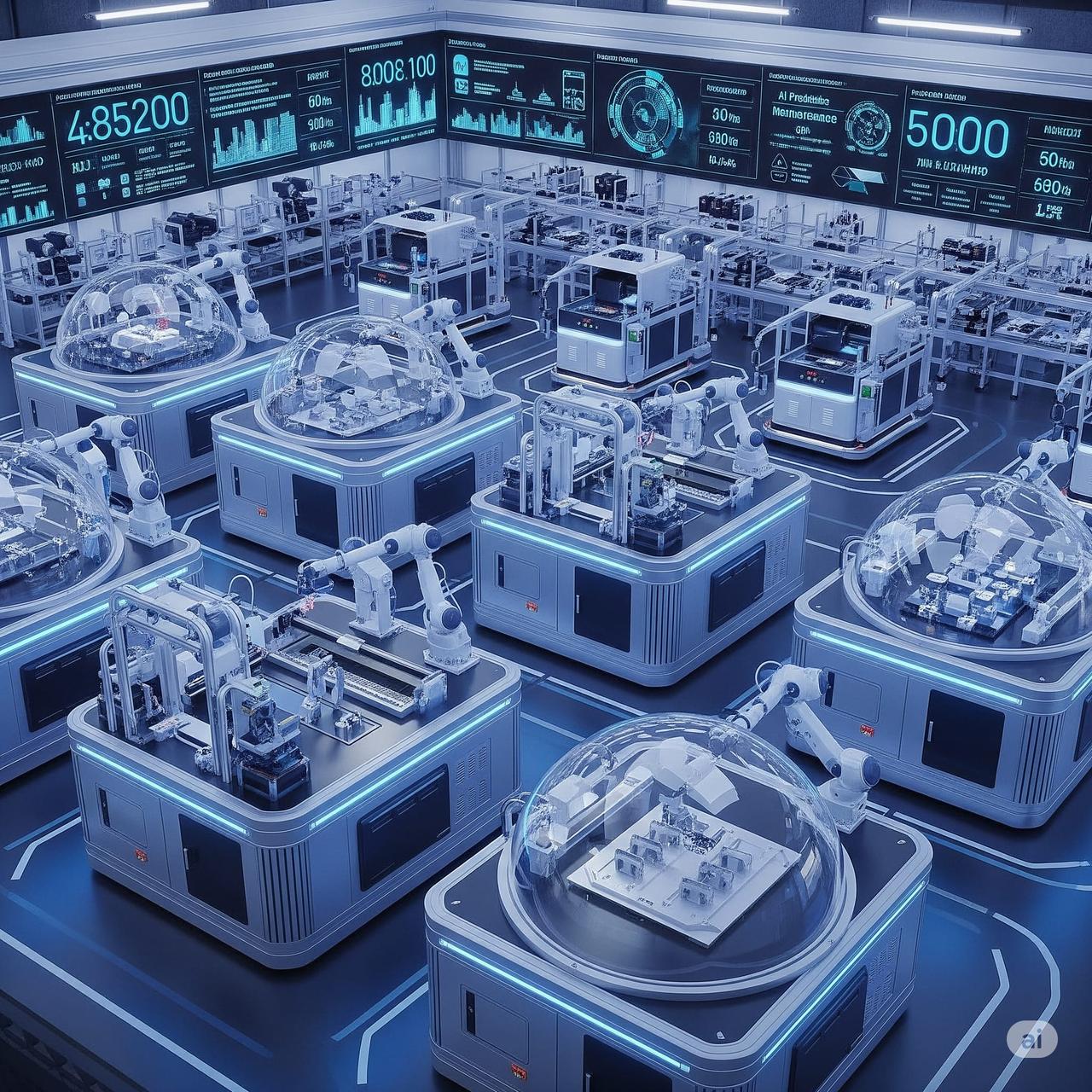
Autonomous Production Cell (Generated with Artificial Intelligence)
Definition | An integrated system consisting of robots, machines, and software that perform production tasks with minimal human intervention | ||||||||
|---|---|---|---|---|---|---|---|---|---|
Basic Component | Specialized software Sensors AGV/AMRs Control units Industrial robots | ||||||||
Main Advantages | Efficiency, flexibility, quality improvement, cost reduction, workplace safety | ||||||||
Important Sectors | Automotive, electronics, pharmaceuticals, food, logistics, battery production | ||||||||
Autonomous production cells are integrated systems designed to enhance efficiency, flexibility, and quality in modern manufacturing industries. These cells consist of industrial robots, machines, sensors, control units, and specialized software working together to perform specific production tasks with minimal human intervention. As one of the foundational pillars of Industry 4.0 and smart factory concepts, autonomous cells enable manufacturers to respond to challenges such as increasing competition, digital transformation, and fluctuating customer demands. Fundamentally, they represent a focused and self-sufficient application of automation, which refers to improving a production process through the use of machines and modern technology. By supporting lean manufacturing principles such as continuous flow and single-piece flow, these systems aim to eliminate waste in production processes.
The origin of autonomous production cells lies in cellular manufacturing, an approach that groups products with similar production processes onto a single production line. This method increases efficiency by minimizing material handling and work-in-process inventory. Autonomous cells build on this concept by integrating advanced technologies to significantly reduce the human factor. A typical autonomous production cell consists of the following components:
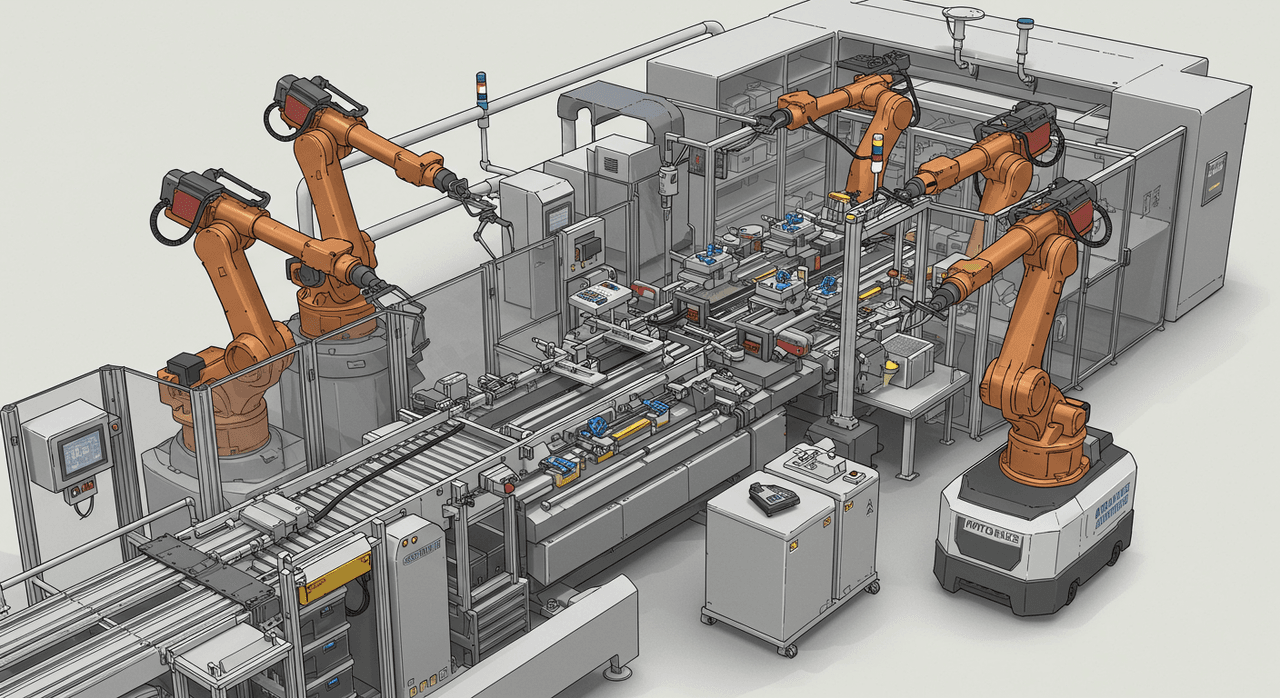
Cells are typically designed with a modular structure, enabling easy expansion or reconfiguration according to changing needs. Material flow within and between cells is facilitated by Autonomous Guided Vehicles (AGVs) or Autonomous Intelligent Vehicles (AIVs/AMRs). These vehicles transport raw materials, semi-finished goods, and finished products safely and precisely between production lines, offering an alternative to conveyor systems or manual handling. Thanks to their high maneuverability and dynamic programming capabilities, they automatically determine optimal routes, thereby automating and accelerating production logistics. Standardized and ready-to-deploy modular cell solutions such as ABB’s OmniVance FlexArc exemplify this structure. Such compact cells provide flexibility by optimizing space and allowing the integration of new robots without altering the cell structure.
The effectiveness of autonomous production cells depends on the seamless integration of their technological components. This integration encompasses areas such as software, quality assurance, and human-robot interaction.
Intelligent software is regarded as the brain of autonomous cells. These systems enable programming of robots and machines, synchronization of tasks, and monitoring of the entire process. Platforms such as Hexagon’s HxGN Robotic Automation allow quality personnel without robotics expertise to program industrial robots and perform fully automated measurements. Simulation and offline programming tools, such as ABB RobotStudio, which create a digital twin of the cell before production begins, significantly reduce setup and integration time, minimize production downtime, and enable early detection of potential errors. Software platforms like OMRON’s Sysmac integrate robots with sensing, control, and motion systems to deliver a holistic, cloud-based, and artificial intelligence-driven production management solution.
In traditional manufacturing, quality control is typically performed manually at the end of production or at specific stages. Autonomous cells, however, embed quality assurance as an inseparable part of the process. Robots equipped with high-resolution cameras, laser scanners, and other sensors inspect parts without removing them from the production line. This enables 100 percent inspection of products. Real-time metrology data allows quality issues to be detected immediately, and in some cases, the process can be automatically corrected. This approach reduces defective output, improves efficiency, and accelerates product time-to-market. For example, Škoda Auto has reduced robotic measurement programming time from several days to just four hours using such systems.
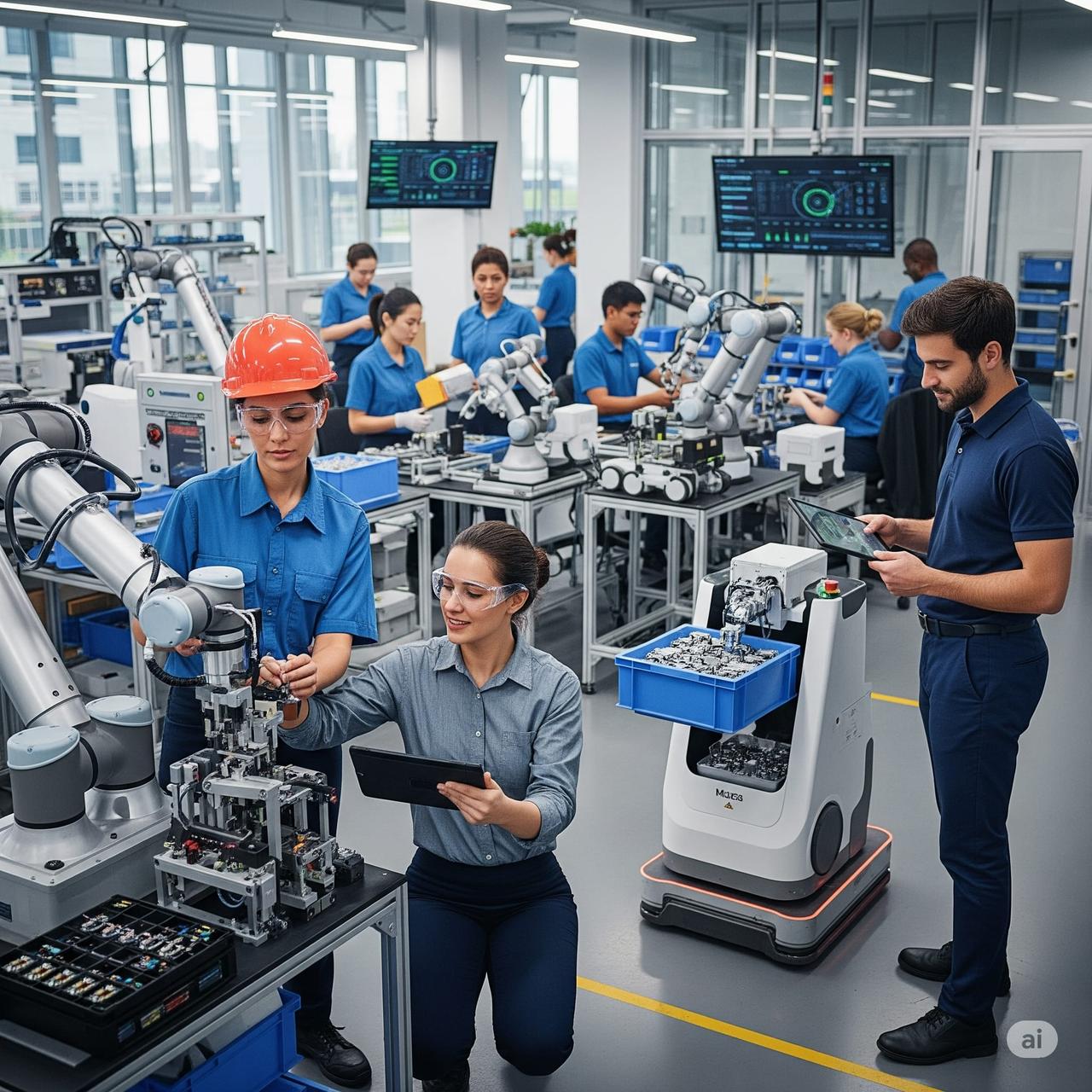
Alongside fully autonomous systems, the concept of Human-Robot Collaboration (HRC), where humans and robots work safely side by side in the same workspace, is becoming increasingly common. In this model, humans take on cognitive tasks such as problem-solving and supervision, while collaborative robots (cobots) handle repetitive, tedious, and ergonomically demanding tasks. This collaboration enhances the flexibility of automation and improves occupational health and safety standards by allowing workers to focus on higher-value activities.
class=\
Autonomous production cells have evolved from being an option in certain sectors to becoming a strategic necessity. Common characteristics of these sectors include high production volumes, repetitive tasks, near-zero-defect quality expectations, harsh working conditions, and strict regulatory requirements.
class=\
Adopting autonomous production cells delivers numerous significant benefits to manufacturing processes. Key advantages include:
ABB Haber Center. "ABB's New OmniVance™FlexArc Kompakt Cell Saves Floor Space and Adds Flexibility to Welding Applications." *ABB.com*. Accessed July 25, 2025.https://new.abb.com/news/tr/detail/94303/abbnin-yeni-omnivance-tm-flexarc-kompakt-hucresi-yerden-tasarruf-saglar-kaynak-uygulamalarina-esneklik-katar
Ajoudani, A., Zanchettin, A. M., Ivaldi, S. et al. "Progress and Prospects of the Human–Robot Collaboration." *Autonomous Robots* 42 (2018): 957–975. Accessed July 25, 2025.https://doi.org/10.1007/s10514-017-9677-2.
Arti Mekatronik. "Hangi Sektörler Acilen Otonom Üretim Hatlarına İhtiyaç Duyuyor? (Analiz)." ArtiMekatronik.com. Accessed July 25, 2025.https://artimekatronik.com/genel-tr/hangi-sektorler-acilen-otonom-uretim-hatlarina-ihtiyac-duyuyor-analiz/.
Ekotürk. "2030'a Kadar Yerli Seviye 3 Otonom Araç Üretimi Hedefleniyor." Ekoturk.com. Accessed July 25, 2025.https://www.ekoturk.com/haberler/2030a-kadar-yerli-seviye-3-otonom-arac-uretimi-hedefleniyor.
He, Suqin, Weiye Zhao, Chuxiong Hu, Yu Zhu, and Changliu Liu. "A Hierarchical Long Short Term Safety Framework for Efficient Robot Manipulation under Uncertainty." *Robotics and Computer-Integrated Manufacturing* 82 (2023): 102522. Accessed July 25, 2025.https://doi.org/10.1016/j.rcim.2022.102522
Hexagon Newsroom. "Hexagon Unveils Platform for Autonomous Quality Assurance." Hexagon.com. Accessed July 25, 2025.https://hexagon.com/tr/company/newsroom/press-releases/2021/hexagon-unveils-platform-autonomous-quality-assurance.
KUKA Türkiye. "Batarya Hücresi Üretimi." KUKA.com. Accessed July 25, 2025.https://www.kuka.com/tr-tr/end%C3%BCstriler/ak%C3%BC-%C3%BCretimi/batarya-h%C3%BCcresi-%C3%BCretimi.
KUKA Türkiye. "Otomasyon." KUKA.com. Accessed July 25, 2025.https://www.kuka.com/tr-tr/future-production/otomasyon
Marca Makina. "Otonom Taşıma Araçları (AGV)." MarcaMakina.com.tr. Accessed July 25, 2025.https://www.marcamakina.com.tr/tr/urunler/kaldirma-iletme-ve-tasima-ekipmanlari/otonom-tasima-araclari-agv/.
Packworld Türkiye. "Omron'un Yeni İnovasyon Laboratuvarı Robotik Üretim Konseptleri Sunuyor." PackWorldTurkiye.com. Accessed July 25, 2025.https://www.packworldturkiye.com/haber/omronun-yeni-inovasyon-laboratuvari-robotik-uretim-konseptleri-sunuyor.html.

Autonomous Production Cell (Generated with Artificial Intelligence)
Definition | An integrated system consisting of robots, machines, and software that perform production tasks with minimal human intervention | ||||||||
|---|---|---|---|---|---|---|---|---|---|
Basic Component | Specialized software Sensors AGV/AMRs Control units Industrial robots | ||||||||
Main Advantages | Efficiency, flexibility, quality improvement, cost reduction, workplace safety | ||||||||
Important Sectors | Automotive, electronics, pharmaceuticals, food, logistics, battery production | ||||||||
No Discussion Added Yet
Start discussion for "Autonomous Production Cells" article
Core Concepts and Structure
Technological Components and Integration
Software, Simulation, and Control
Autonomous Quality Assurance
Human-Robot Collaboration (HRC)
Application Areas and Sectoral Needs
Advantages and Impact on Production