


This article was automatically translated from the original Turkish version.
The conformity experiment, developed by Solomon Asch in the 1950s, is a study in social psychology that examines how individuals shape their behavior under pressure from majority opinion. The experiment aimed to understand the power of social influence and its impact on individual decision-making by revealing individuals’ tendency to conform to an obviously incorrect viewpoint
The Asch paradigm is a series of experiments designed by Solomon Asch to investigate how social pressure from a majority group influences individuals to conform. The experiment centered on a simple perceptual task in which participants were asked to match the length of lines on cards; this task had a structure in which the correct answer was unmistakably clear. Each group contained only one genuine participant, while the others were confederates instructed to give incorrect answers as part of the experiment. Asch developed this design as a response to the problem of ambiguity in Muzafer Sherif’s (1935) autokinetic effect experiment. Taking into account the criticism that Sherif’s experiment could not clearly measure conformity due to the absence of a correct answer, Asch designed a classic experiment in 1951 involving the line judgment task. In this task, if a participant gave an incorrect answer, it was clearly attributable to group pressure
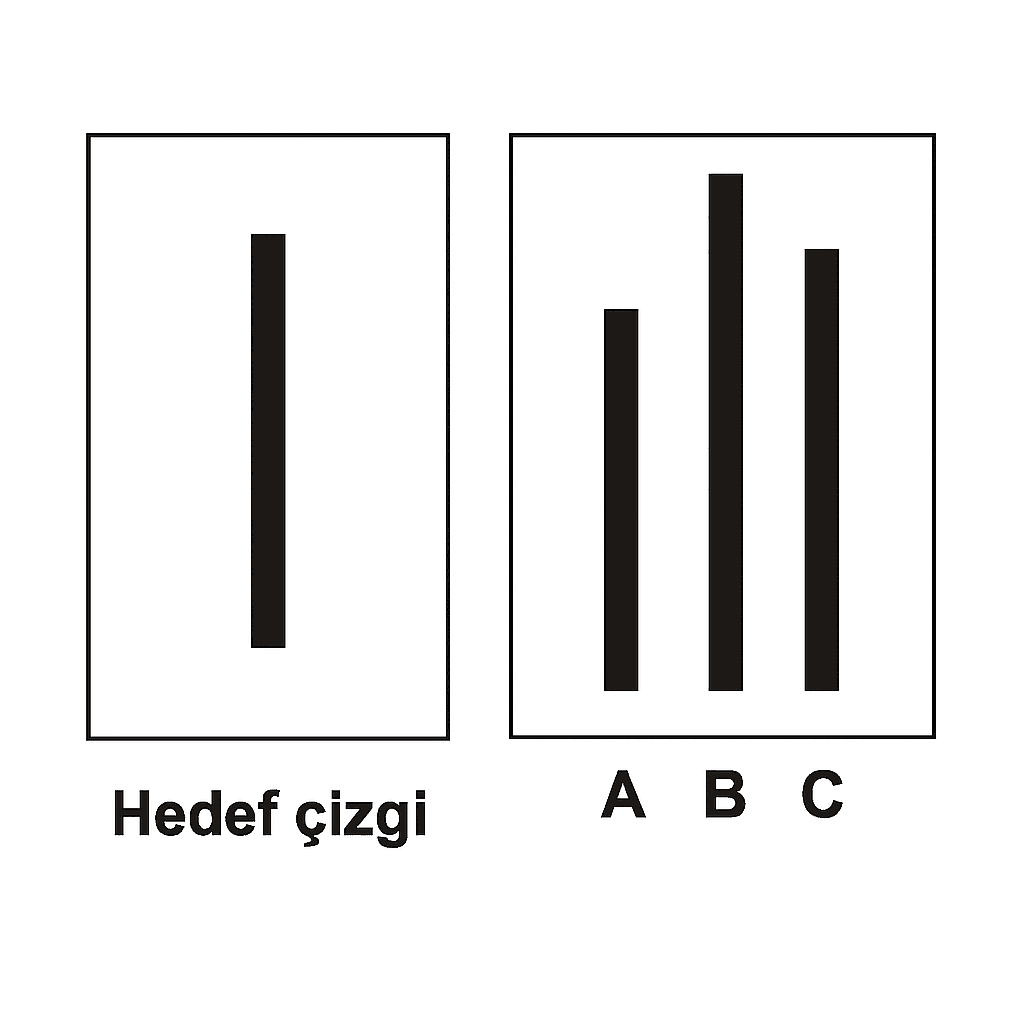
Target Line and Options (Generated by Artificial Intelligence)
The experiment was conducted in a laboratory setting with 50 male students from Swarthmore College in the United States participating under the guise of a “vision test.” Participants were seated in a room with seven confederates and asked, one by one, to aloud state which of the comparison lines (A, B, or C) most closely matched the target line. The genuine participant was typically placed in the position to respond toward the end (usually second to last), so that they could hear the incorrect answers given by others. In the first few trials, the confederates gave correct answers, but in 12 out of 18 trials (critical trials), they were instructed to give incorrect answers. Asch’s central question was whether the participant would conform to the clearly wrong majority choice or remain faithful to their own correct perception.
In the experiment, the independent variable was the presence of group pressure (a majority giving incorrect answers), while the dependent variable was the participant’s response during critical trials (whether they conformed to the majority’s incorrect answer). The control group consisted of 37 individuals who evaluated line lengths alone, without confederates, and showed an error rate of less than 1%
Asch Conformity Experiment (Youtube-eqivideos)
According to Asch’s original findings, approximately 32% of participants conformed to the clearly incorrect majority opinion during critical trials. Overall, 75% of participants conformed at least once, while 25% never conformed. Additionally, a small group of 5% conformed to the majority in all 12 critical trials. In the control group, the error rate was nearly zero.【1】
Qualitative data from post-experiment interviews supported these findings and revealed two main motivations among participants: normative influence (the desire to conform to the group) and informational influence (doubting one’s own perception and trusting the majority). Those who conformed under normative influence acted out of fear of rejection or disapproval; those influenced informationally questioned their own perceptions because they believed the majority might be correct. The 25% who remained independent defended their own perceptions, yet still reported feeling social pressure during the process. 【2】
A 2023 replication by Axel Franzen and Sebastian Mader repeated the original experiment with a 33% error rate and found that this rate dropped to 25% when participants were incentivized with monetary rewards, yet social influence still persisted. The conformity rate for political opinions was measured at 38%.【3】
In additional experiments conducted in 1952 and 1956, Asch examined factors affecting conformity rates. Group size had a significant effect: conformity rose from 3% with one confederate to 32% with three. Adding more confederates beyond three did not increase conformity further. Disrupting group unanimity—for example, by having one confederate give the correct answer—reduced conformity from 32% to 5%. Increasing task difficulty increased conformity, while allowing private responses reduced it.【4】
As formal ethical guidelines did not exist in the 1950s, Asch’s methods, when evaluated by modern standards, exhibit shortcomings. Participants were misled about the true purpose of the experiment and were deceived into believing it was a vision test; this violates the principle of informed consent. Asch argued that such deception was necessary to preserve the experimental conditions. The experiment induced stress, self-doubt, and anxiety in participants; those who resisted conformity faced the risk of embarrassment. However, no long-term harm was reported, and most participants expressed satisfaction after the experiment. The right to withdraw was not explicitly stated, but detailed debriefing was implemented as an ethical safeguard
Asch’s findings have been criticized as potentially specific to the conservative climate of 1950s America (the McCarthy era). In a 1980 replication by Perrin and Spencer, conformity rates were extremely low, suggesting a role for cultural change. Bert Hodges emphasized not only conformity but also the complex dynamics of dissent and social understanding. Today, research continues on the universality of social influence and individual capacity for resistance
Franzen, Axel, and Stefan Mader. “The Power of Social Influence: A Replication and Extension of the Asch Experiment.” *PLOS ONE* 18, no. 11 (2023). Accessed September 30, 2025.https://pmc.ncbi.nlm.nih.gov/articles/PMC10686423/
Hodges, Bert H. “Rethinking Conformity and Imitation: Divergence, Convergence, and Social Understanding.” *Frontiers in Psychology* 5 (2014): 726. Accessed September 30, 2025.https://pmc.ncbi.nlm.nih.gov/articles/PMC4086295/
Larsen, Knud S. “Conformity in the Asch Experiment.” *The Journal of Social Psychology* 94, no. 2 (December 1974): 303–304. Accessed September 30, 2025.https://www.researchgate.net/publication/254349046_Conformity_in_the_Asch_Experiment
McLeod, Saul. “Asch Conformity Line Experiment.” *Simply Psychology*. Updated May 15, 2025. Accessed September 30, 2025.https://www.simplypsychology.org/asch-conformity.html
eqivideos. "Asch Conformity Experiment." YouTube, December 22, 2007. Accessed September 30, 2025.https://www.youtube.com/watch?v=TYIh4MkcfJA
[1]
Saul McLeod, “Asch Conformity Line Experiment,” Simply Psychology, güncellenme tarihi 15 Mayıs 2025, erişim 30 Eylül 2025, https://www.simplypsychology.org/asch-conformity.html
[2]
Saul McLeod, “Asch Conformity Line Experiment,” Simply Psychology, güncellenme tarihi 15 Mayıs 2025, erişim 30 Eylül 2025, https://www.simplypsychology.org/asch-conformity.html
[3]
Axel Franzen ve Stefan Mader, “The Power of Social Influence: A Replication and Extension of the Asch Experiment,” PLoS One 18, no. 11 (2023) erişim 30 Eylül 2025, https://pmc.ncbi.nlm.nih.gov/articles/PMC10686423/
[4]
Saul McLeod, “Asch Conformity Line Experiment,” Simply Psychology, güncellenme tarihi 15 Mayıs 2025, erişim 30 Eylül 2025, https://www.simplypsychology.org/asch-conformity.html

No Discussion Added Yet
Start discussion for "Asch Conformity Experiment" article
Origin and Design of the Experiment
Results and Findings
Factors Influencing Conformity
Ethical Dimensions
Debates and Contemporary Perspectives