This article was automatically translated from the original Turkish version.
+1 More
Registration Number | 1732 | ||||||||
|---|---|---|---|---|---|---|---|---|---|
Registration Date | 05.05.2025 | ||||||||
Application Number | C2023/000200 | ||||||||
Application Date | 07.08.2023 | ||||||||
Name of the Geographical Indication | Arhavi Termonisi | ||||||||
Product / Product Group(s) | Sweets Dough Products Sweet / Baking and Confectionery Products | ||||||||
Type of Geographical Indication | Mahreç Mark | ||||||||
Applicant/Registrant(s) | 2. Arhavi Municipality 1. Arhavi Chamber of Commerce and Industry | ||||||||
Address of the Registrant | 1. Musazade Mah. Cumhuriyet Meydanı No:1 Arhavi ARTVİN, 2. Musazade Mah. Şht. Ast. Mehmet Altanlar Cad. No:1 Arhavi ARTVİN | ||||||||
Geographical Boundary | Arhavi District Artvin Province | ||||||||
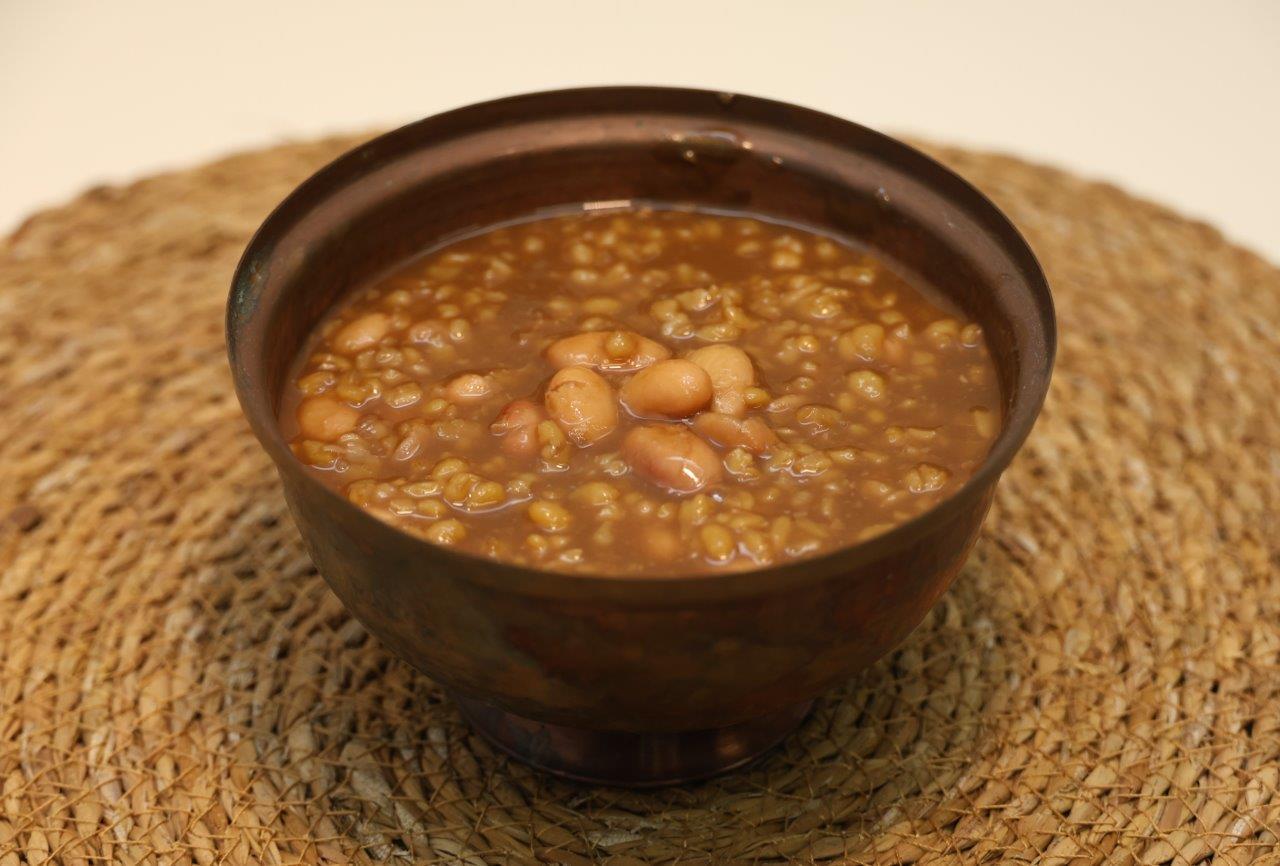
Arhavi Termonisi is a registered protected designation sweet produced in the Arhavi district of Artvin Province, Türkiye. This sweet is sweetened with black grape molasses or pear molasses and prepared by cooking together barbunya beans and/or dried beans with bulgur, without the addition of sugar. Known locally as “Arhavi aşuresi” or “Laz aşuresi,” Arhavi Termonisi is made using molasses derived from the native Isabella grape variety or various pear types cultivated in the region.
Arhavi Termonisi is a sweet sweetened exclusively with black grape molasses or pear molasses, and its ingredients include barbunya beans and/or dried beans combined with bulgur. With a long-standing tradition in the Arhavi district, it is also known among the public as “Arhavi aşuresi” or “Laz aşuresi.” Unlike many other sweets, Arhavi Termonisi contains no sugar; only molasses is used as a sweetener. The molasses used is obtained from the local aromatic Isabella grape variety or from various pear types grown in the region.
Arhavi Termonisi is prepared by combining a limited number of locally cultivated and produced ingredients. It holds a prominent place within the region’s variety of sweets and culinary culture and is strongly associated with the identity of Arhavi.
The production of Arhavi Termonisi follows a defined recipe and procedure. The ingredients required to produce a quantity sufficient for six servings are as follows:
The production process proceeds as follows:
Barbunya beans and/or dried beans are boiled in a pot for approximately 40 minutes. The boiling water is then drained and discarded, and the legumes are rinsed with cold water. Bulgur and water are added to the legumes, and the mixture is boiled for 60 minutes. In a separate container, 100 ml of water is mixed with cornstarch or corn flour and stirred thoroughly using a whisk until fully dissolved. This starch mixture is then gradually added, along with the molasses and salt, to the legume-bulgur mixture. The entire mixture is cooked over low heat for approximately 15 minutes, continuously stirred, until it reaches the consistency of aşure.
Arhavi Termonisi can be served either warm or cold. Optionally, medium-sized chopped hazelnuts may be sprinkled on top during serving. The product can be stored for up to four days at a temperature of 4–6 °C.
Arhavi Termonisi can be produced only within the administrative boundaries of the Arhavi district in Artvin Province, Türkiye. The product’s long-standing regional history and its integral role in Arhavi’s culinary culture establish a clear link between the product and its place of origin. Therefore, all stages of production, processing, and other related operations must be carried out within this geographical boundary.
Monitoring of the production process and the protection of the registered geographical indication rights for Arhavi Termonisi is conducted under the coordination of the Arhavi Chamber of Commerce and Industry and the Arhavi Municipality. The monitoring body consists of at least four experts representing the Arhavi Chamber of Commerce and Industry, the Arhavi Municipality, the Arhavi District Directorate of Agriculture and Forestry, and the Arhavi Chamber of Agriculture.
Inspections may be carried out unannounced at all stages, including production, marketing, and sales. The frequency of inspections is at least once per year, but additional inspections may be conducted at any time upon request or complaint.
The monitoring body holds an annual meeting during the first two months of the year to develop an inspection plan based on the addresses of the individuals and organizations to be inspected. Within this plan, inspections are carried out between July and November, covering production and marketing processes. The inspection criteria include the following:
The monitoring body may receive support from or procure services from experts employed by public or private institutions. The entities holding the registration rights are responsible for initiating and managing legal proceedings to protect the geographical indication.
Turk Patent and Trademark Office. "Arhavi Termonisi Coğrafi İşaret Detayı." Accessed July 14, 2025. https://ci.turkpatent.gov.tr/cografi-isaretler/detay/9822.
Turk Patent and Trademark Office. "Arhavi Termonisi." Accessed July 14, 2025. https://ci.turkpatent.gov.tr/Files/GeographicalSigns/ec42dcca-866a-4cd6-8929-6e3c0d59bac4.pdf.

Registration Number | 1732 | ||||||||
|---|---|---|---|---|---|---|---|---|---|
Registration Date | 05.05.2025 | ||||||||
Application Number | C2023/000200 | ||||||||
Application Date | 07.08.2023 | ||||||||
Name of the Geographical Indication | Arhavi Termonisi | ||||||||
Product / Product Group(s) | Sweets Dough Products Sweet / Baking and Confectionery Products | ||||||||
Type of Geographical Indication | Mahreç Mark | ||||||||
Applicant/Registrant(s) | 2. Arhavi Municipality 1. Arhavi Chamber of Commerce and Industry | ||||||||
Address of the Registrant | 1. Musazade Mah. Cumhuriyet Meydanı No:1 Arhavi ARTVİN, 2. Musazade Mah. Şht. Ast. Mehmet Altanlar Cad. No:1 Arhavi ARTVİN | ||||||||
Geographical Boundary | Arhavi District Artvin Province | ||||||||
Distinguishing Characteristics
Recipe/Production Method
Geographical Boundary Condition
Monitoring