Registration Number | 360 | ||||||||
|---|---|---|---|---|---|---|---|---|---|
Registration Date | June 13, 2018 | ||||||||
Applicant/Registrant(s) | Gaziantep Commodity Exchange | ||||||||
Province(s) | Gaziantep | ||||||||
Product / Product Group(s) | Chocolates and Derivative Products Confectionery | ||||||||
Type of Geographical Indication | Geographical Indication | ||||||||
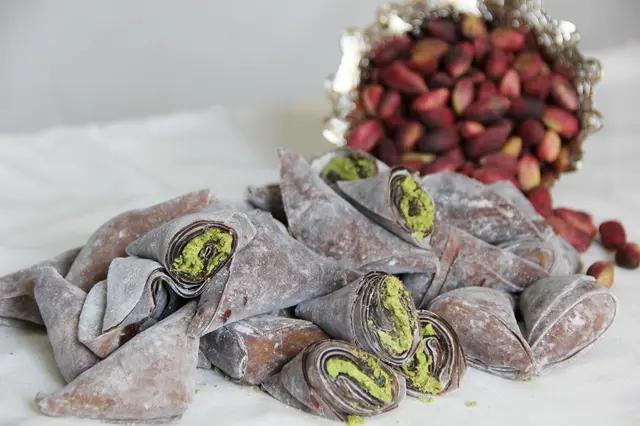
Antep Muskası is a traditional confectionery from Gaziantep, registered as a Geographical Indication on June 13, 2018, under Law No. 6769 on Industrial Property by the Gaziantep Commodity Exchange. Classified under chocolates, confections, and related products, this triangular-shaped sweet is made from grape fruit leather (pestil) filled with a mixture of Antep pistachios, powdered sugar, and starch.
The pestil is cut into strips approximately 6.5 cm wide and 20–27 cm long, with each strip filled with about 5 grams of a filling composed of 55–72% ground Antep pistachios, 14–18% powdered sugar, and 13–16% starch. The final product weighs 32–35 grams.
The pistachios used must comply with TS 1280 standards and be harvested early in the “boziç” period, excluding Siirt, Halebi, and Ohadi varieties. The pestil is made from local grape varieties such as Dökülgen, Hönüsü, and Antep İrikara, grown in Gaziantep.
The production follows traditional techniques and consists of ten key steps:
Antep Muskası must be produced using grapes grown in Gaziantep and its districts, with the filling made exclusively from Antep pistachios. Substitutes like walnuts or almonds are not permitted, ensuring the product’s regional authenticity.
Production and compliance are monitored by a five-member expert committee coordinated by the Gaziantep Commodity Exchange. Inspections, conducted at least biannually or as needed, evaluate production techniques, ingredient suitability, compliance with Turkish Food Regulations, and the absence of aflatoxins, metal contaminants, and additives (except citric acid).
Türk Patent ve Marka Kurumu. Antep Muskası (Gaziantep Muskası). Türk Patent ve Marka Kurumu. Accessed October 21, 2025. https://ci.turkpatent.gov.tr/Files/GeographicalSigns/b9af5cbe-f8da-40da-acb0-915483c743dc.pdf.
Türk Patent ve Marka Kurumu. "Antep Muskası (Gaziantep Muskası)." Türk Patent ve Marka Kurumu. Accessed October 21, 2025. https://ci.turkpatent.gov.tr/cografi-isaretler/detay/38293.

Registration Number | 360 | ||||||||
|---|---|---|---|---|---|---|---|---|---|
Registration Date | June 13, 2018 | ||||||||
Applicant/Registrant(s) | Gaziantep Commodity Exchange | ||||||||
Province(s) | Gaziantep | ||||||||
Product / Product Group(s) | Chocolates and Derivative Products Confectionery | ||||||||
Type of Geographical Indication | Geographical Indication | ||||||||
No Discussion Added Yet
Start discussion for "Antep Muskası / Gaziantep Muskası" article
Production Process
Geographical Boundary and Production Conditions
Inspection Process
This article was created with the support of artificial intelligence.