


This article was automatically translated from the original Turkish version.

The Sumerians were a society that emerged on the historical stage in southern Mesopotamia from around 3500 BCE, inventing writing and laying the foundations of urban civilization. This community closed the prehistoric era and opened the door to recorded history, drawing attention not only through their technical and administrative advancements but also through the language and educational systems they developed.
The view that the Sumerians were not indigenous to Mesopotamia but originated from Central Asia is examined in detail. In particular, the region around Lake Aral is proposed as the source of this migration. This perspective is supported by evidence regarding the linguistic structure of the Sumerian language. The burial structures, religious symbols, and cultural heritage of the Sumerians are also interpreted in alignment with this Central Asian origin theory. Archaeological assessments of Sumerian migration routes suggest they reached Mesopotamia via the southern shores of the Caspian Sea, through Transcaucasia and Eastern Anatolia.
Although Sumerian is classified as an “isolate language” among the world’s languages, its agglutinative structure brings it particularly close to the Ural-Altaic language family. It is emphasized that Sumerian, like Turkish, has a structure in which roots remain unchanged and meaning and grammatical function are added through suffixes. Sumerian words are dominated by monosyllabic roots, from which new words are formed by adding inflectional and derivational suffixes. This structure differs significantly from that of Indo-European languages. Sentence structure highlights agglutinative sequences and chain constructions. Features such as the extensive use of plural markers in both verbal and nominal clauses make Sumerian typologically similar to Turkish.
The Sumerians did not merely develop writing; they also systematically employed it for the transmission of knowledge. In schools known as “edubba,” young people were trained in scribal skills and prepared for roles within state administration.
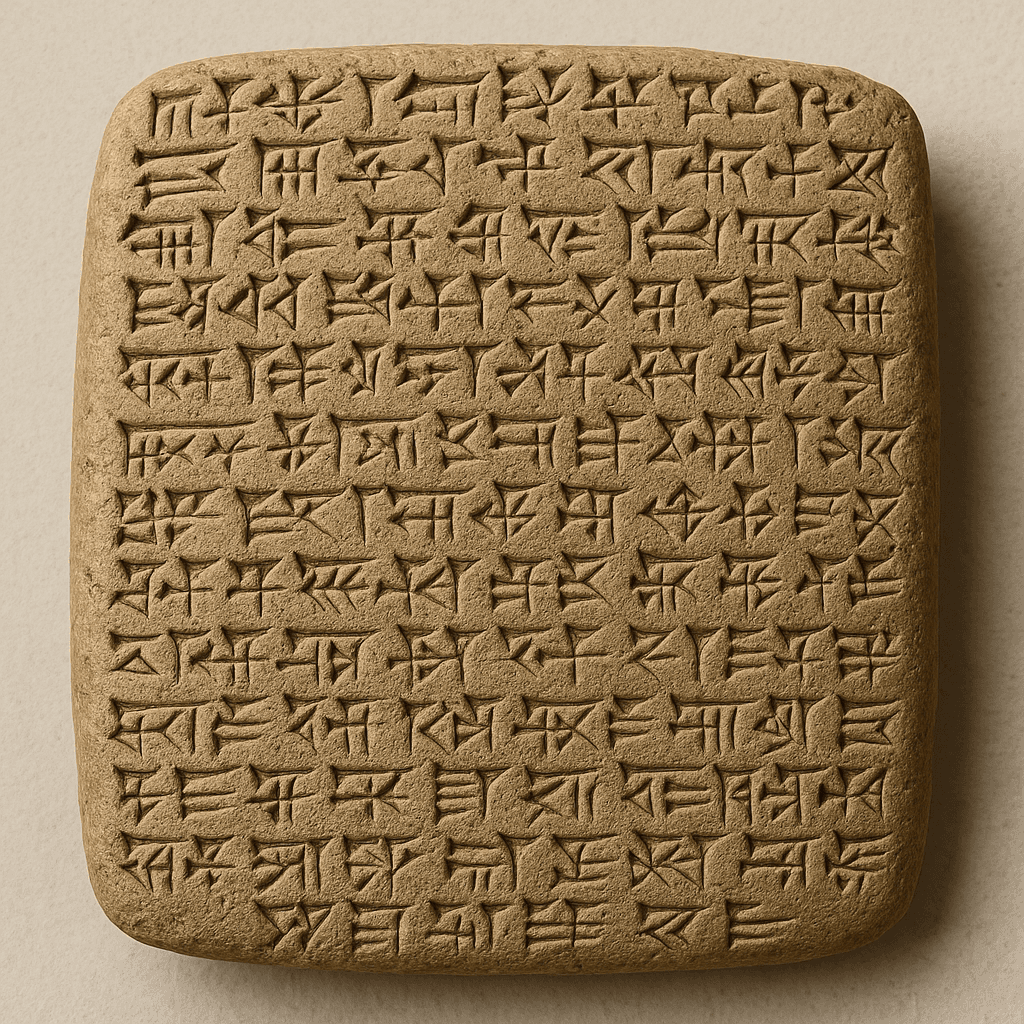
Example of cuneiform script (generated with the aid of artificial intelligence).
The Sumerian educational system was integrated into a temple-centered theocratic economic structure. In this system, individuals brought their produce to temples; goods were recorded by priests and then redistributed within society. In this context, writing became both an instrument of economic control and a tool for socio-cultural production. Information recorded on clay tablets indicates the existence of a systematic accumulation of knowledge in the fields of economy, law, religion, and science. Within this system, education meant more than literacy; it signified the training of elite individuals. Knowledge of writing became a symbol of social status and created an intellectual hierarchy within society.
The Sumerians are known not only for inventing writing but also for leading humanity in fields such as law, astronomy, medicine, and mathematics. The emerging trend toward professional specialization within Sumerian society enabled the formation of a social structure based on division of labor. Specialists and institutional structures in agriculture, crafts, trade, and governance ensured the sustainability of Sumerian civilization. The body of knowledge generated through the Sumerian educational system left an imprint not only on Mesopotamia but also on the civilizations of Anatolia, Egypt, and the Near East, shaping universal cultural history.
Arkeofili. "Sümerlerin Dünyayı Değiştiren 9 İcadı." Arkeofili. Accessed May 8, 2025. https://arkeofili.com/sumerlerin-dunyayi-degistiren-9-icadi/.
Durmuş, İlhami. "Sümerlilerin Kökeni ve Kültürü." Akademik Tarih ve Düşünce Dergisi 5, no. 17 (2018): 177–200.
Yeşil Orman Okulu. "Tarımda Sümerler Medeniyeti." Accessed May 8, 2025. https://www.yesilormanokulu.com/2020/06/tarimda-sumerler-medeniyeti.html.
Özgül, Oktay. "Sümer Sosyal Hayatında Eğitimin Yeri ve Önemi." EÜSBED (Erzurum Üniversitesi Sosyal Bilimler Enstitüsü Dergisi) 4, no. 2 (2011): 402–410.
Views on the Origins of the Sumerians
The Linguistic Structure of Sumerian
Education and Social Structure among the Sumerians
The Sumerians’ Contributions to Civilization