

+2 More

Ancient City of Amblada
Location | Asar Tepe Türkiye Konya Seydişehir | ||||||||
|---|---|---|---|---|---|---|---|---|---|
Region(s) | Pisidia – Northern extensions of the Taurus Mountains | ||||||||
Foundation Period | Hellenistic Period | ||||||||
Findings | Ceramic fragments and terracotta materials from the Roman Period, Grave stelae and examples of stone craftsmanship, Epigraphic data (inscribed stones) | ||||||||
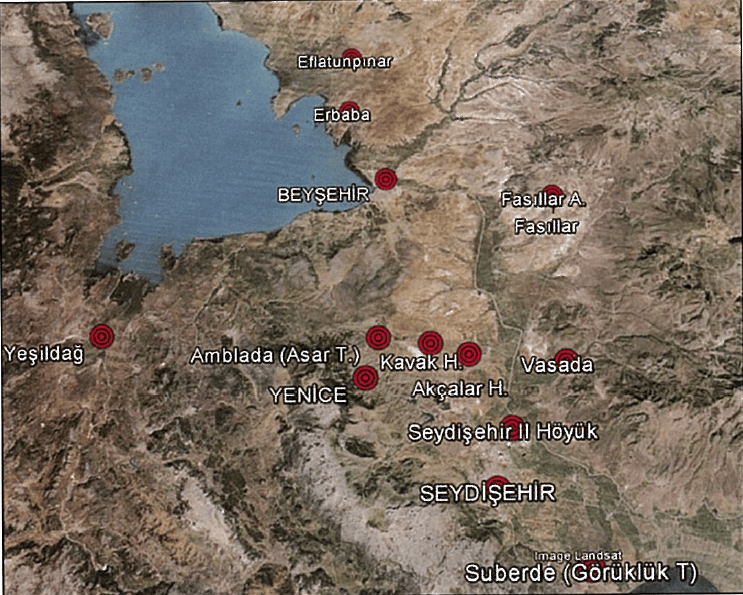
The ancient city of Amblada is located within the borders of Seydişehir district in Konya Province today, situated on an elevation known as Asar Tepe. Positioned along the northern extensions of the Taurus Mountains, the region offered natural defensive advantages, making it a strategically important settlement in antiquity.
Amblada, as part of the ancient Pisidia region, gained significance especially during the Roman Imperial Period. Traces of settlement in the area indicate a continuity dating back to the Hellenistic era. The name "Amblada" is documented in Roman period inscriptions, suggesting that it held the status of a city. Although rarely mentioned in ancient literary sources, valuable information about the city has been uncovered through epigraphic evidence.
The ruins of Amblada are scattered along the slopes of Asar Tepe. Most structures were built using local stone materials, and despite their current ruined state, they provide insight into the city’s urban layout. Some wall remains, believed to be at the city’s center, suggest the presence of public or sacred buildings.
Architectural fragments identified within the city—such as column drums, cut stone blocks, and reused construction elements—reflect both structural sophistication and the stonemasonry traditions of the period. Additionally, the terraced settlement plan seen in Amblada exemplifies the typical Pisidian adaptation to sloped terrain.
Surface surveys conducted in the region have revealed various ceramic fragments, terracotta artifacts, and architectural decorative elements attributed to Amblada. The majority of these findings date to the Roman period. The discovery of inscribed stones within the city offers important data for understanding the settlement’s political and social structure.
Some of the inscribed blocks observed on the surface likely belonged to a temple or a monumental public structure. These inscriptions indicate that Amblada was not only locally significant but also integrated into a broader cultural network. Among the finds are also grave stelae and worked stones that may have belonged to a necropolis area.
Amblada, though lying silently in the depths of modern Anatolia, is a settlement with significant archaeological potential. Through its location, architecture, and surface findings, it holds a meaningful place in the historical topography of the region. The presence of Amblada during the Roman era is attested both by its architectural remains and by inscriptions, marking it as one of the yet-to-be-fully-explored archaeological riches of the area.
Amblada Katalog Çalışması. Amblada'nın (Yeniceköy) Deşifresi. ed. Şimşek, Sedat. Konya 2016.
Kültür Envanteri. "Amblada." Access Date: 02.04.2025. https://kulturenvanteri.com/yer/amblada/#17.84/37.527532/31.74262
Seydişehir Belediyesi. "Vasada Antik Kenti, Amblada (Asar Tepe) Antik Kenti." Access Date: 02.04.2025. https://www.seydisehir.bel.tr/tarihi-merkez/vasada-antik-kenti-amblada-asar-tepe-antik-kenti/16

Ancient City of Amblada
Location | Asar Tepe Türkiye Konya Seydişehir | ||||||||
|---|---|---|---|---|---|---|---|---|---|
Region(s) | Pisidia – Northern extensions of the Taurus Mountains | ||||||||
Foundation Period | Hellenistic Period | ||||||||
Findings | Ceramic fragments and terracotta materials from the Roman Period, Grave stelae and examples of stone craftsmanship, Epigraphic data (inscribed stones) | ||||||||
Historical Background
Architectural Structures
Archaeological Findings
This article was created with the support of artificial intelligence.