
This article is not approved yet.
Acceptance and Commitment Therapy (ACT) is a third-wave approach to behavioral therapies. Third-wave approaches primarily focus on awareness of internal experiences and the acceptance process that develops with this awareness. These approaches emphasize accepting these experiences rather than modifying the cognitive content arising from an individual's internal experiences. When experiencing a psychological problem, instead of labeling behavior with a pathological label, the focus is on strengthening the individual's existing potential and enriching their behavioral repertoire.
ACT is a psychotherapy model developed by Steven C. Hayes and his colleagues and based on empirical data. ACT's philosophical foundations are functional contextualism, while its theoretical basis is relational frame theory. The approach considers psychopathology within the context of an individual's interaction with their environment rather than a structural problem. According to ACT, the basis of psychopathology is an intense avoidance and control effort stemming from psychic pain. These efforts prevent the individual from taking actions consistent with their present moment and values, leading to psychological rigidity that is, maladaptive behavioral patterns. The primary goal of therapy is to reduce these avoidance strategies through acceptance and mindfulness-based interventions and increase the psychological flexibility that allows the individual to take decisive action in line with their values.
The philosophical origin of ACT is functional contextualism theory. This philosophy examines the reasons for a behavior together with the environmental and historical conditions (context) in which the event occurred. Functional contextualism requires focusing on the function of cognitions or emotions in enabling the individual to engage in consistent actions in line with their values, rather than on whether they are “right” or “wrong.” ACT's approach to psychopathology is shaped more by whether maladaptive behaviors serve the person's goals in the current context than by an underlying structural problem.
The theoretical basis of ACT is formed by relational frame theory, which explains the functioning of language and cognition. The theory proposes that human language has the ability to establish relational frames between experientially unrelated events and to learn new responses through these relationships. This linguistic ability, while enabling complex learning, can also become a fundamental source of psychological distress. Relational frame theory explains the cognitive mechanisms of processes such as cognitive fusion (excessive identification with thoughts). With this theory, ACT aims to loosen behavior based on rigid rules created by language and avoidance strategies.
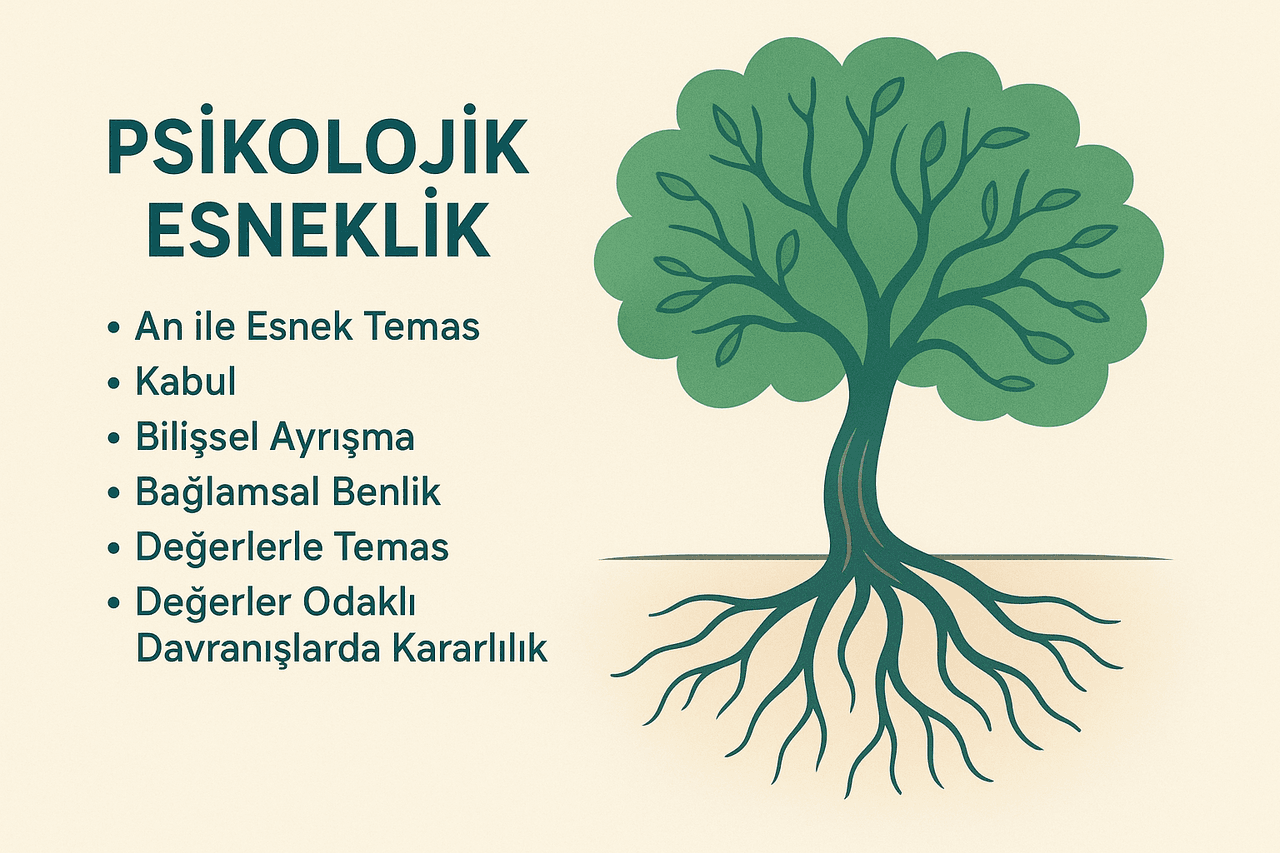
Psychological flexibility refers to an individual's ability to fully engage with their current internal and external experiences and to change or maintain their behavior in line with their chosen values. This model brings together the six fundamental processes of healthy functioning that counteract psychopathology to form a whole. These six processes aim to reverse psychological rigidity (avoidance, cognitive fusion, detachment from the present moment, and a worthless life) through therapeutic interventions and guide the individual towards a life consistent with their values.
The six core processes of the model are as follows:
This process involves shifting one's attention away from ruminating on the past and worrying about the future, focusing instead on the present experience with full, non-judgmental awareness (mindfulness). Being present provides the contextual groundwork for the individual to increase their awareness and analyze dysfunctional behavior patterns.
Acceptance is the willingness to make space for unwanted internal experiences beyond one's control, rather than trying to change or eliminate them, and to experience them as they are without judgment. Acceptance aims to stop fighting negative emotions and establish a new, less combative relationship with these experiences.
The ability to see one's thoughts not as absolute truths but merely as mental events (words, images, sounds). Contrary to cognitive fusion (excessive identification with the content of thoughts), dissociation does not attempt to change the content of the thought. Instead, it reduces the power of the thought to control the individual's behavior by changing the function of the person's response to that thought.
The contextual self is the awareness that there is an unchanging and continuous context that observes all of an individual's internal experiences, including their thoughts, feelings, and bodily sensations. This process frees the person from defining themselves by the content of their temporary internal experiences, allowing them to see things from a broader, more flexible perspective. For example, instead of thinking “I am a failure,” the individual adopts a broader, more flexible perspective.
Values are guiding principles that express the chosen and desired life directions that are important in an individual's life. They serve as a lifelong compass rather than specific goals. In ACT, they determine the fundamental source of motivation and direction for therapeutic change and committed action.
This involves accepting challenging internal experiences in line with one's identified values and implementing effective and contextually appropriate behaviors. The action dimension of psychological flexibility is committed action. Committed action enables individuals to consistently engage in behaviors that make their lives more meaningful and fulfilling despite difficulties.
The fundamental goal of the therapy process in ACT is to develop psychological flexibility in individuals and help reduce their levels of psychological rigidity. Psychological flexibility is defined as “individuals being aware of the experiences that arise in the present moment while acting in accordance with their values and being open to accepting them.” The goal at the end of the therapy process is for the client to have a life that is focused on the present moment and committed to being lived in accordance with their values.
ACT utilizes many different techniques in the therapy process; one of these is metaphors. Metaphors such as the unwanted guest metaphor are used to describe processes with complex philosophical and theoretical contexts. The message conveyed to the client is that when they accept their negative feelings and thoughts rather than fighting them, their effects will diminish over time. Another technique used in the process is being aware of the language used for cognitive defusion. In this technique, instead of saying “I am...”, it is recommended to use expressions such as “I have this thought...” or “A thought crossed my mind that I am worthless.” In this way, the individual can distance themselves from their thoughts. Word repetition and naming negative feelings/thoughts to make them concrete are among the other methods.
The therapeutic relationship established between the therapist and the client in ACT is very important. The “two mountains metaphor” is used to express the equal relationship between the therapist and the client. The therapist helps the client discover and understand their values by exploring the areas they consider important in their life. They encourage the client to live according to their values and do not try to eliminate their symptoms. The stages of the ACT therapy process generally consist of four structures: self-awareness exercises, review of the previous session, core interventions, and homework. Tools such as the Acceptance and Action Questionnaire (AAQ-II), Cognitive Fusion Questionnaire, and Valued Living Questionnaire are used in the assessment process.
Warning: The content in this article is for general encyclopedic information purposes only. The information here should not be used for diagnosis, treatment, or medical guidance. Before making any decisions regarding health issues, you must consult a physician or healthcare professional. The author of this article and KÜRE Encyclopedia accept no responsibility for any consequences that may arise from the use of this information for diagnosis or treatment purposes.
Dursun, Asiye and Mücahit Akkaya. “Kabul ve Kararlılık Terapisi Odaklı Deneysel Araştırmalar: Sistematik Bir Gözden Geçirme.” Psikiyatride Güncel Yaklaşımlar 14, no. 3 (2022): 340–352. Accessed October 19, 2025. https://dergipark.org.tr/tr/download/article-file/2045492
Kul, Aykut and Fulya Türk. “Kabul ve Adanmışlık Terapisi (ACT) Üzerine Bir Derleme Çalışması.” OPUS Uluslararası Toplum Araştırmaları Dergisi 16, Special Issue (October 2020): 3795–3814. Accessed October 19, 2025. https://dergipark.org.tr/tr/download/article-file/1117161
Ulubay, Gizem and Mehmet Güven. “Kabul ve Kararlılık Terapisi ve Psikolojik Esneklik ile İlgili Araştırmaların İncelenmesi.” The Journal of International Lingual, Social and Educational Sciences 8, no. 2 (2022): 92–101. Accessed October 19, 2025. https://dergipark.org.tr/tr/download/article-file/2399766
Yavuz, K. Fatih. “Kabul ve Kararlılık Terapisi (ACT): Genel Bir Bakış.” Türkiye Klinikleri Journal of Psychiatry Special Topics 8, no. 2 (2015): 21–27. Accessed October 19, 2025. https://www.researchgate.net/profile/K-Fatih-Yavuz/publication/324994456_Kabul_ve_Kararlilik_Terapisi_ACT_Genel_Bir_Bakis_Acceptance_and_Commitment_Therapy_ACT_An_Overview/links/5af0b6e00f7e9ba36642d0ad/Kabul-ve-Kararlilik-Terapisi-ACT-Genel-Bir-Bakis-Acceptance-and-Commitment-Therapy-ACT-An-Overview.pdf
Yektaş, Çiğdem. Bilişsel Davranışçı Terapi. İstanbul: Üsküdar Üniversitesi Yayınları, 2020. Accessed October 19, 2025. PDF. (Kabul ve Kararlılık Terapisi [ACT]).

No Discussion Added Yet
Start discussion for "Acceptance and Commitment Therapy / ACT)" article
The Philosophical and Theoretical Foundations of ACT
The Psychological Flexibility Model of Acceptance and Commitment Therapy
Being Present
Acceptance
Dissociation
Contextual Self
Values
Behaviors Aligned with Values
Therapy Process
This article was created with the support of artificial intelligence.