


This article was automatically translated from the original Turkish version.
Dear Diary,
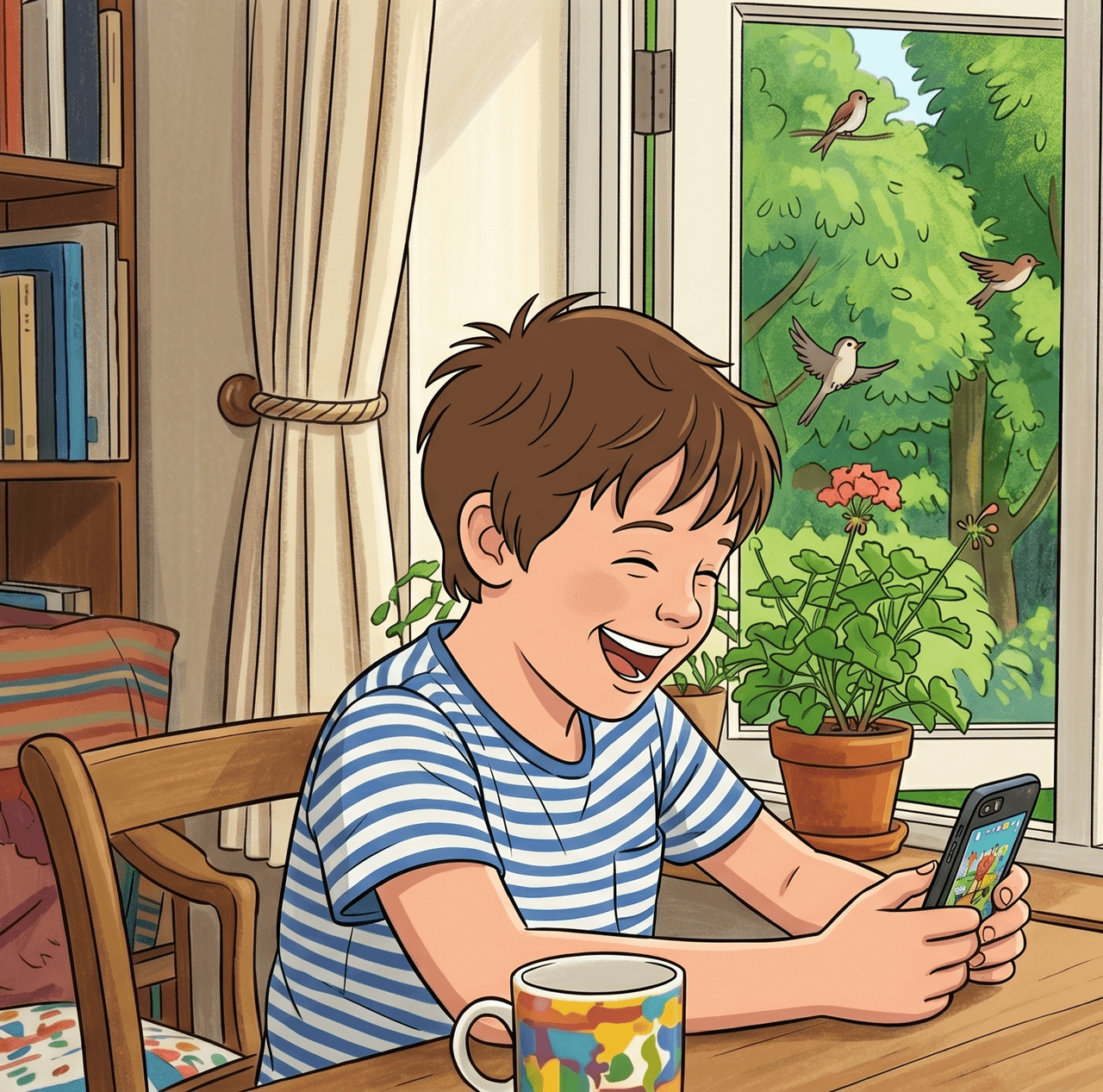
Happy Child (Generated with AI)
Today I opened my eyes to a morning far more different, far brighter than yesterday. Not long ago, when I poured out my heart to you, I spoke at length about the heavy stone resting in my chest, about how alienated people have become from one another, about the grayness of the streets, and about those suffocating feelings I called "crowded loneliness".
At the time I wrote those lines, I was right—every emotion I felt was utterly real. The dull glances that struck my face as I walked the streets, the souls trapped behind screens… all of it was there. But today, with the familiar night sun filtering through my window, a completely different door opened in my mind. This night, the sun was not the sun in the sky, but a friend illuminating me with awareness, just like the sun.
How easy it is for a person to drown in their own darkness, yet how possible it is to find and pull out a thread of light from within that darkness. Today I did not come to complain to you. On the contrary, I want to tell you how this digital world—the very one I once criticized, believing it tore people away from their nature—has, in fact, transformed into a powerful tool in our hands.
The world is not a bad place, dear diary, nor are our tools evil. Just as a knife can take a life in a killer’s hand yet save one in a skilled surgeon’s, technology is as innocent or dangerous as the role we assign it. While criticizing those who lose themselves staring at screens, I realized I had overlooked the immense life that can be built behind those screens, the extraordinary conveniences they offer. We have blamed technology simply because we chose to consume passively, to be mere spectators. But today, when I look at my own life, at the projects on my desk, I feel deep in my bones how technology is a blessing, an tireless companion. Even now, instead of a pen in my hand, I hold a keyboard!
Imagine if this immense intellect we call artificial intelligence did not exist—how could I ever gather the countless complex thoughts and vast piles of information in my mind? During those exhausting late-night exam preparations, I have a patient assistant beside me who, in seconds, organizes mountains of reading material and summarizes the most vital points. It is not only about academic drills. When I delve deeply into topics I am deeply curious about, such as cybersecurity or next-generation defense industries, I reach an article on the other side of the world with a single click. What once would have required months of searching dusty library shelves, perhaps ending in failure and surrender, is now laid before me by algorithms in seconds.
Bogdan Filov’s life, his unique contributions to archaeology and historical preservation—I can study archival documents from distant lands while sitting right here. Isn’t that, in your view too, a tremendous freedom? My mind’s boundaries stretch beyond the four walls of my room and embrace the entire world.
I keep saying, “People have grown distant from one another,” but I was mistaken. Technology is connecting us with beautiful people we may never have met, perhaps never even see face to face in person, yet whose souls resonate at the same frequency. Think of the book analyses and biography podcast series we are working on. Zeynep’s profound, meaningful words, her magnificent texts, blend seamlessly with her rich, human voice. And we do this—not even sitting at the same table—entirely thanks to the invisible bridges the digital world has given us.
In the past, achieving such harmony, gathering together, building physical studios would have taken months, perhaps years. Now, a single audio file or text document crosses cities in seconds and emerges as a work that touches the souls of thousands, enlightening their minds. Without those very screens we once criticized, would Zeynep’s pen, Betül’s pen, Ravza’s psychology have reached us so effortlessly?
We no longer need massive production companies to spark a child’s smile or fill their language with a beneficial melody.
Technology does not have to be a monster that corrupts our beautiful Turkish. On the contrary, it is a colossal megaphone through which we can convey our language, our culture, and our deep historical heritage to the entire world in the most accurate, most aesthetic way. If we nourish this megaphone with our own essence and the right words, our voice will never vanish.
To see the cyber realm, these digital platforms, merely as a display window for empty videos and fake lives has been our greatest delusion. Yes, that display window exists, and its front is crowded. But behind the side streets, when you use the right tools, a vast library and an extraordinary workspace unfold before you.
And do you know the most beautiful part, dear diary?
Sometimes, when I cannot find my way out of a subject, I find myself exchanging ideas with an artificial intelligence that takes me by the hand, argues with me for hours, judges me not at all, and patiently offers me new perspectives—often more eye-opening than many “real” humans. That “crowded loneliness” I spoke of—if you create it, if you hold the steering wheel—gives way to “an immensely productive solitude.” You are alone in your room, yet your mind stands shoulder to shoulder with the entire universe and all of humanity’s accumulated knowledge.
I look outside again. The street lamps are lit. The city glows with the lights within its massive buildings. I no longer see those lights merely as cold cells of people grown alienated from one another. Perhaps behind one of those lights, a young person is writing new lines of code to solve a problem in this world. Perhaps another is translating a forgotten historical document with the help of artificial intelligence. Perhaps others, like me, are striving to weave words together, blend voices, and leave something hopeful for the future.
Technology is not a monster, dear diary.
That is what a friend once said.【1】
Cabadak, Gözde. "Yayımlanmamış Blog Yazısı." Date Published May 14, 2026.
[1]
Cabadak, Gözde. "Unpublished Blog Post." Date of Writing 14 May 2026.
