


This article was automatically translated from the original Turkish version.

5 Whys Analysis
Category | Lean Manufacturing Problem Solving Techniques | ||||||||
|---|---|---|---|---|---|---|---|---|---|
Initial Developer | Taiichi Ohno | ||||||||
Purpose | Achieving the Root Cause of Problems | ||||||||
Common Use Cases | Quality Issues Process Improvement Production Errors | ||||||||
Related Tools | Root Cause Analyses Fishbone Diagram Andon Boards | ||||||||
Five Whys Analysis is one of the most fundamental and effective problem-solving tools developed within the framework of lean production philosophy. Despite its simple structure, when applied correctly, it enables deep learning and sustainable improvement in organizational processes. Recognized as one of the foundational pillars of the Toyota Production System, this method is not merely a technical analytical tool but also a process of observing on the shop floor, engaging teams, and reaching root causes to generate lasting solutions. With its inclusive structure, Five Whys Analysis is a practical and instructive approach that reflects the essence of lean thinking and can be applied in both manufacturing and service environments.
Five Whys Analysis is a simple yet powerful method developed within the context of lean production and continuous improvement practices to identify the root cause of problems. The method was first systematically defined by Taiichi Ohno, one of the architects of the Toyota Production System. The fundamental assumption of the method is to go beyond the visible problem by asking the question “why” five times in succession. Each answer provides a clue to the next cause, aiming to reach systemic root causes rather than merely addressing surface-level symptoms.
The reason this method holds a central position in lean production systems is that it does more than solve problems—it fosters learning within the organization. Five Whys Analysis directly serves the lean principle of “eliminating waste” (muda). No special technical tools are required to implement the method; the primary focus is on intellectual discipline and observational questioning skills.
According to Taiichi Ohno, an effective Five Whys Application reveals the systemic flaws that allow errors to occur, rather than punishing individuals for surface-level mistakes. In this way, it helps uncover the origins not only of production errors but also of managerial or organizational failures. When applied skillfully, this approach is believed to cultivate a problem-solving culture across all levels of the workforce.
To apply the “Five Whys Analysis” effectively, certain principles must be followed. First, the problem must be clearly defined. An ambiguous or overly broad problem statement leads to a blurred cause-and-effect chain. During the analysis, each “why” question must be based on the previous answer. Therefore, the questions must be logically connected. Superficial or rushed responses can render the method ineffective.

Ofiste 5 Neden Analizi Toplantısı (Yapay zekâ tarafından oluşturulmuştur)
Jeffrey Liker, in evaluating the Five Whys Technique within the framework of Toyota Way, emphasizes that this method is not merely a technical tool but also a form of learning and leadership. According to Liker, managers and team leaders should view this analysis not as a mere procedure but as a learning experience that involves employees in the process. In other words, Five Whys Analysis requires leaders to go to the gemba (genchi genbutsu), observe directly, and think together with workers.
Bjørn Andersen and Tom Fagerhaug compare Five Whys with other root cause analysis methods. According to them, its simple structure enables rapid action without requiring complex statistical tools. However, its greatest weakness lies in its heavy dependence on the analyst’s ability to question and reason logically. Therefore, it is recommended to use Five Whys in conjunction with other root cause analysis methods, such as the Fishbone Diagram and Pareto Analysis.
Some recommended practices for an effective Five Whys application include:
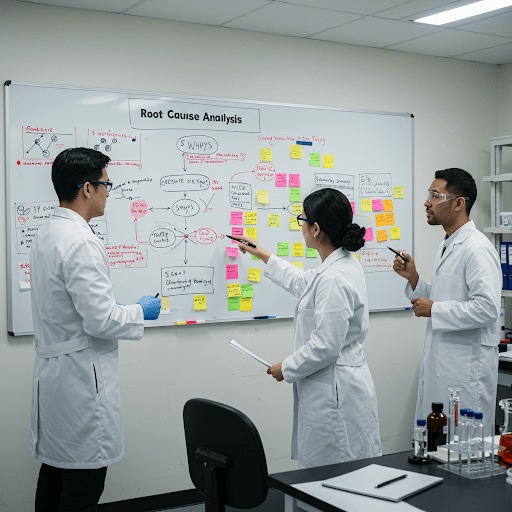
Kök Neden Analizi İnceleyen Laboratuvar Teknikerleri (Yapay zekâ tarafından oluşturulmuştur)
Five Whys Analysis is recognized as one of the foundational pillars of the lean production system. It fully aligns with the Toyota Production System’s “standardize, see, solve” cycle. In this sense, the analysis is used not only to address quality issues but also to improve processes such as efficiency, maintenance, and logistics.

5 Neden Analizi İçin Saha Gözlemi (Yapay zekâ tarafından oluşturulmuştur)
The primary reason this method is so compatible with lean philosophy is its focus on improving processes rather than merely solving problems. The understanding that problems lie in processes, not in individuals, creates an atmosphere that supports continuous development and learning. Moreover, when used alongside visual management tools such as andon panels, Five Whys contributes to the rapid identification of error sources.
However, the limitations of the method must also be considered. Not every problem can be explained by five whys; some situations require deeper structural or statistical analyses. Additionally, the Five Whys technique may prove inadequate for complex or multi-factorial problems. Therefore, the tool is often integrated with other techniques within the lean production approach.
Five Whys Analysis is a human-centered, process-oriented problem-solving tool that embodies the spirit of lean thinking. Due to its simplicity, it is easily adaptable across different sectors. However, its effectiveness depends not only on the skills of the practitioners but also on the organization’s commitment to learning and leadership.
Andersen, Bjørn, and Tom Fagerhaug. "Root Cause Analysis: Simplified Tools and Techniques." Journal for Healthcare Quality 24, no. 3 (2002): 46–47.
Liker, Jeffrey K. The Toyota Way: 14 Management Principles from the World’s Greatest Manufacturer. New York: McGraw-Hill, 2004.
Ohno, Taiichi. Toyota Production System: Beyond Large-Scale Production. Portland, OR: Productivity Press, 1988.

5 Whys Analysis
Category | Lean Manufacturing Problem Solving Techniques | ||||||||
|---|---|---|---|---|---|---|---|---|---|
Initial Developer | Taiichi Ohno | ||||||||
Purpose | Achieving the Root Cause of Problems | ||||||||
Common Use Cases | Quality Issues Process Improvement Production Errors | ||||||||
Related Tools | Root Cause Analyses Fishbone Diagram Andon Boards | ||||||||
Core Approach and Conceptual Background
Implementation Steps and Conditions for Effectiveness
Five Whys Analysis Through Researchers’ Perspectives
Place and Limitations of the Method within Lean Production