


This article was automatically translated from the original Turkish version.
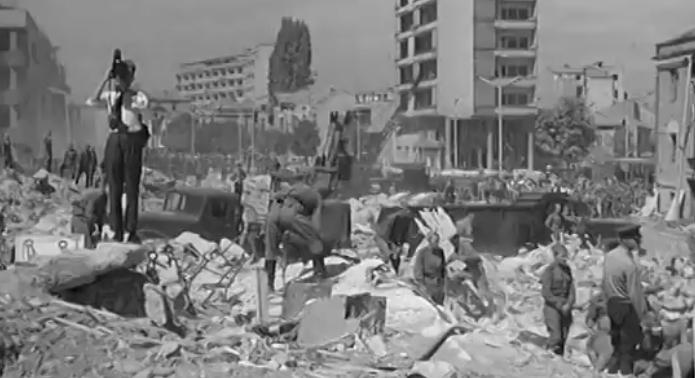
1963 Skopje Earthquake
Country | Yugoslavia | ||||||||
|---|---|---|---|---|---|---|---|---|---|
Date | 26 July 1963 | ||||||||
Countries That Provided Assistance | Türkiye, United Kingdom, France, Germany (West Germany), Soviet Union, United States | ||||||||
Impact | 1070 dead, 3000 injured, more than 200000 homeless people | ||||||||
Magnitude of the Earthquake | 6.1 to 6.9 | ||||||||
1963 Skopje Earthquake occurred on 26 July 1963 at 5:17 a.m. in Skopje, the capital of Macedonia, which at the time was part of the Socialist Federal Republic of Yugoslavia. It is regarded as one of the most destructive natural disasters to affect the Balkans in the 20th century. The morning shock rendered more than 80 percent of the city unusable. The earthquake’s destructiveness drew attention not only for its geological aspects but also for its sociopolitical and architectural dimensions.
Video of the 1963 Skopje Earthquake (British Movietone)
The 1963 Skopje Earthquake had a magnitude of 6.1–6.9 and occurred at a shallow depth of approximately 5.5 kilometers. It took place along the Vardar Graben, a tectonic rift zone. The region is seismically active as it lies within the Alpine-Himalayan orogenic belt. Numerous aftershocks followed the main quake.
As a result of the earthquake, approximately 1,070 people lost their lives, 3,000 were injured, and more than 200,000 people were left homeless. The majority of public buildings, hospitals, schools, and residential structures were destroyed. The city’s historical and cultural heritage also suffered severe damage. The collapse of infrastructure further complicated crisis management.
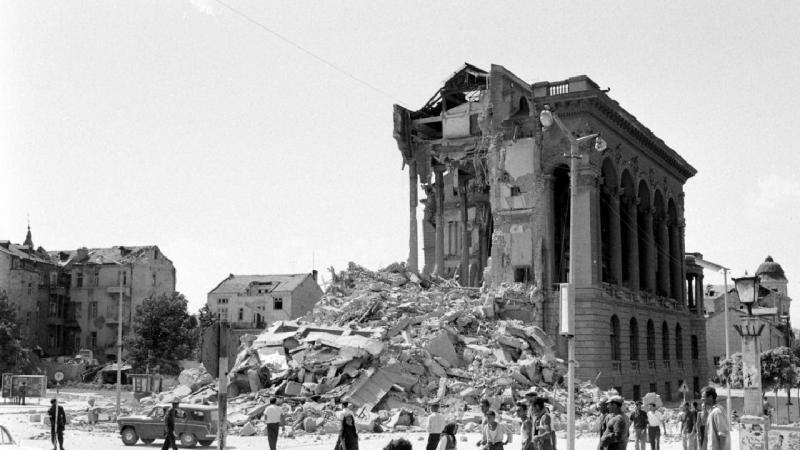
Visual of the 1963 Skopje Earthquake (TRT Haber)
The reconstruction of Skopje after the earthquake was not merely a physical restoration but also a major urban transformation initiative. The United Nations, Soviet Union, United States, Türkiye, and many other countries provided material, technical, and humanitarian aid. Japanese architect Kenzo Tange played a pivotal role in redesigning the city and developed a modernist urban vision. The new Skopje became one of the symbols of modern urban planning within the socialist bloc.
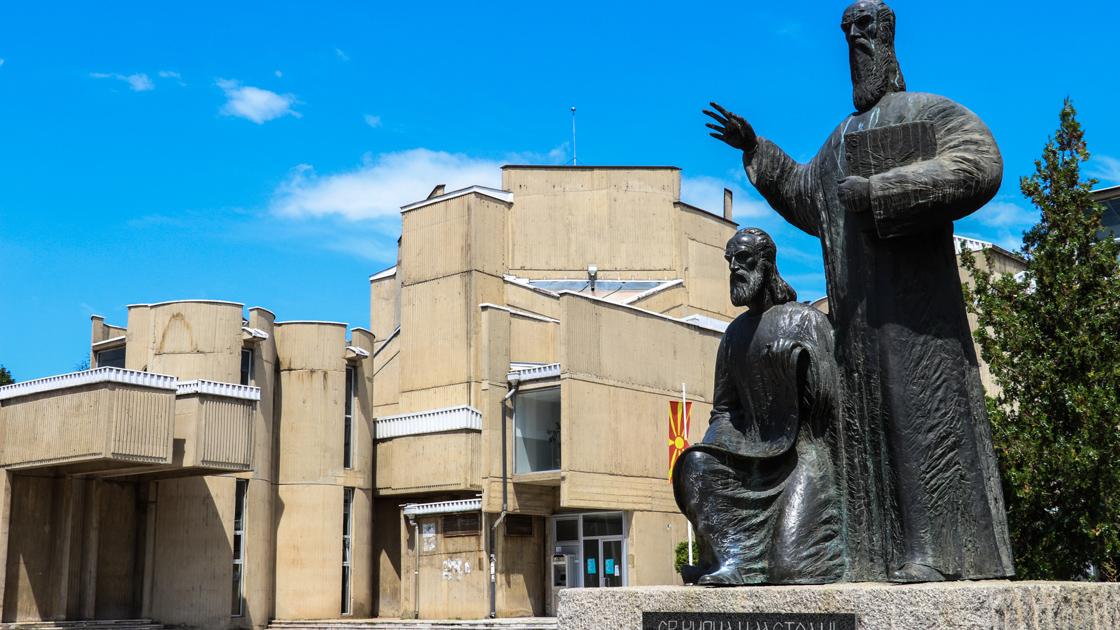
Reconstruction of Skopje (AA)
Despite occurring in the midst of the Cold War, the earthquake became one of the rare humanitarian events in which both Eastern and Western bloc countries provided joint assistance. In this regard, Skopje came to be known as the “city of international solidarity.” Yugoslavia’s policy of non-alignment facilitated the smooth coordination of aid. Among the assistance provided were search and rescue teams and temporary shelter solutions sent by Türkiye.
1963 Skopje Earthquake and Global Press Footage (British Pathe)
Since approximately 80 percent of the city was destroyed, the reconstruction process offered a comprehensive opportunity for urban renewal. During this period, a modernist and brutalist approach was adopted in line with global architectural and urban planning trends of the time.
Kenzo Tange’s Master Plan: Under the leadership of Japanese architect Kenzo Tange, an international team developed a master plan that introduced revolutionary changes to Skopje’s urban planning. The key features of Tange’s plan were:
However, not all elements of Kenzo Tange’s master plan were fully implemented. Some sections were modified or never realized due to political and economic constraints. Nevertheless, post-1963 Skopje became an example in Europe and worldwide for its modernist architecture and innovative urban planning.
Istanbul Technical University Department of Geophysical Engineering. *Üsküp Depremi.* Istanbul Technical University, 2004. Accessed May 28, 2025.https://eski.imo.org.tr/resimler/dosya_ekler/cbe7f6933328889_ek.pdf
Köker, Gözde Melishan. *2. Dünya Savaşı Sonrası Yugoslavya ve Türkiye’de Mimari: 1945–1980 Arası Modernist Mimari Pratikleri.* PhD thesis, Mimar Sinan Güzel Sanatlar Üniversitesi, 2022. Accessed May 28, 2025.https://acikerisim.msgsu.edu.tr/xmlui/handle/20.500.14124/5493
Pritzker Architecture Prize. "Biography: Kenzo Tange." The Pritzker Architecture Prize. Accessed May 28, 2025.https://www.pritzkerprize.com/biography-kenzo-tange.
TRT Haber. “Üsküp tarihindeki en büyük doğal felaketi anıyor.” TRT Haber, July 26, 2021. Accessed May 28, 2025.https://www.trthaber.com/haber/dunya/uskup-tarihindeki-en-buyuk-dogal-felaketi-aniyor-597792.html
UNESCO. *The Skopje Earthquake of 26 July 1963 and the Seismicity of Macedonia.* Paris: UNESCO, 1964. Accessed May 28, 2025.https://unesdoc.unesco.org/ark:/48223/pf0000014189.locale=en

1963 Skopje Earthquake
Country | Yugoslavia | ||||||||
|---|---|---|---|---|---|---|---|---|---|
Date | 26 July 1963 | ||||||||
Countries That Provided Assistance | Türkiye, United Kingdom, France, Germany (West Germany), Soviet Union, United States | ||||||||
Impact | 1070 dead, 3000 injured, more than 200000 homeless people | ||||||||
Magnitude of the Earthquake | 6.1 to 6.9 | ||||||||
No Discussion Added Yet
Start discussion for "1963 Skopje Earthquake" article
Geological Characteristics of the Earthquake
Physical and Human Destruction
Reconstruction and Modernization
International Solidarity and Diplomatic Implications
Urban Planning After the 1963 Skopje Earthquake