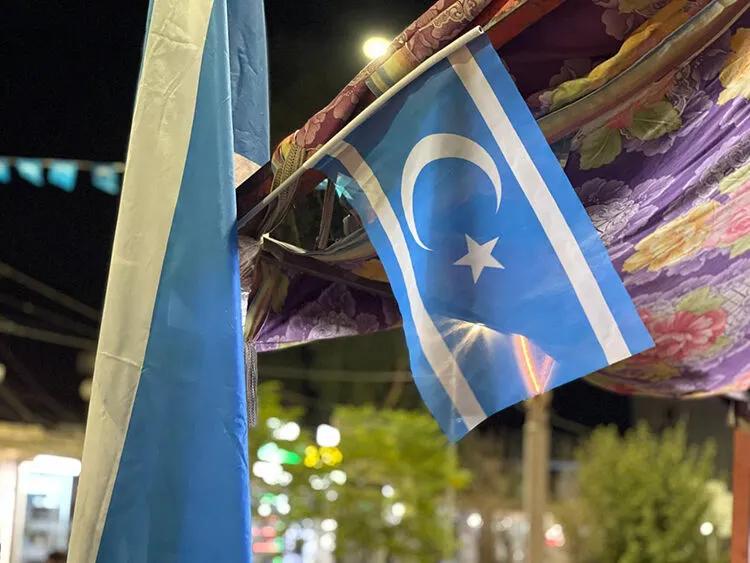
This article was automatically translated from the original Turkish version.
+2 More
History | 14–16 July 1959 | ||||||||
|---|---|---|---|---|---|---|---|---|---|
Period | The early years of the Republic of Iraq | ||||||||
Political Administration | Abdulkerim Qasim government | ||||||||
Target Community | Kirkuk Turkmens | ||||||||
Duration of Events | Three days | ||||||||
Nature of Attacks | Killing Detention Torture Looting Arson Destruction of property | ||||||||
Loss of Life | Only those whose identities could be confirmed: 31–41 people | ||||||||
Number of Injured | 130 | ||||||||
Commemoration Period | 14–20 July, Turkmen Martyrs Week | ||||||||
The 1959 Kirkuk Massacre occurred as a result of political, ethnic, and ideological tensions that escalated into violence in Kirkuk following the abolition of the monarchy and the establishment of a republican regime in Iraq on 14 July 1958. Between 14 and 16 July 1959, during the first anniversary celebrations of the coup, Turkmen civilians were killed, numerous individuals were injured, arrested, or displaced; Turkmen homes, businesses, and cultural spaces were looted and destroyed. Key factors contributing to the outbreak of these events included central government policies, administrative and military personnel changes in Kirkuk, the growing influence of the Iraqi Communist Party and certain extremist political groups, and long-standing demographic competition in the city. The investigations and judicial proceedings initiated by the Iraqi government after the massacre were influenced by shifting political alliances of the period, and only part of the court rulings could be enforced by 1963. In these respects, the 1959 Kirkuk Massacre is one of the major events that left strong imprints on the social memory of Iraqi Turkmen and is crucial for understanding the ethnic, political, and legal history of Kirkuk.
Following the Ottoman Empire's definitive withdrawal from the region after the First World War and the 1918 Armistice of Mudros, an authority vacuum emerged in the Mosul and Kirkuk regions, which were subsequently occupied by British forces. With the establishment of British mandate administration, Kirkuk became part of a new political process in terms of its administrative and demographic structure. In the early years of occupation, Kirkuk and its surroundings retained their character as a region predominantly inhabited by Turkmen populations. According to a 1925 report by a commission appointed by the League of Nations, Turkmen constituted the demographic majority in the Kirkuk district. During this period, resistance movements began against British occupation forces, and Turkmen actively participated in local struggles.【1】
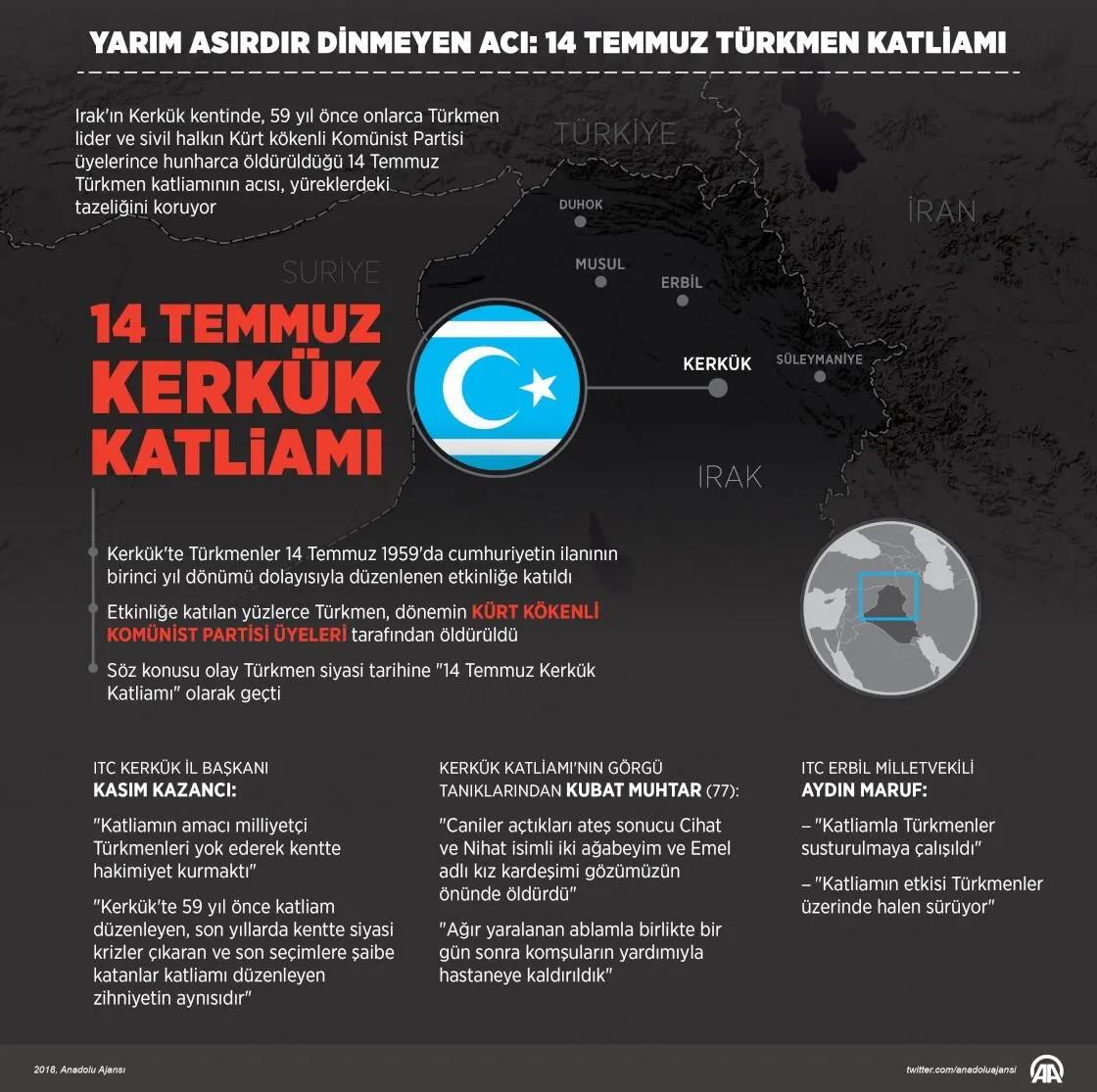
1959 Kerkük Katliamı İnfografiği (Anadolu Ajansı)
In Iraq, a referendum was held nationwide in 1921 to establish a monarchy under British mandate. As a result of this referendum, Faisal, son of Sharif Hussein, ascended the throne as King of Iraq. The people of Kirkuk voted against King Faisal in this referendum. The newly established Kingdom of Iraq began formulating central policies aimed at altering the region's demographic and political balance. Although the Iraqi Constitution adopted in 1925 declared equality before the law for all groups residing in the country, it failed to exhibit an inclusive structure regarding constitutional recognition of ethnic groups.【2】
The Ankara Agreement signed on 5 June 1926 between Turkey, Britain, and Iraq definitively determined the status of Mosul and Kirkuk. Through this agreement, the region remained within Iraqi borders, eliminating the possibility of Turkmen linkage to Turkey. The text of the agreement did not include any special minority status to guarantee the rights of Turkmen remaining in Iraq under international law. The population within Iraqi borders was granted a twelve-month period to emigrate to Turkey, but the majority of Turkmen chose to remain on their lands. This legal outcome positioned Turkmen as original citizens of the newly established Iraqi state.【3】
The Kingdom of Iraq was admitted as a full member of the League of Nations on 30 May 1932. In an international declaration issued by Iraqi Prime Minister Nuri Said Pasha during the membership process, the presence of Turkmen and other minorities in the country was officially recognized. This document granted Turkmen the right to use their mother tongue in regions where they were densely concentrated, such as Kifri, Erbil, and Kirkuk; to establish schools providing Turkish-language education; and to give testimony in judicial institutions in Turkish. The declaration ensured the legal status of Turkmen under an international text.【4】
The cultural and political rights recognized by the League of Nations declaration were gradually withdrawn by successive Iraqi governments in the following years. Starting in the mid-1930s, a centralized assimilation policy targeting Turkmen was implemented. Newly printed textbooks were banned from entering schools in Kirkuk. Turkmen teachers, civil servants, and other public employees were forcibly relocated to southern regions of Iraq. Turkmen presence in local administration was weakened by appointing officials from different ethnic backgrounds to replace them.【5】
Kirkuk's rich oil reserves became the most important economic factor influencing the region's demographic structure. Beginning in 1925 with the start of oil extraction in Kirkuk, the government encouraged migration from rural areas to the city for employment in the oil industry. This wave of migration accelerated the settlement of Arab populations in Kirkuk. The Iraqi government expropriated Turkmen agricultural lands, nationalized them, and resettled newly arrived communities on these lands. Turkmen were prevented from being employed by oil companies in Kirkuk, creating a systematic process of economic exclusion.【6】
The British mandate administration, aiming to maintain control over Kirkuk's administrative and ethnic structure, maintained a special military force in the region. A significant portion of this force consisted of Assyrian soldiers, armed and brought from India and other regions by the British and known as "Levy" troops. These mercenary soldiers were stationed at the Kirkuk barracks and regularly experienced tensions with the local civilian population. These military units, used by the British administration as a political instrument against Turkmen, were the primary perpetrators of the first mass violent incident recorded in Kirkuk's history.【7】
Tensions between the Levy forces and Turkmen erupted into an armed conflict on 4 May 1924. On the eve of Ramadan Bayram, a commercial dispute arose between a group of Assyrian soldiers shopping at Kirkuk's El-Kuriye (Grand Bazaar) and a Turkmen shopkeeper. The argument escalated into a physical fight, resulting in the injury of one Assyrian soldier. The other soldiers, leaving the scene, armed themselves and returned to the bazaar in greater numbers. This group initiated the first acts of violence by randomly firing on civilians in the city center.【8】
As soon as the armed attacks began, the fighting quickly spread throughout the city. The Kirkuk Police Chief, acting under the explicit order of a senior British officer, prohibited police forces from intervening in the events. Unable to leave their barracks, the civilian Turkmen population armed themselves to defend their lives against the soldiers. During the approximately 72-hour (three days and three nights) conflict, military units carried out looting operations targeting Turkmen homes and businesses near Kirkuk Castle. In these events, over fifty civilians, mostly Turkmen, and nine Christians lost their lives, and hundreds were injured.【9】
After the conflict ended, British Political Chief H. Dobbs issued a Turkish proclamation on 5 May 1924, calling on the local population to restore calm. The proclamation announced that the Assyrian soldiers would be immediately removed from Kirkuk and relocated to the regions of Çemçemal and Suleymaniya, and that compensation would be paid to citizens who suffered material damage. A special investigative court established by the Iraqi government sentenced eight Assyrian soldiers to life imprisonment and five others to various prison terms. Due to British political pressure, the Iraqi Council of Ministers issued an amnesty on 29 June 1926, exiling the convicted soldiers to the village of May, under compulsory residence conditions, in the town of Imadiya.【10】
The second major violent incident in Kirkuk's history emerged in 1946 during a mass strike initiated by workers of the Iraqi Petroleum Company. Workers submitted formal demands to company management due to poor working conditions, low wages, inadequate housing, and violations of basic union rights. Central to these demands were the cessation of unjustified dismissals, wage increases, the granting of full-paid leave, and improved transportation. Company management rejected these legal demands and arrested several leading worker representatives.【11】
Following the arrests and repression, approximately five thousand workers, predominantly Turkmen, decided on 3 July 1946 to go on a definitive strike. During the strike, workers gathered in the olive grove area known as "Gavurbaghi" (Christian Garden) in Kirkuk and held peaceful protest demonstrations. Demonstrators demanded the release of their arrested colleagues and immediate improvement of working conditions. Security forces and mounted police units continuously warned the workers to disperse and placed the area under physical siege by controlling all access routes.【12】
The workers' resistance continued uninterrupted until 12 July 1946. On that date, security forces surrounded the crowd gathered in Gavurbaghi square. When the workers refused to leave the area, police forces opened fire with automatic weapons directly into the crowd. As a result of this direct intervention, nearly twenty civilian Turkmen, including women and children, were killed and over a hundred were seriously injured. Investigations at the scene confirmed that the workers were completely unarmed and that the police had used lethal force directly.【13】
In response to the escalation of events and public outcry, an official investigation team sent from Baghdad and appellate court officials conducted on-site inquiries. The prepared investigation report clearly stated that the striking workers had not acted aggressively, were entirely unarmed, and that security forces had applied disproportionate and unjustified violence to control the situation. Following these legal findings, the Iraqi Petroleum Company accepted the workers' demands, released the arrested workers, and removed the Kirkuk Police Chief, who was found primarily responsible for the events.【14】
The 1924 and 1946 massacres, occurring respectively during the mandate and monarchy periods, left lasting sociological impacts on the Turkmen community. After the 1924 events, Turkmen experienced political isolation and inward withdrawal; after the 1946 violence, they strengthened their awareness of preserving their cultural and national identity. The civilian casualties suffered during this period, combined with state-supported assimilation policies and demographic interventions, strengthened social solidarity mechanisms among Turkmen.【15】
As a result of organized dissent within the Iraqi military against the monarchy, a coup was carried out on 14 July 1958 by a military junta led by General Abdul Karim Qasim and Colonel Abdul Salam Arif. This military intervention abolished the monarchy and proclaimed a republic. During the coup, prominent political figures of the monarchy, including King Faisal II, the crown prince, and Prime Minister Nuri Said Pasha, were killed. After the coup, General Abdul Karim Qasim assumed power as Prime Minister and Chairman of the Revolutionary Command Council. In official radio announcements during the first days of the coup, it was stated that Iraq consisted of Arabs, Kurds, and Turkmen, adopting an inclusive narrative regarding the founding elements of the state.【16】
Shortly after the proclamation of the republic, ideological political divisions emerged between the two key leaders of the coup, Abdul Karim Qasim and Abdul Salam Arif. Abdul Salam Arif, serving as Deputy Prime Minister and Minister of Interior, embraced the Pan-Arabism ideology advocated by Egypt's President Gamal Abdel Nasser and demanded Iraq's inclusion in the United Arab Republic formed by Egypt and Syria. In contrast, General Qasim, who followed an Iraqi nationalist line, viewed the rising power of Arab nationalists as a threat to his own authority. To counterbalance the influence of Arab nationalist groups, Qasim formed a strategic alliance with the Iraqi Communist Party and Kurdish political movements.【17】
The power struggle between the two leaders ended with General Abdul Karim Qasim's decisive victory. Abdul Salam Arif was first removed from his post and appointed as ambassador to Bonn, then arrested and imprisoned after secretly returning to the country. With Arif's elimination, Arab nationalist cadres within the military and state apparatus were systematically removed. This political vacuum was rapidly filled by communists who enjoyed Qasim's support. The Iraqi Communist Party rapidly expanded its presence in critical state institutions, military units, labor unions, educational institutions, and the press. During this period, communists increased their activities by establishing paramilitary and political sub-organizations such as the People's Resistance Organization and the Peace Lovers and Advanced Youth groups.【18】
The Provisional Iraqi Constitution of 26 July 1958, which defined the new regime's political landscape, constituted a major turning point for the legal status of Turkmen. While Article Two of the constitution emphasized Iraq's status as part of the great Arab homeland, Article Three declared Arabs and Kurds as joint owners of this homeland and guaranteed their national rights. Contrary to the initial radio announcements made during the coup's first days, the constitutional text made no mention whatsoever of Turkmen, the country's third foundational element. This legal arrangement effectively erased Turkmen from the constitutional framework, depriving them of fundamental rights and leaving them entirely at the discretion of the ruling authority.【19】
One of the most concrete outcomes of the alliance established by Abdul Karim Qasim's administration with communists and Kurdish political movements was the return of Mulla Mustafa Barzani, leader of the Kurdistan Democratic Party, to Iraq. Barzani, who had been declared a political criminal during the monarchy and lived in exile in the Soviet Union for eleven years, was invited back to Iraq in October 1958 under a general amnesty law. Barzani was received with official state protocol in Baghdad and was granted the former residence of Prime Minister Nuri Said Pasha. He established full agreement with Qasim's regime. With Barzani's arrival, Kurdish political groups identified Kirkuk, with its rich oil reserves, as a strategic center for generating economic resources aimed at achieving an independent state.【20】
Shortly after settling in Baghdad, Mulla Mustafa Barzani arrived at Kirkuk Military Airfield on 22 October 1958 to travel to Suleymaniya. Barzani's arrival in the city was turned into a massive demonstration by communist and Kurdish political groups. Armed groups openly provoked Turkmen in Kirkuk's streets. Some demonstrators chanted slogans demanding Turkmen leave Kirkuk immediately, attacked Turkmen businesses and cafes, and destroyed portraits of Turkmen elders. Barzani's visit to the city heightened tensions among different ethnic groups in Kirkuk and created serious security concerns for the Turkmen community.【21】
In addition to political and ideological developments, demographic interventions supported by the central Iraqi government also escalated tensions in Kirkuk. In April 1959, ships arriving from the Soviet Union brought 855 communist refugees who had received military training and were equipped with modern weapons, and deployed them to the region. Furthermore, under the central government's settlement policies and the Land Reform Law, Turkmen agricultural lands were confiscated and distributed to certain communist Kurdish tribes brought from surrounding areas. This systematic population transfer was implemented as a planned administrative strategy aimed at altering Kirkuk's demographic structure to the detriment of Turkmen.【22】
Radical changes were also made to Kirkuk's administrative structure, resulting in the dismissal of Turkmen civil servants and officials, who were replaced by members of other minorities who embraced communist ideology. Maruf Berzenci, who had received education in the Soviet Union and was a member of the Iraqi Supreme Communist Council, was appointed as Mayor of Kirkuk. Avni Yusuf, with communist leanings, was appointed President of the Court of Appeals; Ojin, of Armenian origin, became head of the People's Resistance Organization; and Mehdi Hamit, a Kurdish communist, was appointed head of the Resistance Forces. The majority of police directorates and court judgeships were handed over to Kurdish political cadres, placing Kirkuk's civil, judicial, and administrative governance entirely under the control of this alliance.【23】
In response to rising tensions and the organization of communist groups in the city, Major General Nazim Tabakçali, Commander of the Second Division stationed in Kirkuk, prepared comprehensive reports alerting the central government. In his official intelligence reports sent to Prime Minister Abdul Karim Qasim, Tabakçali clearly stated that armed groups were conducting unauthorized raids on Turkmen homes, the number of communist officers in the military had reached dangerous levels, and this situation constituted preliminary preparation for the forcible annexation of Kirkuk to the Kurdish region. Tabakçali's strategic warnings, calling for the appointment of neutral Arab officers to the city and the disbandment of armed militias, were ignored by Prime Minister Qasim, who needed the support of communists against Arab nationalists.【24】
The most significant armed opposition to communist dominance in the country and General Qasim's policies occurred in Mosul in March 1959. Arab nationalist officers led by Colonel Abdul Wahhab Shawaf launched a military uprising against provocative meetings organized by the communist "Peace Lovers" group and the central government's repression. However, this rebellion attempt was suppressed by army units loyal to the Baghdad government and armed communist groups. The failure of the Shawaf Uprising led to the complete elimination of Arab nationalists in northern Iraq and especially in Kirkuk, while simultaneously strengthening the military and political influence of the Iraqi Communist Party and Kurdish political groups.【25】
Following the Mosul uprising, Major General Nazim Tabakçali, who had been attempting to ensure the security of Turkmen in Kirkuk, was dismissed from his post, arrested, and later executed despite the absence of conclusive evidence, on the grounds that he had supported the Shawaf rebellion. Tabakçali was replaced by Major General Davud al-Jenabi, known for his extreme communist identity, who was appointed Commander of the Second Division and Martial Law Commander. With Jenabi's appointment, control over military units in Kirkuk passed entirely into the hands of the communist and Kurdish political alliance, and the state's primary security forces lost their neutrality, directly aligning themselves with one side in the lead-up to the massacre.【26】
Upon assuming office, Major General Davud al-Jenabi immediately launched a large-scale purge operation within the Second Division headquarters and its subordinate units. He published a list of 102 Arab nationalist and Turkmen-origin officers and exiled them to regions outside Kirkuk, replacing them with communist officers. Additionally, 1,208 Turkmen soldiers serving in the division were arrested and imprisoned on unfounded accusations of engaging in "Turkic nationalism" and secretly working to unite with Turkey. These administrative and military decisions eliminated the last defensive strongholds of Turkmen within the state apparatus.【27】
Jenabi's assimilation policies targeting Turkmen were not limited to military personnel. A large number of Turkmen intellectuals, lawyers, doctors, and teachers were forcibly relocated to remote southern provinces of Iraq. Newspapers such as Beşir and Afak, which published in Turkish and voiced Turkmen concerns, were shut down by military order, and their editorial staff were arrested. Simultaneously, with special search powers granted to the Kirkuk Police Directorate, raids were conducted on Turkmen homes and businesses, and all legal and illegal weapons were confiscated. The primary objective of this disarmament operation was to leave the Turkmen community completely defenseless against impending violent incidents.【28】
By July 1959, the National Solidarity Supreme Council alliance between the Iraqi Communist Party and the Kurdistan Democratic Party had established absolute hegemony in Kirkuk. Civil administration, municipal services, judicial institutions, security forces, military units, and paramilitary militia groups were all placed under the command structure of this alliance. Using the legal and political shield provided by General Abdul Karim Qasim's central authority, these groups completed the process of transforming Kirkuk's demographic and administrative structure in their favor. Left in political isolation and military defenselessness, the Turkmen community was rendered vulnerable to the largest and most organized attack in Kirkuk's history, just before the first anniversary celebrations of the 14 July 1958 coup.【29】
In early April 1959, three ships departing from the Soviet Union brought to Iraq 160 tons of military equipment and communist groups trained in military affairs. This military matériel and armed groups were transported to prepared underground storage areas in Kirkuk. After completing this logistical movement, nearly three thousand Turkmen in Kirkuk were arrested on charges of "Turkic nationalism." During the same period, the editorial staff of the Turkish-language newspapers Beşir and Afak in Kirkuk were entirely exiled, and the newspapers were permanently closed by military order.【30】
Documentary on the 14 July 1959 Kirkuk Massacre (Turkmeneli Television)
Upon assuming command of the Kirkuk Second Division, the Arab communist Davud al-Jenabi immediately launched a large-scale purge operation targeting Turkmen and Arab nationalist officers in the military. Under this operation, 102 officers were reassigned to regions outside Kirkuk and to the Baghdad Provincial Directorate. These vacancies in the military command structure were filled by communist officers. All strategic positions within the Second Division headquarters came under the control of these newly appointed officers.【31】
In addition to military personnel changes, radical appointments were made in civil and administrative administration. A significant portion of Kirkuk's administrative affairs was transferred to Maruf Berzenci, appointed as Mayor of Kirkuk and a member of the Iraqi Supreme Communist Council, and Avni Yusuf, appointed as President of the Court of Appeals. The majority of judges in the Kirkuk court were drawn from communist Kurdish cadres; Ojin, of Armenian origin, became head of the People's Resistance Organization; and Captain Mehdi Hamit was appointed head of the Resistance Forces. The Kirkuk Police Director was also selected from among communist Kurdish officials.【32】
To eliminate the physical resistance capacity of the civilian population, a wide-scale disarmament policy was implemented throughout Kirkuk. Security forces under the Kirkuk Police Directorate were issued unlimited search warrants authorizing them to search all Turkmen homes and businesses. Military police were granted authority to arrest anyone found possessing weapons without questioning. The ultimate aim of these operations was to completely disarm the Turkmen and leave them defenseless against potential physical attacks.【33】
According to Nizamettin Neftçi, expelled from Iraq on 12 May 1959, communists prepared a list of 420 individuals, all Turkmen, for execution and sent it to Prime Minister Abdul Karim Qasim. However, in June 1959, many Turkmen took advantage of a court-issued amnesty and began returning to Kirkuk from exile. The return of exiled intellectuals created a new process of political reorganization within the Turkmen community.【34】
As the first anniversary of the 14 July 1958 coup approached, the Turkmen people and leaders, along with civil society organizations and labor unions, formed a special celebration committee. The Turkmen aimed to demonstrate their loyalty to the central government and the republican regime by participating in these celebrations. As part of preparations, over 130 victory arches were erected on Kirkuk's streets, decorated with Iraqi flags. These independent preparations by Turkmen disturbed the leftist political organizations in Kirkuk.【35】
The National Front, formed by communist and Kurdish political groups, insisted that all celebrations in the city be managed by their own committees. The purpose of this demand was to use their own ideological slogans during the celebrations and to prevent Turkmen from exercising their right to independent representation. The Turkmen celebration committee rejected this unification request and designated Atlas Street as their parade route. Members of the National Front, however, gathered near the Work Bureau in the city center and began inciting actions against Turkmen.【36】
A few days before the celebrations, various planned rumors were spread throughout the city by communist anarchists. Deliberate information circulated claiming that a major event would occur in Kirkuk on the anniversary of the 12 July Gavurbaghi incident. During this period, large numbers of armed tribal members were brought from rural areas to Kirkuk under the names "People's Organizations" and "Farmers' Unions," and these groups remained in the city until 14 July. Recognizing the approaching danger, Staff Officer Abdullah Abdurrahman, serving in the Second Division headquarters, traveled to Baghdad on 13 July to inform Prime Minister Qasim about the planned attack in Kirkuk..【37】
At 18:00 on 14 July 1959, the official parade and celebrations began in Kirkuk. The procession moved toward the bridge on the western bank of Hassa Suyu. At this time, a group of approximately 60 armed individuals, whose institutional affiliations were not officially defined but were identified as communist militias, carrying thick ropes and clubs, arrived from the opposite direction of the parade route. Physical tension began as the procession reached the 14 July Café, located on Atlas Street and serving as the Turkmen gathering point.【38】
At around 19:30, the first gunshot fired near the café triggered paramilitary groups to open direct fire with automatic weapons on the civilian crowd. During this initial gunfire, Osman Hıdır, the owner of the 14 July Café who was distributing water and drinks to the crowd, was shot and killed. The attackers dragged Osman Hıdır's body through Kirkuk's streets, tied to the underside of motor vehicles. After this incident, the unarmed civilian crowd dispersed, and the entire city came under the control of armed groups.【39】
As the events spread throughout the city, at 21:00, security authorities announced a curfew lasting three days via loudspeakers. Turkmen complied with the legal order and retreated to their homes. However, the curfew was not enforced against members of the People's Resistance Organization and militias. Under the leadership of retired police officer Nuri Vali, an armed group stormed the Imam Kasım Police Station, seized eighteen rifles inside, and distributed them to militias outside. On the same night, under direct orders from Reserve Captain Nuri Talabani, weapons from military depots were handed over to National Front members.【40】
On the night of 14 July, armed groups conducted simultaneous raids on the homes of Turkmen leaders whose addresses had been previously identified. Turkmen were taken from their homes under the pretext of being summoned by the Second Division headquarters and executed in makeshift courts set up on the streets or in military barracks. Among the prominent figures of the Turkmen community, retired Lieutenant Colonel Ata Hayrullah and his brother, Captain Dr. Ihsan Hayrullah, were forcibly removed from their homes and killed. Ata Hayrullah's body was hung from an electric pole with a sign reading "Turkic meat, one Filist per kilo." Hundreds of Turkmen were arrested that same night and imprisoned in temporary jails established in schools.【41】
On 15 July, the attacks entered a new phase with the use of heavy weapons. Communist soldiers attached to the Fourth Brigade launched artillery and heavy machine gun attacks on the Kirkuk Castle and surrounding settlements where Turkmen refugees had taken shelter. During these artillery strikes, the Turkmen-owned Atlas and Alemeyn cinemas were completely destroyed. The owners of the Alemeyn Cinema, Mehmet and Selahattin Avcı brothers, were taken from their homes and executed. On the second day of attacks, Kasım Neftçi, Cahit Fahrettin, and the children Emel and Nihat were killed.【42】
Actions against Turkmen civilians assumed a systematic form of physical extermination. Some arrested Turkmen were tied by thick ropes to their ankles to two separate motor vehicles moving in opposite directions and torn apart. Many corpses were crushed by trucks to destroy their physical integrity; some civilians were buried alive. In addition to the loss of life, over 120 Turkmen-owned shops and commercial establishments were destroyed and looted. Looted commercial goods and household items were loaded onto trucks and transported to northern regions of Iraq.【43】
On 16 July, killings and looting continued without interruption. Throughout the events, local police forces and military units in Kirkuk did not intervene against the attackers. To prevent the military hierarchy from functioning, the Commander of the Second Division was imprisoned in his own office. Ambulances requested from hospitals to remove the accumulating corpses were blocked by armed militants; fire trucks attempting to extinguish fires in buildings were destroyed. To eliminate evidence, corpses were thrown into mass graves outside Kirkuk.【44】
After Staff Officer Abdullah Abdurrahman, who escaped from Kirkuk, reached Baghdad and reported the situation in detail to Prime Minister Qasim, the central Iraqi government decided to intervene militarily. Acting on Prime Minister Qasim's orders, Army Support Units dispatched from Baghdad and Karahan entered Kirkuk on 17 July. These military forces directly targeted the Fourth Brigade headquarters, seizing all weapons from soldiers involved in the events. With the central army establishing full control over the city, the three-day physical interventions were halted, and all entry and exit points to Kirkuk were indefinitely closed.【45】
Various statistics exist regarding the number of casualties and injured resulting from the events in Kirkuk between 14 and 16 July 1959. The chaotic environment during the massacre made identification difficult due to some victims being burned alive or having their physical integrity destroyed. The existence of missing persons whose fate remained unknown hindered the determination of an exact death toll. On 18 July, around fifty remains of Turkmen who had been forcibly removed from Kirkuk and killed were found along the shores of Küçük Zap, located 75–80 kilometers from Kirkuk city center. These civilians were killed after being forcibly removed from the city and their bodies crushed by trucks, leading to variations in the death and injury figures over time.【46】
The first official figures regarding the consequences of the massacre were transmitted by local administrators to the central Iraqi government. Kirkuk Police Chief Casim Mahmut Es-Suudi reported in his official letter No. 497 sent to the Kirkuk Governorate on 15 July that twenty Turkmen had been killed and 130 injured. The Kirkuk Police Director's report dated 30 July recorded 32 identified deceased individuals. The same report indicated that an additional 20 bodies, whose identities could not be determined, had been buried in areas where investigations were ongoing. On 2 August, Iraqi Prime Minister Abdul Karim Qasim announced in an official statement that the death toll had reached 79. Later, the central government revised this figure to 31, attributing the numerical change to duplicate counts resulting from photographs of the same corpses taken from different angles. The official number of injured accepted by the central government was 130.【47】
In addition to official authorities' statements, various statistics have emerged from different researches and civil society organization records. Nuri Abdulhamit El-Ani recorded 31 deaths and 251 injuries. The album prepared by the Eurasian Turkic Associations Federation documented the names of 32 Turkmen killed in the massacre. Other researchers identified the death toll as 34 or 25. Combining name lists from various sources indicates that the number of those killed in the massacre ranged between 37 and 41.【48】
The Turkmen killed in the massacre included not only civilians but also intellectuals, civil servants, officers, merchants, and students. Among those killed were retired Colonel Ata Hayrullah, retired Captain Doctor Ihsan Hayrullah, Kasım Neftçi, Selahattin Avcı, owner of the Atlas Cinema, and his brother Mehmet Avcı. Cahit Fahrettin, Osman Hıdır, owner of the 14 July Café, Nurettin Aziz, Abdullah Beyatlı, İbrahim Ramazan, Abdulhalik İsmail, Hasip Ali, Cuma Kanber, Kazım Abbas Bektaş, Şakir Zeynel, Hacı Necim Muhammed, Enver Abbas, Adil Abdulhamit, Züheyr İzzet Çaycı, Fethullah Yunus, Kemal Abdulsamet, and Seyit Gani Nakip were among the other victims.【49】
Kirkuk Massacre (TRT Avaz)
Women and children were also targeted in the attacks. The children Emel Muhtar Fuat, Cihat Muhtar Fuat, and Nihat Muhtar Fuat, aged twelve, were among those killed.【50】 Other identified civilians on the lists include: student Abbas Kadir, technician Abdullah Ali Beyatlı, worker Adil Abdülmeçit, freelance professional Ali Neftçi, petroleum technician Fatih Yunus Ali, worker Habib Ali, worker Selahattin Kayacı, police officer Selahattin Köprülü, and worker Sıddık Rıza. All identified civilians killed in the massacre were members of the Turkmen community.【51】
The methods used in the actions against Turkmen civilians involved physical destruction. Many victims were tied by thick ropes to their ankles and dragged through Kirkuk's streets by motor vehicles. After dragging, some victims' bodies were crushed by trucks. Some civilians were tied by two ropes to their ankles, attached to two different motor vehicles moving in opposite directions, and torn apart. Cahit Fahrettin and Züheyr İzzet Çaycı were among the victims killed by this method.【52】 【53】
Physical attack methods were not limited to dragging by vehicles. Some victims' corpses were hung upside down or directly from the neck onto electric poles and trees. Ata Hayrullah's corpse was hung from an electric pole with a sign reading "Turkic meat, one Filist per kilo."【54】 Attackers gouged out the eyes of some civilians and buried others alive. Prime Minister Abdul Karim Qasim confirmed in official statements that 41 Turkmen had been buried alive and that only three of them had been rescued and hospitalized after the events. Hospitals in Kirkuk were filled with injured civilians during the three-day events, and hundreds of those arrested were imprisoned in schools converted into temporary detention centers.
The massacre in Kirkuk between 14 and 16 July 1959 included looting and destruction targeting the economic assets of the Turkmen community, in addition to loss of life. During the massacre, Turkmen-owned commercial establishments, shops, cinemas, and civilian homes were destroyed using heavy weapons and explosives, and their contents were looted. The attacks were carried out with the aim of physically eliminating the financial and commercial power of Turkmen in Kirkuk. Over the three-day period, the failure of security forces to intervene allowed looting to spread throughout the city center.
Official and civil reports on the scale of material damage reveal the magnitude of destruction. In his report dated 15 July, Kirkuk Police Chief Casim Mahmut Es-Suudi noted that seventy shops and cafes owned by Turkmen had been looted on the second day of the events..【55】 Subsequent investigations by Nuri Abdulhamit El-Ani added that sixty homes had been looted, seventy homes had been burned, and seventeen public institution buildings had been destroyed. Other statistical findings indicate that a total of 324 businesses and homes were looted and rendered unusable. Of the 324 looted properties, only two belonged to Arabs, eleven to Christians, and three to Kurds. The remaining 308 properties were directly owned by Turkmen citizens.【56】
During the destruction of commercial spaces, cinemas, important gathering and cultural centers in Kirkuk, were specifically targeted. The Turkmen-owned Atlas Cinema and Alemeyn Cinema were destroyed by soldiers attached to the Fourth Brigade using artillery and heavy machine guns. The owners of these cinemas, Selahattin Avcı and Mehmet Avcı, were taken from their homes and executed after their businesses were bombed. Another area targeted with heavy weapons was the Kirkuk Castle and surrounding civilian settlements. To force Turkmen refugees sheltering in the castle to surrender, electricity and water lines were cut, and the area was then subjected to artillery fire.【57】
Looting activities were conducted according to an organized logistical plan. Goods, commercial items, and foodstuffs looted from Turkmen homes and businesses were loaded onto trucks waiting on the streets. These looted items were transported out of Kirkuk to northern regions of Iraq. During looting, armed groups engaged in armed conflicts among themselves over the division of stolen goods. Some individuals from the looting groups were killed or injured during these internal conflicts and chaos.【58】
Public services and infrastructure were also damaged during the massacre. Ambulances were requested by the Second Division headquarters and hospitals to collect corpses that had accumulated on the streets and near electric poles. The passage of ambulances to the scene was blocked by armed militants, their tires were punctured, and some ambulances were set on fire. As a result, corpses remained on the streets for extended periods, increasing the scale of physical destruction.【59】
Efforts to extinguish fires caused by heavy weapons and arson were similarly obstructed. The Iraqi Petroleum Company was requested to assist in extinguishing fires, and firefighting teams were dispatched to the area. Firefighting vehicles attempting to reach the fire sites were stopped by attacking groups, firefighters were prevented from intervening, and fire suppression equipment was destroyed. The failure of security forces to intervene in these blockades of firefighting and ambulance services resulted in increased material damage and loss of life.【60】
After the massacre, commercial and civilian life in Kirkuk came to a complete standstill. Due to looted shops, destroyed homes, and damaged infrastructure, basic human needs became difficult to meet. With the city's electricity and water systems severely damaged, Kirkuk was without electricity for several days. The cessation of public services, looting of food stocks, and disruption of supply chains led to a serious food shortage in Kirkuk. The Turkmen community suffered economic losses as a result of the loss of life and these looting and destruction activities.
The Iraqi central government's actual intervention in the violent events in Kirkuk occurred on the fourth day of the events. Acting on Prime Minister Abdul Karim Qasim's orders, Army Support Units dispatched from Baghdad and Karahan arrived in the city on 17 July 1959 and established physical control. Upon the central army's entry, the headquarters of the Fourth Brigade, where soldiers involved in the events were located, was targeted, and all weapons held by personnel there were seized. This military intervention halted physical attacks in the city and restored order. After control was established, Iraqi Prime Minister Abdul Karim Qasim appointed a special investigation commission to identify the administrative and legal responsibilities for the events and conduct a comprehensive inquiry.【61】
The head of the Special Investigation Commission established by the Iraqi government was appointed as Major General Abdurrahman Abdussettar, Director of Military Operations. The commission was immediately sent to Kirkuk to investigate the judicial, military, and administrative dimensions of the events on a broad scale. Commission members used the building known as "Reds House" as their headquarters and directly collected official statements from civilian witnesses and victims. Statements from severely injured individuals receiving treatment in hospitals were obtained by visiting medical facilities directly. As a result of the commission's work, the perpetrators of the murders, the planning stages of the attacks, and the logistical methods used during the actions were documented in an official report.【62】
The investigation process conducted by the Special Investigation Commission encountered various obstacles from paramilitary groups in the city. As pressure and threats against commission members increased, commission member and lawyer Tahsin Rifat traveled to Baghdad to directly inform Prime Minister Qasim that the safety of the investigation was at risk. Despite all physical obstacles, the commission completed its initial investigations within a short time and submitted a detailed investigative report to the Prime Minister. Based on this official report, the central government determined that the attacks were not a spontaneous social reaction, that civilians' homes had been pre-marked, and that the actions were carried out under specific military and civilian coordination.【63】
After the investigation reports reached Baghdad, Prime Minister Abdul Karim Qasim began making official statements defining the central government's stance on the Kirkuk events. On 19 July 1959, speaking at the opening ceremony of Mar Yusuf Church, Qasim described the events in Kirkuk as "genocide" and declared that all perpetrators involved would be severely punished. At a comprehensive press conference on 29 July 1959, he showed journalists photographs of corpses hanging in front of the Second Division headquarters, emphasizing the barbaric nature of the attacks on civilians. Qasim publicly announced that the identities and addresses of the victims had been pre-determined and that they had been forcibly removed from their homes and executed.【64】
1959 Kirkuk Massacre (Iraqi Turks Association)
On 3 August 1959, during an official meeting with representatives of labor unions and various professional organizations, Prime Minister Abdul Karim Qasim provided more precise data regarding the numerical and qualitative aspects of the events. In this statement, he indicated that 120 citizens had lost their lives, 41 of whom had been buried alive, and only three of these had been rescued and hospitalized. Qasim strongly criticized the attackers' actions by comparing them to historical events and stated that similar violent plots had been planned in other Iraqi cities such as Baghdad, Simawa, and Nasiriyah, but had been prevented by preventive security measures taken by the central government.【65】
Following the escalating political and military crisis, various administrative and security measures were implemented nationwide by Iraqi Martial Law Commander and Military Governor Ahmed Salih al-Abdi. Official decrees ordered the complete suspension of activities by the "Committees for the Protection of the Republic" identified as having participated in the events. All illegal weapons in the possession of civilians were required to be surrendered to government authorities by the end of August, and all previously issued licenses for firearms were revoked. Additionally, members of the People's Resistance Organization were strictly prohibited from wearing official army uniforms, and all labor unions determined to have organized the events had their activities terminated.【66】
The government's purge process targeting specific groups after the Kirkuk events took a political turn following an unsuccessful assassination attempt against Prime Minister Abdul Karim Qasim on 7 October 1959. After surviving the assassination attempt, Qasim sought to reorganize power balances within the military and civil bureaucracy to preserve his political authority. In statements made during his recovery at El-Selam Hospital, he began holding the United Arab Republic and Arab nationalists in Iraq directly responsible for the Kirkuk events, rather than the previous groups. This radical political maneuver led to the slowing of the judicial process against the actual perpetrators of the massacre and the indefinite suspension of the enforcement of court rulings.【67】
The legal dimension of the events began with the arrest of suspects identified by the investigation commission. The Iraqi government arrested 260 individuals directly implicated in the physical violence and looting in Kirkuk and sent them to prison. On 12 August 1959, a Special Military Court was established to conduct the judicial trials of those arrested. Former Second Division Commander Davud al-Jenabi and former Kirkuk Mayor Maruf Berzenci, identified as the administrative and military responsible parties for the massacre, were also arrested and brought before this court. The court first examined the cases of military personnel involved in the actions, followed by those of civilian defendants.【68】
The trials and legal investigations at the Special Military Court in Baghdad lasted approximately two years. During the trial process, lawyers such as Habib Hürmüzlü, Tahsin Rifat, and Muhammet Hacı İzzet represented the families of the victims who had lost their lives in the massacre. Judgments were reached based on sworn testimonies of eyewitnesses, the investigation commission's reports, and physical evidence collected. As a result of the trials, death sentences were handed down to 28 defendants for whom conclusive evidence was found. Other defendants involved in inciting the massacre, providing shelter to the perpetrators, or participating in looting received prison sentences according to the severity of their crimes.【69】
The 28 death sentences issued by the Special Military Court were not approved or carried out for a long time due to Prime Minister Abdul Karim Qasim's consideration of changing political alliances and internal balances. The condemned individuals remained imprisoned in Baghdad Prison for approximately three years, and no legal penalties were applied against those whose sentences had been finalized. The central government's failure to enforce court rulings and the subsequent release of some defendants weakened public trust in the state and the legal system among the victims' families.【70】
The political and legal impasse in Iraq changed with a new military coup on 8 February 1963, carried out by Ba'ath Party members and dissident officers in the military. This coup resulted in the overthrow and execution by military court of Prime Minister Abdul Karim Qasim, after which Abdusselam Arif assumed control of the state as president. Immediately after the establishment of the new regime, former Second Division Commander Davud al-Jenabi, identified as one of the primary military planners of the 1959 Kirkuk events, was executed on 11 February 1963 during the first days of the coup. This execution marked the first concrete judicial indication that the new administration intended to implement the long-suspended court rulings.【71】
Shortly after the establishment of the new government, on 1 March 1963, a civilian delegation of twelve members visited President Abdusselam Arif in his official office. During this official diplomatic meeting, the delegation demanded the immediate legal implementation of the death sentences previously issued by the Special Military Court during Qasim's administration but suspended for political reasons. President Arif formally accepted this request and gave the delegation a firm commitment that the sentences of those convicted and found guilty in the Kirkuk events would be carried out as soon as possible. This administrative approval reopened the execution file that had been pending for three years.【72】
Following the official approval from the Presidency, the death sentences issued by the military court entered the execution phase. A formal military announcement No. 30, signed by Northern Region Military Judge Sait Fethi Sıkılı, publicly announced the execution procedures. On 23 June 1963, the 28 defendants whose death sentences had been finalized were executed in the early morning hours at the Kirkuk Police Directorate building. After the executions were completed, the bodies of those executed were publicly displayed on three central squares of Kirkuk to demonstrate the state's judicial authority. Official forensic reports were prepared on the same day by forensic physicians present at the scene and entered into legal records.【73】
The official list of executed perpetrators was published and recorded by official authorities. Among those executed were former Kirkuk Mayor Maruf Berzenci, his brother Hüseyin Berzenci, Abdulcabbar Piruzhan, Fatih Molla Davud, M. Hasan Aziz, Nuri Said Vali, and Necmettin Nadir, prominent local political and administrative figures of the period. These official executions marked the complete legal conclusion of the judicial and administrative investigation process initiated in 1959. The finalization of court rulings in 1963 partially alleviated the sociological tension between the central Iraqi state and the local population affected by the events and officially closed the legal reckoning process against the primary perpetrators of the massacre.【74】
The Republic of Turkey government became officially aware of the violent events in Kirkuk, which began on 14 July 1959, only four days later, on 18 July 1959.【75】 The delayed arrival of news to Ankara was directly influenced by the heavy censorship imposed by the central Iraqi government, the severing of Kirkuk's communication with the outside world, and the closure of Turkey's Mosul Consulate shortly before the events. On the night of 18 July, Foreign Minister Fatin Rüştü Zorlu, returning from Switzerland, immediately went to his office and began examining intelligence reports from Iraq. On the evening of 19 July, Turkey's Ambassador to Baghdad, Fuat Bayramoğlu, was summoned to Ankara to provide detailed information on the scale of the events. Following discussions with Foreign Minister Zorlu, Ambassador Bayramoğlu received the necessary diplomatic instructions and delivered a personal message from Prime Minister Adnan Menderes to Iraqi Prime Minister General Abdul Karim Qasim.【76】
The Turkish Ministry of Foreign Affairs issued its first official statement regarding the Kirkuk events on 25 July 1959. In this official announcement, based on available information, it was clearly stated that the violence began during the 14 July celebrations, that communist-oriented groups had attacked Turkmen, and that the Iraqi government had deployed military units to Kirkuk to suppress the events.【77】 The Ministry of Foreign Affairs statement confirmed that approximately thirty Iraqi citizens of Turkmen origin had lost their lives and announced that formal initiatives had been undertaken with the Iraqi government to obtain a firm guarantee that such violations would not be repeated.
During the days of diplomatic activity, Moscow Radio made international claims directly blaming Turkey and Turkmen for the events. In its news bulletins on 20 July and afterward, Moscow Radio alleged that the Kirkuk events were orchestrated by imperialist powers in contact with Turkey, and that Turkmen had formed a secret political society named "Turan" aiming to separate Mosul and Kirkuk from Iraq and annex them to Turkey. In response to these baseless claims, the Turkish government issued a new diplomatic statement on 28 July 1959, clearly stating that the sole culprit of the bloody events in Kirkuk was international communism and that Moscow Radio's claims were a deliberate propaganda effort aimed at creating division between Turkey and Iraq.【78】
The first official political initiative in the Turkish Grand National Assembly regarding the Kirkuk events was undertaken by CHP Niğde Deputy Asım Eren. On 5 August 1959, Asım Eren submitted a parliamentary question to the Speaker requesting a response from the Foreign Minister. In this proposal, he demanded an official statement regarding the murders committed by communist militias against Turkmen between 14 and 17 July, and explicitly asked about the death toll, the amount of material loss, and whether cooperation with the United Nations would be pursued to protect Turkmen in the future.【79】
The first news of the massacre in Kirkuk reached Turkish public opinion through Syrian, Lebanese, and Israeli radio and press outlets. The first news articles on the Kirkuk events in Turkish newspapers began appearing on 18 July 1959. Based on Syrian press sources, these initial reports stated that 27 people had been killed and 250 injured in armed clashes in Kirkuk, and that the events were triggered by communist groups. These reports, based on foreign agencies, were initially inadequate in reflecting the humanitarian dimensions and identities of the victims.
The absence of reliable intelligence and information flow in the early days of the events led to conflicting figures regarding the number of dead and injured being published in Turkish newspapers. The newspaper Hürriyet reported on 18 July that over a hundred people had been killed, while the 20 July edition of Akşam newspaper carried a headline claiming at least one thousand dead. Milliyet newspaper reported on 22 July that 850 people had lost their lives within six days, while Son Posta newspaper recorded approximately a hundred deaths on the same date. After official authorities announced on 25 July through the Ministry of Foreign Affairs that the death toll was thirty, and after eyewitnesses such as Dr. Abdulhalik Beyatlı reached Turkey, media figures were replaced by more accurate statistics.【80】
Turkish newspapers identified communist groups as the primary perpetrators of the attacks. The newspaper Cumhuriyet, on 20 July, titled its article "A New Coup in Iraq," interpreting the events as a military and political uprising against the central government. Son Posta newspaper, on 21 July, used the headline "Communists Want to Seize Power in Iraq," drawing attention to the ideological objectives of the events, while Hürriyet newspaper published "Bloody Clashes with Communists in Kirkuk," and Yeni Sabah newspaper published "Communists Launch an Offensive in Iraq" to inform readers.【81】 Columnist Coşkun Kırca, in Vatan newspaper, stated that the violence was entirely the work of local communist elements and that the blame was being deliberately shifted to the Turkic nationalism movement; while Tercüman newspaper columnist Peyami Safa stated that communists were inciting division in Kirkuk.【82】
Civil society organizations and Turkmen associations operating in Turkey also conducted various information campaigns in response to the massacre. Enver Yakuboğlu, President of the Iraqi Turks Culture and Mutual Aid Society based in Istanbul, publicly informed the public about the background of the massacre through press conferences and official statements. In these statements, Yakuboğlu revealed that the Turkish-language newspapers Beşir, Afak, and Kirkuk had been shut down by communist militias, Turkmen intellectuals had been arrested, and the violent events had been pre-planned. Additionally, Turkmen students studying in Turkey and civil society representatives sent telegrams and official memorandums to Iraqi Prime Minister Qasim, demanding that perpetrators be punished as an example, material damages be compensated by the government, neutral Arab officers be immediately appointed to Kirkuk, and the security of Turkmen be constitutionally guaranteed.【83】
Following the 14 July 1959 Kirkuk Massacre, numerous Turkmen families, fearing for their safety, began mass migration from Kirkuk toward Baghdad and the Turkish border. The Iraqi Council of State, aiming to halt this population movement, legally prohibited Iraqis from leaving Kirkuk. Those who had already left were granted a three-month legal period to return in order to preserve their property. It was officially announced that Turkmen who did not return within the specified period would have their properties confiscated by the state. Despite these coercive administrative measures and threats of punishment, many Turkmen, fearing further physical attacks, refused to return to Kirkuk and chose to continue their lives in other regions.【84】
With the Ba'ath Party's rise to power in Iraq in 1968, systematic "Arabization" (Ta'rib) policies aimed at altering the demographic structure of Kirkuk and its surroundings in favor of Arabs were implemented at the highest state levels. Under these policies, agricultural lands in areas densely populated by Turkmen were confiscated by the state. According to official documents, 135,022 dunams of Turkmen land were nationalized at extremely low compensation rates and allocated to Arab tribes brought from southern Iraq. In 1976, administrative decisions changed the historical name of Kirkuk city to "El-Tamim," meaning "nationalization," and Turkmen village and town names were replaced with Arabic names. The use of Turkish and the conduct of cultural activities were completely banned by official administration.【85】
Under the Arabization policies, special decrees issued by the central Iraqi government subjected Turkmen to forced migration. Starting in the early 1980s, tens of thousands of Turkmen were forcibly expelled from Kirkuk and exiled to southern Iraqi provinces such as Kut, Amara, and Samawa. The strategic and central areas vacated by Turkmen were systematically resettled with Arab populations brought from the south. Decisions made by the Revolutionary Command Council in 1981, 1984, and 1986 granted Arab families who settled in Kirkuk a 10,000 Iraqi Dinar subsidy, free land plots, and priority employment in Kirkuk oil companies. Turkmen civil servants in population offices were removed from their administrative duties and replaced by Arabs, and central manipulations were carried out on demographic data.【86】
The general population census conducted in 1987 to permanently alter the demographic structure of Kirkuk constituted another phase of the assimilation policies. During this census, citizens were offered only Arab or Kurdish options on forms, and the Turkmen identity, as the country's original element, was officially erased. Turkmen villages whose residents refused to select Arab nationality on the forms were identified by security forces and completely emptied. The populations of the villages of Ömer, Leylan, Menden, Karahasan, Bulova, Kümbetler, Topuzova, Çardağı, Yayçı, and Türkalan were forcibly relocated to southern regions, their homes were demolished and rendered unusable, and the areas were resettled with externally brought Arab populations.【87】
International conflicts and internal crises in Iraq accelerated mass migration of Turkmen abroad. Especially after the 1990–1991 Gulf War, Turkmen migration outside the country constituted 80 percent of all migration recorded up to that point. After the war, the "Safe Zone" established by the United Nations north of the 36th parallel, which prohibited Iraqi aircraft flights, did not include Kirkuk and Mosul provinces, where Turkmen were densely concentrated. This strategic exclusion left Turkmen completely exposed to Saddam Hussein's military operations, ethnic cleansing campaigns, and revenge attacks. Thousands of Turkmen, having completely lost their physical security, were forced to seek refuge in Turkey and European countries through illegal routes.【88】
The 1959 Kirkuk Massacre has left lasting psychological effects on the Turkmen community, acquiring the status of a "selected trauma." According to political psychology, for an event to attain the status of a selected trauma, the victim group must be unable to process loss and grief healthily and unable to confront the perpetrators. The extraordinary physical violence of the massacre, the prolonged failure to punish the perpetrators, and the continuous state repression after the events have caused Turkmen to transmit the legacy of this massacre across generations. This social trauma has become an inseparable part of Iraqi Turkmen identity and remains vividly alive in collective memory.
The psychological damage caused by the massacre has been directly transmitted to new generations who did not experience the events firsthand, through oral culture, literature, and commemorative ceremonies. Turkmen systematically keep the memory of the massacre victims alive through annual commemorative programs, academic conferences, and cultural activities held each July. The 1959 events are treated as a central and unchanging theme in Turkmen literature, poetry, novels, and elegies. Popular folk songs such as "Kirkuk Prison" and various artistic works have played a critical role in embedding the trauma permanently into collective consciousness and facilitating intergenerational psychological transmission. This conscious transmission process ensures that younger generations do not forget the massacre.【89】
One of the most prominent sociological reflections of the massacre is the weakening of Turkmen loyalty and trust toward the central Iraqi state. The failure of state security forces to protect civilians during the events, and the complicity or direct participation of some military units in the massacre, damaged public trust in the state. The fact that the official investigation commission's conclusive findings were ignored and that death sentences were only enforced years later, following another coup and regime change, weakened confidence in the justice system. This atmosphere of distrust weakened the organic and political bonds between Turkmen and the state, leading them into a process of social withdrawal.【90】
In addition to the physical and psychological devastation, the massacre sharpened Turkmen national awareness, solidarity spirit, and political consciousness. Prior to the events, the Turkmen community, engaged in relatively apolitical commercial life, felt the need to organize around associations and unions to preserve their physical existence after the massacre. As news of the massacre received wide coverage in Iraqi and international press, the general label of "Iraqi Turks" gave way to a distinct and prominent "Turkmen" identity. Other ethnic groups in Iraq were compelled to recognize Turkmen as an original and distinct entity with their own political and cultural demands following these events.【91】
The Kirkuk Massacre of 14–16 July 1959 constituted a decisive turning point in the political and social history of Iraqi Turkmen. The events formed a violent phase of interventions aimed at altering the region's demographic structure and successive regimes' assimilation policies. The prolonged failure to punish the perpetrators and the interruption of the legal process led to internal and external migration from Kirkuk as a result of the loss of life, material destruction, and ongoing repression, resulting in a planned transformation of the city's ethnic structure. Despite all these physical and psychological impacts, the massacre accelerated Turkmen political organization and awareness of legitimate representation, enabling their distinct national identity to emerge more prominently on the political stage. This historical event, transmitted across generations, has acquired the status of a lasting social trauma and become an integral part of the existence and sociological identity of Turkmen in Iraq.
Anadolu Ajansı. “Kerkük katliamında gözleri önünde babası öldürülen Terzibaşı 64 yıldır o günü unutamıyor.” Accessed July 13, 2026.https://www.aa.com.tr/tr/dunya/kerkuk-katliaminda-gozleri-onunde-babasi-oldurulen-terzibasi-64-yildir-o-gunu-unutamiyor/2945622
Anadolu Ajansı. “Kerkük’e bağlı Altunköprü nahiyesindeki Türkmenler, yerel yönetimin 'dışlayıcı politikalarını' protesto etti.” Accessed July 13, 2026.https://www.aa.com.tr/tr/dunya/kerkuk-e-bagli-altunkopru-nahiyesindeki-turkmenler-yerel-yonetimin-dislayici-politikalarini-protesto-etti/3620352
Anadolu Ajansı. “Yarım asırdır dinmeyen acı: 14 Temmuz Türkmen katliamı.” Accessed July 13, 2026.https://www.aa.com.tr/tr/dunya/yarim-asirdir-dinmeyen-aci-14-temmuz-turkmen-katliami/1202894
Anadolu Ajansı. “Yarım asırdır dinmeyen acı: 14 Temmuz Türkmen katliamı.” Accessed July 13, 2026.https://www.aa.com.tr/tr/dunya/yarim-asirdir-dinmeyen-aci-14-temmuz-turkmen-katliami/1202894
Beden, Aydın. “Türk Basınına Göre Türkiye-Irak İlişkilerinde Türkmenler (1926-2001).” PhD thesis,Akdeniz Üniversitesi Institute of Social Sciences, 2011. Accessed July 13, 2026.
Cömert, İlhan Yılmaz. “14-16 Temmuz 1959 Kerkük Katliamı ve Sonuçları.” Anka Enstitüsü. Accessed July 13, 2026.https://ankaenstitusu.com/14-16-temmuz-1959-kerkuk-katliami-ve-sonuclari/
Duman, Bilgay. “14 Temmuz 1959 Kerkük Katliamı ve Türkmenlerin Bugünü.” ORSAM (Ortadoğu Araştırmaları Merkezi). Accessed July 13, 2026.https://orsam.org.tr/yayinlar/14-temmuz-1959-kerkuk-katliami-ve-turkmenlerin-bugunu/
Duman, Bilgay. “14-20 Temmuz Türkmen Şehitleri Haftası ve 1959 Kerkük Katliamının Düşündürdükleri.” ORSAM (Ortadoğu Araştırmaları Merkezi). Accessed July 13, 2026.https://orsam.org.tr/yayinlar/14-20-temmuz-turkmen-sehitleri-haftasi-ve-1959-kerkuk-katliaminin-dusundurdukleri/
Ergün, Bilge Yasemin. “Irak Hükûmetlerinin Türkmen Politikası ve Musul’dan Türkiye’ye Yapılan Göçler (1958-1993).” Master's thesis,Erciyes Üniversitesi Institute of Social Sciences, 2018. Accessed July 13, 2026.https://tez.yok.gov.tr/UlusalTezMerkezi/TezGoster?key=vbVkXe1KChYWNElr1MuLZh2-h4cnT4CwgydUzE4Z5NftBYza2dSVqRdJTZzvh2Eh
Hazır, Tunahan. 2019. “14 Temmuz 1959 Kerkük Katliamı”. Niğde Ömer Halisdemir Üniversitesi Sosyal Bilimler Enstitüsü Dergisi 1, no. 2: 148–155. Accessed July 13, 2026.
Hazır, Tunahan. “Tanıkların Gözüyle 14 Temmuz 1959 Kerkük Katliamı.” Master's thesis, Niğde ÖmerHalisdemir Üniversitesi Institute of Social Sciences, 2020. Accessed July 13, 2026.https://scholar.google.com/citations?view_op=view_citation&hl=tr&user=V9PEydUAAAAJ&citation_for_view=V9PEydUAAAAJ:Y0pCki6q_DkC
Irak Türkleri Derneği. “14 TEMMUZ 1959 KERKÜK KATLİAMI.” YouTube. Accessed July 13, 2026.
Iraqi Turks Culture and Mutual Aid Association. "1959 Kirkuk Massacre and Events Preceding It Discussed in Istanbul." Accessed July 13, 2026.https://irakturkleri.org/haber/1959-kerkuk-katliami-ve-oncesinde-cereyan-eden-olaylar-istanbulda-ele-alindi
Kırım Haber Ajansı. “14-16 Temmuz 1959: Kerkük Katliamı'nın acısı dinmiyor!” Accessed July 13, 2026.https://www.qha.com.tr/turk-dunyasi/14-16-temmuz-1959-kerkuk-katliami-nin-acisi-dinmiyor-509644
Majeed, Mohammed. “1958-2017 Yılları Arasında Kerkük Türkmenlerinin Asimilasyon Sorunu.” Master's thesis, İstanbul Gelişim Üniversitesi Lisansüstü Eğitim Enstitüsü, 2022. Accessed July 13, 2026.https://scholar.google.com/citations?view_op=view_citation&hl=en&user=Yck_k3wAAAAJ&cstart=20&pagesize=80&citation_for_view=Yck_k3wAAAAJ:UebtZRa9Y70C
Pamukçu, Gürkan. 2019. “Kerkük’te Etnik Çatışmanın Kökenleri ve 14 Temmuz 1959 Kerkük Katliamı”. Bilge Strateji 11 (20): 93-116. Accessed July 13, 2026.https://dergipark.org.tr/tr/pub/bs/article/751663
T.C.Keçiören Belediyesi. “Kerkük Katliamı Martyrs Commemorated in Keçiören.” Accessed July 13, 2026.https://www.kecioren.bel.tr/kerkuk_katliami_sehitleri_keciorende_anildi-2913-haber.html
TRT Avaz. “İZLER 'Kerkük Katliamı'.” YouTube. Accessed July 13, 2026.https://www.youtube.com/watch?v=vDfzzJHyK_k
Türker, Fevzi. “66.Yılında 14 Temmuz 1959 Kerkük Katliamı.” Kerkük Gazetesi. Accessed July 13, 2026.https://kerkukgazetesi.com/66-yilinda-14-temmuz-1959-kerkuk-katliami/
Türkmeneli Televizyonu. “14 Temmuz 1959 Kerkük Katliamı Belgeseli.” YouTube. Accessed July 13, 2026.https://www.youtube.com/watch?v=49gj0KY4PyU
Türkmeneli Vakfı. “14 Temmuz 1959 Kerkük Katliamı “Şehitleri Anarken””. Accessed July 13, 2026.https://www.turkmenelivakfi.org/14-temmuz-1959-kerkuk-katliami-sehitleri-anarken/
Yılmaz, Selçuk. “Irak Türkmenlerine Yapılan Katliamlar ve BununTürk İnkılap Yansımaları (1924-1959).” Master's thesis,Ankara Üniversitesi Institute of Turkish Revolution History, 2005. Accessed July 13, 2026.https://tez.yok.gov.tr/UlusalTezMerkezi/tezDetay.jsp?id=Lg-E1LJe6XaSuDfzuBiZgQ&no=_g0sAxwcHeKKPuifFXnvKQ
Zade, İnci. “14 Temmuz Kerkük Katliamı.” Akademik Araştırma Enstitüsü. Accessed July 13, 2026.https://aae.org.tr/14-temmuz-kerkuk-katliami/
Zineelabdin, Adil. “Kerkük Katliamı’nın 62. Yıl Dönümünde Türkmenlerin Durumu.” ORSAM Bakış, no. 180 (July 2021): 1–14. Accessed July 13, 2026.https://orsam.org.tr/dosya/--kerkuk-katliaminin-62-yil-donumunde-turkmenlerin-durumu.pdf
Öz, Enes. “14 Temmuz 1959 Kerkük Katliamı ve Katliamın Türk Kamuoyundaki Yansımaları.” Master's thesis,Erciyes Üniversitesi Institute of Social Sciences, 2014. Accessed July 13, 2026.https://tez.yok.gov.tr/UlusalTezMerkezi/tezDetay.jsp?id=82yU4MKaZHP57u47PzPQkw&no=Ij5Dm4F6aDk7e0kUe-eJBQ
[1]
Tunahan Hazır, 2019. “14 Temmuz 1959 Kerkük Katliamı”. Niğde Ömer Halisdemir Üniversitesi Sosyal Bilimler Enstitüsü Dergisi 1 (2): 149, erişim tarihi: 13 Temmuz 2026. https://dergipark.org.tr/tr/pub/nohusosbil/article/650175
[2]
Aydın Beden, “Türk Basınına Göre Türkiye-Irak İlişkilerinde Türkmenler (1926-2001)” (doktora tezi, Akdeniz Üniversitesi Sosyal Bilimler Enstitüsü, 2011), s.76, erişim tarihi: 13 Temmuz 2026. https://tez.yok.gov.tr/UlusalTezMerkezi/tezDetay.jsp?id=bijx5Z8LusipvjTuAhl90Q&no=FCgXbcs0V81Twc_XQ23u0g
[3]
Hazır, “14 Temmuz 1959 Kerkük Katliamı,” 150.
[4]
Gürkan Pamukçu, “Kerkük’te Etnik Çatışmanın Kökenleri ve 14 Temmuz 1959 Kerkük Katliamı,” Bilge Strateji 11, no. 20 (2019): 96, erişim tarihi: 13 Temmuz 2026, https://dergipark.org.tr/tr/pub/bs/article/751663
[5]
Selçuk Yılmaz, “Irak Türkmenlerine Yapılan Katliamlar ve Bunun Türk Kamuoyuna Yansımaları (1924-1959)” (yüksek lisans tezi, Ankara Üniversitesi Türk İnkılap Tarihi Enstitüsü, 2005), 31, erişim tarihi: 13 Temmuz 2026, https://tez.yok.gov.tr/UlusalTezMerkezi/tezDetay.jsp?id=Lg-E1LJe6XaSuDfzuBiZgQ&no=_g0sAxwcHeKKPuifFXnvKQ
[6]
Hazır, “14 Temmuz 1959 Kerkük Katliamı,” 151.
[7]
Hazır, “14 Temmuz 1959 Kerkük Katliamı,” 150.
[8]
Hazır, “14 Temmuz 1959 Kerkük Katliamı,” 150.
[9]
Hazır, “14 Temmuz 1959 Kerkük Katliamı,” 150.
[10]
Hazır, “14 Temmuz 1959 Kerkük Katliamı,” 150.
[11]
Hazır, “14 Temmuz 1959 Kerkük Katliamı,” 151.
[12]
Hazır, “14 Temmuz 1959 Kerkük Katliamı,” 151.
[13]
Hazır, “14 Temmuz 1959 Kerkük Katliamı,” 151.
[14]
Yılmaz, “Irak Türkmenlerine Yapılan Katliamlar ve Bunun Türk Kamuoyuna Yansımaları (1924-1959)” s.46.
[15]
Hazır, “14 Temmuz 1959 Kerkük Katliamı,” 155.
[16]
Bilgay Duman., “14 Temmuz 1959 Kerkük Katliamı ve Türkmenlerin Bugünü,” ORSAM (Ortadoğu Araştırmaları Merkezi), erişim tarihi: 13 Temmuz 2026. https://orsam.org.tr/yayinlar/14-temmuz-1959-kerkuk-katliami-ve-turkmenlerin-bugunu/
[17]
Adil Zineelabdin, “Kerkük Katliamı’nın 62. Yıl Dönümünde Türkmenlerin Durumu,” ORSAM Bakış, no. 180 (Temmuz 2021): 5, erişim tarihi: 13 Temmuz 2026, https://orsam.org.tr/dosya/--kerkuk-katliaminin-62-yil-donumunde-turkmenlerin-durumu.pdf
[18]
Yılmaz, “Irak Türkmenlerine Yapılan Katliamlar ve Bunun Türk Kamuoyuna Yansımaları (1924-1959)” s.61.
[19]
Zineelabdin, “Kerkük Katliamı’nın 62. Yıl Dönümünde Türkmenlerin Durumu,” 4.
[20]
Bilgay Duman, “14-20 Temmuz Türkmen Şehitleri Haftası ve 1959 Kerkük Katliamının Düşündürdükleri,” ORSAM (Ortadoğu Araştırmaları Merkezi), erişim tarihi: 13 Temmuz 2026, https://orsam.org.tr/yayinlar/14-20-temmuz-turkmen-sehitleri-haftasi-ve-1959-kerkuk-katliaminin-dusundurdukleri/
[21]
Zineelabdin, “Kerkük Katliamı’nın 62. Yıl Dönümünde Türkmenlerin Durumu,” 8.
[22]
Zineelabdin, “Kerkük Katliamı’nın 62. Yıl Dönümünde Türkmenlerin Durumu,” 11.
[23]
Bilgay Duman, “14 Temmuz 1959 Kerkük Katliamı ve Türkmenlerin Bugünü,” ORSAM (Ortadoğu Araştırmaları Merkezi), erişim tarihi: 13 Temmuz 2026. https://orsam.org.tr/yayinlar/14-temmuz-1959-kerkuk-katliami-ve-turkmenlerin-bugunu/
[24]
Hazır, “14 Temmuz 1959 Kerkük Katliamı,” 152.
[25]
Aydın Beden, “Türk Basınına Göre Türkiye-Irak İlişkilerinde Türkmenler (1926-2001)” (doktora tezi, Akdeniz Üniversitesi Sosyal Bilimler Enstitüsü, 2011), s.216, erişim tarihi: 13 Temmuz 2026. https://tez.yok.gov.tr/UlusalTezMerkezi/tezDetay.jsp?id=bijx5Z8LusipvjTuAhl90Q&no=FCgXbcs0V81Twc_XQ23u0g
[26]
Beden, “Türk Basınına Göre Türkiye-Irak İlişkilerinde Türkmenler (1926-2001).” s.223.
[27]
Mohammed Majeed, “1958-2017 Yılları Arasında Kerkük Türkmenlerinin Asimilasyon Sorunu” (yüksek lisans tezi, İstanbul Gelişim Üniversitesi Lisansüstü Eğitim Enstitüsü, 2022), s.65, erişim tarihi: 13 Temmuz 2026. https://scholar.google.com/citations?view_op=view_citation&hl=en&user=Yck_k3wAAAAJ&cstart=20&pagesize=80&citation_for_view=Yck_k3wAAAAJ:UebtZRa9Y70C
[28]
İlhan Yılmaz Cömert, “14-16 Temmuz 1959 Kerkük Katliamı ve Sonuçları,” Anka Enstitüsü, erişim tarihi: 13 Temmuz 2026. https://ankaenstitusu.com/14-16-temmuz-1959-kerkuk-katliami-ve-sonuclari/
[29]
Mohammed Majeed, “1958-2017 Yılları Arasında Kerkük Türkmenlerinin Asimilasyon Sorunu” s.66.
[30]
Mohammed Majeed, “1958-2017 Yılları Arasında Kerkük Türkmenlerinin Asimilasyon Sorunu” s.66.
[31]
Mohammed Majeed, “1958-2017 Yılları Arasında Kerkük Türkmenlerinin Asimilasyon Sorunu” s.66.
[32]
Mohammed Majeed, “1958-2017 Yılları Arasında Kerkük Türkmenlerinin Asimilasyon Sorunu” s.66.
[33]
Mohammed Majeed, “1958-2017 Yılları Arasında Kerkük Türkmenlerinin Asimilasyon Sorunu” s.66.
[34]
Mohammed Majeed, “1958-2017 Yılları Arasında Kerkük Türkmenlerinin Asimilasyon Sorunu” s.67.
[35]
Mohammed Majeed, “1958-2017 Yılları Arasında Kerkük Türkmenlerinin Asimilasyon Sorunu” s.67.
[36]
Mohammed Majeed, “1958-2017 Yılları Arasında Kerkük Türkmenlerinin Asimilasyon Sorunu” s.67.
[37]
Enes Öz, “14 Temmuz 1959 Kerkük Katliamı ve Katliamın Türk Kamuoyundaki Yansımaları” (yüksek lisans tezi, Erciyes Üniversitesi Sosyal Bilimler Enstitüsü, 2014), s.55, erişim tarihi: 13 Temmuz 2026, https://tez.yok.gov.tr/UlusalTezMerkezi/tezDetay.jsp?id=82yU4MKaZHP57u47PzPQkw&no=Ij5Dm4F6aDk7e0kUe-eJBQ
[38]
Mohammed Majeed, “1958-2017 Yılları Arasında Kerkük Türkmenlerinin Asimilasyon Sorunu” s.68.
[39]
Mohammed Majeed, “1958-2017 Yılları Arasında Kerkük Türkmenlerinin Asimilasyon Sorunu” s.68.
[40]
Mohammed Majeed, “1958-2017 Yılları Arasında Kerkük Türkmenlerinin Asimilasyon Sorunu” s.68.
[41]
Mohammed Majeed, “1958-2017 Yılları Arasında Kerkük Türkmenlerinin Asimilasyon Sorunu” s.69.
[42]
Mohammed Majeed, “1958-2017 Yılları Arasında Kerkük Türkmenlerinin Asimilasyon Sorunu” s.70.
[43]
Mohammed Majeed, “1958-2017 Yılları Arasında Kerkük Türkmenlerinin Asimilasyon Sorunu” s.70.
[44]
Mohammed Majeed, “1958-2017 Yılları Arasında Kerkük Türkmenlerinin Asimilasyon Sorunu” s.71.
[45]
Mohammed Majeed, “1958-2017 Yılları Arasında Kerkük Türkmenlerinin Asimilasyon Sorunu” s.71.
[46]
Enes Öz, “14 Temmuz 1959 Kerkük Katliamı ve Katliamın Türk Kamuoyundaki Yansımaları” (yüksek lisans tezi, Erciyes Üniversitesi Sosyal Bilimler Enstitüsü, 2014), s.90, erişim tarihi: 13 Temmuz 2026, https://tez.yok.gov.tr/UlusalTezMerkezi/tezDetay.jsp?id=82yU4MKaZHP57u47PzPQkw&no=Ij5Dm4F6aDk7e0kUe-eJBQ
[47]
Selçuk Yılmaz, “Irak Türkmenlerine Yapılan Katliamlar ve Bunun Türk Kamuoyuna Yansımaları (1924-1959)” (yüksek lisans tezi, Ankara Üniversitesi Türk İnkılap Tarihi Enstitüsü, 2005), 88, son erişim: 13 Temmuz 2026, https://tez.yok.gov.tr/UlusalTezMerkezi/tezDetay.jsp?id=Lg-E1LJe6XaSuDfzuBiZgQ&no=_g0sAxwcHeKKPuifFXnvKQ
[48]
Yılmaz, “Irak Türkmenlerine Yapılan Katliamlar ve Bunun Türk Kamuoyuna Yansımaları (1924-1959)” s.88.
[49]
İnci Zade, “14 Temmuz Kerkük Katliamı,” Akademik Araştırma Enstitüsü, erişim tarihi: 13 Temmuz 2026. https://aae.org.tr/14-temmuz-kerkuk-katliami/
[50]
İnci Zade, “14 Temmuz Kerkük Katliamı.,” Akademik Araştırma Enstitüsü, erişim tarihi: 13 Temmuz 2026. https://aae.org.tr/14-temmuz-kerkuk-katliami/
[51]
Aydın Beden, “Türk Basınına Göre Türkiye-Irak İlişkilerinde Türkmenler (1926-2001)” (doktora tezi, Akdeniz Üniversitesi Sosyal Bilimler Enstitüsü, 2011), s.241, erişim tarihi: 13 Temmuz 2026. https://tez.yok.gov.tr/UlusalTezMerkezi/tezDetay.jsp?id=bijx5Z8LusipvjTuAhl90Q&no=FCgXbcs0V81Twc_XQ23u0g
[52]
Yılmaz, “Irak Türkmenlerine Yapılan Katliamlar ve Bunun Türk Kamuoyuna Yansımaları (1924-1959)” s.84.
[53]
Beden, “Türk Basınına Göre Türkiye-Irak İlişkilerinde Türkmenler (1926-2001)” s.236.
[54]
Yılmaz, “Irak Türkmenlerine Yapılan Katliamlar ve Bunun Türk Kamuoyuna Yansımaları (1924-1959)” s.84.
[55]
Beden, “Türk Basınına Göre Türkiye-Irak İlişkilerinde Türkmenler (1926-2001)” s.234.
[56]
Zineelabdin, “Kerkük Katliamı’nın 62. Yıl Dönümünde Türkmenlerin Durumu,” 10.
[57]
Yılmaz, “Irak Türkmenlerine Yapılan Katliamlar ve Bunun Türk Kamuoyuna Yansımaları (1924-1959)” s.84.
[58]
Yılmaz, “Irak Türkmenlerine Yapılan Katliamlar ve Bunun Türk Kamuoyuna Yansımaları (1924-1959)” s.85.
[59]
Yılmaz, “Irak Türkmenlerine Yapılan Katliamlar ve Bunun Türk Kamuoyuna Yansımaları (1924-1959)” s.87.
[60]
Yılmaz, “Irak Türkmenlerine Yapılan Katliamlar ve Bunun Türk Kamuoyuna Yansımaları (1924-1959)” s.87.
[61]
Yılmaz, “Irak Türkmenlerine Yapılan Katliamlar ve Bunun Türk Kamuoyuna Yansımaları (1924-1959)” s.87.
[62]
Yılmaz, “Irak Türkmenlerine Yapılan Katliamlar ve Bunun Türk Kamuoyuna Yansımaları (1924-1959)” s.89.
[63]
Yılmaz, “Irak Türkmenlerine Yapılan Katliamlar ve Bunun Türk Kamuoyuna Yansımaları (1924-1959)” s.90.
[64]
Zineelabdin, “Kerkük Katliamı’nın 62. Yıl Dönümünde Türkmenlerin Durumu,” 11.
[65]
Beden, “Türk Basınına Göre Türkiye-Irak İlişkilerinde Türkmenler (1926-2001)” s.247.
[66]
Yılmaz, “Irak Türkmenlerine Yapılan Katliamlar ve Bunun Türk Kamuoyuna Yansımaları (1924-1959)” s.87.
[67]
Yılmaz, “Irak Türkmenlerine Yapılan Katliamlar ve Bunun Türk Kamuoyuna Yansımaları (1924-1959)” s.90.
[68]
İlhan Yılmaz Cömert, “14-16 Temmuz 1959 Kerkük Katliamı ve Sonuçları,” Anka Enstitüsü, erişim tarihi: 13 Temmuz 2026. https://ankaenstitusu.com/14-16-temmuz-1959-kerkuk-katliami-ve-sonuclari/
[69]
Yılmaz, “Irak Türkmenlerine Yapılan Katliamlar ve Bunun Türk Kamuoyuna Yansımaları (1924-1959)” s.90.
[70]
İlhan Yılmaz Cömert, “14-16 Temmuz 1959 Kerkük Katliamı ve Sonuçları,” Anka Enstitüsü, erişim tarihi: 13 Temmuz 2026. https://ankaenstitusu.com/14-16-temmuz-1959-kerkuk-katliami-ve-sonuclari/
[71]
Yılmaz, “Irak Türkmenlerine Yapılan Katliamlar ve Bunun Türk Kamuoyuna Yansımaları (1924-1959)” s.91.
[72]
Yılmaz, “Irak Türkmenlerine Yapılan Katliamlar ve Bunun Türk Kamuoyuna Yansımaları (1924-1959)” s.91.
[73]
Yılmaz, “Irak Türkmenlerine Yapılan Katliamlar ve Bunun Türk Kamuoyuna Yansımaları (1924-1959)” s.97.
[74]
Yılmaz, “Irak Türkmenlerine Yapılan Katliamlar ve Bunun Türk Kamuoyuna Yansımaları (1924-1959)” s.96.
[75]
Beden, “Türk Basınına Göre Türkiye-Irak İlişkilerinde Türkmenler (1926-2001)” s.254.
[76]
Enes Öz, “14 Temmuz 1959 Kerkük Katliamı ve Katliamın Türk Kamuoyundaki Yansımaları” (yüksek lisans tezi, Erciyes Üniversitesi Sosyal Bilimler Enstitüsü, 2014), s.94, erişim tarihi: 13 Temmuz 2026, https://tez.yok.gov.tr/UlusalTezMerkezi/tezDetay.jsp?id=82yU4MKaZHP57u47PzPQkw&no=Ij5Dm4F6aDk7e0kUe-eJBQ
[77]
Beden, “Türk Basınına Göre Türkiye-Irak İlişkilerinde Türkmenler (1926-2001)” s.256.
[78]
Tunahan Hazır, 2019. “14 Temmuz 1959 Kerkük Katliamı”, Niğde Ömer Halisdemir Üniversitesi Sosyal Bilimler Enstitüsü Dergisi 1 (2): 53, erişim tarihi: 13 Temmuz 2026. https://dergipark.org.tr/tr/pub/nohusosbil/article/650175
[79]
Beden, “Türk Basınına Göre Türkiye-Irak İlişkilerinde Türkmenler (1926-2001)” s.259.
[80]
Beden, “Türk Basınına Göre Türkiye-Irak İlişkilerinde Türkmenler (1926-2001)” s.257.
[81]
Enes Öz, “14 Temmuz 1959 Kerkük Katliamı ve Katliamın Türk Kamuoyundaki Yansımaları” (yüksek lisans tezi, Erciyes Üniversitesi Sosyal Bilimler Enstitüsü, 2014), s.100, erişim tarihi: 13 Temmuz 2026, https://tez.yok.gov.tr/UlusalTezMerkezi/tezDetay.jsp?id=82yU4MKaZHP57u47PzPQkw&no=Ij5Dm4F6aDk7e0kUe-eJBQ
[82]
Hazır, “Tanıkların Gözüyle 14 Temmuz 1959 Kerkük Katliamı.” s.48-49.
[83]
Öz, “14 Temmuz 1959 Kerkük Katliamı ve Katliamın Türk Kamuoyundaki Yansımaları” s. 89.
[84]
Bilge Yasemin Ergün, “Irak Hükûmetlerinin Türkmen Politikası ve Musul’dan Türkiye’ye Yapılan Göçler (1958-1993)” 56.
[85]
Ergün, “Irak Hükûmetlerinin Türkmen Politikası ve Musul’dan Türkiye’ye Yapılan Göçler (1958-1993)” s.75.
[86]
Beden, “Türk Basınına Göre Türkiye-Irak İlişkilerinde Türkmenler (1926-2001)” s.313.
[87]
Beden, “Türk Basınına Göre Türkiye-Irak İlişkilerinde Türkmenler (1926-2001)” s.388.
[88]
Ergün, “Irak Hükûmetlerinin Türkmen Politikası ve Musul’dan Türkiye’ye Yapılan Göçler (1958-1993)” s.4.
[89]
Hazır, “14 Temmuz 1959 Kerkük Katliamı”, s.154.
[90]
Hazır, “14 Temmuz 1959 Kerkük Katliamı”, s.154.
[91]
Yılmaz, “Irak Türkmenlerine Yapılan Katliamlar Ve Bunun Türk Kamuoyuna Yansımaları (1924-1959)”, 102.

History | 14–16 July 1959 | ||||||||
|---|---|---|---|---|---|---|---|---|---|
Period | The early years of the Republic of Iraq | ||||||||
Political Administration | Abdulkerim Qasim government | ||||||||
Target Community | Kirkuk Turkmens | ||||||||
Duration of Events | Three days | ||||||||
Nature of Attacks | Killing Detention Torture Looting Arson Destruction of property | ||||||||
Loss of Life | Only those whose identities could be confirmed: 31–41 people | ||||||||
Number of Injured | 130 | ||||||||
Commemoration Period | 14–20 July, Turkmen Martyrs Week | ||||||||
No Discussion Added Yet
Start discussion for "1959 Kirkuk Massacre" article
Historical Background of Kirkuk Before 1959
Kirkuk During the Mandate and Monarchy Periods
Events of 1924 and 1946
The 1958 Iraqi Coup and Political Developments
Proclamation of the Republic and General Abdul Karim Qasim's Rule
Activities of Political Groups and Administrative Changes in Kirkuk
The Kirkuk Massacre of 14–16 July 1959
Developments and Preparations Before 14 July
Beginning of Events and Chronological Development
Consequences and Aftermath of the Massacre
Casualties and Injured
Looting Activities and Material Damage
The Iraqi Government's Stance and Legal Process
Government Intervention and Investigation Commission
Trial of the Responsible Parties and Court Rulings
Aftermath of the 1959 Kirkuk Massacre
The Republic of Turkey's Stance and Diplomatic Initiatives
Reflections in the Turkish Press and Public Opinion
Sociological and Demographic Impacts of the Massacre
Migration Movements and Demographic Change
Sociological Impacts