This article was automatically translated from the original Turkish version.
History | 1948 | ||||||||
|---|---|---|---|---|---|---|---|---|---|
Place | Palestine | ||||||||
Context | The establishment of the State of Israel through the displacement of Palestinians | ||||||||
Main Results | The expulsion of nearly one million Palestinians, the killing of approximately 15,000 people, the destruction of 675 villages and towns, and the dispossession and statelessness of the Palestinians | ||||||||
Nakba is the term used to describe the forced displacement, population movement, dispossession, and social disintegration experienced by hundreds of thousands of Palestinians during the establishment of the State of Israel in 1948. In Arabic, the term “an-Nakba” means catastrophe and encapsulates this transformation in Palestinian history with all its physical and cultural consequences.
The Nakba is regarded as a historical event that caused lasting changes to the region’s demographic structure and left Palestinian society facing long-term exile, statelessness, and identity loss. Key components of this process included the depopulation or destruction of numerous villages, the forced displacement of civilians, and fundamental shifts in the legal status of those who remained. As such, the Nakba is recognized as one of the central concepts in history, international law, and refugee studies for understanding the shaping of Palestinian society after 1948. The event continues to occupy a central place both in the collective memory of Palestinians and in regional political debates.
Nakba Documentary (AA)
The events of 1948 that led to the Nakba were the culmination of political, demographic, and social dynamics that had developed over centuries in the land of Palestine. The historical context of this period encompasses the long-standing settled structure of Palestinian society and the nationalist movements that gained momentum from the 19th century onward.
Palestine had changed hands among empires since antiquity—including the Assyrians, Babylonians, Persians, Hellenistic kingdoms, and Romans—and due to its strategic location, it was frequently a site of population movements and cultural interactions. From the Middle Ages onward, the region remained under Islamic administration for centuries, developing a social structure dominated by an Arab population. During the Ottoman period, Palestine preserved its multi-religious and multicultural character; until the late 19th century, the majority of the population consisted of Muslim Arabs, followed by Christian Arabs and Jewish communities.
The Jewish people, dispersed across a wide geographic area due to wars and exiles since antiquity, had maintained the religious concept of the “Promised Land.” However, the modern idea of return to Palestine acquired a political character in the 19th century under the influence of rising antisemitism and nationalist ideologies in Europe.
Political Zionism became an institutionalized movement with the First Zionist Congress convened in 1897 under the leadership of Theodor Herzl. Herzl’s book Der Judenstaat and the program adopted at the congress brought the goal of establishing a Jewish homeland in Palestine onto the international stage. The first organized waves of Jewish migration during this period initiated a limited but significant Jewish settlement in Palestine while it was still under Ottoman rule. The Ottoman administration gradually introduced regulations to restrict immigration and land purchases.
After World War I, Palestine came under British mandate administration under the political influence of the 1917 Balfour Declaration. This declaration pledged support for the establishment of a “national home for the Jewish people” in a region where approximately 90 percent of the population was Arab. Between 1920 and 1948, the British administration implemented a series of policies that facilitated Jewish immigration and organization while generating political fractures within the Arab community.
During this period;
Although rising Arab-Jewish conflicts prompted Britain to establish various commissions to seek solutions, these efforts produced no lasting outcomes.
In the post-World War II period, support from the United States became decisive within the Zionist movement. The political influence of Jewish communities in the United States and the approach of President Truman’s administration played a key role in bringing the Palestine issue onto the United Nations agenda. Meanwhile, tensions in Palestine escalated; due to increasing violence, political deadlock, and international pressure, Britain decided in 1947 to hand over the region to the United Nations (UN).
The UN Special Committee on Palestine (UNSCOP) examined the situation on the ground and produced two main reports. The majority report proposed dividing Palestine into Arab and Jewish states. On 29 November 1947, the UN General Assembly voted to adopt the majority plan. Following the plan, tensions in the region rapidly escalated into armed conflict. In the early months of 1948, violence intensified in cities and villages. This environment both restricted the movement of Palestinian civilians and initiated mass flight.
In Jewish tradition, the concepts of “Zion” and the “Promised Land” had long carried primarily religious and spiritual meaning, with Jerusalem viewed as a sacred center. In this understanding, return to Palestine was sustained as a spiritual expectation rooted in messianic belief and sacred texts.
In the second half of the 19th century, the rise of nationalism and antisemitism in Europe transformed this religious expectation into a political program. Increasing anti-Jewish movements across Europe, particularly in Russia, strengthened the search for a secure national framework and redirected attention toward Palestine.
The first organized initiatives of modern Zionism emerged with the “Lovers of Zion” society in Eastern Europe. Although limited by lack of coordination and financial resources, this society initiated the first mass migrations to Palestine and established the idea of “returning to Zion” as a practical goal.
The decisive figure in transforming Zionism into a systematic and political movement was Theodor Herzl, a Jewish journalist of Hungarian origin. After witnessing the antisemitic atmosphere surrounding the Dreyfus Affair, Herzl focused on the “Jewish question”; in his 1896 book Der Judenstaat, he detailed how Jews could reach Palestine and establish a political entity there.
Herzl argued that for Zionism to succeed, it required international and institutional organization; he secured the founding of the World Zionist Organization at the First World Zionist Congress held in Basel in 1897. The Basel Program adopted at the congress defined the establishment of a Jewish homeland in Palestine as the fundamental objective of the Zionist movement.
Under Ottoman rule, Zionist leaders sought support from Sultan Abdulhamid II and made various efforts regarding land acquisition and settlement. However, the Ottoman administration rejected these demands through regulations limiting immigration and land purchases. This situation pushed the Zionist movement to seek the protection of a powerful imperial power, gradually turning its focus toward Britain.
The displacement of the Palestinian population is linked to a colonial discourse within Zionism. This discourse is based on viewing Palestine as a “space independent of its people.”
This perspective is epitomized in the slogan frequently cited in Zionist literature: “a land without a people for a people without a land.” Through this narrative, Palestine is depicted as a territory abstracted from its indigenous population, awaiting “reclamation,” while Jews are presented as a community historically deprived of their homeland, needing to return to these lands to re-enter modern history. At this point, Zionism, like other colonial discourses, activates claims of modernization and civilization. Palestine is portrayed as an area inhabited by a “traditional and backward” society, thus open to external modernizing intervention. This framing, which codes Jewish settlement as “modernization,” constitutes a key ideological framework that legitimizes the displacement of the Palestinian population.
Within this framework;
Thus, the Zionist discourse became intertwined with a Europe-centered colonial modernization project. The emphasis on reconstructing and revitalizing the land of Palestine emerges within a context that marginalizes the historical presence and claims of the indigenous population.
Britain’s role in Palestine was central to the occurrence of the Nakba. The 1917 Balfour Declaration contained Britain’s commitment to support the establishment of a “Jewish national home” in Palestine. This declaration granted international legitimacy to Zionist demands at a time when approximately 90 percent of the population was Arab.
After World War I, Palestine was placed under British mandate at the 1920 San Remo Conference, a decision later confirmed by the League of Nations. The British mandate administration pursued policies that facilitated Jewish immigration and organization, while generating growing discontent and political tension within the Arab community.
Following the Balfour Declaration;
Throughout the mandate period, Britain established various commissions to resolve Arab-Jewish conflicts. However, these efforts failed to produce lasting peace due to the unwillingness of both sides to accept proposed solutions.
After World War II, the direction of the Zionist movement increasingly shifted toward the United States. Under pressure from American Jewish communities and lobbies, the U.S. government began offering more open support to Zionist demands regarding Palestine. Particularly during Harry Truman’s presidency, the United States adopted a pro-partition stance at the United Nations. The Truman administration played a decisive role in securing the adoption of the plan to divide Palestine into Jewish and Arab states by applying political and economic pressure on other countries during UN votes.
The plan prepared by the UN Special Committee on Palestine (UNSCOP) proposed dividing the territory of Palestine between two states. While Zionists supported this plan, Arab states and Palestinian Arabs vehemently opposed it. The United States’ role during this period was one of the decisive factors in granting international legitimacy to the Zionist movement and facilitating the establishment of the State of Israel. American support was also a critical factor in Britain’s decision to withdraw from Palestine and transfer the issue to the UN.
By 1947, political and social tensions in Palestine had reached a point where Britain declared it could no longer govern the region and transferred the issue to the United Nations. In response, the UN established a fact-finding mission called the Special Committee on Palestine (UNSCOP) to examine conditions on the ground. Based on its investigations, UNSCOP presented two distinct recommendations to the General Assembly:
The majority recommendation, adopted by the committee, proposed dividing the territory of Palestine into:
The minority group within the committee proposed that Palestine be structured as a single federal state. Under this model:
While this proposal was seen by Arab representatives as more balanced, it was rejected by the Zionist movement.【3】
On 29 November 1947, the UN General Assembly voted to adopt the partition plan outlined in the majority report. This decision dramatically altered the course of conflict in Palestine:
Following the decision, tensions in the region escalated rapidly; armed clashes intensified in cities and rural areas, opening the path to the Nakba.
After the UN General Assembly adopted the 1947 Partition Plan, political tensions in Palestine rapidly transformed into widespread conflict. Violence erupted between the Zionist movement, which accepted the plan, and Palestinian Arabs, who rejected it; by early 1948, attacks spread and mutual clashes became persistent in cities, villages, and along transportation routes.
Relations between the two communities in Palestine completely broke down, and the influence of armed groups increased. Zionist organizations (Haganah, Irgun, and Lehi) intensified their military capabilities and launched operations against Arab settlements. In the Arab community, lacking a centralized military force, local militias and volunteer units became the primary actors in the conflict. During this period, incidents such as attacks on roads, armed confrontations in urban centers, village raids, and mass displacement continued to escalate.
Britain, unable to maintain control due to escalating violence, announced that it would completely withdraw from Palestine on 15 May 1948. This declaration created a major political and military vacuum; both sides sought to strengthen their positions within this gap. The mandate administration’s capacity to maintain public order had severely weakened, and British forces largely chose to remain neutral, further deepening the conflict.
Hours before Britain’s withdrawal, on 14 May 1948, Zionist leader David Ben-Gurion declared the establishment of the State of Israel in Tel Aviv. This declaration constituted an early step toward statehood, preceding the date envisioned in the UN Partition Plan. The founding of the state was the culmination of long-standing Zionist efforts in:
Immediately after the declaration of Israel’s establishment, the armies of Egypt, Jordan, Syria, Iraq, and Lebanon entered Palestine and launched military operations against the newly formed state. With this development, the conflict ceased to be a local civil war between two communities and became a regional war.
Despite the intervention of Arab armies;
During this period, numerous Arab settlements were depopulated or captured, contributing to the expansion of the population movement defined as the Nakba.
The hostilities of 1948 ended in 1949 with a series of armistice agreements. As a result:
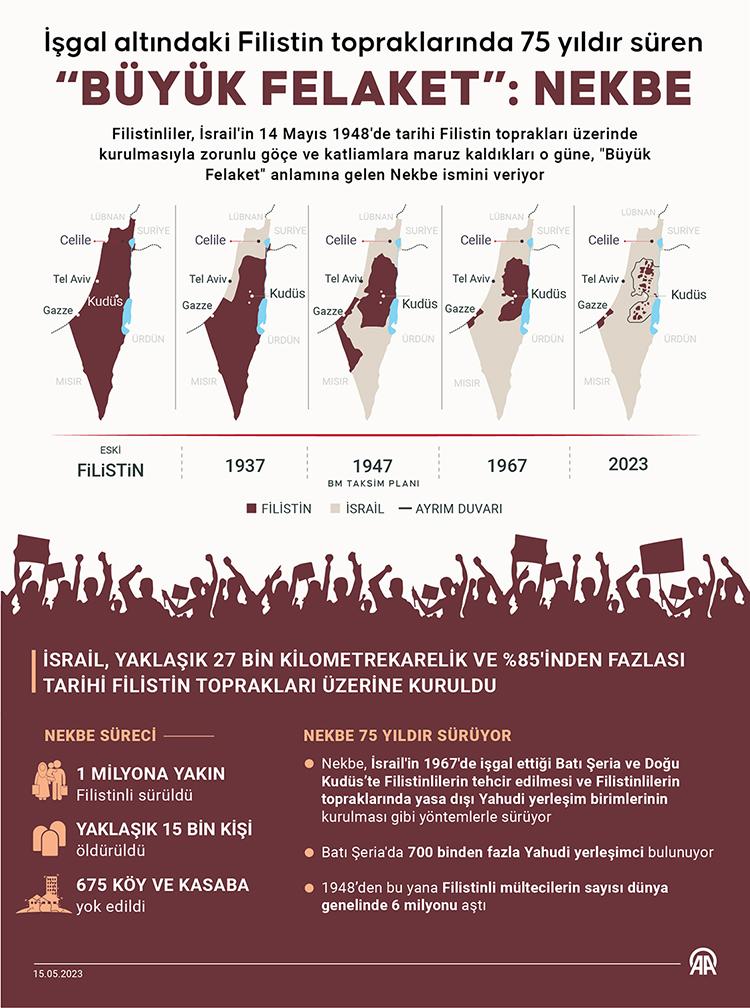
Infographic on the Nakba (AA)
One of the most significant outcomes of the Nakba was the reclassification of the legal status of Palestinians. During Israel’s post-1948 population census, the “present absentee” category emerged, placing Palestinian individuals in a gap between their physical presence and legal status. Individuals classified under this category:
A significant portion of displaced Palestinians began living in refugee camps established with the support of international organizations after dispersing to neighboring countries. With the creation of the United Nations Relief and Works Agency for Palestine Refugees in the Near East (UNRWA), these camps transformed from temporary shelters into permanent settlements, shaping the new social structure of the Palestinian people.
According to UNRWA, as of 2010, 43.4 percent of the approximately 10.9 million Palestinian Muslims worldwide were in a refugee status.【6】
The Nakba is not merely a single event of 1948; it has acquired a dimension of continuity through institutional structures that continue to affect the legal and social existence of Palestinians, particularly through emergency regulations and property laws. Practices such as restrictions on daily movement, fragmentation of social spaces, prohibition of property transfer, and denial of the right of return have shaped the lives of Palestinians over the long term. Thus, the Nakba has become a lasting historical and sociological condition at the center of modern Palestinian history, far beyond a mere wartime episode.
The generations born after the Nakba, though many have never seen Palestine, have constructed their identity through family narratives, collective memory in the camps, cultural elements, and literary and oral productions related to the experience of exile. For this reason, Palestinian identity has been transmitted from the first generation of the displaced to subsequent generations not as a geographical affiliation but as a historical memory and a claim to rights.
Anadolu Ajansı. "Filistin'in 'felaketi' olan Nekbe'nin üzerinden 72 yıl geçti." Accessed November 27, 2025.https://www.aa.com.tr/tr/dunya/filistinin-felaketi-olan-nekbenin-uzerinden-72-yil-gecti/1841716
Anadolu Ajansı. "İşgal altındaki Filistin topraklarında 75 yıldır süren 'Büyük Felaket': Nekbe." Accessed November 27, 2025.https://www.aa.com.tr/tr/dunya/isgal-altindaki-filistin-topraklarinda-75-yildir-suren-buyuk-felaket-nekbe/2897896
Boyalı, Ayşegül. "Al-Nakba Sonrası Filistin Sürgün Anlatılarında Çıplak Hayat Kavramı." Master's thesis, İstanbul Bilgi Üniversitesi, 2016. Accessed November 27, 2025.https://tez.yok.gov.tr/UlusalTezMerkezi/TezGoster?key=T1mWGp9MngYYkCSgiJvtVlGl7TUZgvOWLOVfv1UvqAMQt8f8HOFvEeo0mPRhO-Lz
Tergek, Şehmus. "İngiltere, ABD ve Siyonizm Üçgeni: El Nakba’ya Giden Yol." Master's thesis, İstanbul Üniversitesi, 2022. Accessed November 27, 2025.https://tez.yok.gov.tr/UlusalTezMerkezi/TezGoster?key=kIrIdtdJ31bRgjb6fHvMUTfnRxyZdKZ_hQ0UViRvTsuJTUl2_8h_ViO8cUFRZfMF
YouTube. "Filistinliler için 1948’den bu yana dinmeyen acı: Nekbe." Anadolu Ajansı. Accessed November 27, 2025.https://www.youtube.com/watch?v=DDqQuVqIxJg
[1]
Ayşegül Boyalı, Al-Nakba Sonrası Filistin Sürgün Anlatılarında Çıplak Hayat Kavramı (Yüksek Lisans Tezi, İstanbul Bilgi Üniversitesi, 2016), 15–17. https://tez.yok.gov.tr/UlusalTezMerkezi/TezGoster?key=T1mWGp9MngYYkCSgiJvtVlGl7TUZgvOWLOVfv1UvqAMQt8f8HOFvEeo0mPRhO-Lz
[2]
Şehmus Tergek, İngiltere, ABD ve Siyonizm Üçgeni: El Nakba’ya Giden Yol (Yüksek Lisans Tezi, İstanbul Üniversitesi, 2022), 109-112. https://tez.yok.gov.tr/UlusalTezMerkezi/TezGoster?key=kIrIdtdJ31bRgjb6fHvMUTfnRxyZdKZ_hQ0UViRvTsuJTUl2_8h_ViO8cUFRZfMF
[3]
Tergek, İngiltere, ABD ve Siyonizm Üçgeni: El Nakba’ya Giden Yol, 111. https://tez.yok.gov.tr/UlusalTezMerkezi/TezGoster?key=kIrIdtdJ31bRgjb6fHvMUTfnRxyZdKZ_hQ0UViRvTsuJTUl2_8h_ViO8cUFRZfMF
[4]
Anadolu Ajansı. "İşgal altındaki Filistin topraklarında 75 yıldır süren "Büyük Felaket": Nekbe." Son Erişim: 27.11.2025. https://www.aa.com.tr/tr/dunya/isgal-altindaki-filistin-topraklarinda-75-yildir-suren-buyuk-felaket-nekbe/2897896
[5]
Boyalı, Al-Nakba Sonrası Filistin Sürgün Anlatılarında Çıplak Hayat Kavramı, 16–23. https://tez.yok.gov.tr/UlusalTezMerkezi/TezGoster?key=T1mWGp9MngYYkCSgiJvtVlGl7TUZgvOWLOVfv1UvqAMQt8f8HOFvEeo0mPRhO-Lz
[6]
Tergek, İngiltere, ABD ve Siyonizm Üçgeni: El Nakba’ya Giden Yol, 122. https://tez.yok.gov.tr/UlusalTezMerkezi/TezGoster?key=kIrIdtdJ31bRgjb6fHvMUTfnRxyZdKZ_hQ0UViRvTsuJTUl2_8h_ViO8cUFRZfMF

History | 1948 | ||||||||
|---|---|---|---|---|---|---|---|---|---|
Place | Palestine | ||||||||
Context | The establishment of the State of Israel through the displacement of Palestinians | ||||||||
Main Results | The expulsion of nearly one million Palestinians, the killing of approximately 15,000 people, the destruction of 675 villages and towns, and the dispossession and statelessness of the Palestinians | ||||||||
No Discussion Added Yet
Start discussion for "1948 Nekbe Incident" article
Historical Background
The Emergence of Zionism
The “Land Without a People” Narrative
The Role of Regional and Global Powers
United Nations Partition Plan (1947)
Partition Proposal
Federal One-State Proposal
The 1948 War and the Establishment of the State of Israel
Intervention by Arab States and Regionalization of the War
War Outcomes and Armistice Agreements
The “Present Absentee” Category
Refugee Camps and the Disintegration of Social Structure
The Continuity of the Nakba