


This article was automatically translated from the original Turkish version.
Christmas Truce
Armistice Date | December 24, 1914 - December 26, 1914 | ||||||||
|---|---|---|---|---|---|---|---|---|---|
Front | Western Front | ||||||||
Side | English German and French Soldiers | ||||||||
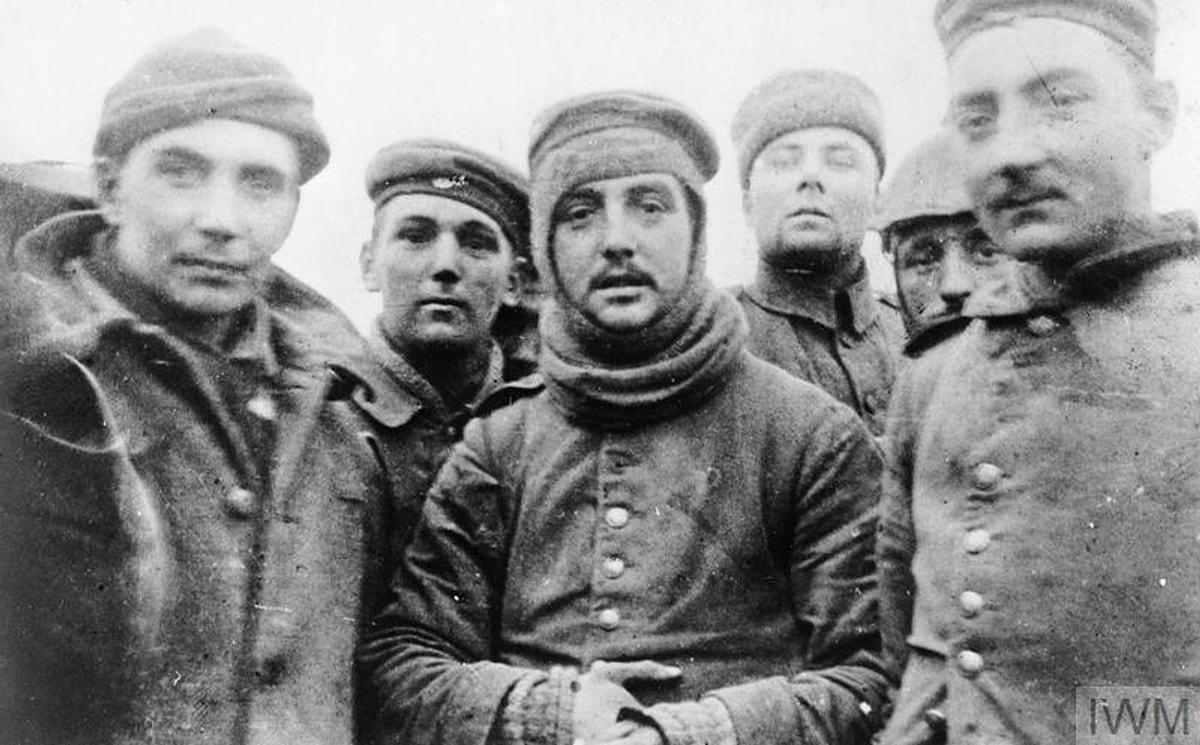
The 1914 Christmas Truce was a series of informal ceasefires along the Western Front during the First World War, in which enemy soldiers spontaneously laid down their arms, met in a peaceful manner, exchanged gifts, and even played football. The 1914 Christmas Truce is one of the most intriguing events of the First World War. These unofficial ceasefires occurred in late December 1914 along the Western Front, resulting in soldiers from opposing armies—primarily British, French, and German—leaving their trenches to meet, exchange gifts, and in some places, play improvised football matches. The Christmas Truce was not a single event but a mosaic of temporary moments of peace that emerged at the local level. These moments were shaped by the spirit of the Christmas season and a shared human experience under the harsh conditions of war.
The First World War, which began in the summer of 1914, plunged Europe into widespread conflict. In August, Germany invaded Belgium and advanced toward France. The British Expeditionary Force (BEF) was deployed to the continent to support the Allied powers. In this period, mobile warfare quickly gave way to trench warfare. Along the Western Front, from Belgium to northern France, extensive trench lines exposed soldiers to grueling environmental conditions.
The Battles of the Marne and First Ypres in September and October solidified the front lines. In the early months of the war, soldiers began enduring life in trenches where basic necessities were scarce. As winter conditions worsened, life on the front became increasingly difficult, negatively affecting military morale. The war’s prolongation, far beyond the initial expectation of a short conflict, led both sides to reassess their expectations of victory.
By 1914, Christmas held a significant cultural and religious place in European societies. The themes of peace and goodwill associated with the season were observed to resonate among soldiers on the front. Both sides’ soldiers, separated from their families during this time, expressed the emotional void created by the holiday in various ways. In German trenches, traditional elements such as Christmas trees and candles were placed, and this atmosphere played a key role in shaping the events that followed.
It is also notable that propaganda efforts and dehumanizing rhetoric were relatively limited at this stage. Many soldiers on the front, while not personally knowing their opponents, perceived them as fellow human beings enduring similar hardships. This mutual recognition was a crucial factor in the emergence of the truce.
By 1914, Christmas held a significant cultural and religious place in European societies. The themes of peace and goodwill associated with the season were observed to resonate among soldiers on the front. Both sides’ soldiers, separated from their families during this time, expressed the emotional void created by the holiday in various ways. In German trenches, traditional elements such as Christmas trees and candles were placed, and this atmosphere played a key role in shaping the events that followed.
It is also notable that propaganda efforts and dehumanizing rhetoric were relatively limited at this stage. Many soldiers on the front, while not personally knowing their opponents, perceived them as fellow human beings enduring similar hardships. This mutual recognition was a crucial factor in the emergence of the truce.
On the morning of 25 December, the most prominent moments of the truce occurred. No Man’s Land, normally a zone of combat, became a temporary meeting ground. Soldiers emerged from their trenches and approached each other with cautious restraint. These encounters quickly evolved into mutual interactions. The exchange of cigarettes, food, and small gifts was a central feature of the process. In some areas, German soldiers offered beer and sausages, while British soldiers provided whisky and canned food.
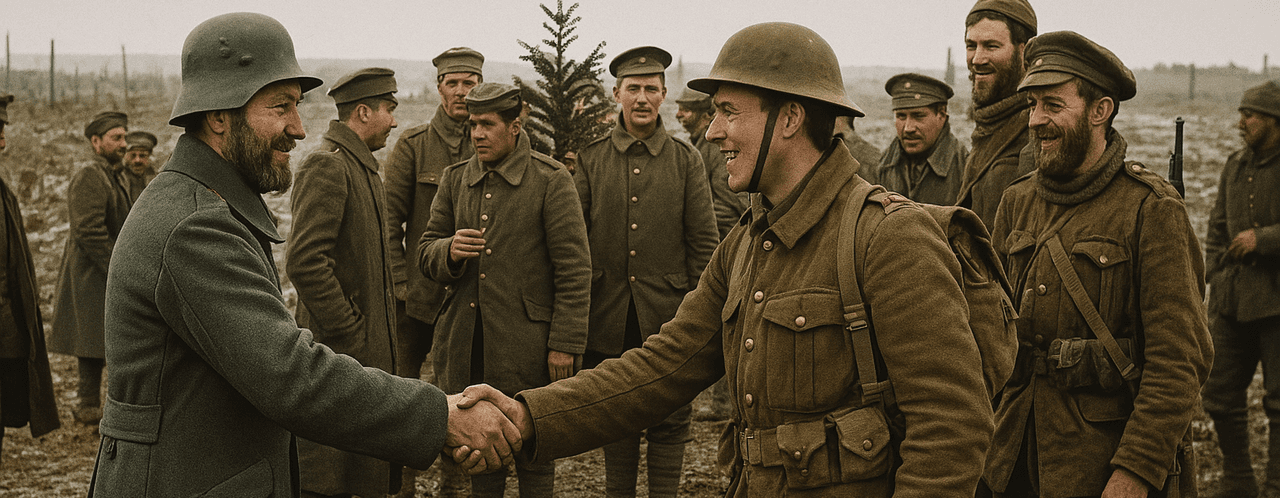
German and British Soldiers in Close Proximity (Generated by Artificial Intelligence.)
There are numerous primary sources documenting these moments. For example, in a letter from Captain Robert Hamilton of the British 2nd Division, a friendly meeting with a German officer is described. Similarly, a soldier from the German 16th Infantry Regiment recorded in his diary exchanging souvenirs with British troops. These documents are significant for documenting the local and human dimensions of the events.
One of the most well-known aspects of the Christmas Truce is the alleged football matches played in No Man’s Land. However, the scale and nature of these matches remain debated among historians. Some primary sources, particularly letters from British soldiers, mention improvised games. For instance, a soldier from the Royal Warwickshire Regiment wrote, “We played football with the Germans and beat them 3–2.” Yet, most of these matches were informal gatherings in which a few soldiers kicked a tin can or a makeshift ball, rather than organized games.
The football stories played a significant role in romanticizing the truce, though they were sometimes exaggerated. Although no official match records exist, soldiers’ letters and oral accounts confirm that such activities occurred at least in some areas.
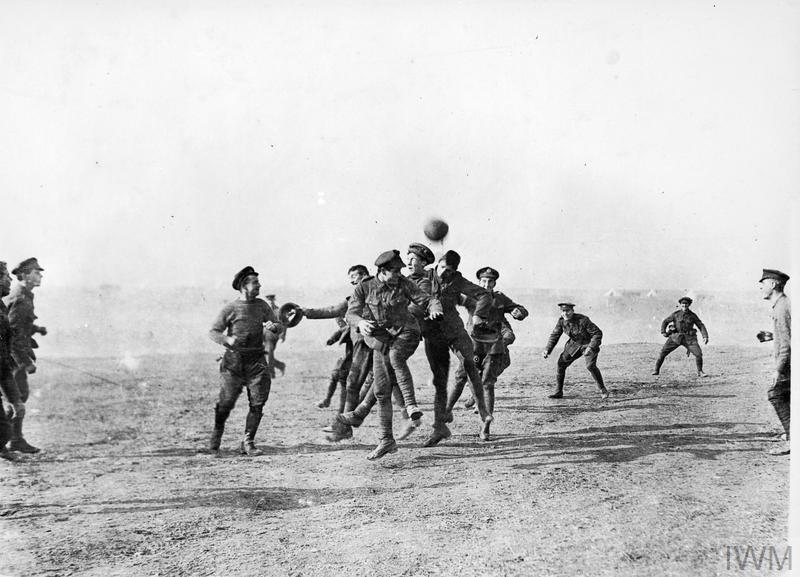
A Football Match Played During the Christmas Truce (IWM)
The truce did not occur across the entire Western Front but was concentrated in specific areas. The region around Ypres in Belgium and the Artois region in France, where British and German units faced each other, were the most extensively documented. Limited instances of fraternization were also reported between French and German troops, but French soldiers, whose homeland was under occupation, generally remained more distant.
In some areas, the truce lasted only a few hours; in others, it extended over several days. For example, in a sector held by the British 1st Division, the truce continued until 26 December, with both sides cooperating to bury their fallen soldiers.
The truce occurred spontaneously and was not sanctioned by higher command. From a military discipline standpoint, such fraternization was considered a serious breach. Both the British and German armies took stern measures upon learning of the truce. The British High Command issued an order on 26 December prohibiting any recurrence of such incidents. On the German side, some officers reportedly warned their men and even imposed disciplinary penalties.
Nevertheless, many junior officers on the ground chose to turn a blind eye to the events, recognizing that suppressing them would damage troop morale.
The Christmas Truce generated widespread reactions both on the front and at home. Soldiers’ letters and diaries conveyed these events to their families and friends. In Britain, newspapers such as The Times and Daily Mail published soldiers’ letters to share the story with the public. However, these reports were often censored and used for propaganda purposes.
In Germany, news of the truce was less widespread due to stricter military censorship. Still, some local newspapers published accounts provided by soldiers. On both sides, the truce temporarily boosted public morale by revealing the human face of war.
As the war progressed, the narrative of the Christmas Truce was shaped by propaganda and mythmaking. On the British side, the truce was romanticized with emphasis on “civilization” and “humanity.” On the German side, although less emphasized, some narratives highlighted the disciplined yet humane character of German soldiers.
Stories such as the football matches, especially in the late 20th century, were exaggerated in popular culture and transformed into legend. Films, novels, and documentaries emphasized the emotional aspects of the truce, sometimes overshadowing its historical complexity.
In the 20th and 21st centuries, the Christmas Truce has been remembered as a symbol of peace and humanity. In 2014, the 100th anniversary of the truce was marked by various events across Europe. In Britain, memorials were erected and exhibitions held to commemorate the football matches played in No Man’s Land. UEFA organized a memorial match near Ypres.
The truce has also become a powerful symbol for anti-war movements. Peace advocacy groups argue that the truce demonstrates that people can come together even under the most dire circumstances.
In popular culture, the Christmas Truce has inspired numerous works. The 2005 film Joyeux Noël explored the emotional and dramatic dimensions of the truce. Similarly, Paul McCartney’s song “Pipes of Peace” and Sainsbury’s 2014 advertising campaign brought the spirit of the truce to a broad audience.
In literature, the truce has frequently been addressed as a theme. Works such as Michael Morpurgo’s War Horse conveyed the truce’s message of humanity to younger generations. However, these works sometimes prioritized emotional impact over historical accuracy.
https://www.iwm.org.uk/history/the-real-story-of-the-christmas-truce
https://www.stratejivefinans.com/noel-ateskesi-genc-askerlerin-insanliga-biraktigi-ders/
"The Christmas Truce: A Historical Overview." Oxford Scholarship Online. Accessed April 13, 2025.https://academic.oup.com/kentucky-scholarship-online/book/14939
BBC Culture. "The WW1 Christmas Truce: The War for That Moment Came to a Standstill." December 19, 2023.https://www.bbc.com/culture/article/20231219-the-ww1-christmas-truce-the-war-for-that-moment-came-to-a-standstill
British Newspaper Archive. "The Story of the 1914 Christmas Truce as Reported by WW1 Newspapers." December 19, 2014.https://blog.britishnewspaperarchive.co.uk/2014/12/19/the-story-of-the-1914-christmas-truce-as-reported-by-ww1-newspapers/.
Brown, Malcolm, and Shirley Seaton. Christmas Truce: The Western Front December 1914. London: Pan Books, 1994.
Forestburgh Historical Society. "The Christmas Truce of 1914." December 2019.https://forestburgh.net/wp-content/uploads/2019/12/Christmas-Truce.pdf.
Imperial War Museum. "Voices of the First World War: Episode 9 – The Christmas Truce." Podcast, 2014.
Jürgs, Michael. Der kleine Frieden im Großen Krieg: Westfront 1914. München: Goldmann Verlag, 2003.
Kershaw, Ian. *The Christmas Truce of 1914: A History*. New York: HarperCollins, 2015.https://books.google.com.tr/books?hl=tr&lr=&id=syavCgAAQBAJ&oi=fnd&pg=PP1&dq=christmas+truce+ww1&ots=0RSQTUXpAt&sig=bBIrGKy-iSLsMwN9X-V84xqmUoA&redir_esc=y#v=onepage&q&f=false
Martin, Lorna. "The Christmas Truce of 1914." The Guardian, December 19, 2004.https://www.theguardian.com/uk/2004/dec/19/christmas.lornamartin.
National Army Museum. "The Christmas Truce of 1914." National Army Museum. Accessed [insert date if provided].https://www.nam.ac.uk/explore/christmas-ww1.
National World War I Museum and Memorial. "The Christmas Truce of Winter 1914." The World War I Museum.
O’Donnell, William. *The Christmas Truce: A Tale of War and Peace*. New York: Oxford University Press, 2015.https://books.google.com.tr/books?hl=tr&lr=&id=XkOEAwAAQBAJ&oi=fnd&pg=PT5&dq=christmas+truce+ww1&ots=6UgSdDPCMF&sig=aJq_rypokSKXsRvQdApsUIcRX7E&redir_esc=y#v=onepage&q&f=false
Time. "The Christmas Truce of 1914." 2015.https://time.com/3643889/christmas-truce-1914/.
Weintraub, Stanley. Silent Night: The Story of the World War I Christmas Truce. New York: Free Press, 2001.https://archive.org/details/silentnightstory00wein
“Western Front, 1916–17 [Map].” *NZHistory*, New Zealand Ministry for Culture and Heritage. Accessed March 27, 2025.https://nzhistory.govt.nz/media/photo/western-front-1916-17-map
Christmas Truce
Armistice Date | December 24, 1914 - December 26, 1914 | ||||||||
|---|---|---|---|---|---|---|---|---|---|
Front | Western Front | ||||||||
Side | English German and French Soldiers | ||||||||
No Discussion Added Yet
Start discussion for "1914 Christmas Truce" article
Historical Context
The Early Months of the First World War
The Cultural Significance of Christmas
Development of the Truce
Initial Contacts
Meeting in No Man’s Land
Football Matches
Scope and Limitations of the Truce
Geographical Distribution
Command Response
Cultural and Social Impact
Contemporary Perceptions
Propaganda and Mythmaking
Historical Legacy
Commemoration of the Truce
Place in Modern Culture