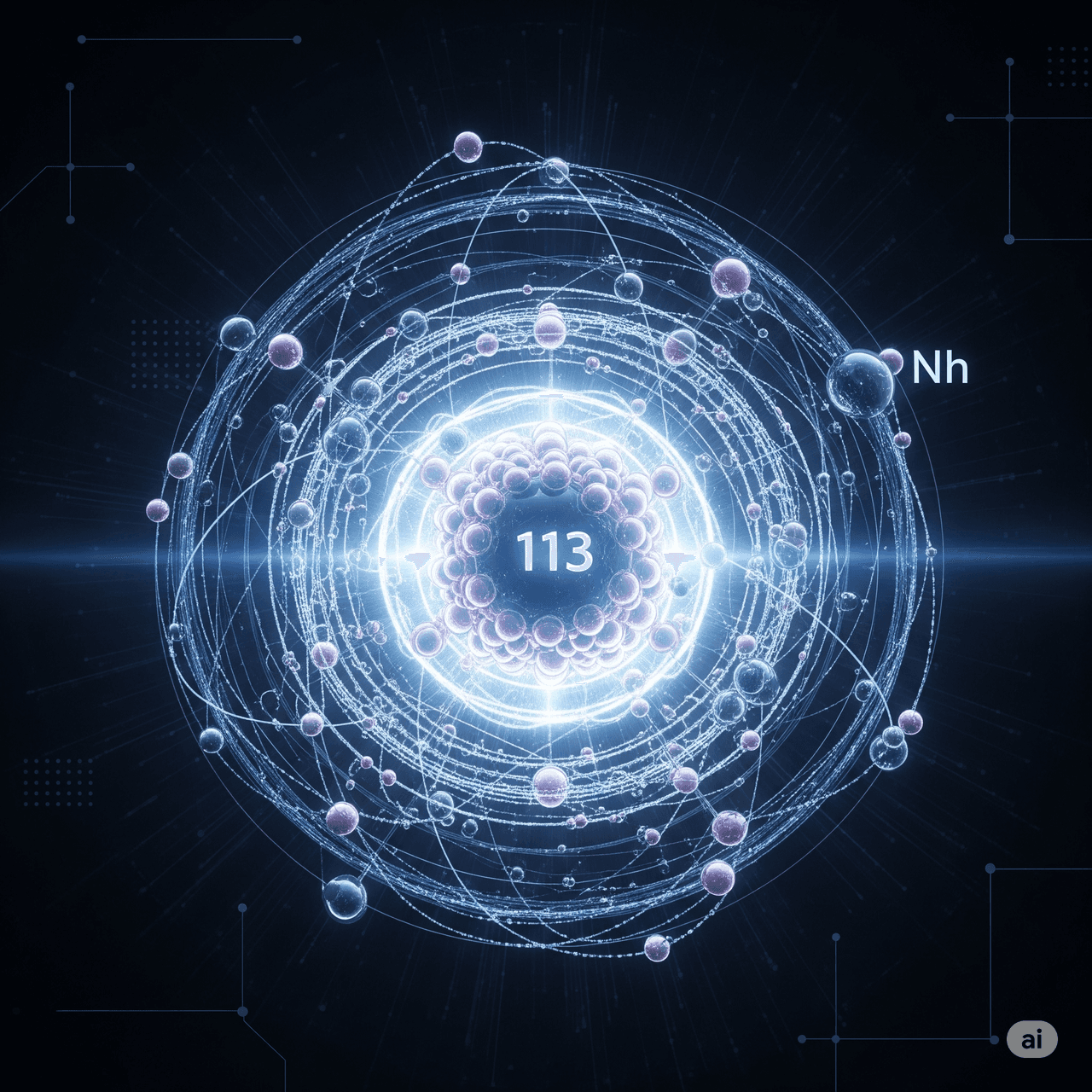


Nihonium Element
Nihonium, with the symbol Nh and atomic number 113, is an artificial element. It does not occur in nature and is produced only in laboratory conditions. It is radioactive and has a very short half-life. Scientists study nihonium to understand the behavior and atomic structure of superheavy elements.
(Generated with Artificial Intelligence.)
History
Nihonium was discovered in Japan in 2003. Its name is derived from Nihon, the Latin name for Japan. The discovery of this element marked a significant milestone in research on superheavy elements and nuclear chemistry.
Physical Properties
The physical properties of nihonium are not fully known due to the extremely small quantities produced. Theoretically, it belongs to the group of transition metals and is expected to have a metallic structure. Observations are limited because its atoms have an extremely short half-life.
Chemical Properties
Nihonium may behave similarly to transition metals and can exhibit chemical properties comparable to other superheavy elements. Due to its radioactivity, chemical experiments can only be conducted under specialized laboratory conditions.
Applications
Nihonium has no applications in daily life or industry. It is used solely in scientific research to study the properties of superheavy elements.
Natural Occurrence
Nihonium does not occur in nature and is produced entirely in laboratory settings. The number of atoms produced is extremely small, often limited to just a few atoms at a time. For this reason, it is exceedingly rare and valuable to scientists.
Scientific Significance and Future Perspectives
Nihonium is an important element in research on superheavy elements and atomic nuclei. Through its study, scientists can gain a better understanding of the behavior and structure of radioactive elements. In the future, further investigation of this element may provide new insights in fundamental physics and nuclear science.