

`unsupervised-learning` Related Article Results
 Un
UnUnsupervised Learning
Unsupervised learning is a branch of machine learning that aims to enable models to learn patterns in data without the use of labeled data. In this approach, the model uses only input data to cluster, group, or structure the information. Unsupervised learning is particularly useful when working with large unlabeled datasets and is commonly employed to uncover hidden structures and relationships within data. The most common unsupervised learning techniques include clustering and dimensionality re
EN
Ahsen Güneş
UnUnsupervised Learning
Unsupervised learning is a branch of machine learning that aims to enable models to learn patterns in data without labeled examples. In this approach, the model uses only input data to classify, group, or structure information. Unsupervised learning is particularly useful when working with large datasets that lack labels. It is employed to uncover hidden structures and relationships within data sets. The most common unsupervised learning techniques include clustering and dimensionality reduction
EN
Ahsen Güneş
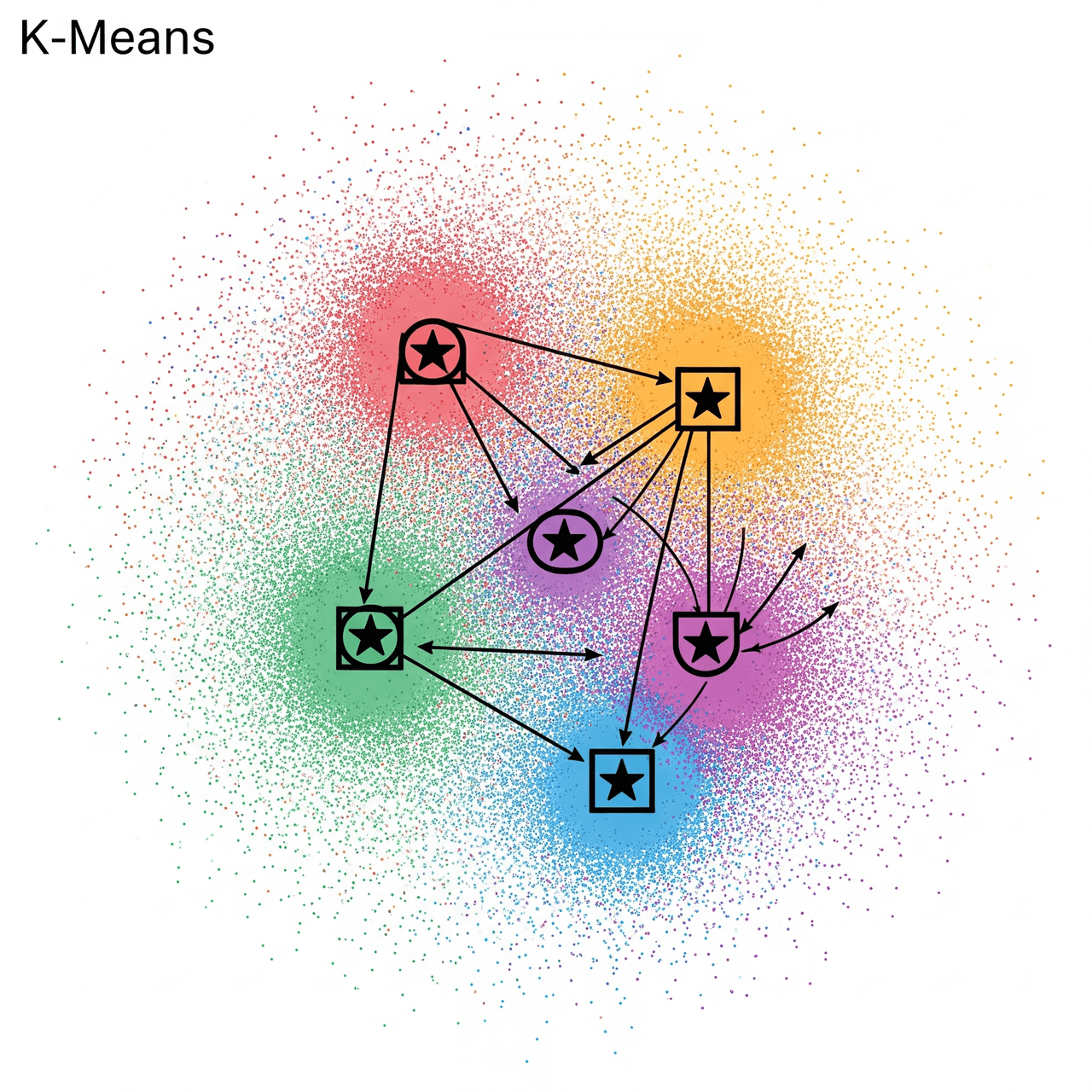
K-Means Clustering Algorithm
K-Means Clustering Algorithm is a center-based, iterative machine learning algorithm that partitions unlabeled (unsupervised) data points into K clusters based on their similarity. Each data point belongs to exactly one cluster; in this regard, it is a "hard" clustering technique. Unlike supervised learning, the K-Means algorithm does not require class labels and aims to discover the natural structure within the data. Basic Working Principle The K-Means algorithm forms clusters around a predefin
EN
Yağmur Nur Küçükarslan