

`mechanics` Related Article Results
 Cr
CrCreep
Creep is defined as the time-dependent plastic deformation of materials under constant temperature and constant load. This phenomenon is a critical damage mechanism in engineering components operating at high temperatures for extended periods. Creep deformation can be observed across a wide range of materials including metals, ceramics, and polymers, and plays a significant role in determining the service life of materials. Creep Curve and Stages A typical creep curve consists of three main stag
EN
Muzaffer Yalçın
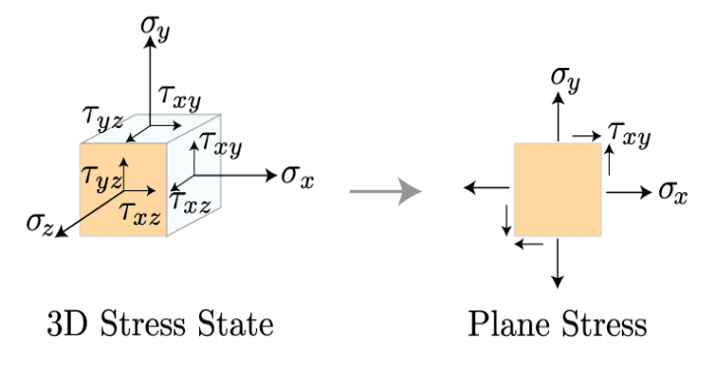
Plane Stress
Plane stress describes the condition in which stresses are zero along one plane. This condition typically applies to thin plates. Because the thickness direction of the material is significantly smaller compared to the other directions, negligible stress develops in this direction and is assumed to be zero (σz = σxz = σyz = 0). Thus, only the stresses in the x and y directions (σx, σy, τxy) are considered. Importance of Plane Stress An increase in the number of equations in theoretical and numer
ENElyesa Köseoğlu
DyDynamic
Dynamics (n.): The branch of physics that studies the change of systems under the influence of motion and forces. Origin The word "dynamics" is derived from the Greek term "dynamikos," meaning "related to power or motion." This term is used in physics and engineering to explain movement, forces, and equilibrium states. Dynamics gained its modern meaning through Newton’s laws of motion and has found applications in various fields, from engineering to biology. Areas of Use Historical Use: The conc
EN
Furkan Üresin

Planet Gear System
Planetary gear system (or epicyclic gear system) is a compact gear mechanism consisting of a central sun gear, multiple planet gears rotating around it, and an outer ring gear with internal teeth. This system is particularly used in applications requiring high torque and precise speed control. The behavior of a planetary gear system depends on which component is held stationary, which serves as the input, and which serves as the output. Different combinations can achieve speed increase, speed re
EN
Furkan Aygan

Hooke’s Law
Hooke’s Law emerged during the 17th-century Scientific Revolution, particularly alongside advancements in mechanics and materials science. The English scientist Robert Hooke introduced this law in his 1678 publication titled “Lectures de Potentia Restitutiva, or of Spring.” Through experiments on various spring systems, Hooke discovered that there is a constant ratio between the deformation of an elastic object and the force applied to it. This ratio varies depending on the material and geometry
EN
Sümeyye Akkanat Terzioğlu