


This article was automatically translated from the original Turkish version.
+1 More
Location | Nevşehir Province Zelve Valley - Paşabağları Area Avanos District | ||||||||
|---|---|---|---|---|---|---|---|---|---|
Date(s) | Active settlement area from the 9th century to the 20th century (particularly during the Byzantine and Seljuk periods) | ||||||||
Notable Structures | Fish Church Grape Church Deer Church | ||||||||
Settlement Date | Used as a village until the 1950s, evacuated in 1952 due to danger | ||||||||
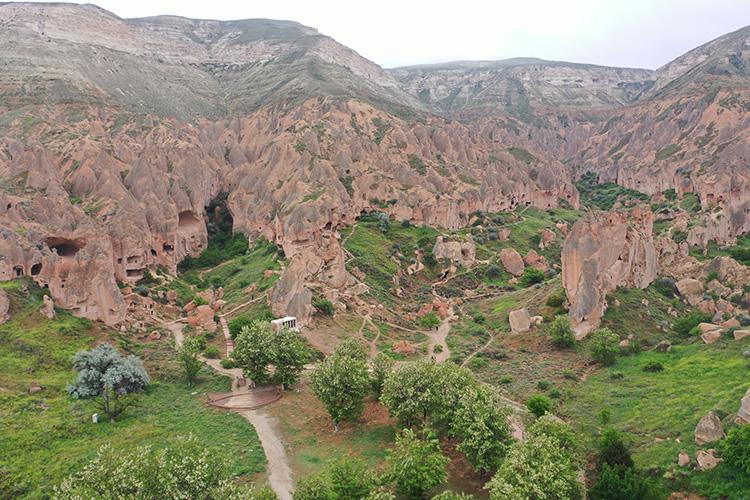
Zelve Open-Air Museum is a historical and archaeological site located within the boundaries of Avanos district in Nevşehir Province, Türkiye, and is one of the oldest settlements in the Cappadocia region. It is situated approximately 2 km east of the Göreme-Avanos road, on the northern slope of Aktepe. The area, composed of three distinct valleys, holds significant importance in terms of rock-cut architecture, fairy chimney formations, and the history of Christianity.

Zelve Open-Air Museum-Anadolu Agency
The settlement history of Zelve Valley extends back to the Byzantine period, particularly to the early centuries of Christianity. From the 9th century onward, it became an important religious center for Christian monks and priests. The churches of Balıklı, Üzümlü, and Geyikli, constructed before the Iconoclastic Period (728–842), are among the earliest examples of art and architecture from this era. Zelve is also regarded as one of the first centers where religious education was provided to monks.
The area was used as a village settlement until the 1950s; however, due to the dangers of rockfalls and erosion, it was abandoned in 1952. The inhabitants relocated to Aktepe Village, established approximately 2 km north of the valley. Zelve was granted the status of an “open-air museum” in 1967 and placed under protection.
The Zelve Open-Air Museum consists of numerous rock-cut structures, including dwellings, churches, monasteries, mosques, pigeon houses, mills, and food storage rooms. The first and second sections of the valley are especially rich in religious buildings, while the third valley allows visitors to see both Islamic and Christian structures—such as mosques and monasteries—side by side. In this respect, Zelve preserves traces of a multi-religious and multicultural way of life.
Naturally, the area is distinguished by fairy chimneys and badlands formations created through the erosion of volcanic tuff. Consistent with the general geological structure of Cappadocia, the tuff in Zelve is easily workable, which enabled settlers to carve it for various purposes.

Zelve Open-Air Museum-Museum Card
The Zelve Open-Air Museum is included within the “Göreme National Park and the Rock Sites of Cappadocia”, inscribed on the UNESCO World Heritage List in 1985. It holds a “mixed heritage” status due to its both natural and cultural significance. The museum operates under the authority of the Ministry of Culture and Tourism and plays a vital role in the preservation, exhibition, and promotion of the region’s archaeological and ethnographic values.
Anadolu Ajansı. "Zelve Açık Hava Müzesi turistleri tarihte yolculuğa çıkarıyor." Anadolu Ajansı, June 2, 2022. https://www.aa.com.tr/tr/kultur-sanat/zelve-acik-hava-muzesi-turistleri-tarihte-yolculuga-cikariyor/2594470. Accessed May 14, 2025.
Ministry of Culture and Tourism of the Republic of Türkiye. "Zelve - Paşabağlar Örenyeri." *Müze Kart*. https://muze.gov.tr/muze-detay?DistId=ZPO&SectionId=ZPO01. Accessed May 14, 2025.
Turkish Museums. "Nevşehir Zelve-Paşabağları Örenyeri." Turkish Museums. Accessed May 14, 2025.
Şenay Güngör. "Koruma Statülerinin Koruma-Kullanma Dengesine Etkisi: Zelve Açık Hava Müzesi (Nevşehir/Avanos) / The Effect of Protection Statuses on Protection-Use Balance: The Case of Zelve Open Air Museum (Nevşehir/Avanos)." Gaziantep University Journal of Social Sciences 15, no. 1 (2016): 205–223. https://dergipark.org.tr/tr/download/article-file/223117. Accessed May 14, 2025.

Location | Nevşehir Province Zelve Valley - Paşabağları Area Avanos District | ||||||||
|---|---|---|---|---|---|---|---|---|---|
Date(s) | Active settlement area from the 9th century to the 20th century (particularly during the Byzantine and Seljuk periods) | ||||||||
Notable Structures | Fish Church Grape Church Deer Church | ||||||||
Settlement Date | Used as a village until the 1950s, evacuated in 1952 due to danger | ||||||||
No Discussion Added Yet
Start discussion for "Zelve Open-Air Museum" article
History
Physical Structure and Features
Protection Status and Significance