


This article was automatically translated from the original Turkish version.
+2 More
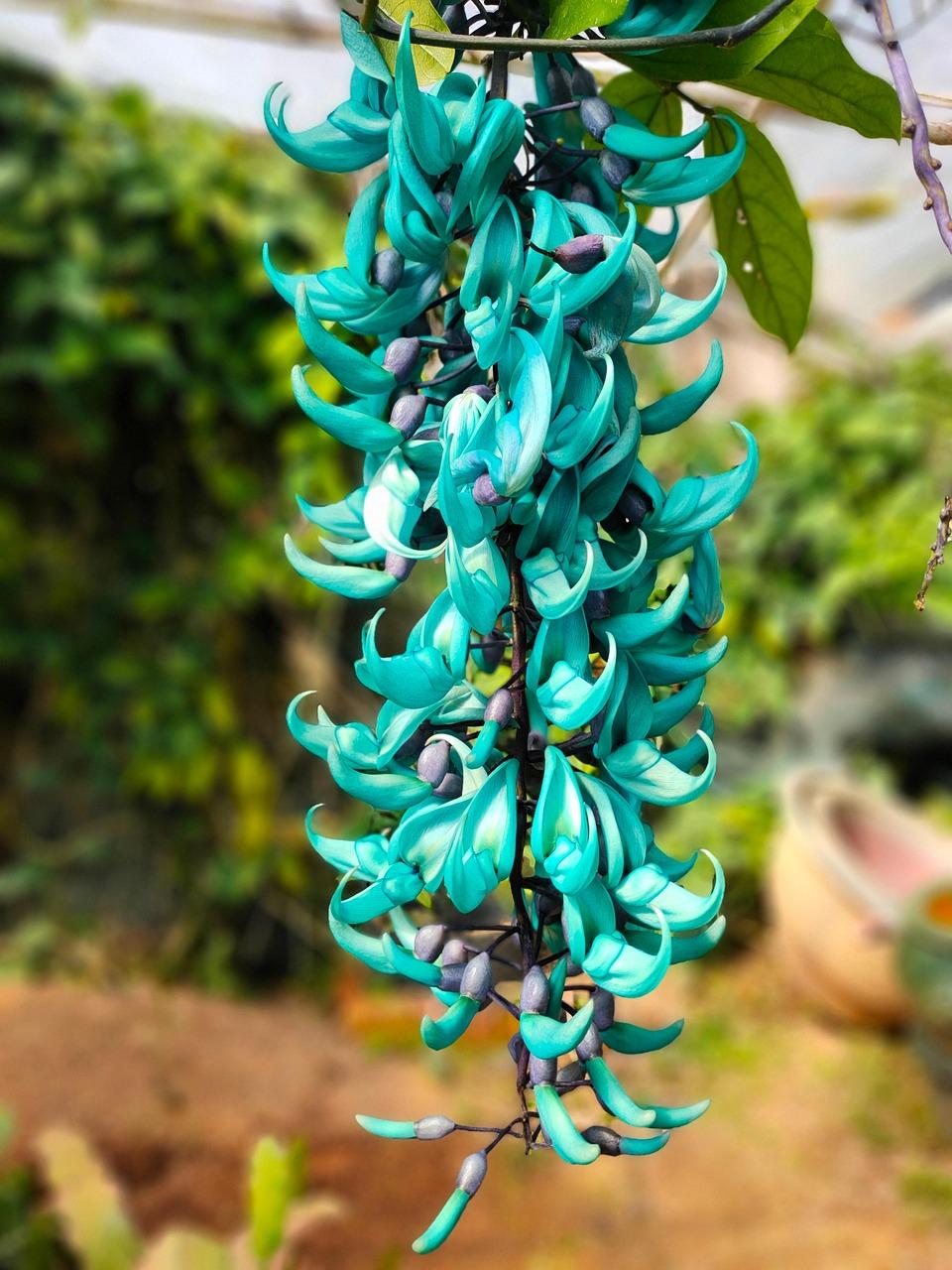
Yeşim Asma (Strongylodon macrobotrys)
Family | Fabaceae | ||||||||
|---|---|---|---|---|---|---|---|---|---|
Type(s) | Tropical ivy | ||||||||
Distribution(s) | Philippines and Southeast Asian tropical forests | ||||||||
Characteristics | Turquoise-green, claw-shaped flowers; woody stem reaching 15–18 m | ||||||||
Habitat | Moist shaded tropical rainforests | ||||||||
Usage | Cultivated as an ornamental plant in landscapes and botanical gardens | ||||||||
Yeşim Asma (Strongylodon macrobotrys A. Gray, Fabaceae) is a woody, perennial, climbing vine belonging to the Fabaceae family and native to tropical regions. In Turkish, it is known as “yeşim asması” or “yeşim çiçeği.” The species is distinguished by its extraordinary pendulous flower clusters, which are turquoise to jade-green in color, pincer-shaped, and arranged in inflorescences up to 3 meters long.
The genus name Strongylodon derives from the Greek words “strongylos” (round) and “odontos” (tooth), referring to the rounded, toothed structure of the flower calyx. The specific epithet macrobotrys means “large cluster,” alluding to its distinctive flowering form.
Strongylodon macrobotrys is endemic to the Philippines. It grows naturally on the islands of Luzon, Catanduanes, and Mindoro, in low to mid-elevation (300–1000 m) moist tropical forests, along riverbanks and in valleys. In its natural habitat, it prefers slightly acidic, humus-rich, well-drained soils. Partial shade and temperate tropical climates are optimal for its growth.
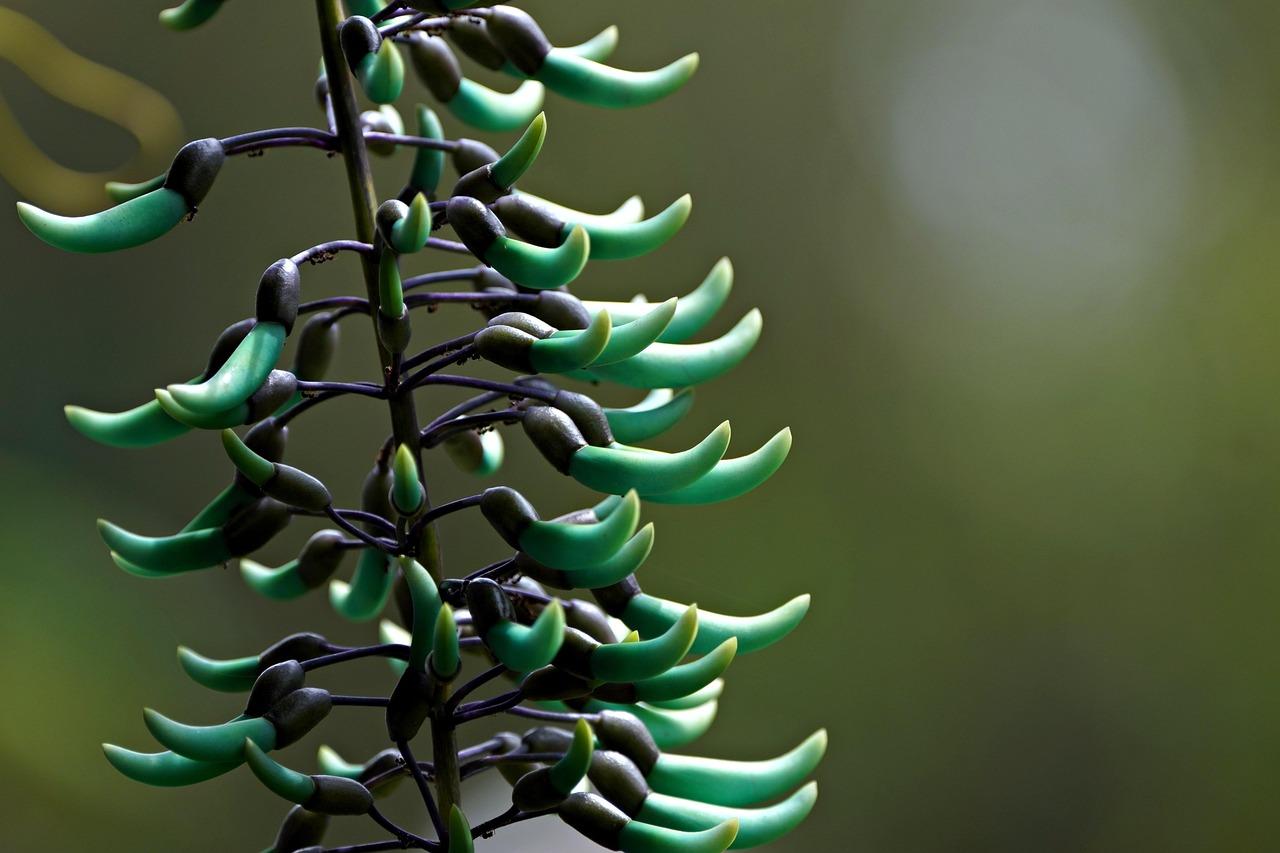
Image of Yeşim Asma Flower Bud. (Pıxabay)
The plant is primarily pollinated by fruit bats. The nocturnal turquoise color of the flowers attracts these animals. As bats insert their heads into the flowers to feed on nectar, pollen adheres to their fur and is transferred to subsequent flowers. Additionally, the bird Aethopyga bella, certain bee species, and the butterfly Papilio palinurus contribute to pollination. In cultivation settings where bats are absent, hand pollination may be necessary.
Yeşim asma is widely cultivated for ornamental purposes, particularly in tropical and subtropical regions. It is ideal for covering pergolas, arches, and trellises.
Strongylodon macrobotrys is classified as “Vulnerable” (VU) according to IUCN criteria due to habitat destruction and deforestation. Its endemism to the Philippines makes its conservation especially critical. Both ex-situ (cultivated conservation) and in-situ (in natural habitats) conservation strategies are essential for the species’ long-term survival.
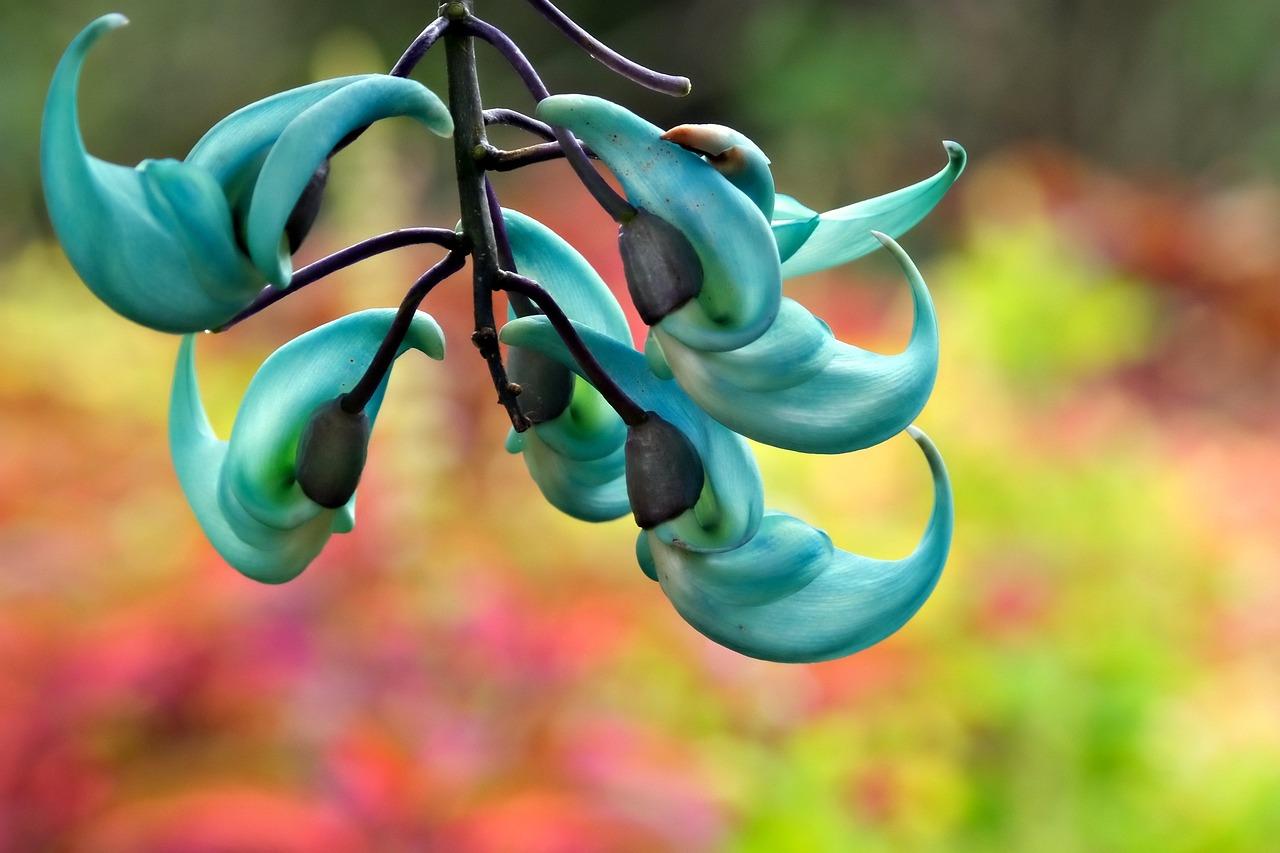
Image of Yeşim Asma Flower. (Pıxabay)
Yeşim Asma (Strongylodon macrobotrys) is a species of notable interest not only for its aesthetic value but also for its ecological, taxonomic, and chemical properties. As an important component of tropical vegetation, this vine is valued not merely as an ornamental plant but also as a source of environmentally friendly compounds. The high anti-corrosive activity of its secondary metabolites highlights its potential in green chemistry and materials science. However, the shrinking of its natural habitats poses a serious threat to its future survival.
Garden Club of America. *Strongylodon macrobotrys - Español*. Accessed June 17, 2025. https://gardenclub.org/sites/default/files/2024-03/strongylodon%20macrobotrys-espan%CC%83ol.pdf
Hadsall, Annalee S., Michelle D. R. Alejado, Ariel R. Larona, and Ivy Amor F. Lambio. “Strongylodon juangonzalezii, a Remarkable New Species of Strongylodon (Fabaceae) from Mulanay, Quezon Province, Philippines.” *PhytoKeys* 73 (2016): 1–12. Accessed June 17, 2025. https://pdfs.semanticscholar.org/90b4/78cd46294018dedbfdd0ac2b34702f7abfdd.pdf
Ministry of Agriculture and Forestry,Samsun İl Directorate. *Süs Bitkileri Hastalık ve Zararlıları*. Samsun: İl Tarım Müdürlüğü Yayınları, 2021. Accessed June 17, 2025. https://samsun.tarimorman.gov.tr/Belgeler/Yayinlar/Kitaplarimiz/sus_bitkileri_hastalik_ve_zararlilari.pdf
Ministry of Agriculture and Forestry. *Ornamental Plants Sector Policy Document 2020–2024*. Ankara:TAGEM Yayınları, 2020. Accessed June 17, 2025. https://www.tarimorman.gov.tr/TAGEM/Belgeler/yayin/SU%CC%88S%20BI%CC%87TKI%CC%87LERI%CC%87sekto%CC%88rpolitika%20.pdf
Missouri Botanical Garden. “Strongylodon macrobotrys.” *Plant Finder*. Accessed June 17, 2025. https://www.missouribotanicalgarden.org/PlantFinder/PlantFinderDetails.aspx?taxonid=280642
Pixabay. "Arka Fon." Photograph. Accessed June 17, 2025. https://pixabay.com/tr/photos/arka-fon-7025593/
Pixabay. “Yeşim Asması Çiçek Bitki Örtüsü.” Photograph. Accessed June 17, 2025. https://pixabay.com/tr/photos/ye%C5%9Fim-asmas%C4%B1-%C3%A7i%C3%A7ek-bitki-%C3%B6rt%C3%BCs%C3%BC-8365038/
Pixabay. “Yeşim Asması Çiçekler Çiğ Bitki.” Photograph. Accessed June 17, 2025. https://pixabay.com/tr/photos/ye%C5%9Fim-asmas%C4%B1-%C3%A7i%C3%A7ekler-%C3%A7i%C4%9F-bitki-7385863/
Pixabay. “Çiçek Tomurcukları Yeşim Asması.” Photograph. Accessed June 17, 2025. https://pixabay.com/tr/photos/%C3%A7i%C3%A7ek-tomurcuklar%C4%B1-ye%C5%9Fim-asmas%C4%B1-8609062/
Plant Pono. "Strongylodon macrobotrys." *Pono Plants Database*. Accessed June 17, 2025. https://plantpono.org/pono-plants/strongylodon-macrobotrys/
Ugi, Benedict U., Victoria M. Bassey, Mbang E. Obeten, Stephen A. Adalikwu, and Desmond O. Nandi. “Secondary Plant Metabolites of Natural Product Origin—Strongylodon macrobotrys as Pitting Corrosion Inhibitors of Steel around Heavy Salt Deposits in Gabu, Nigeria.” Journal of Materials Science and Chemical Engineering 8, no. 5 (2020): 38–60. Accessed June 17, 2025. https://www.scirp.org/pdf/msce_2020052716093821.pdf
[1]
Endüstriyel ve Bilimsel Önemi
2020 tarihli bilimsel bir çalışmada, S. macrobotrys’in yapraklarından elde edilen üç sekonder metabolit (alkaloit, saponin ve flavonoid) ile çelik yüzeylerde korozyon önleme etkisi araştırılmıştır.
Yöntemler: Gravimetrik analiz, gazometrik ölçüm, elektrokimyasal empedans spektroskopisi (EIS) ve potansiyodinamik polarizasyon.
Bulgular:
Alkaloit ekstraktı (AESML): %99.2 inhibisyon
Saponin ekstraktı (SESML): %92.6 inhibisyon
Flavonoid ekstraktı (FESML): %84.7 inhibisyon
Bu sonuçlar, bitkinin biyolojik temelli korozyon önleyici ajan olarak sanayide kullanılabileceğini göstermektedir.
Yeşim Asma (Strongylodon macrobotrys)
Family | Fabaceae | ||||||||
|---|---|---|---|---|---|---|---|---|---|
Type(s) | Tropical ivy | ||||||||
Distribution(s) | Philippines and Southeast Asian tropical forests | ||||||||
Characteristics | Turquoise-green, claw-shaped flowers; woody stem reaching 15–18 m | ||||||||
Habitat | Moist shaded tropical rainforests | ||||||||
Usage | Cultivated as an ornamental plant in landscapes and botanical gardens | ||||||||
No Discussion Added Yet
Start discussion for "Yeşim Asma (Strongylodon macrobotrys)" article
Etimology
Natural Distribution and Habitat
Morphological Characteristics
Vegetative Structures
Generative Structures
Pollination and Ecology
Reproduction and Cultivation
Landscape and Cultural Use
Conservation Status