This article was automatically translated from the original Turkish version.
+2 More
Location | Bornova Plain İzmir | ||||||||
|---|---|---|---|---|---|---|---|---|---|
Date | Neolithic Period (8,500 Years Ago) | ||||||||
Discovery | 2003 | ||||||||
Surface Area | ~70,000 m² | ||||||||
Layers | Roman, Bronze, Chalcolithic, Neolithic | ||||||||
Yeşilova Höyüğü is the oldest settlement site in İzmir, located in the central part of the Bornova Plain, atop alluvial deposits formed by the Manda Çayı and Gökdere rivers. It pushes the city’s prehistoric past back at least 8,500 years. Along with the Yassıtepe and İpeklikuyu mounds, it forms the “Prehistoric Settlement Area of İzmir” and holds key significance for reflecting Neolithic lifeways and architectural traditions along the western Anatolian coast.
The mound was established on a surface approximately 14 meters above sea level in the Bornova Plain; however, due to intense alluvial accumulation in the region, cultural layers begin 3 to 4 meters below the present-day plain surface. Excavations at Yeşilova Höyüğü have identified four main cultural layers extending from the surface down to the natural soil. These layers cover a chronology ranging from the Roman Period to the Neolithic.
This uppermost layer dates to the Roman Period. Although no architectural structures from this era have been found, typical finds include burials and pottery fragments. Remains of a baked clay künk system possibly associated with architecture have also been identified in this layer.
Located beneath the Roman layer, Layer II belongs to the Early Bronze Age I period. No significant architectural structures have been identified in this layer. The period is represented primarily by widespread pottery fragments and a concentrated burial area in the center of the mound (Area No. 1). In this cemetery, a tradition of burying the dead intact in large ceramic jars (pithos burials) is evident.
Beginning approximately 500 years after the end of Neolithic settlement around 5700 BCE, this phase is known as the Chalcolithic Period (Copper-Stone Age) (Layers III.1 and III.2). The new groups arriving in the region exhibited a distinct cultural structure from the previous period. Characteristic features of this layer include oval-shaped pit houses (primitive huts) and dark-colored pottery.
Layer IV, the thickest and longest-lasting occupation phase of the mound, dates to the Neolithic Period (Polished Stone Age). This layer extends back at least 8,500 years and is subdivided into eight distinct sub-layers (1a-c and 2–8).
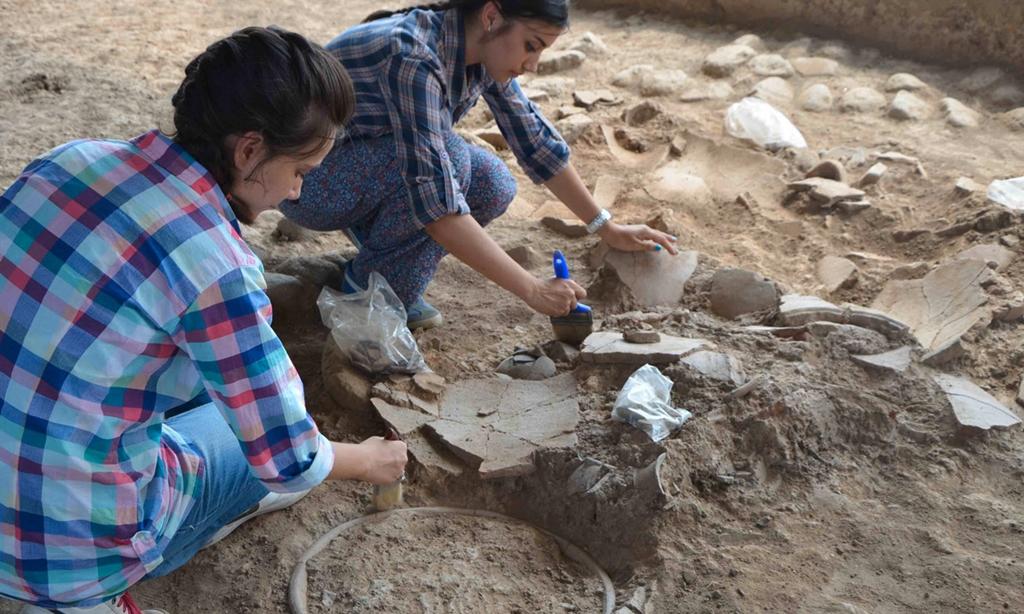
Excavation Work at Yeşilova Höyüğü (Visit İzmir)
Geoarchaeological data reveal that Yeşilova Höyüğü witnessed a dynamic process of environmental change throughout its occupation history. During the Early Holocene (8,500 years ago), sea levels were significantly lower than today, placing the settlement far inland from the coast. However, during the Middle Holocene (5,500 years ago), a sea level rise (transgression) caused seawater to advance deep into the Bornova Plain, bringing the coastline within approximately 2.5 kilometers of the mound.
During this period, inhabitants had to contend not only with sea level fluctuations but also with flooding caused by the Manda Çayı and its tributaries. Stratigraphic sections show that cultural layers were periodically interrupted by flood sediments, indicating that the settlement was abandoned temporarily on several occasions due to flooding.
The architecture of Yeşilova Höyüğü stands out with its unique character, distinct from inland western Anatolia and identified as the “Coastal Aegean Culture.” In the early Neolithic phases (Layer IV.2), circular huts with stone foundations and diameters ranging from 1.5 to 2 meters were constructed.【1】
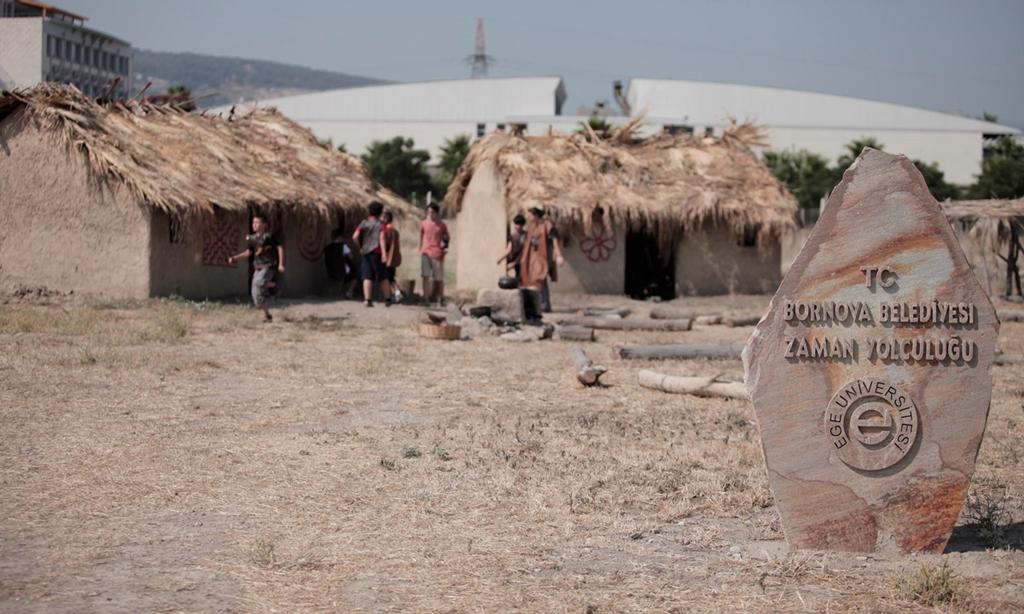
With population growth and increasing social organization during Phase IV.1, a major architectural transformation occurred: larger rectangular dwellings measuring 5x6 and 6x8 meters were built with stone foundations and walls constructed using the rammed earth (mühre) technique. These structures were erected in a dispersed arrangement rather than contiguous rows and were positioned radially around a shared courtyard. A baked clay house model recovered during excavations confirms that, unlike the flat-roofed buildings of inland Anatolia, these dwellings had pitched roofs supported by wooden posts, adapted to the rainy coastal climate.
While maintaining hunter-gatherer traditions, the Yeşilova community developed a productive economy based on settled agriculture and animal husbandry. The large number of stone and bone tools, weaving workshops, and pottery production areas identified at the site indicate organized craft activities beyond household-level production.
Especially in Layer IV.1c, the reuse of hundreds of worn grinding stones as building material in wall construction demonstrates both recycling of materials and the intensity of cereal processing. Furthermore, the large quantities of marine shell remains and fish net weights recovered during excavations document the significant role of marine resources in the diet and the active exploitation of coastal resources by the community.
Yeşilova Höyüğü was discovered in 2003 and entered the scholarly record as the oldest known settlement within the urban center of İzmir. Prior to this discovery, İzmir’s past was believed to extend no further back than 5,000 years; excavations at the mound have extended the city’s history to at least 8,500 years ago. The first scientific excavations began in 2005 in collaboration with the İzmir Archaeology Museum, and from 2008 onward, they were led by Assoc. Prof. Dr. Zafer Derin on behalf of the Republic of Türkiye Ministry of Culture and Tourism and Ege University.【2】
Current excavations are no longer limited to Yeşilova Höyüğü alone but have been expanded under the “Prehistoric Settlement Area of İzmir Project,” encompassing an area approximately 1,200 meters in diameter and including the Yassıtepe and İpeklikuyu mounds. Since 2005, this long-term project has included not only archaeological excavations but also geoarchaeological borehole studies aimed at understanding the paleogeography and environmental changes of the settlement. Additionally, interactive workshops and educational spaces have been established on-site to share scientific findings and artifacts with visitors, promoting the integration of archaeological knowledge into public life.
Derin, Zafer. "İzmir-Yeşilova Höyüğü ve Geç Neolitik Dönem'de Kıyı Ege Mimarisi." *Höyük*, no. 12 (2023): 23–38. Accessed December 30, 2025.https://hoyuk.gov.tr/ozet/90/tur
Ege Üniversitesi. "Yeşilova Höyük." yesilova.ege.edu.tr. Accessed December 30, 2025.https://yesilova.ege.edu.tr/
Karadaş, Aylin. "İzmir'in Bilinen İlk Yerleşmesi Yeşilova Höyüğü'nde Jeoarkeoloji ve Paleocoğrafya Araştırmaları." *Ege Coğrafya Dergisi* 23, no. 1 (2014): 43-55. Accessed December 30, 2025.https://dergipark.org.tr/tr/download/article-file/56734
Visit İzmir. "Yeşilova Höyüğü." İzmir Büyükşehir Belediyesi. Accessed December 30, 2025.https://www.visitizmir.org/tr/Destinasyon/8752.
İzmir İl Directorate of Culture and Tourism. "Yeşilova Höyüğü Kazı / Bornova-İzmir." T.C. Kültür veTurizm Bakanlığı. Accessed December 30, 2025.https://izmir.ktb.gov.tr/TR-77164/yesilova-hoyugu-kazi--bornova--izmir.html.
[1]
Zafer Derin, "İzmir-Yeşilova Höyüğü ve Geç Neolitik Dönem'de Kıyı Ege Mimarisi," Höyük, sy. 12 (2023): 27, Erişim tarihi: 30 Aralık 2025, https://hoyuk.gov.tr/ozet/90/tur.
[2]
Ege Üniversitesi, "Yeşilova Höyük," yesilova.ege.edu.tr, Erişim tarihi: 30 Aralık 2025, https://yesilova.ege.edu.tr/.

Location | Bornova Plain İzmir | ||||||||
|---|---|---|---|---|---|---|---|---|---|
Date | Neolithic Period (8,500 Years Ago) | ||||||||
Discovery | 2003 | ||||||||
Surface Area | ~70,000 m² | ||||||||
Layers | Roman, Bronze, Chalcolithic, Neolithic | ||||||||
Stratification
Layer I: Roman Period
Layer II: Early Bronze Age
Layer III: Chalcolithic Period
Layer IV: Neolithic Period
Paleogeography and Environmental Changes
Architectural Development and Settlement Organization
Economy, Technology, and Social Life
History of Excavations and Current Research