This article was automatically translated from the original Turkish version.
+1 More
Inventor | Görkem Şen | ||||||||
|---|---|---|---|---|---|---|---|---|---|
Invention Date | 2009 (Year development began) | ||||||||
Materials | Wooden body/neck, Two strings, Coiled springs, Membranes (drumheads) | ||||||||
Origin | Türkiye | ||||||||
Classification | Acoustic Instrument (Stringed and Percussion) | ||||||||
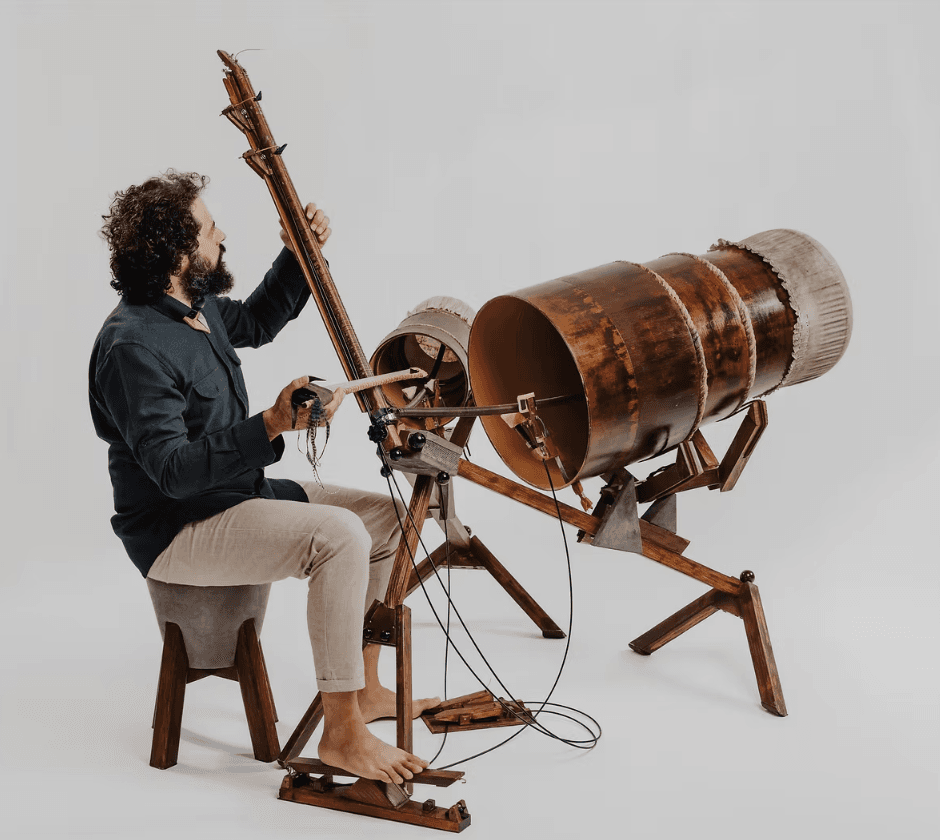
Yaybahar is a new musical instrument invented by Turkish musician and designer Görkem Şen, operating entirely on acoustic principles yet possessing a sound character reminiscent of electronic synthesizers. It is a patented instrument exhibiting melodic and polyphonic capabilities.
The instrument is distinguished by its ability to produce an ambient and resonant sound through natural physical vibrations, without any electrical connection or digital processor. In academic literature, it is examined as a hybrid design that captures an original timbre by utilizing the dispersive properties of strings in sound transmission.
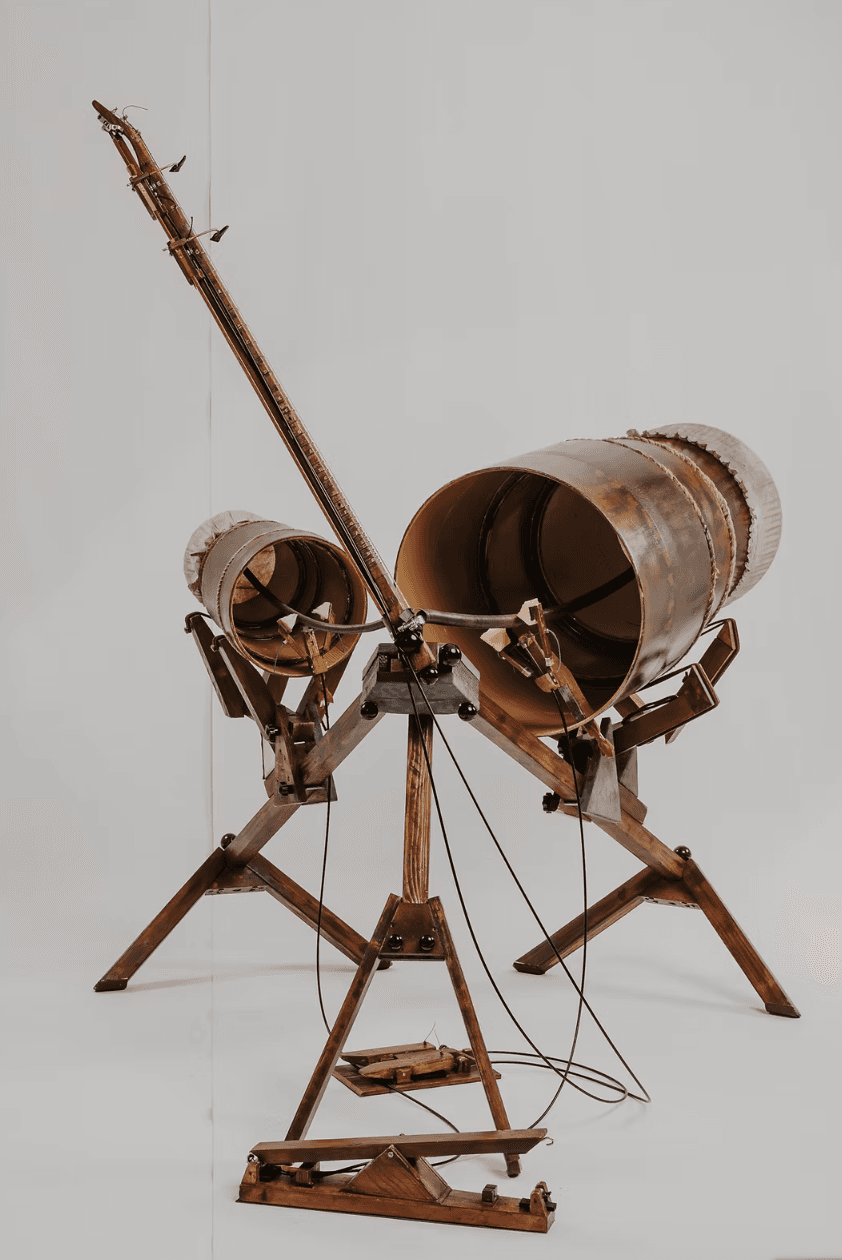
Yaybahar (GORKEM SEN)
The development of Yaybahar was initiated in 2009 by its inventor Görkem Şen. Şen set out to design a mechanism unlike any existing one ("from zero"), and since no reference or precursor model existed, he conducted numerous experiments and observations in a laboratory setting. The evolution of the instrument was shaped by research into how sound could be more efficiently processed acoustically, ultimately leading to its final form. Following its invention, the instrument attracted attention in international music and technology circles and has served as a case study for researchers working on physical modeling.
The key features distinguishing Yaybahar from other stringed instruments are its innovative bridge system, positioned between the strings and the body, and its string-membrane mechanism for sound amplification. The instrument’s working principle consists of the following stages:
Through this system, delay and reverb effects typically achieved with electronic effect pedals are produced entirely through natural and acoustic means.
Yaybahar by Görkem Şen (Yaybahar)
Yaybahar is a versatile instrument that can be played using both bowed and percussive techniques. The performer can press the strings on a keyboard with one hand while using a bow, and simultaneously strike the springs or membranes with a mallet in the other hand to create rhythmic and atmospheric layers. This diversity of techniques enables the instrument to generate both melodic and polyphonic textures simultaneously. Scientific analyses have identified that the highly dispersive character of the springs is responsible for the instrument’s characteristic synthetic timbre.【1】
Yaybahar by Görkem Şen (Yaybahar)
Yaybahar is recognized as one of the original inventions in the field of acoustic instrument design in the modern era. The instrument has been the subject of academic studies in the field of "Applied Physical Modeling" and has been analyzed as a complex acoustic model for sound synthesis algorithms.
Christensen, Pelle J., Willemsen, Silvin, and Stefaina Serafin. "Applied Physical Modeling for Sound Synthesis: the Yaybahar." In *2nd Nordic Sound and Music Conference: Multisensory Experience Lab, Aalborg University* (2016): 1–6. Accessed January 17, 2026.https://www.researchgate.net/profile/Silvin-Willemsen/publication/378033967_Applied_Physical_Modeling_for_Sound_Synthesis_The_Yaybahar/links/65c3b6b634bbff5ba7f53863/Applied-Physical-Modeling-for-Sound-Synthesis-The-Yaybahar.pdf
GORKEM SEN. "Yaybahar Hakkında." tr.gorkemsen.com. Accessed January 17, 2026.
Russo, Riccardo., Ducceschi, Michele., and Bilbao, Stefan. "Efficient simulation of the yaybahar using a modal approach." In *Proceedings of the 26th International Conference on Digital Audio Effects*. (2023): 1-8. Accessed January 17, 2026.https://cris.unibo.it/bitstream/11585/939822/1/DAFx2023-2.pdf
Yayahar. "Yaybahar Improvisation at Seaside." YouTube, 2:41. Accessed January 18, 2026.https://www.youtube.com/watch?v=j_LW-eUYt7Y
Yayahar. "Yaybahar by Gorkem Sen." YouTube, 6:59. Accessed January 17, 2026.https://www.youtube.com/watch?v=45m0TkLpmQg
[1]
Riccardo Russo, Michele Ducceschi, and Stefan Bilbao, "Efficient simulation of the yaybahar using a modal approach," in *Proceedings of the 26th International Conference on Digital Audio Effects* (2023): p. 1.

Inventor | Görkem Şen | ||||||||
|---|---|---|---|---|---|---|---|---|---|
Invention Date | 2009 (Year development began) | ||||||||
Materials | Wooden body/neck, Two strings, Coiled springs, Membranes (drumheads) | ||||||||
Origin | Türkiye | ||||||||
Classification | Acoustic Instrument (Stringed and Percussion) | ||||||||
History and Development
Structural Features
Performance and Technique
Place in the Literature