


This article was automatically translated from the original Turkish version.
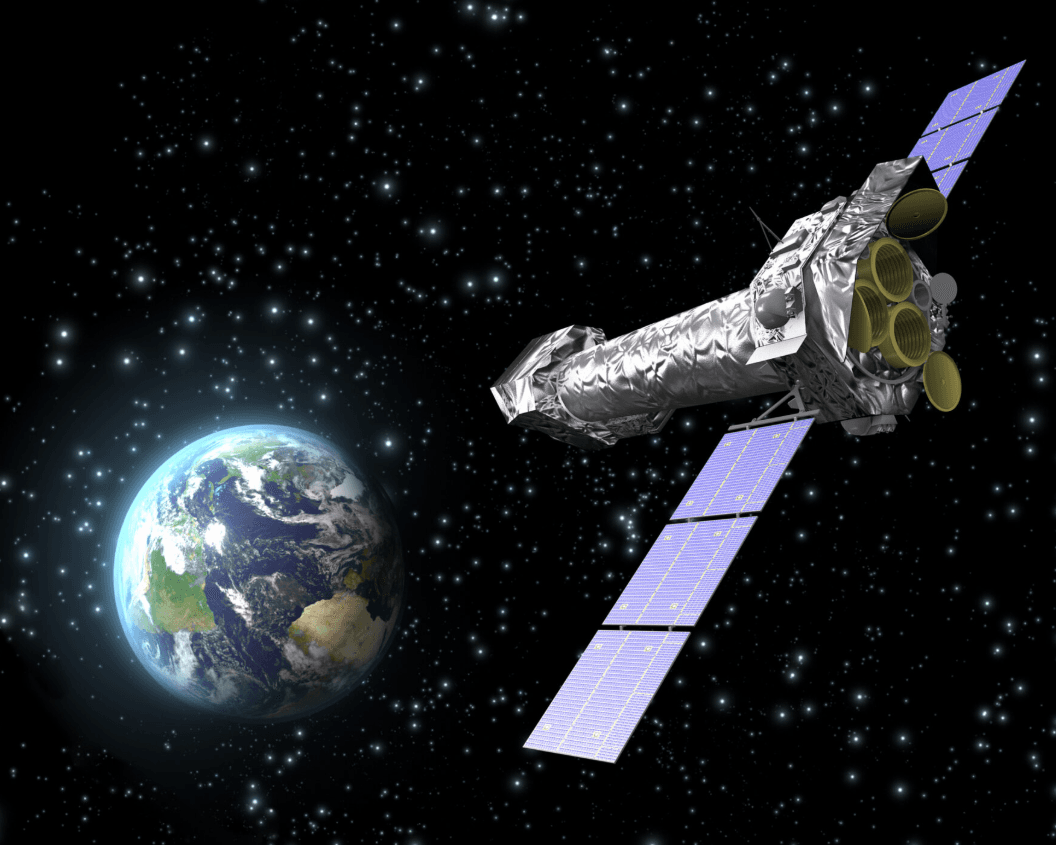
XMM-Newton Satellite
Launch Date | 10 Aralık 1999 | ||||||||
|---|---|---|---|---|---|---|---|---|---|
Launch Site | French Guiana, Kourou Spaceport | ||||||||
Operating Institution | European Space Agency (ESA) | ||||||||
Mission Type | X-ray astronomy / Space telescope | ||||||||
XMM-Newton (X-ray Multi-Mirror Mission – Newton) is a space telescope developed by the European Space Agency (ESA) designed to conduct high-precision X-ray observations. It was launched into space on 10 December 1999 aboard an Ariane 5 rocket from the Guiana Space Centre in French Guiana. The satellite is named after Sir Isaac Newton, one of the founders of gravitational theory. Its mission aimed to obtain high-resolution spectral data across a broad energy range and to carry out long-term, comprehensive observations of the most energetic and dynamic regions of the universe.
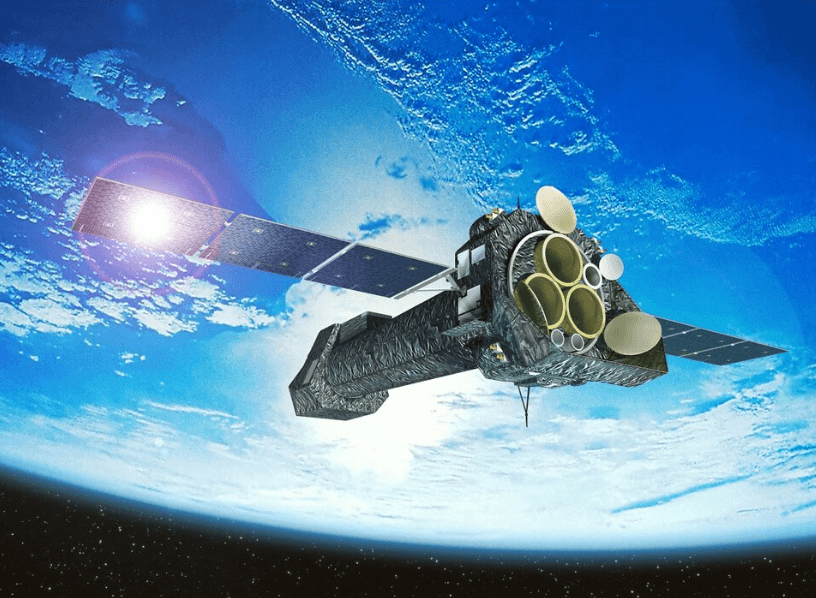
XMM-Newton Uydu Görseli (NASA)
The XMM-Newton satellite has a total mass of approximately 3.8 tonnes and was considered one of ESA’s largest scientific satellites at the time of its launch. With a length of about 10 metres and a diameter of approximately 4.0 metres, the satellite features an architecture specifically optimized for optical and X-ray observations.
The satellite’s primary observational systems are as follows:
XMM-Newton carries three X-ray telescopes, each composed of 58 nested mirrors designed to collect high-energy photons. Thanks to the technology employed, these telescopes generate X-ray data with both broad bandwidth and high resolution.
EPIC consists of CCD detectors positioned at the focal planes of the three X-ray telescopes. EPIC detects X-rays across different energy levels and is used to construct sky maps. The EPIC system includes three detectors, each with distinct detection capabilities: MOS1, MOS2, and pn-CCD. This system plays a critical role in determining the positions, brightnesses, and energy distributions of celestial objects.
Two RGS instruments are integrated into two of the telescopes and disperse X-ray photons by wavelength to achieve high spectral resolution. This capability is essential for analyzing the chemical composition and physical state of hot plasmas.
The OM enables observations of X-ray sources in the ultraviolet and visible light bands. This system, comprising a telescope with a diameter of approximately 30 cm, allows simultaneous data acquisition in the optical band alongside X-ray observations. This integration enables more comprehensive analyses by combining data from different regions of the electromagnetic spectrum.
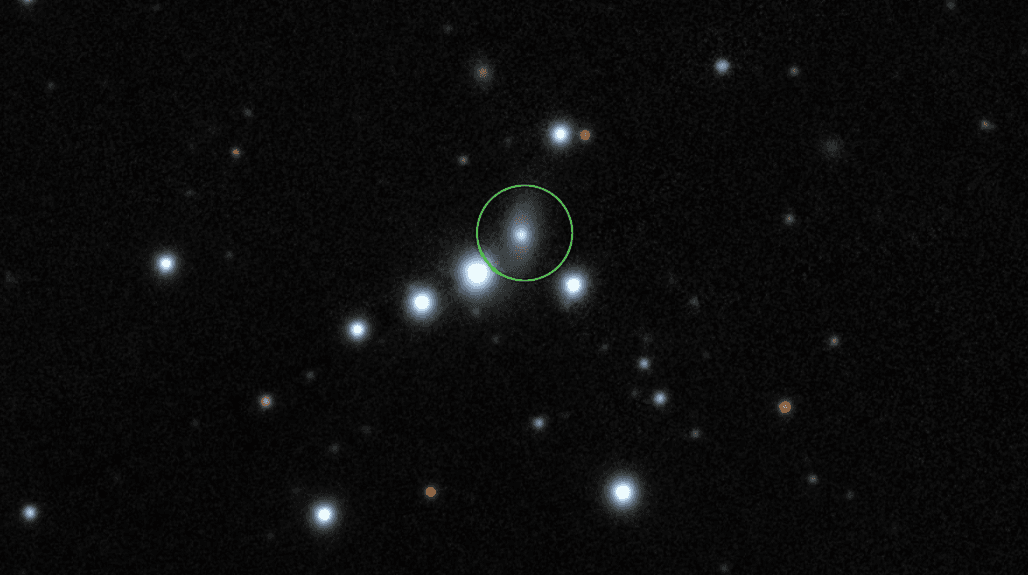
The active galaxy enclosed in a circle, 1ES 1927+654, has exhibited extraordinary changes since 2018 when it underwent a dramatic flare in visible ultraviolet and X-ray light. The galaxy hosts a central black hole with a mass of approximately 1.4 million solar masses and is located 270 million light years away. (NASA)
XMM-Newton is placed in a 48-hour highly elliptical orbit. This orbital configuration allows the satellite to conduct prolonged uninterrupted observations far from Earth’s magnetosphere and radiation belts. The high altitude reduces background radiation and enhances signal clarity.
Since its launch, XMM-Newton has produced highly valuable scientific data for the astrophysics community. These data have enabled significant discoveries in areas such as:
Additionally, XMM-Newton observed a previously unknown type of neutron star that emits continuous and regular X-ray bursts. This discovery has contributed to the development of theories regarding the internal structure of cosmic objects.
XMM-Newton Introduction (YouTube / NASA Video)
XMM-Newton data are openly available to researchers supported not only by ESA but also by NASA and other international institutions. Mission data are made accessible to scientists through public archives such as HEASARC (High Energy Astrophysics Science Archive Research Center). As a result, the project has formed the foundation of a broad, interdisciplinary research network.
Bilim Genç. "XMM-Newton Uydusu Kozmik Devin Kalp Atışlarını Yakaladı." TÜBİTAK Bilim Genç. Accessed May 19, 2025.Accessed Adresi.
European Space Agency (ESA). 2020. “XMM-Newton Factsheet.” European Space Agency. Accessed May 19, 2025.Accessed Adresi.
NASA VİDEO. "Reflections on 20 Years of XMM-Newton's X-ray Astronomy." YouTube. Date Published: September 17, 2019. Accessed May 19, 2025.Accessed Adresi.
NASA. 2021. “XMM-Newton Guest Observer Facility.” NASA Goddard Space Flight Center. Accessed May 19, 2025.Accessed Adresi.

XMM-Newton Satellite
Launch Date | 10 Aralık 1999 | ||||||||
|---|---|---|---|---|---|---|---|---|---|
Launch Site | French Guiana, Kourou Spaceport | ||||||||
Operating Institution | European Space Agency (ESA) | ||||||||
Mission Type | X-ray astronomy / Space telescope | ||||||||
No Discussion Added Yet
Start discussion for "XMM-Newton Satellite" article
Design Features and Technical Components
X-ray Telescopes
EPIC (European Photon Imaging Camera)
RGS (Reflection Grating Spectrometer)
OM (Optical Monitor)
Orbit and Observing Conditions
Scientific Achievements and Contributions
International Collaboration and Access