


This article was automatically translated from the original Turkish version.

One morning you pick up your phone and see a single-word message on the screen: "WHERE ARE YOU?"
Is this a harmless question born of casual curiosity about your whereabouts, or a noisy demand fueled by impatience and irritation? Suddenly a defensive mechanism activates within you. You think, Why is he shouting now? You imagine the other person glancing at the clock in anger, seething inwardly at you. Yet the person on the other side may simply have been wondering where you were for a friendly meeting and accidentally left the famous key on while typing hastily: Caps Lock. How is it that lifeless pixels on a screen can transform in our minds into such a loud angry and threatening voice?

(Yapay zeka ile oluşturulmuştur)
Written communication, by its nature, lacks the tone inflection and body language of the human voice. In face-to-face interaction we discern whether a sentence is a joke a threat or plain information from the rise and fall of the speaker’s tone. In the digital world we have had to create our own emotional interpreters to fill this gap. Uppercase letters are the noisiest elements in the typographic world. They occupy more space on the page appear bolder and directly draw the eye. This visual dominance triggers an immediate alarm response in the brain. A text flowing in normal lowercase letters is like a calm river gliding effortlessly over the eye. But when we encounter a block of text entirely in uppercase the flow is abruptly interrupted. Our brain interprets this sudden visual change as equivalent to a sudden loud sound in nature and alerts us.
In fact the mechanical typewriter ancestor of the Caps Lock key the Shift Lock was invented for purely practical reasons: to highlight headings and emphasize important words. In the early days of the internet the same logic applied. In that primitive era when bold or italic options were unavailable those wishing to emphasize something turned to uppercase letters. But human psychology quickly fills voids. Over time continuous use of uppercase letters ceased to be a tool of emphasis and became instead an attempt to overwhelm silence and dominate the other person. In the age of social media this has become fully institutionalized. Today Caps Lock is the digital world’s official standard for shouting.
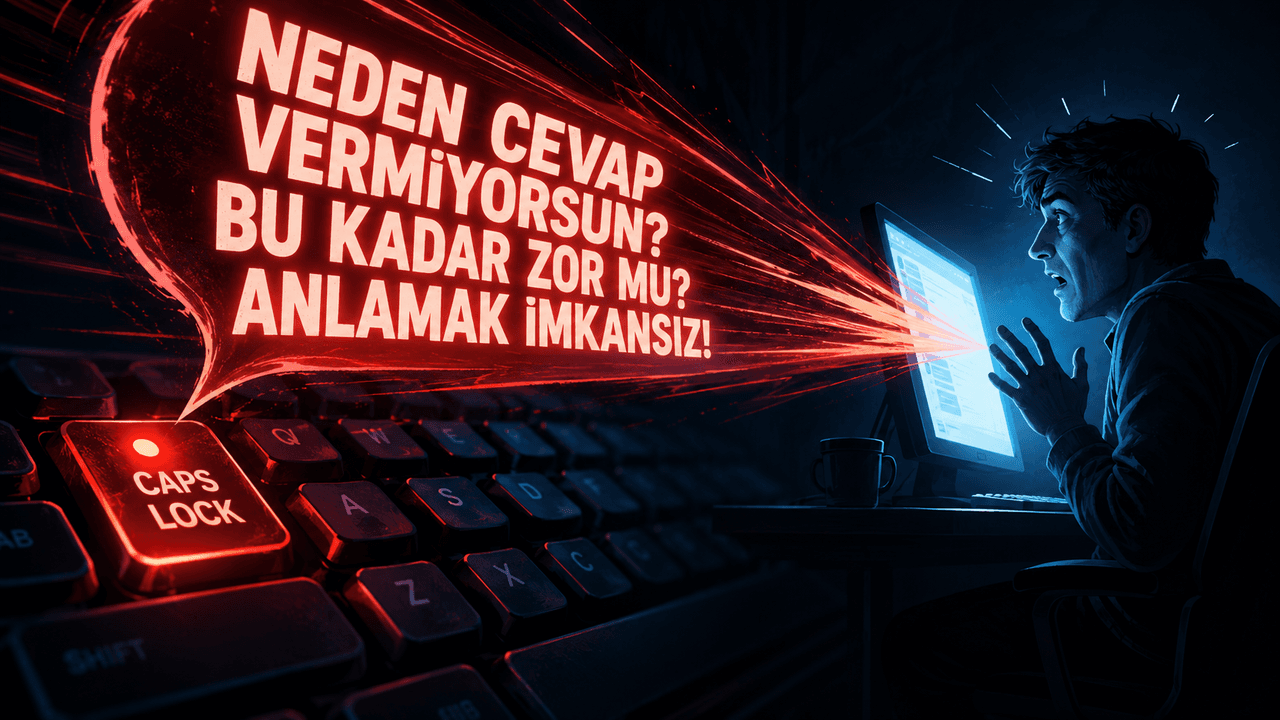
(Yapay zeka ile oluşturulmuştur)
Caps Lock is not merely a typing preference but also a modern instrument of social anger. The safe distance provided by the keyboard drives people to “shout” things they would never say face to face. Without seeing the other person’s facial expression we cannot gauge the impact of our words. Pressing the Caps Lock key to vent anger is far easier than grabbing a megaphone and yelling into a crowd. Moreover the person writing in uppercase equates the size of their argument and its truthfulness with the size of the letters. The illusion that “the bigger I write the more right I am” is the greatest dead end in digital debates.
Today using all uppercase letters in emails or messaging apps is equivalent to walking into a business meeting holding a megaphone and shouting at everyone’s face. It triggers an immediate defensive reaction and blocks healthy communication. The next time your hand moves toward that small seemingly innocent Caps Lock key remember this: Your correctness or the tone of your voice is not determined by the size of the letters but by the depth of your words. In the digital world we need to choose the right words not to shout to be heard.