


This article was automatically translated from the original Turkish version.
Berberidaceae family Berberis genus member Berberis vulgaris L. is one of the important shrub species native to Türkiye’s flora. Known locally as “Kadın Tuzluğu”, this species is widely used as an ornamental plant in landscape settings and is also valued in traditional medicine. Among the four Berberis species native to Türkiye, B. vulgaris stands out due to its woody structure, aesthetically appealing leaves, and fruits.
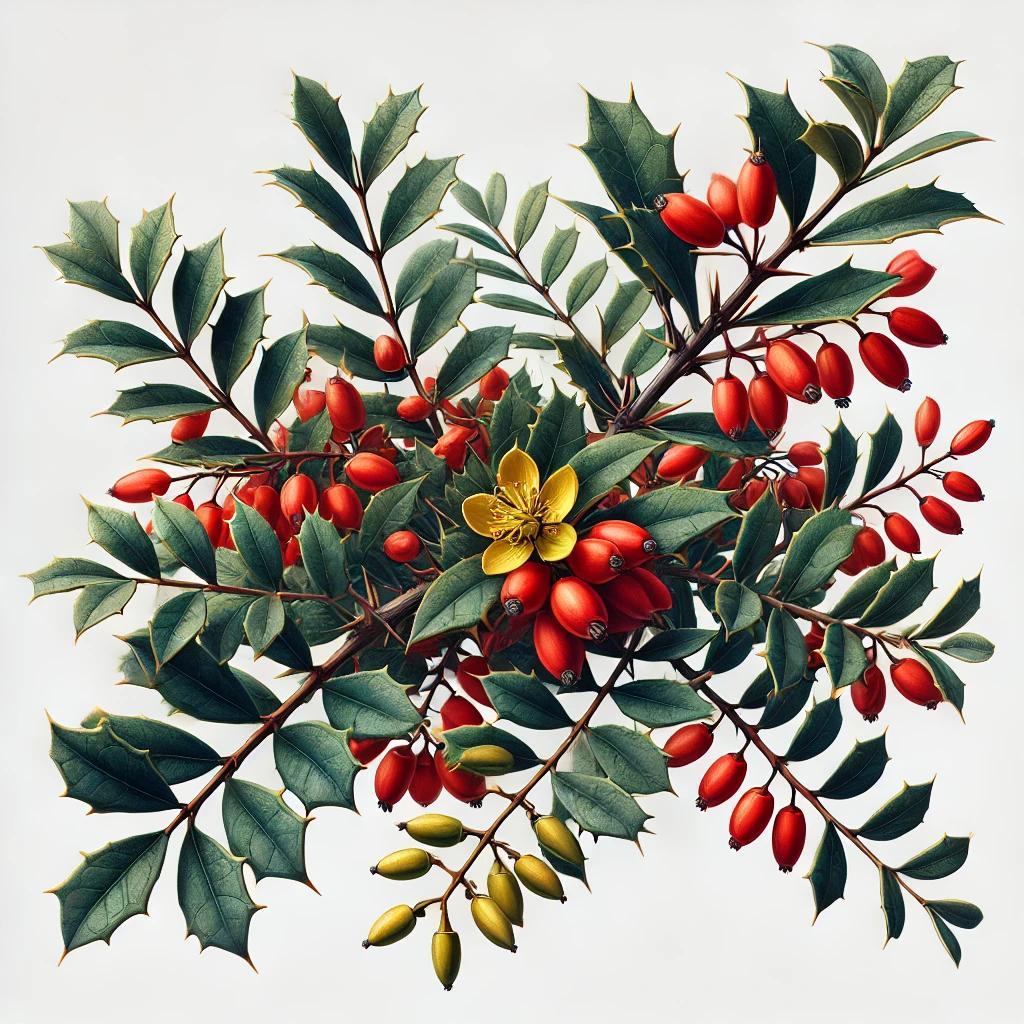
Kadın Tuzluğu Plant (Generated by artificial intelligence.)
Berberis vulgaris is a deciduous, thorny shrub that can grow up to 1.5 to 2 meters tall. Young stems have a yellowish bark that turns gray with age. Thorns are typically arranged in groups of three and measure 1–2 cm in length. Leaves are oval or inversely oval in shape, elliptical, 3–8 cm long, with finely toothed margins and no stomata on the upper surface. These leaves exhibit rich color variation and can appear in green, red-green, yellow, and dark red tones. Flowers are yellow and arranged in racemes of 15–25 blooms. When ripe, the fruits turn a bright red color; these grape-like structures, 8–12 mm long, are both ornamental and functional.
Although Kadın Tuzluğu prefers sunny environments, it can also adapt to partial shade and shaded conditions. It is known for its tolerance to cold climates. This species has low soil preferences and can thrive even in dry and stony areas. Due to these traits, it is considered among low-maintenance plant species for landscape design.
Berberis vulgaris is frequently selected for roadside plantings, parks, and gardens due to the attractiveness of its fruits and the diversity of its leaf colors. Cultivars include ‘alba’ with white fruits, ‘lutea’ with yellow fruits, ‘dulcis’ with sweet fruits, ‘atropurpurea’ with red leaves, ‘aureomarginata’ with yellow-edged leaves, and ‘marginata’ with white-edged leaves. Red-leaved forms are especially common in the landscape design of major cities such as Istanbul.
Propagation of Berberis vulgaris can be achieved through green cuttings taken in spring or semi-hardwood cuttings taken at the end of summer. It responds well to pruning and shaping. Fertilization based on soil analysis supports healthy growth. Irrigation needs should be determined according to climate and soil conditions, avoiding overwatering.
Kadın Tuzluğu may be susceptible to black spot disease and certain pests. Soft-bodied insects and red spider mites are common pests affecting this species. Therefore, regular monitoring and, when necessary, biological or chemical control measures are important for maintaining plant health.
Berberis vulgaris L. holds an important position both as a native flora component and in cultural landscape applications. This species attracts attention due to its aesthetic appearance, low maintenance requirements, woody anatomical features, and potential for use in traditional medicine. Its ability to adapt to diverse environmental conditions further enhances its value. Future research into its genetic variation and ecological adaptations is essential for ensuring its sustainable use.
Arslan, Mustafa. "Türkiye Doğal Türlerinden Berberis vulgaris L. (Adi Kadın Tuzluğu) Odununun Anatomik Yapısı." Uluslararası Anadolu Ziraat Mühendisliği Bilimleri Dergisi 3, no. 3 (2021): 73–77.
Atatürk Orman Çiftliği Müdürlüğü. "Kadın Tuzluğu." Accessed March 23, 2025.https://www.aoc.gov.tr/Portal/BitkiselUretimler/kadin-tuzlugu/63

Morphological Characteristics
Ecological Requirements
Uses and Cultivars
Cultivation and Propagation
Pests and Diseases