+2 More

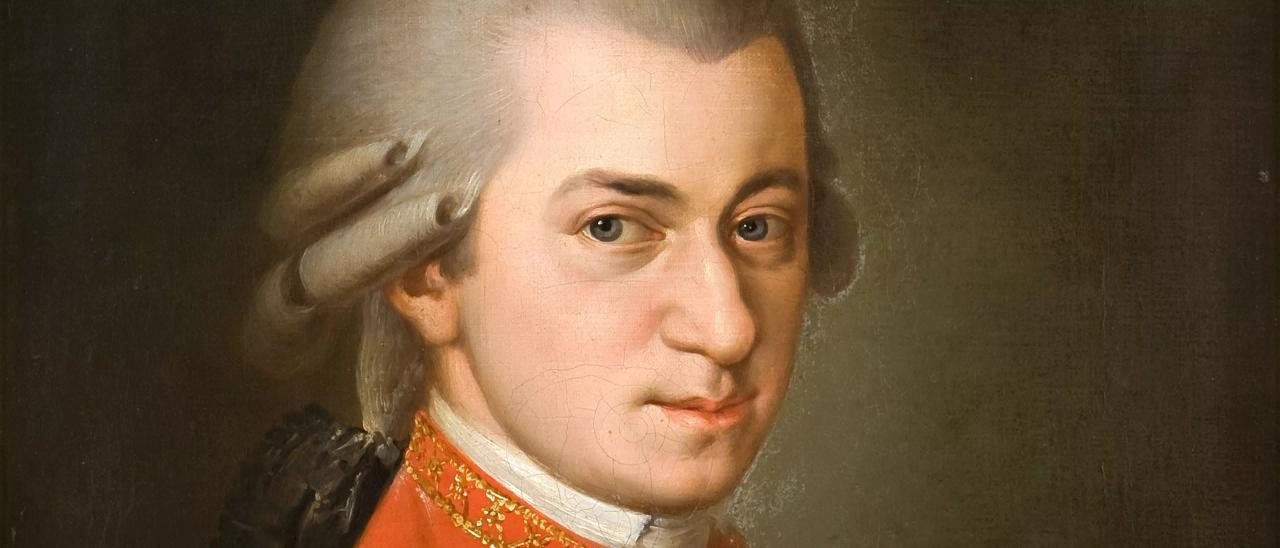
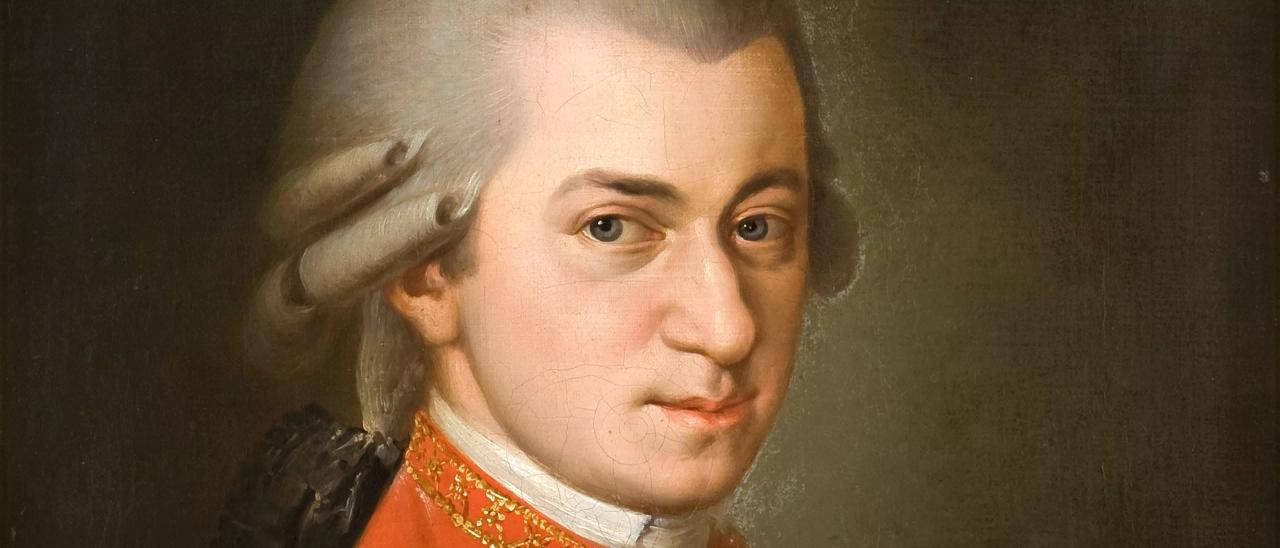
Wolfgang Amadeus Mozart
Spouse | Constanze Weber | ||||||||
|---|---|---|---|---|---|---|---|---|---|
Date of birth | 1756-01-27 | ||||||||
Date of death | 1791-12-05 | ||||||||
Period | 18th century – Classical Music Period | ||||||||
Profession | Composer – Pianist | ||||||||
Child | Raimund Leopold Mozart Franz Xaver Wolfgang Mozart Anna Maria Mozart Friedericke Maria Anna Mozart Johann Thomas Leopold Mozart Karl Thomas Mozart | ||||||||
Wolfgang Amadeus Mozart, whose full name was Johannes Chrysostomus Wolfgangus Theophilus Mozart, was born on 27 January 1756 in the city of Salzburg, part of the Archduchy of Austria. At the time, Salzburg held the status of an independent prince-archbishopric within the Holy Roman Empire.
Mozart’s father, Leopold Mozart (1719–1787), was a musician from the German city of Augsburg. He served in the court orchestra of Salzburg and was renowned for his expertise in music education. His work “Violinschule” (1756) is a foundational treatise on violininstruction. As a composer, violinist, and music theorist, Leopold Mozart took an active role in his son’s musical education.
Mozart’s mother, Anna Maria Pertl (1720–1778), was the daughter of a Salzburg family. Wolfgang Amadeus Mozart was the second of seven children to survive infancy. Their first child, Maria Anna Walburga Ignatia Mozart(1751–1829), known within the family as “Nannerl,” played theharpsichord. The Mozart family belonged to a musical bourgeois household adhering to Catholic traditions. The house in which they lived is now open to the public as a museum in Salzburg under the name “Mozart’s Birthplace” (Mozarts Geburtshaus).
Mozart’s interest and talent in music became evident at the age of three. His father Leopold was then teaching his daughter Maria Anna (“Nannerl”) to play the harpsichord. Wolfgang observed his sister’s lessons and began composing his own melodies on the instrument. In 1761, at the age of five, Mozart started composing short musical pieces and performed small stage plays and dances. In 1762, at age six, he gave his first public concert in Munich.
To further develop his son’s talent, Leopold Mozart organized European tours beginning in 1762, which included Wolfgang and Maria Anna. These tours covered major musical centers such as Munich, Vienna, Paris, London, The Hague, Mannheim, and Zurich. During these travels, Wolfgang performed for aristocratic audiences, was received at royal courts, and met leading musicians of the era.
The concert tour lasting from 1763 to 1766 profoundly influenced Mozart’s observational and learning abilities in music. In London, he performed before the British Royal Family and met Johann Christian Bach (son of Johann Sebastian Bach), from whom he absorbed significant musical influences. He began composing his first symphonies during this period. Mozart also engaged in academic studies alongside music, including language, history, and mathematics. His father Leopold personally supervised these studies to support his son’s development. It is documented that Mozart could speak French, Italian, and Latin in addition to German.
While in London between 1764 and 1765, Mozart composed his first large-scale symphony, known as Symphony No. 1 in E-flat major, K. 16. This work is recorded as his first complete symphony, written at the age of eight. The minuets, sonatas, and variations he composed during this period demonstrate his early mastery of structural coherence in music.
1762 – Munich and Vienna: Mozart embarked on a European tour with his father Leopold and sister Maria Anna. In Munich, he performed before Maximilian III Joseph, Elector of Bavaria. Later that year, he gave a performance at the Austrian Imperial Court in Vienna and was received by Empress Maria Theresa. During this period, he composed several dance pieces and small harpsichord works.
1763–1766 – Western European Tour: Beginning in Salzburg, the Mozart family undertook an extensive tour through Germany, France, Belgium, the Netherlands, England, and Switzerland. Cities visited included Augsburg, Mannheim, Paris, London, The Hague, Brussels, Lyon, Geneva, and Zurich.
1763–1764 – Paris: Mozart performed harpsichord works for the French aristocracy. During this period, his Sonatas for Harpsichord (K. 6–9) were published.
1764–1765 – London: Mozart performed at the Royal Court before King George III and Queen Charlotte. He met Johann Christian Bach and composed his Symphony No. 1 in B-flat major, K. 16, in London.
1765–1766 – Netherlands and The Hague: Despite falling ill in the Netherlands, Mozart continued composing. He wrote various sacred works and symphonies, including Symphony No. 5 in B-flat major, K. 22. In The Hague, he composed special pieces for the birthday of the Dutch Prince.
1766–1769 – Salzburg: In Salzburg, Mozart composed instrumental works and music for German and Latin school plays. In 1768, he composed the Singspiel “Bastien und Bastienne” in Vienna. The same year, he completed the opera buffa “La finta semplice,” which was not staged.
1769–1773 – Italian Travels and Returns to Salzburg: In 1769, Mozart traveled to Italy. He received an opera commission in Milan. In Rome, he was awarded an honorary knighthood by the Pope. He was admitted to the Accademia Filarmonica in Bologna. During this period, he composed operas seria such as “Mitridate” (1770), “Ascanio in Alba” (1771), and “Lucio Silla” (1772). He also wrote his first string quartets. In late 1771, he continued composing symphonies numbered 14 through 21 in Salzburg.
1778–1779 – Paris: Mozart remained in Paris from March 1778 to January 1779. During this time, his mother passed away. He did not secure any opera commissions but composed the Sinfonia Concertante for wind instruments, a concerto for flute and harp, several chamber works, and the ballet music “Les Petits Riens.” He also gave private lessons.
1781–1791 – Vienna: Mozart settled in Vienna in 1781 and remained there until his death. During this period, he composed a large number of works across various genres.
Wolfgang Amadeus Mozart is regarded as one of the leading representatives of the Classical Periodin European music during the second half of the 18th century. His musical output reflects the stylistic characteristics of the era while expanding its boundaries. The Classical Period is generally defined as spanning approximately 1750 to 1820 in Western music history. Its key features include balance, clarity, symmetry, formal structure, simplicity, and natural expression.
Structural Usage: Structural forms are central to Mozart’s music. He employed sonata form, rondo, theme and variations, and fugue. In his works, he developed thematic material while maintaining formal coherence. Melody,
Harmony and Rhythm: Mozart maintained melodies that were fluid, balanced, and memorable. His harmonic structures adhered to the conventions of the Classical period, yet in some works he employed modulations, unexpected cadences, and surprising transitions to expand harmonic possibilities.
Development of the Concerto Form: Mozart played a pivotal role in the development of the piano concertoform. Among his 27pianoconcertos, many have become cornerstones of the concerto repertoire.
Contributions to Opera: Mozart made significant contributions to the art of opera. He composed works in the opera seria, opera buffa, and Singspiel genres. His operas advanced the evolution of opera in the Classical period through character development, dramatic structure, and orchestral richness. His skill in creating multi-voiced ensembles and dramatic contrasts became defining features of his operatic works.
Transition from Baroque to Classical: Some of Mozart’s works, particularly those containing fugues and contrapuntal passages, reflect Baroque influences. He studied the compositions of J.S. Bach and Handel, incorporating elements of their tradition to enrich Classical forms. In his later works, such as the Requiem and the Jupiter Symphony, characteristics of both periods are clearly evident.
Mozart - Turkish March (Patricio Inostroza Cornejo)
Wolfgang Amadeus Mozart was a prolific composer of opera during the second half of the 18th century. His output in stage works contributed significantly to the operatic style of the era through its musical structure, dramatic construction, and character development. Throughout his life, Mozart composed both serious and comic operas, as well as works in the Singspiel (sung dialogue) genre.
Dramatic Structure: Scene transitions maintain musical continuity and narrative cohesion.
Orchestration: The orchestra is not merely an accompaniment but an active dramatic element.
Ensemble Sections: Duets, trios, quartets, and other ensemble passages are used to advance dramatic development.
Opera Seria (Serious Opera): Typically based on historical or mythological subjects, it features themes of royalty, heroism, and virtue. Mozart adhered to the conventions of this genre but grounded his characters in human and dramatic realism.
Opera Buffa (Comic Opera): Centered on everyday life, social class differences, and satirical commentary. Mozart combined humorous elements with sophisticated musical techniques in this genre.
Singspiel (Sung Play): A German-language operatic form alternating spoken dialogue with musical numbers.
Idomeneo, K. 366 (1781): Mozart’s first major opera seria. Drawing on ancient mythology, it reflects the operatic conventions of its time in both musical and staging terms.
Le nozze di Figaro (The Marriage of Figaro), K. 492 (1786): An example of opera buffa. The libretto by Lorenzo Da Ponte centers on class conflict, individual rights, and love. It draws attention for its political subtext and melodic richness.
Don Giovanni, K. 527 (1787): A synthesis of opera buffa and opera seria elements, with strong dramatic weight. Its treatment of the Don Juan myth and musical narrative holds a significant place in classical music history.
Così fan tutte, K. 588 (1790): The final installment of the Da Ponte trilogy. It explores relationships, fidelity, and identity games. Despite its subject matter, it exemplifies Mozart’s mastery of counterpoint and multi-voiced structures.
Die Zauberflöte (The Magic Flute), K. 620 (1791): Premiered shortly before Mozart’s death. Written in the Singspiel form, its plot is shaped by symbolic, allegorical, and Masonic elements. Though presented in a folk-tale format, it carries profound philosophical content.
La finta giardiniera, K. 196 (1775): Composed in the opera buffa style, it revolves around romantic entanglements and identity confusion. It is among Mozart’s early stage works.
La clemenza di Tito, K. 621 (1791): Mozart’s final opera seria. It centers on the clemency of the Roman Emperor Titus. Though composed rapidly, it reflects a masterful application of Classical forms.
The Eastern influences found in some of Wolfgang Amadeus Mozart’s works are linked to the widespread 18th-century European musical trend known as “Alla Turca” (in the Turkish style). This movement emerged during a period when Ottoman cultural influences were reflected across Europe, particularly in Austria, Germany, and France, where it affected music, fashion, and theatrical arts.
“Alla Turca” means “in the Turkish style” in Italian. The term was used in Europe to describe a stylized interpretation of Ottoman Mehter music. Mehter musicwas the military band music of the Ottoman army (Mehterhâne), noted by Westerners for its rhythmic structure, use of percussion instruments, and high volume. Particularly thecymbal,bass drum, large pipes, andzurna-like instrumentswere regarded as “exotic” in European musical circles.
During the 17th and 18th centuries, relations between the Ottoman Empire and European states included both warfare and intense diplomatic contact. Interest in the Ottomans intensified after the Second Siege of Vienna in 1683, triggering a cultural wave known as “Turquerie.” This fascination extended beyond music: Ottoman clothing, coffee, tulips, ceramic patterns, and harem themes appeared in painting, theater, decorative arts, and architecture. Ottoman envoys’ visits to European courts featured Mehter performances, which contributed to the spread of “Turkish style” music in Europe.
The musical practices of the European “Alla Turca” movement generally drew on the rhythmic and sonic structure of Mehter music. These characteristics include: strong use of percussion instruments (cymbals, bass drum); prominent use of binary or ternary rhythmic patterns; syncopations and accented beats; a martial march-like melody created through arpeggios and repeated notes; ornamental melodic structures; and distinctive dynamic intensity.
Mozart did not treat this style as superficial decoration but as an integral part of musical expression. In works influenced by “Alla Turca,” he integrated Mehter music elements into Western orchestral forms through melodic structure, rhythmic organization, and dynamic contrast. The Mehter style was not unique to Mozart; it also appeared in the works of other composers of the period, including Beethoven,Haydn, andGluck.
This music influenced the development of Western military bands, especially expanding the use of percussion instruments. “Alla Turca” pieces were also used in theatrical works featuring Ottoman figures and Eastern themes. In this sense, it functioned as a form of cultural communication across periods.
In the final quarter of the 18th century, Wolfgang Amadeus Mozart composed several stage and instrumental works influenced by Ottoman-Turkish culture. These works are connected to the rising European trend known as “Turquerie.” Mozart treated this theme as both exotic and dramatic, integrating Turkish characters or Ottoman palace settings into diverse musical structures.
Piano Sonata No. 11 in A major, K. 331 – Rondo Alla Turca (“Turkish March”): The third movement of this work, the “Rondo Alla Turca,” is one of Mozart’s most famous and frequently performed pieces. This section features a march rhythm reminiscent of Mehter music, emphatic accompaniments, recurring motifs, and percussive textures. The title “Alla Turca” emphasizes the Turkish musical influence. The “Turkish character” is created on thepianowithout actual percussion instruments.
Violin Concerto No. 5 in A major, K. 219 – “Turkish Concerto”: Composed in 1775, this concerto exhibits “Turkish music” influences, particularly in its final movement. Rapid, sharp rhythmic transitions, percussive-like accompaniments, and asymmetrical melodic lines evoke the atmosphere of aTurkish march. For this reason, the work is popularly known as the “Turkish Concerto.”
Die Entführung aus dem Serail (The Abduction from the Seraglio), K. 384: Completed in 1782, this Singspiel (sung dialogue opera) centers on an escape story set in an Ottoman palace. Characters include Pasha Selim, Konstanze, Belmonte, and Osmin. Mozart employed orchestration techniques resembling Mehter music, notably the prominent use of percussion instruments (cymbals, bass drum, triangle), to evoke a “Turkish musical” atmosphere. The musical language combines dramatic expression with folk-like melodies. The opera reflects the contemporary European image of the Ottoman Empire through the figure of the “merciful pasha.”
Zaide, K. 344 – Unfinished Turkish-Themed Opera: Zaide tells a love and escape story set during the reign of Sultan Suleiman. The libretto is in German and follows the Singspiel form with spoken dialogue. Although unfinished, the work contains themes of the Ottoman palace, harem, and slavery. Some arias feature rhythmic structures reminiscent of Mehter tempos.
Le gelosie del seraglio (The Jealousies of the Seraglio), KV Anh. 109/135a (1772): This ballet is based on a theatrical scenario of intrigue and jealousy set in an Ottoman palace. Its eighth dance stands out for its rhythmic structure evoking Janissary music. As a whole, it exemplifies European stage representations of the “Turkish palace.”
In these works, Mozart juxtaposed Eastern and Western characters to create dramatic contrasts. In most of them, Turkish figures or Turkish musical elements were used not as political commentary but as subjects of artistic and cultural fascination.
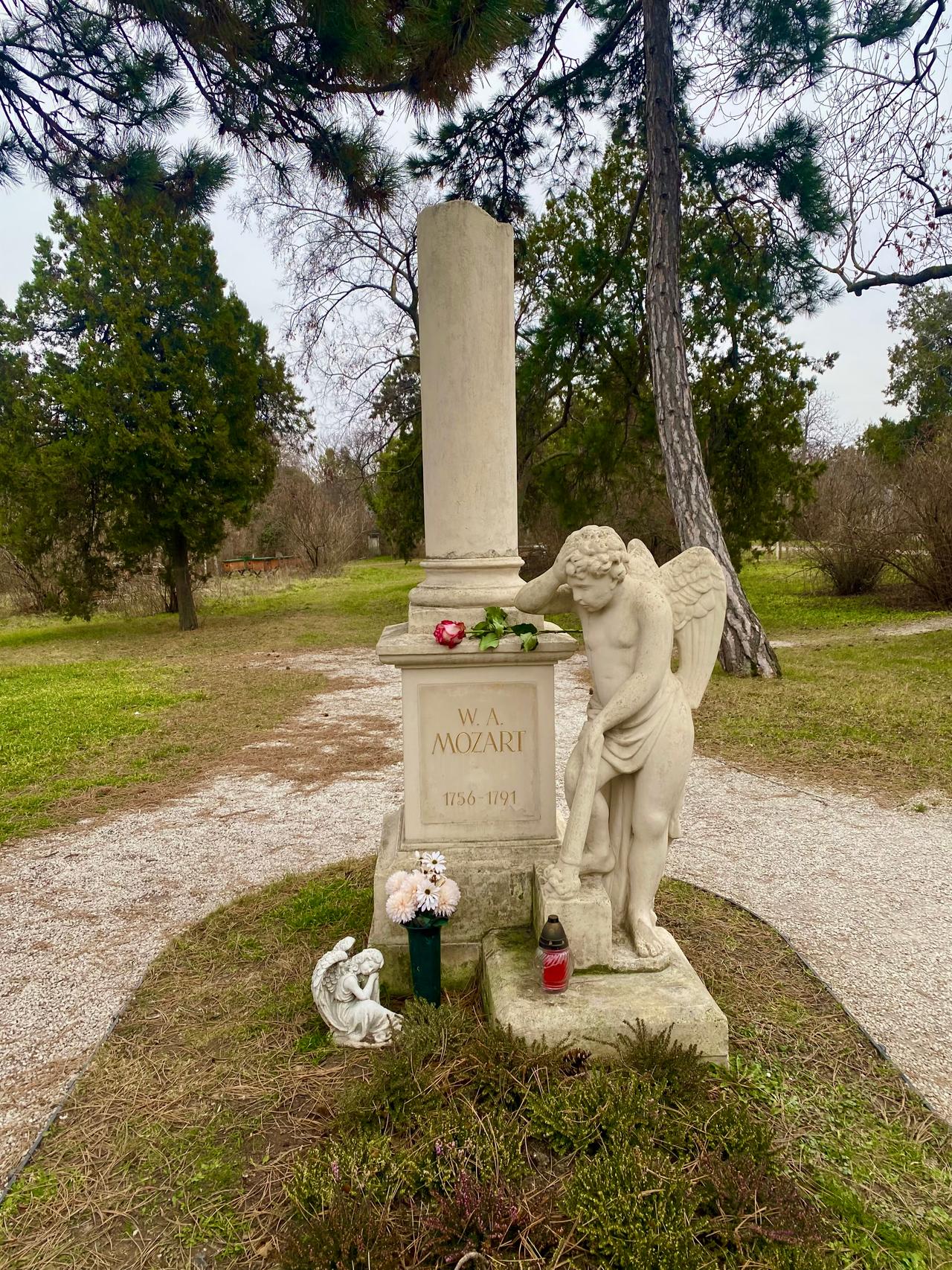
Mozart's Grave (Y. B. Keskin)
Wolfgang Amadeus Mozart spent his final decade (1781–1791) in Vienna, the capital of Austria. This period saw both high productivity and financial hardship. He faced economic difficulties and struggled to secure steady commissions to support himself.
Vienna Years (1781–1791): In 1781, Mozart left his position at the Salzburg court and settled in Vienna as a freelance composer. During this time, he composed numerous symphonies, piano concertos, operas, and chamber works. He organized public concerts and taught students. In 1782, he premiered the opera “The Abduction from the Seraglio.” In 1786, he wrote “The Marriage of Figaro”; in 1787, “Don Giovanni”; and in 1790, “Così fan tutte.” He also produced symphonic masterpieces such as the “Piano Concerto No. 23” (K. 488), “Symphony No. 40” (K. 550), and the “Jupiter Symphony” (K. 551). During these years, Mozart became a member of a Masonic lodge and incorporated Masonic symbols and values into some of his works. His opera “The Magic Flute” (Die Zauberflöte), composed in 1791, is viewed within this context.
Final Work: Requiem (KV 626): Mozart’s final work, composed in the last months of his life, was the “Requiem” (KV 626), a mass for the dead. It was commissioned anonymously by a messenger (later identified as Count Franz von Walsegg). Mozart did not complete the work before his death. The remaining sections were finished by his student Franz Xaver Süssmayr.
Mozart died on 5 December 1791 at the age of 35 in his home in Vienna. Contemporary records list the cause of death as “acute miliary fever,” but modern researchers have proposed various medical causes, including chronic kidney failure, rheumatic fever, and infectious diseases. Some claims suggest he was poisoned, though these lack scientific evidence.
In accordance with the common practice of the time, Mozart was buried in a “third-class” funeral at the St. Marx Cemetery (Sankt Marxer Friedhof). Such burials did not include individual grave markers; therefore, the exact location of Mozart’s grave remains unknown today. However, a memorial stone was later erected in his honor at the cemetery, and another monumental tomb was constructed at the Vienna Central Cemetery (Zentralfriedhof).
Mozart’s death made a profound impact on the European musical world of the 18th century. Despite his young age, his over 600 compositions established his enduring place in music history. Although he endured financial hardship in his final years, his artistic output remained intense.
Numerous academic publications, articles, and analytical studies have been devoted to Mozart. These works provide data not only on his musical content but also on the social, political, and cultural structures of his era. His life and works have also served as subjects for many literary works, theatrical plays, and films. One well-known example is the 1984 film “Amadeus”.
Mozart’s compositions are now foundational texts in music education at nearly every level. In particular: Piano sonatas and concertos serve as essential resources for technical development and expressive skill.
Chamber music works are used as models to cultivate ensemble discipline and cohesion. His symphonies and operas are primary sources in musicology education for the study of analysis, form, orchestration, and dramatic structure.
Many physical sites associated with Mozart now serve as museums: his birthplace in Salzburg (Mozarts Geburtshaus) and his residence in Vienna (Mozarthaus Vienna). These venues are equipped with musical documents, manuscripts, personal belongings, and period instruments. Visitors each year explore these museums to gain direct historical insights into Mozart’s life.
Mozart’s name has been given to numerous music institutions, orchestras, competitions, and festivals around the world: The Salzburg Mozarteum University and the International Mozart Foundation conduct educational and archival activities. The annual Salzburg Mozart Festival brings live performances of his works to audiences. International competitions also encourage young musicians to develop their skills within Mozart’s repertoire.
Austria Info. "Wolfgang Amadeus Mozart." Accessed July 28, 2025.https://www.austria.info/en-gb/profiles/wolfgang-amadeus-mozart/.
Aydınoğlu, Tutu. "Osmanlı Dönemi Türk Müziğinin Wolfgang Amadeus Mozart’ın Eserlerine Etkisi." *Asya Studies* 5, no. 5 (2018): 57–66. Accessed July 28, 2025.https://makale.isam.org.tr/items/6760cff3-f3c8-401c-a4c8-fe2ce94882eb
Bozkurt, Ayşe, and Ebru Gökdağ. “Mozart’ın Zaide Operasının 18. Yüzyıldaki Benzer Temalı Eserlerle Olan İlişkisi.” *Art-e Sanat Dergisi* 17, no. 34 (2024): 969–997. Accessed July 28, 2025.https://www.researchgate.net/publication/387593150_Mozart%27in_Zaide_Operasinin_18_Yuzyildaki_Benzer_Temali_Eserlerle_Olan_Iliskisi
English National Opera. “Wolfgang Amadeus Mozart.” Accessed July 28, 2025.https://www.eno.org/people/wolfgang-mozart/.
Goodman, Alan H. “Bringing Culture into Human Biology and Biology Back into Anthropology.” *American Anthropologist* 115, no. 3 (2013): 359–373. Accessed July 28, 2025.https://sites.hampshire.edu/agoodman/files/2019/03/Presidential-Address-Goodman.pdf.
Mozarteum Foundation Salzburg. "Wolfgang Amade Mozart." Accessed July 28, 2025.https://mozarteum.at/en/wolfgang-amade-mozart#mozarts-death.
Opera Philadelphia. “Wolfgang Amadeus Mozart.” *figaro*. Accessed July 28, 2025.https://www.operaphila.org/whats-on/on-stage-2016-2017/figaro/composer/.
Perl, Benjamin. “Mozart in Turkey.” *Cambridge Opera Journal* 12, no. 3 (2000): 219–235. Accessed July 28, 2025.https://www.cambridge.org/core/services/aop-cambridge-core/content/view/06F4D7034920A15636FC90734FF8C9EB/S0954586700002196a.pdf/div-class-title-mozart-in-turkey-div.pdf.
Tuğrul, Elif Gökçe. "W. A. Mozart’ın Müziğini Şekillendiren Etkiler: Çağdaşı Besteciler, Müzik Stil ve Akımları, Toplumsal Koşullar." İdil Sanat ve Dil Dergisi 6, no. 35 (2017): 2097–2118. Accessed July 28, 2025.https://www.idildergisi.com/makale/pdf/1498413422.pdf
YouTube. "Mozart - Alla Turca (Turkish March)." YouTube video. Accessed July 28, 2025.https://www.youtube.com/watch?v=rrk-zuuc77U.
Çelik, Anıl. “Klasik Dönem Bestecisi W.A. Mozart’ın Yaşamı, Müzik Anlayışı ve Klarnet Eserleri.” İdil Sanat ve Dil Dergisi (2012). Accessed July 28, 2025.https://www.ajindex.com/dosyalar/makale/acarindex-1423867959.pdf
İş Sanat. "Mozart Kimdir?" Accessed July 28, 2025.https://issanat.com.tr/mozart-kimdir/.

Wolfgang Amadeus Mozart
Spouse | Constanze Weber | ||||||||
|---|---|---|---|---|---|---|---|---|---|
Date of birth | 1756-01-27 | ||||||||
Date of death | 1791-12-05 | ||||||||
Period | 18th century – Classical Music Period | ||||||||
Profession | Composer – Pianist | ||||||||
Child | Raimund Leopold Mozart Franz Xaver Wolfgang Mozart Anna Maria Mozart Friedericke Maria Anna Mozart Johann Thomas Leopold Mozart Karl Thomas Mozart | ||||||||
No Discussion Added Yet
Start discussion for "Wolfgang Amadeus Mozart" article
Musical Education
European Tours and Early Works
Musical Style and the Classical Period
Opera and Stage Works
Major Opera Genres
Major Works
Turkish Music Influence and the Alla Turca Style
Musical Characteristics of the Alla Turca Style
Turkish-Themed Works
Final Years and Death
Death
Funeral
Mozart’s Legacy