


This article was automatically translated from the original Turkish version.
Wireless Mesh Networks
Type | Wireless Network Technology | ||||||||
|---|---|---|---|---|---|---|---|---|---|
Purpose | by establishing multi-hop connections between nodes to provide wide-ranging and flexible wireless communication without requiring a central infrastructure | ||||||||
Basic Component | Mesh Routers Mesh Clients | ||||||||
Architectural Types | Infrastructure Mesh Networks Hybrid Mesh Networks Client Mesh Networks | ||||||||
Wireless mesh networks (Wireless Mesh Networks - WMN) are wireless networks in which nodes (network routers and clients) self-organize and dynamically establish connections without requiring a central infrastructure. In these networks, nodes achieve end-to-end data transmission by forming multi-hop connections directly or indirectly with each other. Mesh networks hold a significant place among wireless communication technologies due to their flexibility, scalability, and self-healing properties.
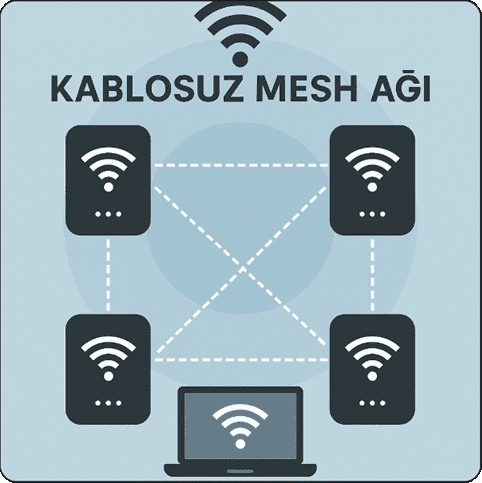
The fundamental components of wireless mesh networks are mesh routers and mesh clients. Mesh routers include multiple wireless interfaces in addition to the functions of traditional wireless routers. These routers provide extended coverage with lower transmission power through a multi-hop communication system. Mesh clients are typically user devices that can dynamically connect to the network.

(Kaynak:Yapay zeka tarafından üretilmiştir.)
Mesh networks offer high flexibility by enabling nodes to automatically connect to each other and allowing the network to self-configure. These networks are generally classified into three architectural types:
Infrastructure (Backbone) Mesh Networks: Connect wireless devices to a wired network. Mesh routers act as central control units that link the wireless network to the wired infrastructure.
Client Mesh Networks: An independent local network formed by client devices using ad-hoc or peer-to-peer connections without reliance on a wired infrastructure. Each node functions as both a client and a router.
Hybrid Mesh Networks: Combine ad-hoc and infrastructure topologies. Mesh routers form the backbone of the network while clients can also perform functions such as routing of data packets.
Wireless mesh networks are distinguished by the following features:
Routing is essential for the efficient operation of wireless mesh networks. Various metrics used during routing ensure that data packets reach their destination via the optimal path. Metrics such as Hop Count, Expected Transmission Count (ETX), Expected Transmission Time (ETT), and Weighted Cumulative ETT (WCETT) have been developed to improve data transmission quality.
Routing protocols vary according to network characteristics:
Ad-hoc Based Protocols: Protocols such as AODV, DSR, and OLSR are suitable for networks with mobile nodes.
Controlled Flooding Protocols: Ensure controlled data dissemination between nodes.
Traffic-Aware Protocols: Optimize routing by monitoring network traffic.
Opportunistic Routing Protocols: Dynamically select the most suitable path based on the current status of available routes in the network.
Multi-Channel Multi-Radio (MCMR) architectures have been integrated to enhance the performance of mesh networks. These architectures aim to increase network capacity by reducing interference. Channel assignment is a critical process in MCMR networks, employing fixed, dynamic, and hybrid assignment schemes. Architectures using directional antennas have been developed to minimize interference and improve routing accuracy.
Wireless mesh networks can be used in various scenarios:
Community Mesh Networks: Provide services such as shared internet access, security cameras, emergency communication, and local market platforms within neighborhoods.
Municipal Mesh Networks: Used in urban commercial areas, tourism information points, and citizen service applications.
Home Mesh Networks: Enable connectivity for audio, video, telephony, and smart devices within homes.
Campus Mesh Networks: Provide uninterrupted internet access in classrooms, laboratories, and administrative areas of universities and educational institutions.
Rural Area Mesh Networks: Deliver low-cost and sustainable internet access in isolated regions.
Spontaneous Mesh Networks: Create temporary networks for data, voice, and video services.
In university campuses, mesh networks are used to provide wide coverage and reliable connectivity. For instance, in one study, a mesh network was designed to replace the existing star topology Wi-Fi network. The wireless internet service provided by 18 access points was insufficient because each access point could support only 20 users. The proposed mesh network was designed by placing eight routers at specific locations. Simulation results showed that the mesh network achieved higher performance (24,000 bit/s compared to 15,000 bit/s), lower latency (0.0007 ms compared to 0.0084 ms), and greater packet delivery than the existing network.
Mesh network technology is also used in applications requiring high bandwidth and low latency, such as video surveillance systems. For example, a large-scale video surveillance system deployed on a university campus was built using a mesh network infrastructure, and the impact of routing algorithms on video quality was analyzed. In this system, multi-path routing was employed to achieve load balancing, fault tolerance, and high total bandwidth.
In rural areas, mesh networks are ideal for providing low-cost and sustainable internet access. A mesh network project implemented in a rural community was developed with community participation and applied with respect for local traditions. The network was established using solar-powered nodes and open-source software. The project aimed to ensure sustainability through training local technicians and implementing modular electrical systems. However, social and cultural dynamics emerged as key factors influencing the project’s success.
Cañarte, M. & Parra, D. Study and design of an access node to serve as a pilot for the implementation of a wireless mesh network in the faculty of electrical and computer engineering of the Espol. Espol, 1-7, 2010
Durukan Odabaşı, Şafak. Kablosuz Mesh Ağlar ve Kablosuz Mesh Ağ Uygulamaları. PhD thesis, İstanbul Üniversitesi Fen Bilimleri Enstitüsü, 2013.
Gómez, B., Maimó, J., and Merideño, J. Wireless Mesh Networks. Enginyeria Informática Universitat de les Illes Balear, 9-12, 2010.
Ochoa, J. Design and Implementation of a Wireless Network Pilot for the center of the city of Loja, based on MESH Technology. Cuenca, Ecuador, 2013
Velasco, M. Design of a WISP on the campus of the Universidad Técnica del Norte to provide wireless internet services using a wireless mesh scheme. Quito, Ecuador, 2009.https://bibdigital.epn.edu.ec/handle/15000/4186?mode=full
Vásconez, D. & Manzano, V. Wireless Mesh Network (WNM) standard 802.11 transmission and coverage optimization in schools in the province of Tungurahua. Ambato, Ecuador, 2014.

Wireless Mesh Networks
Type | Wireless Network Technology | ||||||||
|---|---|---|---|---|---|---|---|---|---|
Purpose | by establishing multi-hop connections between nodes to provide wide-ranging and flexible wireless communication without requiring a central infrastructure | ||||||||
Basic Component | Mesh Routers Mesh Clients | ||||||||
Architectural Types | Infrastructure Mesh Networks Hybrid Mesh Networks Client Mesh Networks | ||||||||
No Discussion Added Yet
Start discussion for "Wireless Mesh Networks (Wi-Fi Mesh)" article
Definition and Structure
Features
Routing and Channel Assignment
Multi-Channel Multi-Radio Architectures
Application Areas
Application Example 1
Application Example 2
Application Example 3