


This article was automatically translated from the original Turkish version.
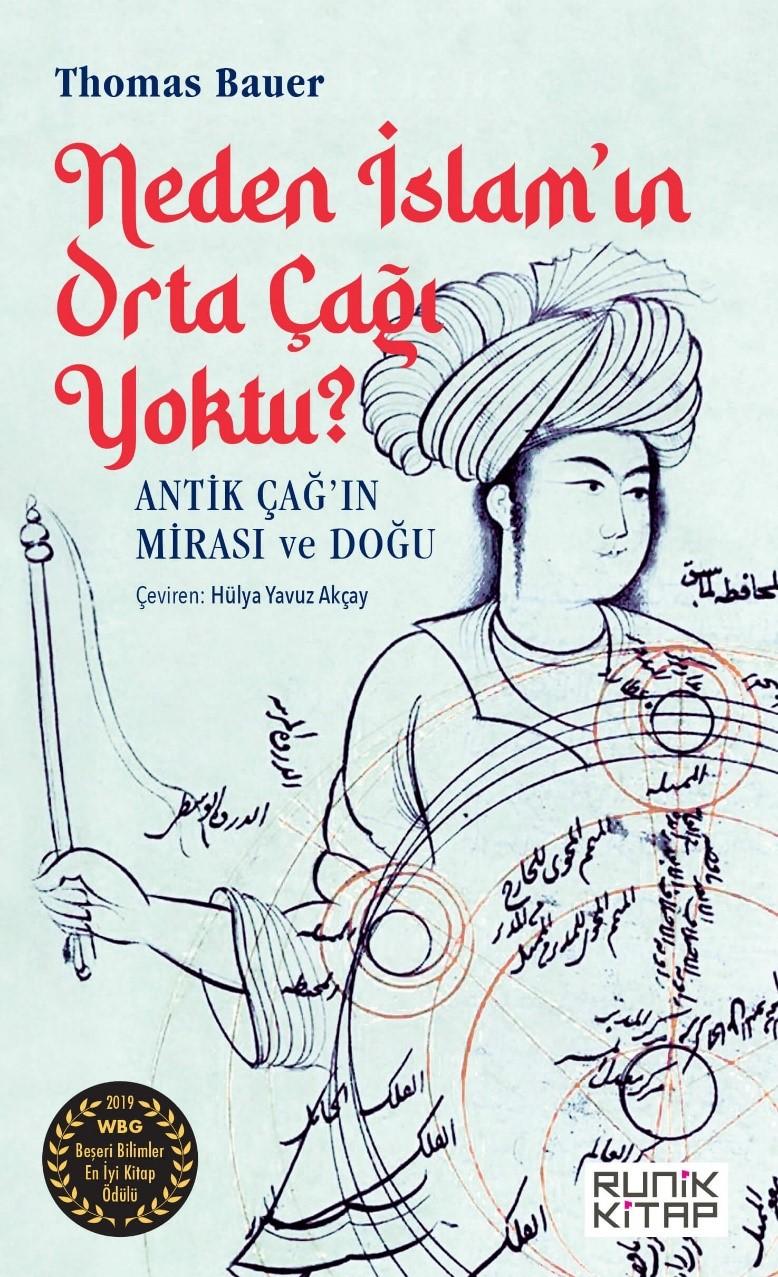
Thomas Bauer - Why Was There No Medieval Islam?
Author(s) | Thomas Bauer | ||||||||
|---|---|---|---|---|---|---|---|---|---|
Publisher(s) | Runik Kitap | ||||||||
Number of Pages | 162 | ||||||||
Translator(s) | Hülya Yavuz Akçay | ||||||||
Publication Date | 26.04.2021 | ||||||||
“Why Was There No Islamic Middle Ages? The Legacy of Antiquity and the Orient” (Warum es kein islamisches Mittelalter gab – Das Erbe der Antike und der Orient), written by Thomas Bauer and published in 2020 by Runik Kitap in the Turkish translation by Hülya Yavuz Akçay, examines the argument that the Western historical periodization of “Antiquity – Middle Ages – Modern Era” is not applicable to Islamic history.
Thomas Bauer argues that Islamic history does not correspond to the Western concept of the “Middle Ages.” According to this view, the period of social, economic and intellectual decline that began with the collapse of ancient Greek and Roman civilizations in the West did not occur in the Islamic world. Bauer emphasizes that from the 8th century onward, the Arab-Islamic civilization preserved the scientific and cultural heritage inherited from Antiquity and further enriched it through new intellectual developments.
The foundational elements of ancient Greek philosophy, Roman urbanism and Hellenistic science were translated into Arabic through extensive translation movements, and systematic knowledge transmission was facilitated by institutions such as Bayt al-Hikma. Research in fields such as mathematics, astronomy, medicine, geography and philosophy did not merely preserve ancient knowledge but produced a new intellectual synthesis that advanced it.
According to Bauer, this continuity contradicts the Western notion of the “Dark Ages.” With the fall of the Roman Empire, cultural institutions in Europe weakened, literacy rates declined and intellectual production contracted. In contrast, urban life, trade networks, educational institutions and scientific activity in the Islamic world continued without interruption. Therefore, Islamic history cannot be said to have experienced the kind of cultural rupture or intellectual stagnation characteristic of the Western Middle Ages.
Bauer stresses that the concept of the “Middle Ages” is historically specific to the internal development of Western Europe and should not be used as a universal category. The historical development of Islamic civilization must be understood within a framework of continuous intellectual development stretching from Antiquity to the modern era. This approach seeks to interpret Islamic history not through Western periodization schemes but through its own cultural dynamics.
The work analyzes the scientific and intellectual activities of the Islamic world between the 8th and 13th centuries. During this period, the influence of ancient thought persisted in Islamic societies in fields such as mathematics, astronomy, medicine, philosophy and literature. The book asserts that Islamic culture demonstrated continuity from Antiquity to the modern era and that the periodized breaks characteristic of Western historiography are inappropriate for understanding this civilization.
Bauer employs the concept of “culture of ambiguity” (Kultur der Ambiguität) to explain the intellectual flexibility within the Islamic world. This concept refers to a cultural structure that values multiplicity of meaning over rigid certainty. Bauer notes that Islamic societies cultivated a mental environment open to diverse interpretations and viewpoints. This perspective defines Islamic culture not as static but as intellectually dynamic.
The work offers an alternative perspective on the position of the Islamic world in historical periodization debates. By asserting that Islamic history cannot be adequately explained through Western-centric concepts, it highlights the notion of intercivilizational continuity. The book is regarded as a reference source in the fields of Islamic studies, cultural history and historical theory.
Altıntop, Mevlüt. “Thomas Bauer, *Neden İslam’ın Orta Çağı Yoktu* (Book Review).” *Akademik Platform İslami Araştırmaları Dergisi (Apjir)* 7, no. 1 (2023): 154–162. Accessed October 19, 2025. https://doi.org/10.52115/APJIR.1247584.
Bauer, Thomas. Neden İslam’ın Orta Çağı Yoktu: Antik Çağın Mirası ve Doğu. Istanbul: Runik Kitap, 2024. Accessed October 19, 2025.

Thomas Bauer - Why Was There No Medieval Islam?
Author(s) | Thomas Bauer | ||||||||
|---|---|---|---|---|---|---|---|---|---|
Publisher(s) | Runik Kitap | ||||||||
Number of Pages | 162 | ||||||||
Translator(s) | Hülya Yavuz Akçay | ||||||||
Publication Date | 26.04.2021 | ||||||||
No Discussion Added Yet
Start discussion for "Why Was There No Medieval Islam? (Book)" article
Core Thesis of the Work
Historical and Cultural Context
Conceptual Framework
Scientific Significance