


This article was automatically translated from the original Turkish version.

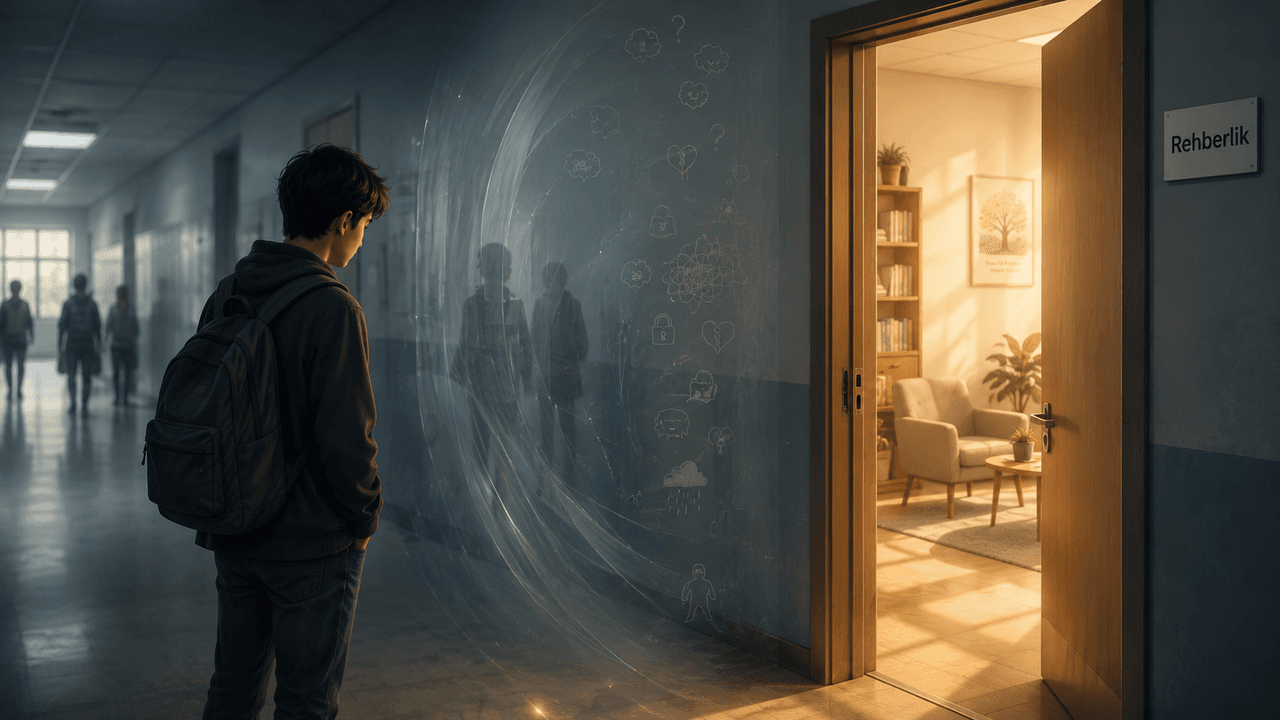
At the far end of the school corridor, in a quiet corner where the noise gradually fades, there is a sign written in a calm font: Guidance Service. Yet for many students, passing beneath that sign feels like walking through an invisible minefield. Steps quicken, eyes fix on the floor, as if merely looking too long at the door might cause a label to stick to them. The old, clumsy but stubborn legend whispered from ear to ear immediately kicks in: "If you’re going there, you must be crazy." or "What could possibly bring someone to that room unless they’re in deep trouble?"
Where does this great illusion come from—the one that drives young minds away from that room, turning it not into a sanctuary but into a place of stigma?
In truth, it all begins with the small, poisonous leak of our society’s unresolved relationship with mental health seeping through the walls of schools. Adolescence and youth are periods when peer approval is nearly a matter of survival. In this stage, where everyone strives to appear “perfect,” “strong,” and “problem-free,” knocking on the door of the guidance office feels like shouting aloud to the world: "I can’t do this on my own." For a young person discovering themselves, bearing the label of being “different” or “weak” is an unbearable risk. As a result, that door no longer represents a warm space for help—it becomes a social threshold requiring courage to cross.
(Yapay zeka ile oluşturulmuştur)
Moreover, peer pressure is not the only cause of this hesitation. Often, the system itself reinforces this perception. Unfortunately, in many schools, the guidance service is positioned as a “pre-disciplinary checkpoint.” Students who cause disruptions in class, break rules, or experience sudden drops in grades are immediately sent there. As a result, students internalize this schema: "The guidance office is where the misbehaving and the 'fixable' go."
How can a young person believe that the professional on the other side will listen without judgment? To them, it is no longer a confidant’s room—it is merely the deputy principal’s office with slightly softer chairs.
When the greatest fear of all—the fear of exposure—is added to the mix, the walls grow even thicker. Privacy is the strongest shield in the world of youth. The doubts—“Will what I say reach the teachers’ lounge?” “Will they call my parents?”—add tons of weight to the door’s handle. In this fragile period, where trust hangs by a thread, if the boundaries of confidentiality are not clearly defined, entering that room ceases to be an act of courage and becomes a social risk.
Yet we must redefine that door and the world behind it.
The guidance service is neither a “certification center for madness” nor a secret detention room within the school. It is a judgment-free space where one can share the beautiful yet confusing emotions of growing up, the crushing anxiety of exam nights, broken friendships, or simply the feeling that “today I don’t feel like I belong in this world.”
If we can believe that the voice in that room is there only to listen, then we will understand that what we flee as “madness” is, in fact, nothing more than simply being human. For life sometimes moves too quickly, and along this stream that flows like water, we all need a space where we can pause to breathe and be accepted exactly as we are. And that room is, in truth, just one step away.