


This article was automatically translated from the original Turkish version.

Do you need a multi-purpose graphics card today? You may require a powerful graphics card for many different applications, such as gaming, scientific computations, processing big data, or training artificial intelligence models. When searching for a consumer-grade graphics card capable of meeting all these needs, products like NVIDIA GeForce or AMD Radeon come to mind. However, there is an important limitation to note here. The NVIDIA GeForce series card with the highest VRAM capacity is the RTX 5090, which features 32 GB of memory.
While modern motherboards can support RAM values of 128–256 GB, why do we not see similar values in graphics cards? Suppose you are training an artificial intelligence model and require 33 GB of VRAM. In this case, you would need to purchase a second graphics card. Why cannot the VRAM capacity of multi-purpose graphics cards be increased further? Let us examine the physical and strategic reasons behind this limitation.
Physical limitations can be summarized by two key factors:
First, graphics cards are limited to a maximum memory bus width of 384 bits. Assuming each bus bit lane is 32 bits, the total number of memory channels is calculated as 384 ÷ 32 = 12. Normally, one memory chip can be connected to each memory channel. However, if a clamshell configuration is used, two DRAM chips can be connected to a single memory channel, allowing a maximum of 12 × 2 = 24 GDDR6X memory modules to be mounted on a single graphics card PCB.
The second constraint arises from the fact that GDDR6X memory chips are currently available with a maximum density of 2 GB per chip. Under these conditions, the maximum VRAM capacity achievable on consumer-grade graphics card PCBs is 24 × 2 = 48 GB. To achieve higher capacities, either the memory bus width or the maximum density of memory modules would need to be increased. If you require more than this, you should consider data center-class graphics cards instead of consumer-grade ones. For example, the H100 graphics card has 80 GB of VRAM. Such cards achieve high memory capacities by stacking memory modules vertically and using significantly wider memory buses.
You might be wondering: “When I look at the market, I can find DDR5 RAM modules with sizes like 8 GB or 16 GB. Why don’t GPU manufacturers use these to achieve higher GB values?” The answer lies in the fundamental differences between GDDR and DDR memory, both in purpose and architectural design. Comparing DDR RAM used by CPUs and installed on motherboards with the embedded GDDR RAM used by GPUs based solely on GB capacity is misleading. The following table better summarizes this distinction:
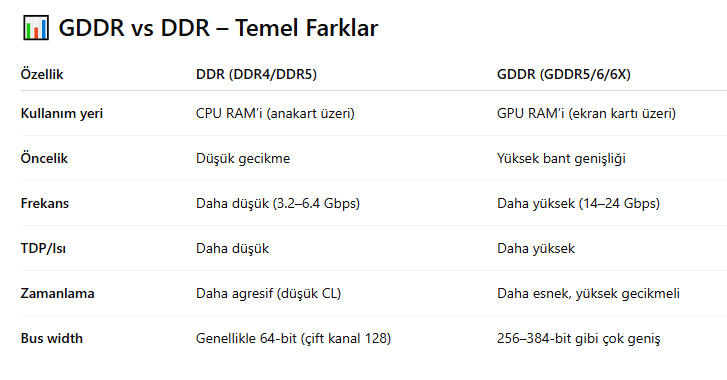
Comparison of GDDR and DDR characteristics (generated with YZ).
The primary reason consumer graphics cards have limited VRAM capacity or lack upgradeable VRAM is that manufacturers design their products based on market demands and target audience analysis. GPU manufacturers typically classify their products into entry-level, mid-range, and high-end tiers. This segmentation aims to offer price-performance options suited to each user profile, thereby attracting consumers across all budget levels into their ecosystem. Under this strategy, low- and mid-range graphics cards do not include high VRAM values because they are generally intended for less graphically demanding tasks such as casual gaming, office work, or video playback.
It is assumed that users of these cards will not need such memory capacity, and adding extra VRAM would only increase the card’s cost without improving performance, thereby reducing its competitiveness. This perception has persisted since earlier generations and remains prevalent today. Therefore, if you as a consumer require high VRAM values—for tasks such as model training, development, or rendering—you are expected to choose data center-class graphics cards.
Additionally, from a marketing perspective, VRAM capacity is offered incrementally. For instance, a model with 8 GB of VRAM may be followed by variants with 12 GB or 16 GB to encourage users to move toward more expensive segments. This practice is applied as a product lineup sales strategy, even in the absence of any technical limitation. If every graphics card were equipped with 32–48 GB of VRAM—or if VRAM were upgradeable—the distinction between high-end and mid-range models would vanish, potentially reducing sales of premium products. Thus, VRAM capacity is not only constrained by technical factors but also deliberately limited to ensure profit maximization and maintain product diversity.
NVIDIA Developer Forums. “Why GPU Memory Size Is Small?” Accessed May 1, 2025. https://forums.developer.nvidia.com/t/why-gpu-memory-size-is-small/17640.
NVIDIA. "H100 Tensor Core GPU." Accessed May 1, 2025. https://www.nvidia.com/en-us/data-center/h100/.
Why Is the DDR5 RAM Used on a Graphics Card but Not Used for CPUs on Motherboards?” Quora. Accessed May 1, 2025. https://www.quora.com/Why-is-the-DDR5-RAM-used-on-a-graphics-card-but-not-used-for-CPUs-on-motherboards.
Wrong_User_Logged. "why GPUs have so little VRAM?" Reddit, r/hardware. Accessed May 1, 2025. https://www.reddit.com/r/hardware/comments/1bzuws4/why_gpus_have_so_little_vram/.