


This article was automatically translated from the original Turkish version.
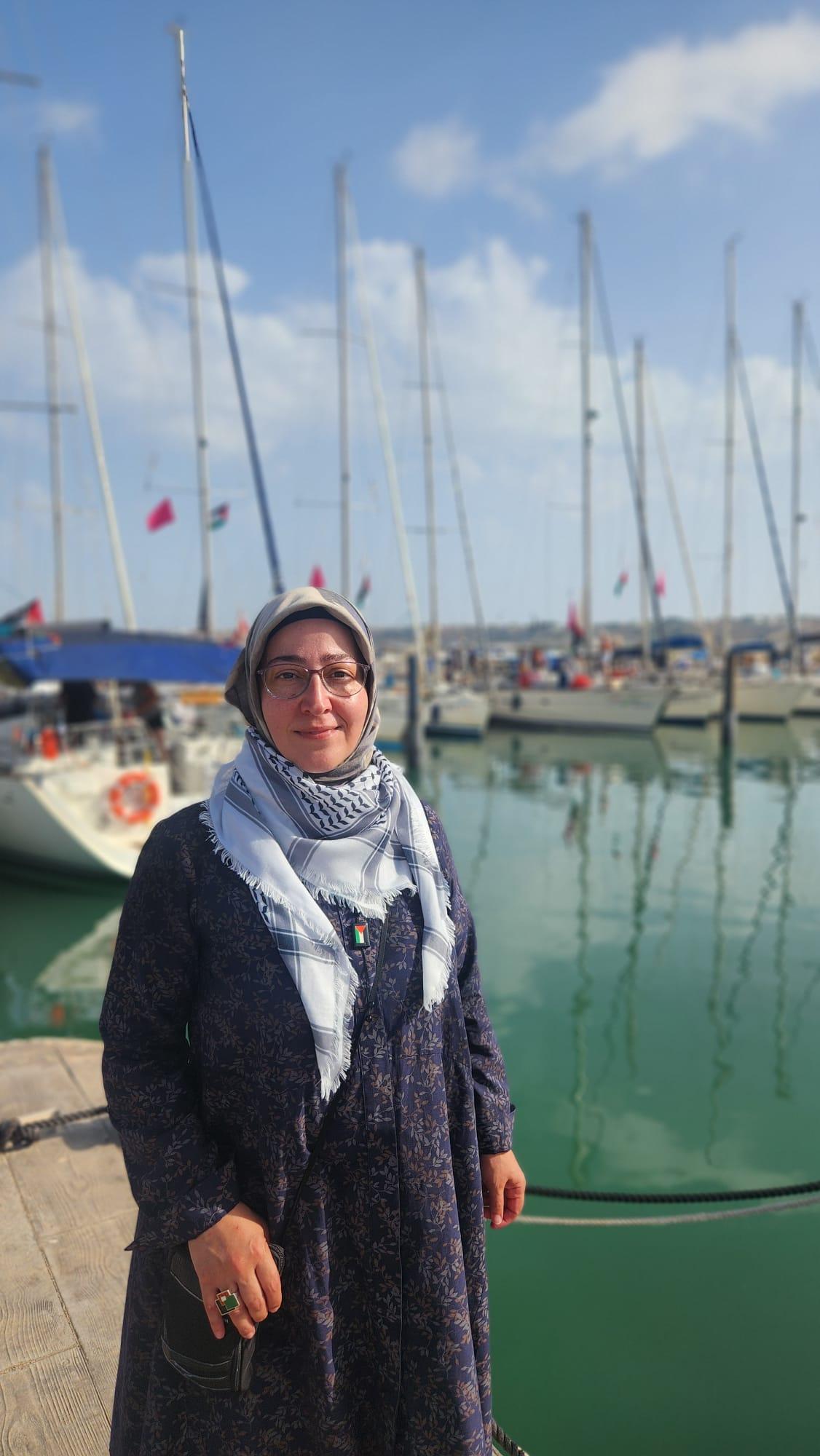
Some journeys are not undertaken to reach a destination, but to understand or to convey a truth.
Like the physical and spiritual journey undertaken by Prophet Ibrahim in search of truth…
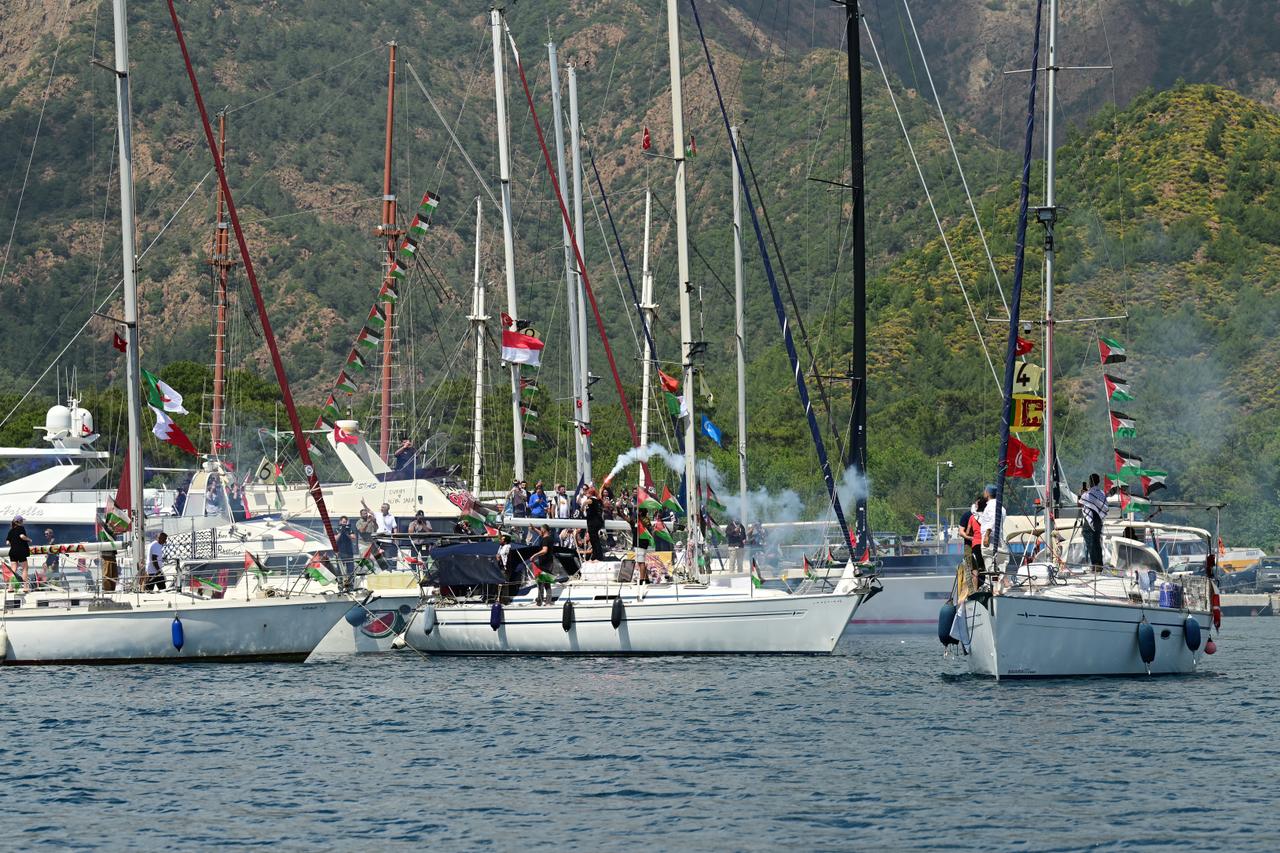
Sumud Flotilla Anchored in Marmaris (Anadolu Ajansı)
Like Gandhi’s Salt March, which exposed the injustice of colonial rule…
Like Martin Luther King’s famous movement, which declared to the world America’s moral contradictions…
My own first journey aboard the Sumud Flotilla was precisely such a journey.
It was not only a civilian initiative aimed at breaking the siege of Gaza, which Israel has maintained since 2007; it was also a journey intended to remind the world of what Israel truly is—a state whose brutal practices extend even to killing infants in their cribs. It was a civil, humanitarian, and moral protest against a genocide that screens, social media, and ultimately the entire world have gradually normalized. It was a cry meant to make this protest heard across the globe…
Because silence is never neutrality; sometimes, silence is cowardice—or even complicity—with the oppressor.
The Israeli issue—yes, it is not the Palestinian issue, but the Israeli issue, since the core problem is Israel’s boundless occupation—stands precisely at this point. It is an issue paid for in the blood and lives of children and babies. A price so terrible that merely witnessing or observing it becomes unbearable.
Yet we all watch. Quietly, in shock, in sorrow, in revolt…
Throughout my career as a journalist, my repeated visits to Palestine, and especially to Gaza, the things I saw, heard, and witnessed intensified this revolt within me. And it imposed upon me a heavy burden of responsibility. First, I abandoned the myth of “neutral journalism,” because this testimony did not ask me to report as an observer, but to reveal my own stance. I was no longer merely describing events, showing them, or writing about them—I stood within a circle of truth that demanded I confront my own position and humanity’s stance in the face of what was happening. In the land where the Palestinian people have resisted for years through “Sumud.” So when I first heard the name “Sumud Flotilla,” I was truly moved.
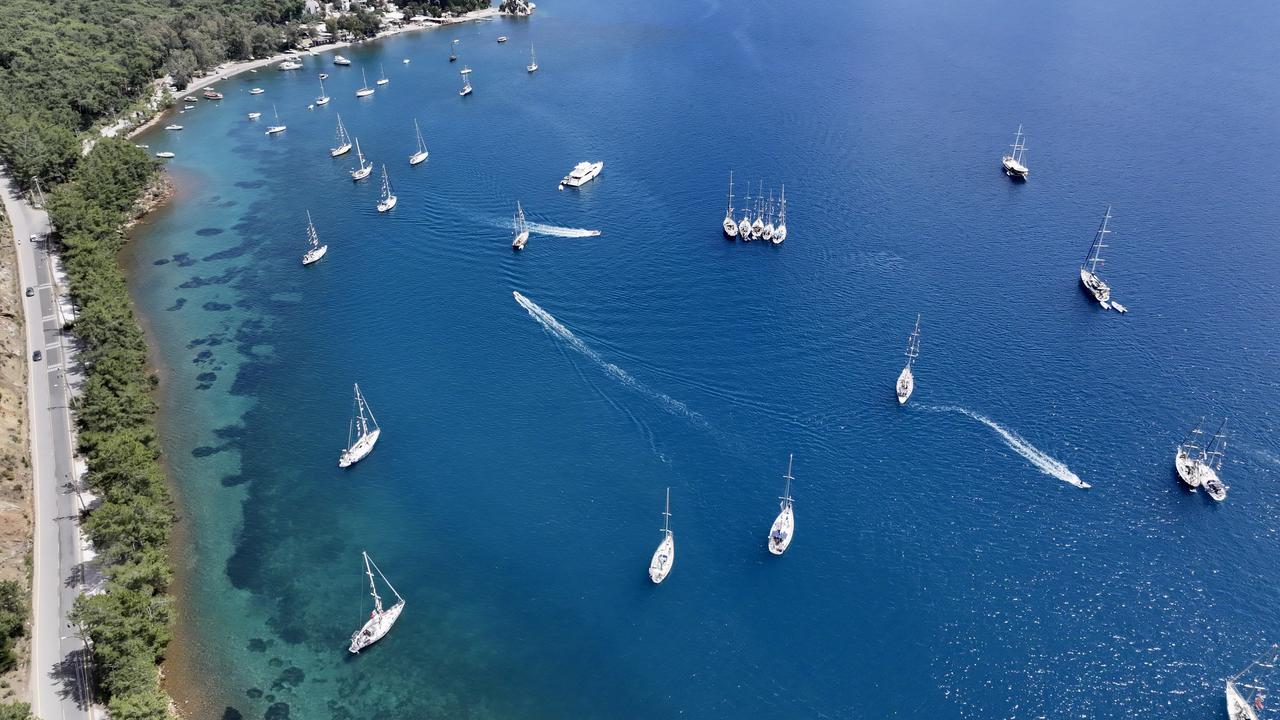
Sumud Flotilla Anchored in Marmaris (Anadolu Ajansı)
Even though nearly all maritime attempts to break the blockade have failed, and even after we witnessed the horrific massacre of the Mavi Marmara, this journey was still one that had to be undertaken. Because every second we spent sitting in our homes, continuing our daily lives, a child, a woman, or an innocent person was dying—killed by bombs, by starvation, or by lack of medical care. The world knows the details of the journey. Around 500 activists, aboard 50 ships from Spain, Italy, Tunisia, and Greece, were captured by Israeli military forces in international waters after a series of attacks and obstruction attempts. They were taken first to Ashdod Port, then to prison. After three days of detention, we were deported from the country with a 100-year ban on entry into Israel.
So what changed? If the First Sumud Flotilla failed to break the blockade and never reached Gaza, can we call it a failure?
It is precisely here, without drowning anyone in details, that as a journalist I wish to speak about the global communicative impact of this journey.
“Hasbara” is a Hebrew word meaning “explanation” or “clarification.” It encompasses Israel’s public diplomacy, strategic communication, and propaganda efforts aimed at legitimizing its policies, military operations, and Zionist narrative before global public opinion. In the current context, hasbara means not merely “explaining,” but setting the narrative, diverting attention, manufacturing a discourse of victimhood, equating criticism with antisemitism, rendering the suffering of the Palestinian people invisible, and portraying Israel’s military or political actions as defensible.
In essence, it is state-sponsored international propaganda and perception management.
A coordinated discourse produced across media, social media, diplomacy, academia, and NGO networks…
In short, all of Israel’s efforts to reshape global perception regarding its occupation of Palestinian land fall under the concept of hasbara. We have seen similar perception management campaigns in history. Hitler’s Nazi propaganda is the clearest and, ironically, most analogous example. The strategies employed by Joseph Goebbels, Hitler’s close associate and Minister of Public Enlightenment and Propaganda, were nearly identical. The difference lies only in the fact that today’s hasbara operates with far greater strength thanks to new communication technologies.
Until now, when it came to Palestine, world public opinion has always remained under the influence of this dominant perception management.
Whoever produces the first narrative, whoever disseminates the first information, determines how the rest of the world interprets events—often without questioning the frame at all.
Sumud Flotilla Departing from Marmaris (Anadolu Ajansı)
Israel’s arguments to portray itself as “good” and its actions as “just” are well known: security threats, counterterrorism, the right to self-defense, or sowing doubt among the public.
These narratives, constructed within this framework, were disseminated globally within minutes through Western media outlets such as CNN, BBC, AP, and Reuters. Because people first heard the story through Israel’s version, subsequent information was pushed to the background. For example, during the hospital attack in Gaza in 2023, Israel’s official accounts released dozens of conflicting messages within the first minutes, creating information pollution. They first denied the attack, then blamed Islamic Jihad, then claimed the explosion was caused by the hospital’s fuel tanks. In reality, the cause of the destruction was an unmistakable airstrike—but they succeeded in confusing the minds of the world, especially those not closely following the issue.
One of hasbara’s main strategies is to make its own victimhood more visible. While dozens of Palestinian children are brutally killed, images of an Israeli child frightened by sirens circulate on TV screens, front pages of newspapers, and social media. Or, through expressions like “security operation” or “precision strike,” a perception is created as if only a target was hit and all other civilians were spared. We have witnessed this countless times.
In fact, Israel’s Ministry of Foreign Affairs has a specialized social media team called the “Digital Diplomacy Unit,” whose task is to produce content for TikTok, Reels, and X, and disseminate it globally in multiple languages.
So the entire event is nothing but Israeli propaganda.
And no one in the world dares to challenge Zionism—until the Sumud Flotilla began its preparations.
Fifty ships, over five hundred volunteers, participation from more than 44 countries. This unprecedented civilian maritime mission began its journey in people’s minds even before setting sail. The flotilla first pierced the invisible wall of global news flow. As activists’ statements spread, the media, and then politicians, began to dare call the massacre what it was: genocide.
The brutality that had raged in Gaza for two years became more visible in global media.
For perhaps the first time, humanity began to question itself with such intensity. People poured into the streets. And for the first time in a century, what had happened in Palestine became the global agenda.
In other words, the Sumud Flotilla shattered the manipulative wall Israel had carefully constructed over decades to encircle our minds, and it spread the narrative: “The world’s conscience is marching toward Gaza.”
Israel, of course, did not remain idle. It immediately mobilized the same methods.
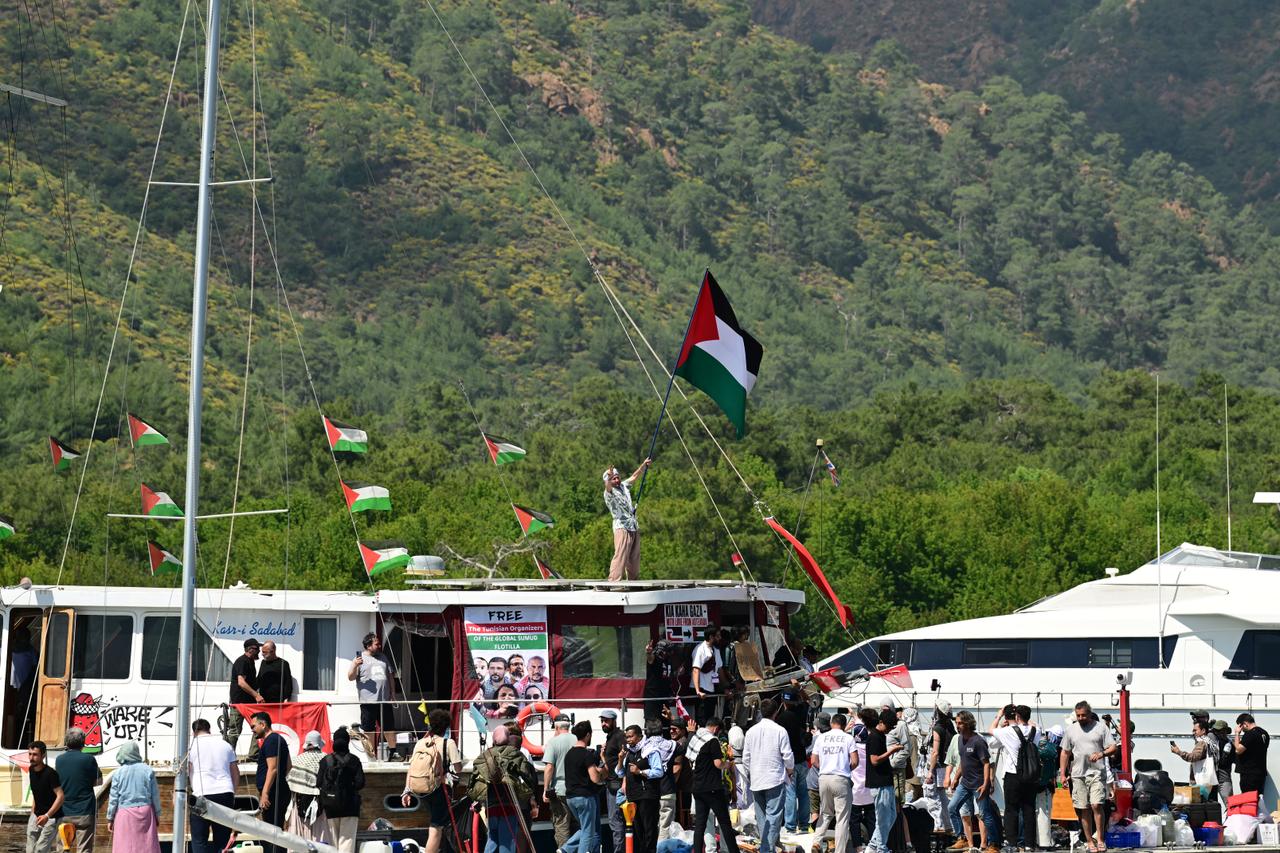
Sumud Flotilla Anchored in Marmaris (Anadolu Ajansı)
“This flotilla is a provocation,” they said. “There are official channels for delivering aid to Gaza.”
When these arguments failed, they turned to slander, accusing the flotilla’s leadership and participants of terrorism and antisemitism.
Yet most of the activists aboard the flotilla were respected, even internationally renowned figures in their own countries—and Israel’s lies found no purchase this time.
The Sumud Flotilla, in turn, made a crucial countermove: it began telling its own story, even writing it, from its own perspective.
And newspapers carried the flotilla’s voices to their front pages:
This first narrative reshaped the language of international journalism.
Within the first 12 hours, media outlets such as BBC, Al Jazeera, Guardian, TRT World, AJ+, and Middle East Eye changed their headlines to describe the mission as “an international civilian movement aiming to deliver humanitarian aid to Gaza.” As the words “civilian,” “humanitarian,” “international,” and “conscience” entered circulation, Israel’s “terrorism” narrative found no resonance.
A similar dynamic unfolded on social media.
Within the first 24 hours after the flotilla set sail, hashtags such as “peaceful civilian flotilla,” “global solidarity walk,” “end the blockade,” and “Sumud movement” spread faster than Israel’s curated content.
And the Sumud Flotilla, for the first time in a long while, decisively shifted global public opinion in favor of Palestine. Panels spread across Europe, student movements erupted in the United States, solidarity demonstrations arose in Latin America, and civil society declarations emerged in Africa.
None of these were defensive positions. All were expressions of the first narrative—and the Sumud Flotilla, for the first time, rewrote the story correctly, from the beginning.
Before the flotilla was intercepted, the message we delivered to the world was: “The world’s conscience is marching toward Gaza. Israel is trying to stop it.”
Israel’s drone attacks on ships in international waters near Crete only strengthened this message.
And when, approaching Gaza, we were again blocked in international waters by Israeli forces using a method no pirate would dare use, what the world witnessed was Israel obstructing an international civilian humanitarian movement.
In short, the Sumud Flotilla reversed the game for the first time.
Israel’s explanations could not alter this framework.
Thus, although the Sumud Flotilla never reached Gaza, it achieved a major success.
Because success does not always require reaching a final destination.
The same was true with Sumud.
This flotilla, of which I am proud to have been a part, awakened the world, mobilized it, and gave it a completely new perspective…
In Europe, Asia, and Africa, people spoke of Gaza for days.
And everyone clearly saw this: “Life in Gaza can be saved, but Israel will not allow these lives to be saved.”
This was the first great victory.
The second victory was bringing the concrete demand for a “humanitarian corridor” within the framework of international law and human rights to the forefront of global discourse. It popularized the idea of “acting together” among the public and accelerated ceasefire negotiations.
I would have liked to end this article with the sentence: “And the weapons fell silent; the occupation ended.” But unfortunately, that did not happen.
A so-called ceasefire was declared.
But the war in Gaza did not end; only the cameras and eyes were turned elsewhere.
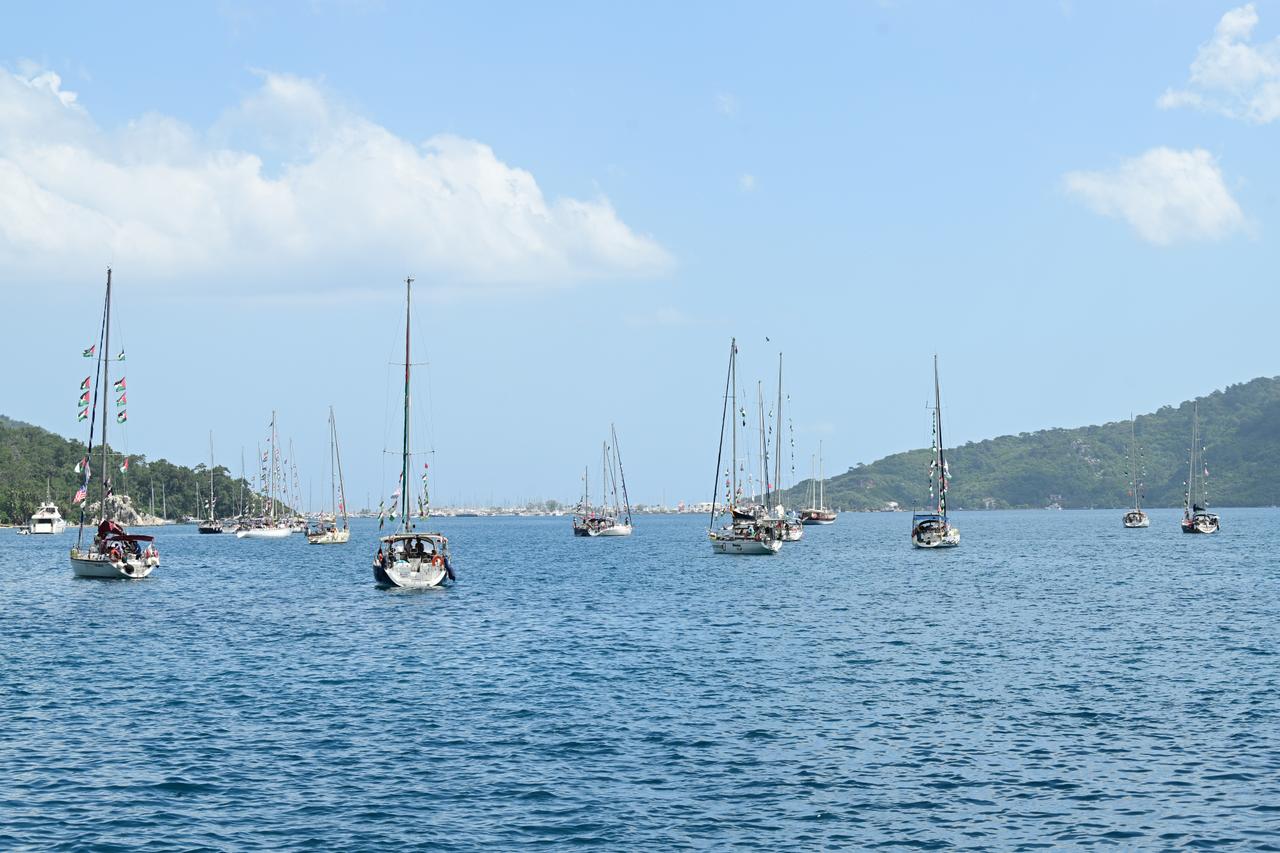
Sumud Flotilla Departing from Marmaris (Anadolu Ajansı)
The bombs did not stop.
The hunger did not end.
The pain did not cease.
Gaza needs 650 trucks of aid per day to survive.
Today, the maximum number of trucks entering is 200…
That is less than one-third of what is needed.
Winter arrived, and the people of Gaza endured a brutal winter in makeshift shelters.
The world fell silent.
In short, the war in Gaza did not end; it was simply removed from our view.
That is why the decision was made to continue the Sumud journey.
The Second Sumud Flotilla is now underway. It was subjected to a military operation in international waters, and part of the fleet was disabled.
Thiago and Saif, architects of the flotilla, were arrested and taken to Israel. Shackled at the feet, they were brought before a so-called court.
Thiago Avila was not even allowed to attend his mother’s funeral.
Now the story continues. The Second Flotilla has resumed its journey, departing from Türkiye.
And the children of Gaza still wait, full of hope.
Mothers still pray…
Fathers still search for their lost ones.
And some questions remain unanswered:
Where does the world stand in this story?
Can we think of Palestine’s freedom as separate from our own inner freedom?
Should we not protest this genocide, which enslaves our souls?
If we abandon the ship, will we not have abandoned our very purpose of existence?
Sumud is the answer to these questions.
And it is one of the purest, most authentic forms of remaining human in our time.
Anadolu Ajansı. "Küresel Sumud Filosu Gazze'ye Gitmek İçin Marmaris'ten Demir Aldı". Accessed May 14, 2026. https://aa.com.tr/tr/pg/foto-galeri/202651416531_kuresel-sumud-filosu-gazzeye-gitmek-uzere-marmaristen-demir-aldi/161660