


This article was automatically translated from the original Turkish version.
When we celebrate a holiday, what are we truly celebrating? A page from a calendar, or a mythical conception that has long settled in our collective memory? Halloween, which we translate into Turkish as "Çılgınlar Gecesi," arrives at our doors on the night of October 31. Universally speaking, pumpkins are hollowed out, masks are worn, decorations are hung, frightening tales are told, or horror-themed activities are organized.
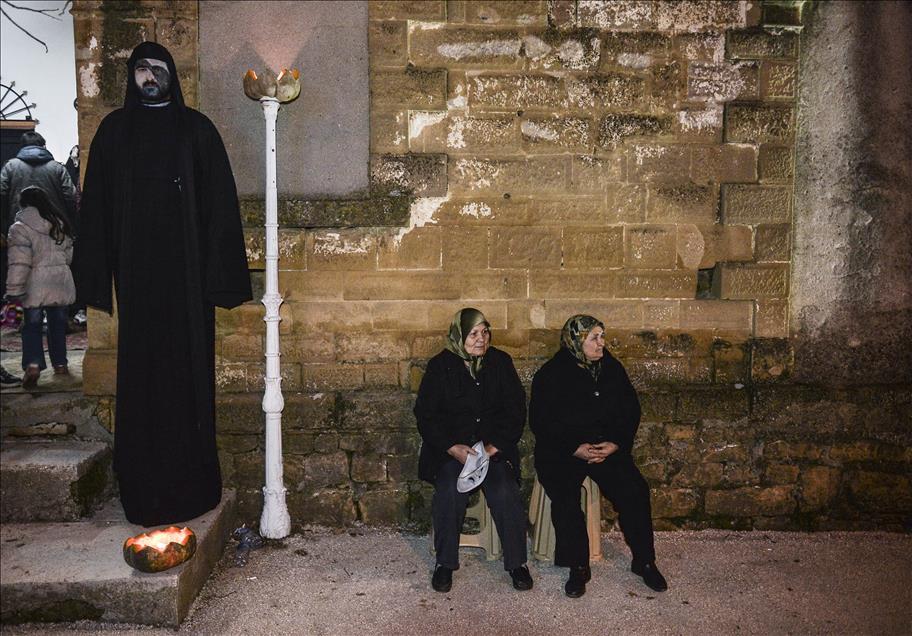
Bocuk Night in Keşan, Edirne (AA)
The origins of Halloween trace back to ancient times when the harvest ended and winter loomed. Among the Celts, spirits drew near to the world. In Rome, the fruitfulness of Pomona and the ancestral ties of Parentalia were celebrated. The Christian calendar associated All Hallows’ Eve with the same night. Rituals and names changed, but the essence remained: the reckoning of the harvest and the liminal state between the dead and the living.
This narrative crossed oceans and, propelled by capitalism’s dazzling allure, took on a new form in America—with masks, costumes, jack-o’-lanterns, and the commercial glitter of “trick or treat.” The imagery is loud, the music is high, and the youth are exuberant. Participants revel in terrifying costumes, savoring the pleasure of becoming someone—or something—entirely different for one night.
Even our own young people do this. Regardless of whether they understand why, they ask, “Why don’t we have such beautiful holidays, entertainments, and rituals like they do?” Children who were no longer told ghost stories by their parents or grandparents—deemed no longer pedagogically appropriate—begin encountering Halloween from preschool onward. The demonic, malevolent, and devilish figures in their minds are roughly the same. For instance, if you ask them to describe a witch, they will vividly depict a grotesque woman with a pointed hat flying on a broomstick.
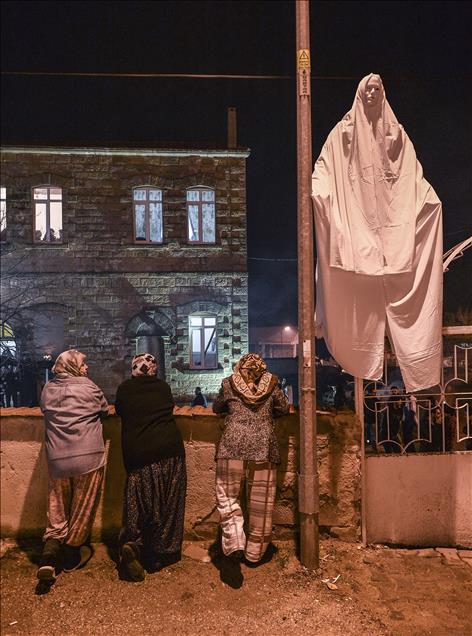
Bocuk Night in Keşan, Edirne (AA)
No. In our narratives, the witch does not ride a broom—she rides a küp. When an Anatolian says, “I rode the küp,” that is the küp. It speaks in the language of anger, yet its roots are mythical. The witch leaps onto her küp at the threshold of night, changes her form, lets her tail dangle in the water. Sometimes she becomes a deer, sometimes an old crone, sometimes a stranger whose beauty drives men mad. She is among the people—in the corner of the street, in the crowd of the market, at the head of the queue… and most often where the trap lies.
Our witch is a figure whose magic dissolves when she crosses water, whose spell is cleansed after being immersed three times, and whose tail reveals itself in the water. Water in our tradition does not merely purify—it distinguishes. It separates good from evil, truth from deception.
Myths are the veins that tremble in the unconscious of societies. Once, woman was revered as the goddess who gave birth and protected, her light likened to the sky’s radiance. Umay’s hand rested above the cradle. Ak Ene’s breath hovered above the water. For those who wish to see it so, it remains so.
As social order changed, the same woman was branded as the “source of sin.” Her wisdom became “deception,” her healing “sorcery,” her independence a “threat.” It was here that the image of the witch was born: a darkened portrayal of the shamanic woman in patriarchal memory. As the distinction between white and black widened, the shadow of the “black” replaced the white shaman. This is why, in our stories, Hızır’s intervention is never in vain. The divine warning that breaks the witch’s web of deceit is an ancient way of restoring cosmic balance. At the spring of the mountain, at the threshold of the cave, by the shore of the sea… the trap is set from within, but aid always descends from above. And the sky is always linked to the sacred.
In Güzel Ahmet, the elderly woman dressed as a pilgrim who comes to the door; in Bey Böyrek, the küpçü who leads travelers astray; in Kurbânî and Perüzât, the hand that exiles the hero to a deserted island; in Gül ile Sitemkâr, the beauty disguised as a trick inside the cave—each is a witch as an obstacle. She deceives, separates, exiles, and brings down. But beneath every trap lies the same question: Whom should the hero listen to? The ancient warning or the deceptive appearance?
The answer is clear. Children who do not listen to their elders’ folktales will heed the deceptive appearance and turn toward it. They will memorize the broom-riding, pointed-hat witch. Because in cartoons and novels, there is no witch who rides a küp. They will fail to understand Hızır’s warning. In preschools, carving pumpkins will be seen as normal, and Halloween celebrations as globalization.
Perhaps the issue is not choosing one over the other, but forgetting ourselves—or remembering ourselves anew.
It is easy to be angry at those who celebrate Halloween. But is it easy to understand their infinite acceptance and adoption of everything imported?
A person whose roots have been severed or torn away seeks belonging in other symbols and other people’s stories.
When a society stops telling its own stories, it soon becomes a character in someone else’s. Yet everyone has their own “fear”; every culture has its own darkness, its own cure… Our witches were the mirror of our wounds, our fears, and our remedies. To remember them again is not to reject “the other”—it is to remember ourselves.
Yes, we see the strong winds of globalization. But we must not forget that trees stand firm on their roots.
Anadolu Ajansı. "Trakya'da bir Ortaçağ geleneği: "Bocuk" Accessed November 6, 2025. https://www.aa.com.tr/tr/pg/foto-galeri/trakyada-bir-ortacag-gelenegi-quot-bocukquot-
Polat, Leyla Yılmaz. “Türk Halk Hikâyelerinde ‘Cadı’ İmgesi: Kadın Algısının Mitolojik Derinliği.” Folklor Akademi Dergisi 8, no. 3 (2025): 591–606. https://dergipark.org.tr/tr/pub/folklor/issue/94833/1735583
T.C. Kültür ve Turizm Bakanlığı. "İl Müdürümüzün Bocuk Gecesi hakkında AA yapmış olduğu röportaj." Accessed November 6, 2025. https://edirne.ktb.gov.tr/TR-199874/il-mudurumuzun-bocuk-gecesi-hakkinda-aa-yapmis-oldugu-r-.html
Do Our Witches Ride Brooms?
From Umay to Albastı: The Transformation of an Archetype
So, Whose Witch’s Holiday Is It?