


This article was automatically translated from the original Turkish version.
+2 More
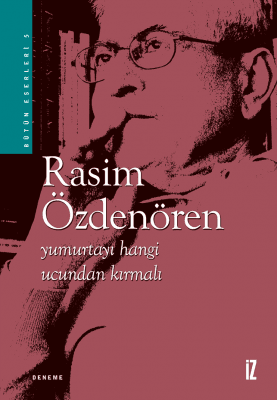
Which End of the Egg Should Be Broken
Author(s) | Rasim Özdenören | ||||||||
|---|---|---|---|---|---|---|---|---|---|
Number of Pages | 288 | ||||||||
Publisher(s) | İz Yayınları | ||||||||
Type(s) | Essay | ||||||||
Printing Language | Turkish | ||||||||
Which End of the Egg to Break is a critical work that examines the differences between Western and Islamic cultures through fundamental concepts such as modernization, science, freedom, law, and social structures. The book offers an enriched analysis of cultural degradation, value shifts during the process of Westernization, and the contradictory nature of the West, as detailed in with anecdotes. The work consists of six chapters.
First Chapter: The conceptions of humanity in the Western and Islamic worlds are compared. While Western colonial history (including the massacre of Native Americans and the slave trade) is criticized, the Islamic society is emphasized as being more grounded in values. Attention is drawn to how Muslims have begun to view their own history through the mirror of the West.
Second Chapter: Concepts such as private life, capitalism, and the opposition between science and religion are discussed. The understanding of freedom is explained through the metaphor of a kite string: “If the string breaks, the meaning of freedom vanishes.” The relationship between totalitarian regimes and individual control is examined. The contradictory nature of the West is illustrated with examples provided by Bertrand Russell.
Third Chapter: Issues such as law, divorce, crime, and punishment are addressed. The rising rate of divorce is linked to the disintegration of the family structure in Western society. It is noted that similar problems are emerging in Islamic countries that emulate the West.
Fourth Chapter: The process of Westernization in Türkiye is critiqued through the perspectives of thinkers such as Ziya Gökalp, Peyami Safa, and Mümtaz Turhan. The way these intellectuals view the West and their cultural solutions are questioned.
Fifth Chapter: Examples of imitation of Europe and the motivations behind such imitation are analyzed. Western “symbols of civilization,” such as zoos, are interpreted in Islamic culture as signs of savagery. The continued presence of racism in the West is emphasized.
Sixth Chapter: Quotations from Western thinkers such as Dostoyevski, Rousseau, Kafka, and Camus are used to expose the internal contradictions of the West. It is argued that Western thought is internally conflicted and has failed to establish an absolute model.
Cultural Critique: The imposition of Western values as universal is challenged.
Modernization and Science: Scientific progress must be evaluated not only in technical terms but also through its ethical dimensions.
Freedom and Society: The concept of freedom must be balanced with the individual’s responsibility within society.
Critique of Westernization: Original cultural development is proposed as an alternative to mere imitation.
Religion and Morality: Religious values are presented as a foundation that upholds human dignity, whereas the West is said to have weakened these values.
Özdenören, Rasim. Yumurtayı Hangi Ucundan Kırmalı. İz Yayıncılık, 2022.

Which End of the Egg Should Be Broken
Author(s) | Rasim Özdenören | ||||||||
|---|---|---|---|---|---|---|---|---|---|
Number of Pages | 288 | ||||||||
Publisher(s) | İz Yayınları | ||||||||
Type(s) | Essay | ||||||||
Printing Language | Turkish | ||||||||
No Discussion Added Yet
Start discussion for "Which End of the Egg Should You Crack? (Book)" article
Subject
Theme