


This article was automatically translated from the original Turkish version.

Throughout history, women’s hair has carried meanings beyond mere aesthetics. In the Arabian Peninsula during the pre-Islamic period — known as the Jahiliyyah Era — women letting their hair flow freely or swaying it rhythmically while dancing was not merely a physical movement; it was also a cultural message. What lay behind this behavior?
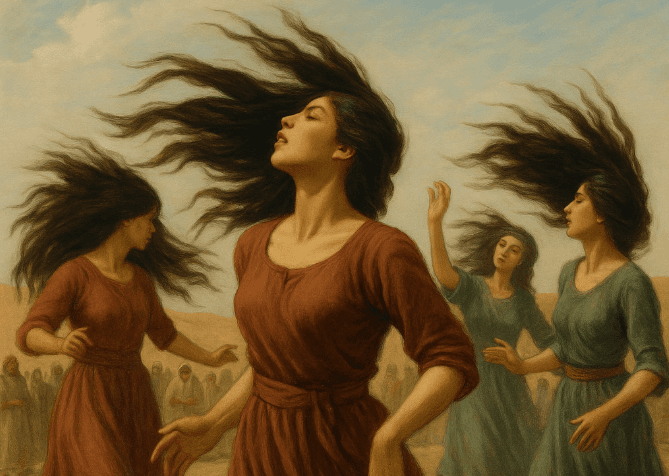
Women Swinging Their Hair in the Jahiliyyah Era (Generated by Artificial Intelligence)
In Arab societies, hair held significant symbolic value as an emblem of femininity. Long, well-maintained hair represented both beauty and youth. A woman’s act of freely swinging her hair was seen as an expression of her self-confidence and her status within society.
In Jahiliyyah-era Arab society, communal gatherings — especially weddings, festivals, and celebratory events — were not merely occasions for entertainment but also stages where social identities were displayed and individuals presented themselves and their status. In such events, young women dancing while rhythmically swaying their long, well-groomed hair carried a distinctive meaning within the aesthetic and social framework of the time.
These dances were not ordinary entertainment but rather performances. The rhythmic swinging of hair revealed not only physical grace but also the self-assurance expressed through body language. Hair was at the center of this performance; as it moved, it reflected light and responded to the wind, creating a striking visual effect. In the aesthetic sensibility of the era, beauty was not confined to facial features alone but also found in how the body was carried and how natural elements like hair were utilized.
These dances sometimes occurred in women-only gatherings, and at other times in broader social settings where men were present as observers. Thus, the display of hair in this manner was not only an expression of individual freedom but also carried an indirect message intended for others — particularly men of marriageable age and their families.
Equally important was the fusion of hair swinging with dance. Like in many other traditions, dance in Jahiliyyah society possessed a ritualistic quality. The rhythmic movement of the body aimed to leave an impression on spectators and attract attention within the crowd. It was, in effect, a natural stage, and young women sought ways to stand out upon it.
With the advent of Islam in Arab society, fundamental values governing individual behavior and social roles were redefined. Many customs and cultural practices prevalent during the Jahiliyyah Era were either abandoned or transformed to align with Islamic ethics and decorum. One of the most notable shifts occurred in attitudes toward women’s body language and visibility. In this context, the visibility and display of hair underwent a profound transformation.
Islam places great emphasis on personal modesty. In interactions between men and women, clearly defined boundaries are seen as essential to ensuring chastity for both genders. This perspective is rooted in the principles of individual purification and the preservation of social harmony. Covering the hair emerged as an expression of this understanding of modesty. Hair was no longer viewed merely as adornment; it came to be regarded as a private domain, requiring protection from the gaze of others.
The Qur’an contains direct guidance on modesty for women in verses such as Surah An-Nur (24:31) and Surah Al-Ahzab (33:59). These verses instruct women to conceal their adornments from unrelated men, thereby safeguarding personal piety and social order. In this context, modest covering is not merely an external practice but a manifestation of inner intention, devotion to God, and respect.
Islam’s approach to the female body is not to isolate women from society but to regulate their participation in social life while preserving their dignity and worth. Covering conspicuous elements such as hair does not diminish a woman’s value; rather, it redefines her worth in terms of inner qualities rather than external appearance. This perspective seeks to move women from being perceived as “objects to be looked at” to being recognized as “individuals worthy of respect.”
“Tell the believing women to lower their gaze and guard their modesty, and not to display their adornments except what is apparent. Let them draw their head coverings over their chests. Let them not display their adornments except to their husbands, their fathers, their husbands’ fathers, their sons, their husbands’ sons, their brothers, their brothers’ sons, their sisters’ sons, other women, their female slaves, male servants who lack sexual desire, or young children who are unaware of women’s private parts. Let them not stamp their feet so that their hidden adornments may be known. O believers, turn to Allah in repentance, so that you may succeed.”【1】
“O Prophet, tell your wives, your daughters, and the women of the believers to draw their outer garments over themselves. That is more suitable for them to be recognized and not harassed. Allah is ever Forgiving and Merciful.”【2】
Diyanet İşleri Başkanlığı. *Ahzâb Suresi 59. Ayet Tefsiri*. Accessed May 18, 2025. https://kuran.diyanet.gov.tr/tefsir/Ahz%C3%A2b-suresi/3592/59-ayet-tefsiri.
Diyanet İşleri Başkanlığı. *Nûr Suresi 31. Ayet Tefsiri*. Accessed May 18, 2025. https://kuran.diyanet.gov.tr/tefsir/N%C3%BBr-suresi/2822/31-ayet-tefsiri.
Milliyet. 2017. “ABD Başkanı Trump’a BAE’de Sıra Dışı Karşılama.” Milliyet, May 20. Accessed May 18, 2025. https://www.milliyet.com.tr/dunya/abd-baskani-trumpa-baede-sira-disi-karsilama-7371890.
[1]
Diyanet İşleri Başkanlığı. 2024. Nûr Suresi 31. Ayet Tefsiri. Erişim 18 Mayıs 2025. https://kuran.diyanet.gov.tr/tefsir/N%C3%BBr-suresi/2822/31-ayet-tefsiri.
[2]
Diyanet İşleri Başkanlığı. Ahzâb Suresi 59. Ayet Tefsiri. Erişim 18 Mayıs 2025. https://kuran.diyanet.gov.tr/tefsir/Ahz%C3%A2b-suresi/3592/59-ayet-tefsiri.
The Symbolic Power of Hair
Hair Swinging as a Performative Element
The Islamic Approach
Surah An-Nur — Verse 31 Interpretation
Surah Al-Ahzab — Verse 59 Interpretation