


This article was automatically translated from the original Turkish version.
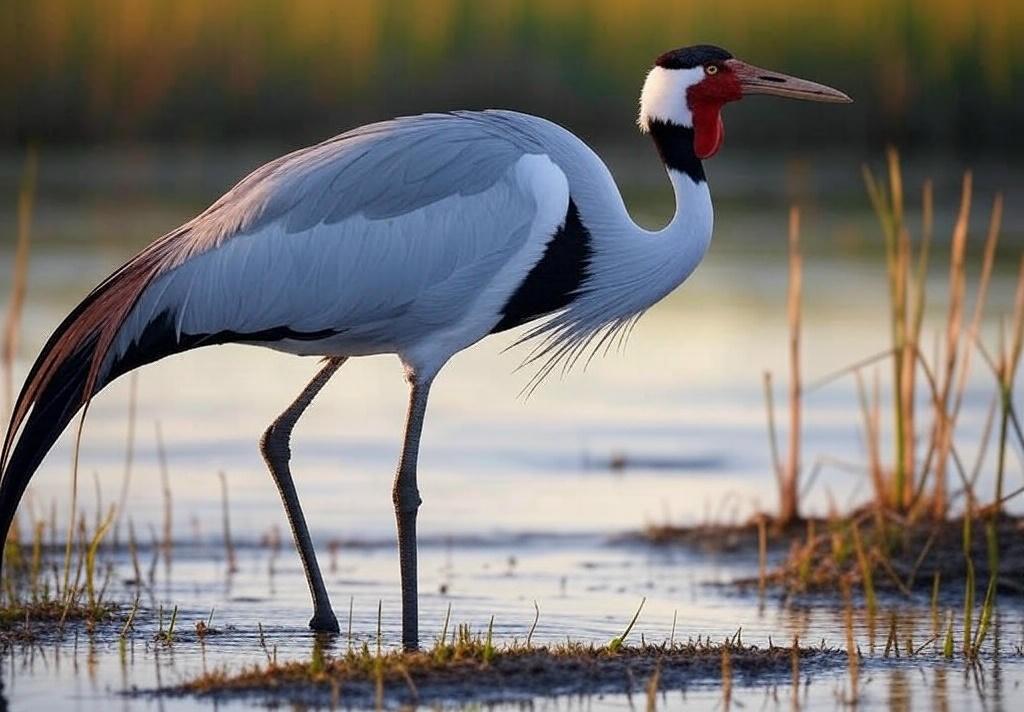
Bugeranus Carunculatus
Scientific Name(s) | Bugeranus Carunculatus | ||||||||
|---|---|---|---|---|---|---|---|---|---|
Conservation Status | Endangered (IUCN) | ||||||||
Distribution(s) | Eastern and Southern Africa | ||||||||
Habitat | Wetlands and Grasslands | ||||||||
Diet(s) | Aquatic Plants and Invertebrates | ||||||||
Wattled Crane is the largest crane species in Africa and is highly dependent on wetland habitats. This species is found in eastern and southern Africa, particularly in extensive swamps and river floodplains of Zambia and Botswana. Its global population is estimated at approximately 6,000–8,000 individuals and is classified as "Vulnerable" by the IUCN.
The Wattled Crane stands about 175 cm tall and weighs 7.5–9 kg. It is distinguished by its gray back, black underparts, long white neck and red bare face. It derives its name from the white dangling "wattles" of feathers hanging from its throat.
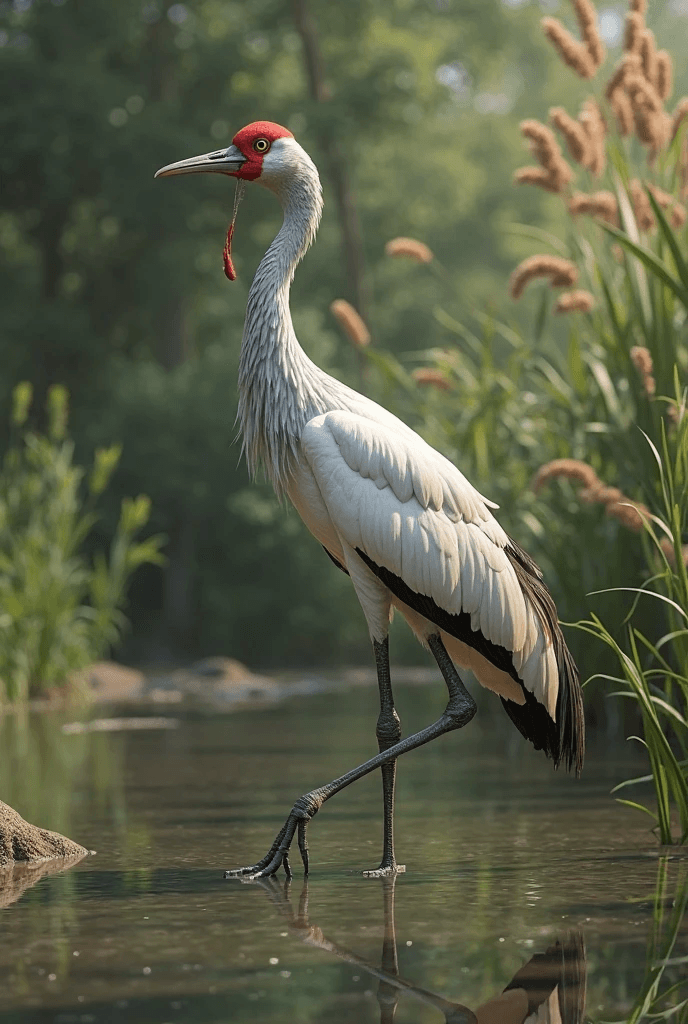
Wattled Crane (Generated by Artificial Intelligence)
This species inhabits habitats characterized by wetlands and grasslands. It occurs in Zambia, Botswana, Angola, Namibia, Zimbabwe, Mozambique, Tanzania, South Africa and Ethiopia. The largest populations are concentrated in Zambia’s Kafue Flats and Botswana’s Okavango Delta.
The Wattled Crane feeds on aquatic plant rhizomes and tubers, particularly of Eleocharis spp., as well as aquatic insects, mollusks and amphibians. Approximately 90 percent of its foraging activity occurs in shallow water. It is typically seen in pairs or small groups.
The breeding season usually begins in April. Nests are constructed from reeds at the edges of swamps. The incubation period lasts about 33–36 days and typically only one chick is successfully raised. Chicks acquire flight capability after approximately 100–150 days and remain with their parents for up to one year.
The Wattled Crane is threatened by habitat loss, wetland drainage, hydroelectric projects, agricultural expansion and human disturbance. Collisions with power lines and illegal egg collection also negatively impact its population. Internationally, it is protected under the Agreement on the Conservation of African-Eurasian Migratory Waterbirds (AEWA).
Animal Diversity Web. "Bugeranus carunculatus (Wattled Crane)." Animal Diversity Web. Accessed May 3, 2025. https://animaldiversity.org/accounts/Bugeranus_carunculatus/.
BirdLife International. “Wattled Crane Bugeranus Carunculatus Species.” BirdLife DataZone. Accessed May 3, 2025. https://datazone.birdlife.org/species/factsheet/wattled-crane-bugeranus-carunculatus.
International Crane Foundation. “Wattled Crane.” International Crane Foundation. Accessed May 3, 2025. https://savingcranes.org/species/wattled-crane/.
Mongabay. “Outlook Improves for Wattled Crane in South Africa.” Mongabay. Accessed May 3, 2025. https://news.mongabay.com/short-article/outlook-improves-for-wattled-crane-in-south-africa/.
SANBI. "Bugeranus carunculatus Gmelin JF, 1789." SANBI. Accessed May 3, 2025. https://speciesstatus.sanbi.org/assessment/last-assessment/2995/.
WWF. “Zambia: The Future of the Wattled Crane Hangs in the Balance.” WWF. Accessed May 3, 2025. https://wwf.panda.org/es/?12510%2FZambia-The-future-of-the-Wattled-Crane-hangs-in-the-balance=.

Bugeranus Carunculatus
Scientific Name(s) | Bugeranus Carunculatus | ||||||||
|---|---|---|---|---|---|---|---|---|---|
Conservation Status | Endangered (IUCN) | ||||||||
Distribution(s) | Eastern and Southern Africa | ||||||||
Habitat | Wetlands and Grasslands | ||||||||
Diet(s) | Aquatic Plants and Invertebrates | ||||||||
No Discussion Added Yet
Start discussion for "Wattled Crane (Bugeranus carunculatus)" article
Physical Characteristics
Habitat and Distribution
Diet and Behavior
Reproduction
Threats and Conservation