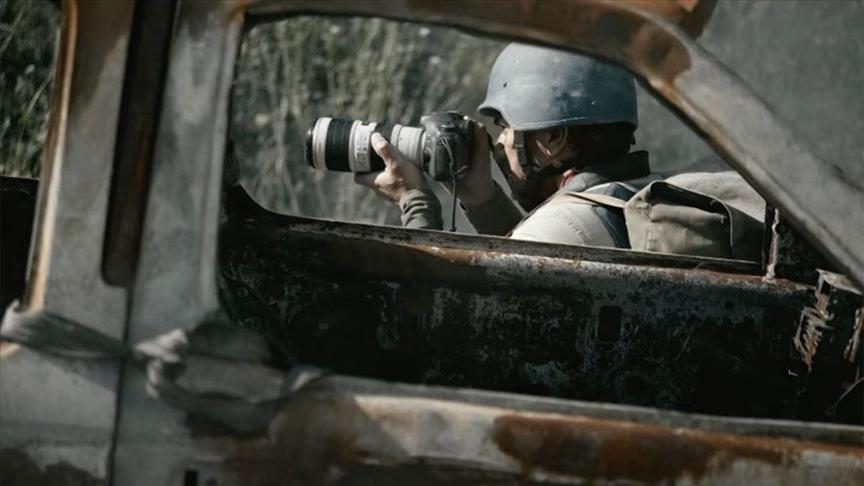
This article was automatically translated from the original Turkish version.
+2 More
Area of Expertise | Armed conflict, war, areas of social crisis | ||||||||
|---|---|---|---|---|---|---|---|---|---|
Social Role | Public transparency, accountability, documentation of human rights violations | ||||||||
Security Threats | Abduction, hostage-taking, capture by armed/illegal entities | ||||||||
Basic Task | Transmitting first-hand impartial information, data, and images from conflict zones | ||||||||
Basic Task | Transmitting data and images Providing first-hand impartial information from conflict zones | ||||||||
Main Field | Journalism | ||||||||
Social Role | Public transparency Accountability Documentation of human rights violations | ||||||||
Area of Expertise | Armed conflict War Areas of social crisis | ||||||||
Security Threats | Abduction by armed/illegal entities Hostage-taking Capture | ||||||||
War Correspondence is a specialized field of journalism that involves gathering firsthand information, images, and reports directly from armed conflicts, wars, uprisings, and social crisis zones, and transmitting them to the public. This profession serves the fundamental principles of public transparency and accountability by documenting, through firsthand records, the civilian struggle for survival beyond military strategies, humanitarian crises, migration movements, and human rights violations.
War correspondence, which defends the rights of democratic societies to access transparent, accountable, and uncensored information, has historically served as one of the mechanisms through which the true face and human cost of conflicts have been conveyed to the global public. During crises and wars, elements concealed by the powerful or warring parties through disinformation and manipulation tools can be revealed through the testimony of correspondents.
In this context, war correspondence fulfills a vital function by contributing to the enforcement of international law, the documentation of human rights violations, and the archival recording of events through firsthand accounts. Uncensored and objective data from the field make visible the civilian struggle behind diplomatic reports and military bulletins, revealing the tragedies faced by children, migration waves, and humanitarian crises such as famine, thereby laying the groundwork for global awareness.
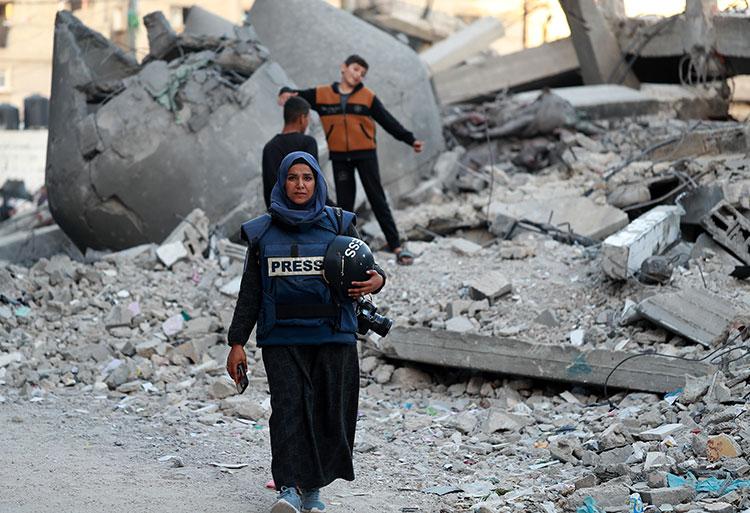
Palestinian Photo Correspondent Dua el-Baz (Anadolu Ajansı)
War correspondents play a crucial role in countering systematic propaganda campaigns designed to manipulate public opinion, deepen hostility policies, and legitimize war socially. Ethical journalism; enables correspondents to clearly understand the nature of conflict, its underlying causes, and the concrete destruction it produces.
Informed societies that recognize the truth can become a rational pressure force urging governments to end wars. Thus, a narrative framework centered on neutrality, by rejecting hate speech, opens space for a conciliatory rhetoric (the skillful, fluent, and persuasive communication of emotions and ideas); this lays the foundation for hidden dialogue channels between conflicting parties, directly or indirectly facilitating ceasefire processes, diplomatic negotiations, and ultimately, the opening of a path to lasting peace.
The preparation phase that a correspondent assigned to active conflict and war zones must undertake before stepping onto the field is a process that directly determines their chance of survival. The first and most strategic step of this operational preparation is acquiring an intellectual framework on the historical background, cultural fabric, ethnic and religious sensitivities, and current political and military dynamics of the mission area.
The correspondent must go beyond routine reporting by continuously researching the region, analyzing past and current news reports from international agencies, and reviewing current images and photographs to gain familiarity with the region’s physical conditions and visual landscape.
To comprehend the nature of the crisis without falling victim to one-sided manipulation, monitoring local discussions on digital platforms and through social media hashtags, and cross-verifying sources with triangulation methods are integral parts of this preparation process.
Even if an official travel schedule has not yet been finalized, examining strategic logistical routes, alternative pathways, road safety conditions, and accommodation options as if departure could occur at any moment prevents operational bottlenecks such as being unable to secure tickets or find lodging during sudden crises. Journalists, within this risk management framework, always keep a fully stocked and ready-to-deploy emergency bag containing their most essential life-saving and professional equipment.
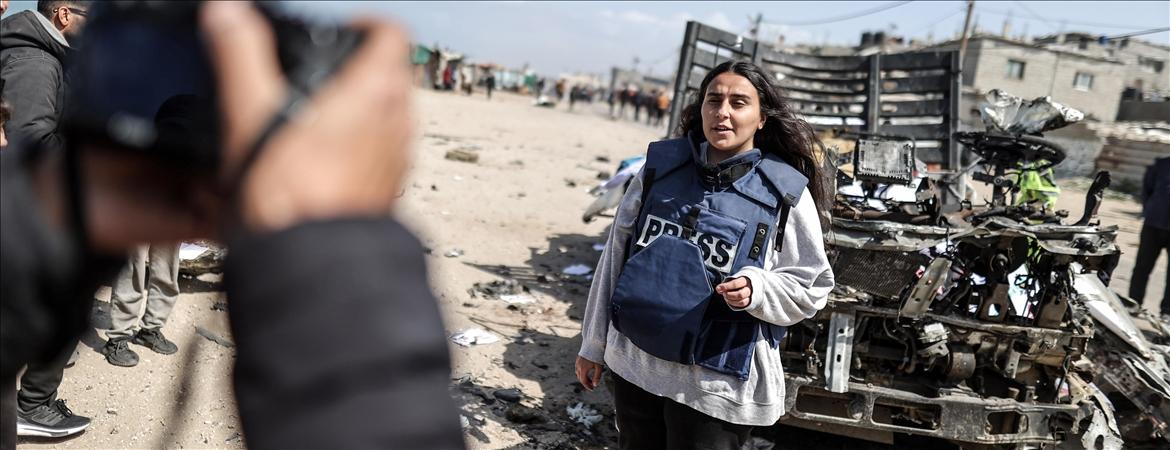
A Female Correspondent Operating in the Conflict Zone in Gaza (Anadolu Ajansı)
Establishing a sustainable communication network with local actors who are well acquainted with the region is a critical necessity in the logistical and operational preparation phase. Before deployment, correspondents must update contacts with local journalists, civil society representatives, politicians, military or militia figures, and local figures they previously met during earlier assignments to ensure reliable, firsthand information flow.
Especially to overcome language barriers, gain trustworthy access to sources, and receive accurate guidance, an early agreement must be reached with a seasoned and reliable local guide and translator, vetted through references from other colleagues.
In addition to all these operational networks, alternative travel plans, evacuation routes to safe zones, shelter strategies, and crisis evacuation protocols must be clearly defined, concrete, and documented in writing. Considering that communication with the news center may be disrupted in areas lacking reliable electricity and network infrastructure, backup communication devices such as long-lasting batteries, power adapters, and satellite phones must be tested and included in the emergency bag.
As a critical security measure, a coded communication protocol containing pre-agreed “safe words” (coded phrases) must be established so that the correspondent can discreetly alert the news center of danger during phone calls without revealing their situation, and this protocol must be synchronized with news center management.
When operating in active combat zones and frontline war areas, the safety of the correspondent and their team always takes precedence over the rating, visual quality, or special news value of the report. Accordingly, correspondents operating in operational zones use ballistic protective vests with steel or ceramic plates compliant with international ballistic protection standards (NIJ standards), designed to resist shrapnel and high-caliber bullets, along with ballistic helmets.
In terms of clothing, military uniforms, camouflage patterns, or attire resembling local militia groups must be avoided. Correspondents must wear blue or neutral-colored gear clearly marked with the prominent “PRESS” (BASIN) label to ensure they are immediately identifiable as independent civilian journalists, not combatants.
The most important logistical asset for a war correspondent in the operational terrain is the backpack they carry, optimized for weight and mobility. In addition to basic personal hygiene and nutrition needs, this bag must contain a first-aid kit capable of responding immediately to severe injuries sustained in active combat environments, including gauze, sterile dressings, wound tape, tincture of iodine, and tourniquets. It must also include painkillers, antipyretics, antibiotics, and medications for severe diarrhea to counter frequent infectious risks in the field environment.
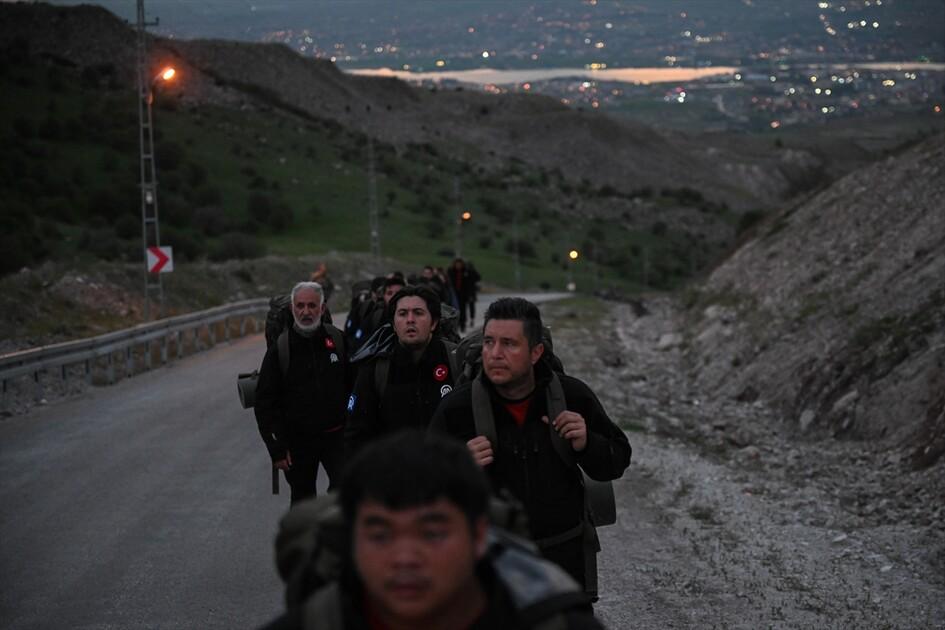
War Correspondence and Operational Processes (Anadolu Ajansı)
To ensure technical continuity in conflict zones, multi-purpose commando knives or pocket knives, as well as portable sensor-based alarm systems and specialized locking mechanisms that can be attached to doors or windows to enhance room security upon hotel arrival, should be included in the travel kit.【1】
In war conditions where infrastructure has collapsed, electricity has been cut for days, or completely destroyed, reliable communication with the center and transmission of digital data require power adapters compatible with the host country’s electrical system, high-capacity long-lasting portable power stations (power banks), and satellite phones as indispensable technical components of the emergency bag.
In addition, a large white scarf must be included in the correspondent’s bag; this accessory can serve as a mechanical tourniquet or padding to stop bleeding in case of severe injury, or as a mask against dust storms or chemical gas exposure. In critical moments, it can function as a white flag (symbol of surrender or civilian status), preventing weapons from being directed at the correspondent.【2】
Upon arrival in active conflict and crisis zones, every behavioral pattern and reporting methodology employed by correspondents and their teams is strategically vital for sustaining operational safety. Upon reaching the area, correspondents must resist pressure from news managers or institutional structures to prioritize sensational imagery and breaking news, avoiding hasty and impulsive decisions.
Before taking any operational step, time must be allocated to understand the region’s sociological structure, the current trajectory of the conflict, logistical routes, and alternative escape paths. Safe movement in the field requires complete visual familiarity with all surrounding military and paramilitary symbols—from flags used at checkpoints and uniforms to armbands and identification markings on armored vehicles.
When selecting accommodation, strategic risk assessments must be considered. Hotels where one of the warring parties regularly holds diplomatic or military meetings and makes operational decisions may appear advantageous as information sources, but they must be avoided due to the risk of becoming direct military targets. Instead, correspondents should prefer shared living spaces that are less conspicuous yet connected to logistical networks, occupied by other international independent correspondents, enabling rapid deployment of professional solidarity and collective security mechanisms during emergencies.
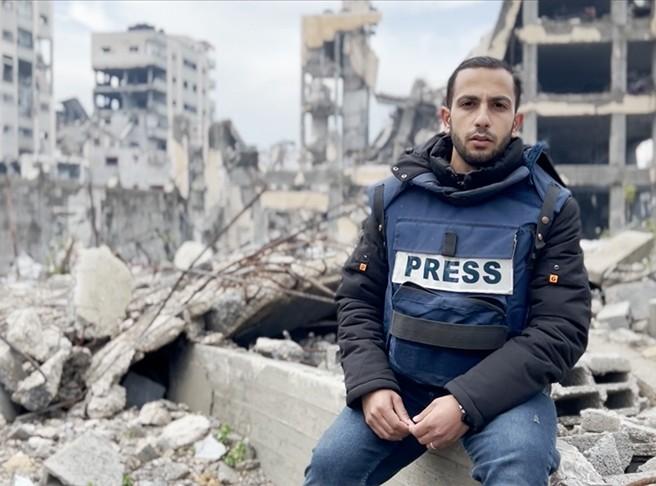
Journalist Enes eş-Şerif, Killed in the Conflict in Gaza (Anadolu Ajansı)
While actively reporting in the field, careful analysis of environmental factors and natural changes serves as the correspondent’s defense mechanism against invisible threats.
During field reconnaissance or street reporting, an unusual silence, rapid closure of shops, or complete emptying of streets indicates that a military operation, artillery bombardment, or ambush is imminent; in such cases, correspondents must immediately withdraw to safe corridors.
Especially along active combat lines, extreme vigilance is required against unexploded ordnance, cluster munitions, and anti-personnel minefields. One must never be the first to enter abandoned public buildings, shelters, or enclosed spaces without conducting a thorough search.
The news center must be regularly and continuously informed of travel routes and real-time location changes, with every movement planned according to an evacuation protocol. The critical ethical and humanitarian dimension of field activities lies in safeguarding the lives of local sources who provide information to the correspondent through interviews or acts of hospitality.
In war correspondence, the rigid 5W1H rules of traditional journalism must sometimes be relaxed; because the content of a report, even after the correspondent has safely left the area, can become a threat to local sources who continue to live there. Accordingly, any visual or textual detail that reveals the identities, families, exact coordinates, or hiding places of civilians or local guides must be removed from news bulletins.
Secret or open recordings must not be made without the explicit consent of individuals; if individuals request, on security grounds, that recordings not be published after interviews, the relevant content must be removed from archives.
The most fundamental element distinguishing professional war correspondence from propaganda journalism and ensuring the legitimacy of journalism itself is strict adherence to universal ethical principles and objectivity standards. Correspondents operating in conflict zones, even when subjected to psychological and institutional pressure from their own media organizations or societies to demonize the opposing side and absolutize their own, are obligated to report events solely based on bare reality.
Regardless of pressure from their employers or societies to vilify the enemy or glorify their own side, correspondents must resist disinformation mechanisms and report only what they observe on the ground.
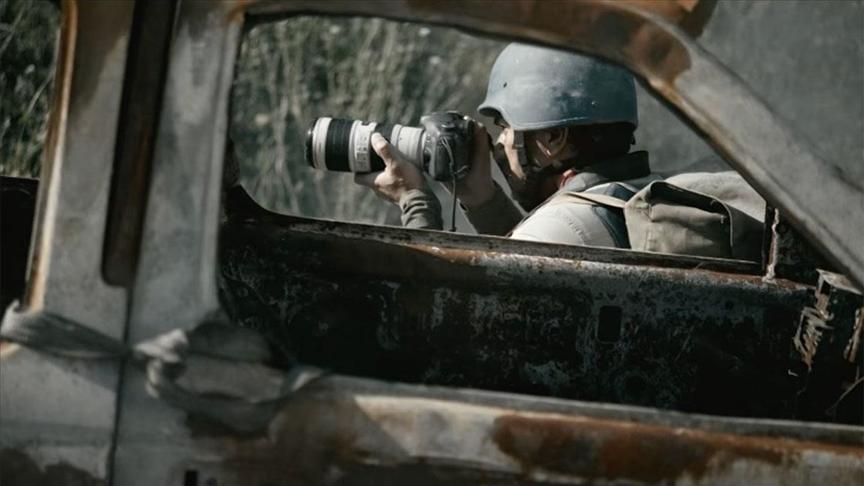
A Photo Correspondent During a Crisis (Anadolu Ajansı)
As emphasized by professional authorities such as the International Network of Ethical Journalism, ethical reporting in conflict zones requires adopting a fair, balanced, and unbiased stance that reflects all dimensions of the events unfolding.【3】 In this spirit, going beyond dominant narratives to tell the stories of the “others” and the silenced masses is essential for fully understanding the humanitarian dimension of war.
Questioning the true motives and intentions behind statements by politicians or military leaders designed to mobilize public opinion, incite hatred, or escalate tensions is among the core duties of war correspondents, as it prevents such rhetoric from becoming propaganda tools.
The nature of active combat, due to logistical and security constraints, often prevents a single correspondent from simultaneously observing both sides of the front or collecting data from both sides at the same time. However, this physical impossibility cannot justify one-sided reporting; the responsibility for maintaining balance and ensuring bulletin objectivity rests directly with news centers. News centers must create balanced broadcasts by assigning correspondents to both opposing fronts simultaneously or at different times, or by calmly integrating field reports with information from international agencies, digital networks, and official statements from opposing parties.
War correspondence ranks among the most dangerous, physically and psychologically exhausting professional fields globally, carrying high levels of life-threatening, operational, and logistical risks.
Journalists and photo correspondents actively operating on the frontlines face immediate lethal physical threats without regard to factional affiliation: being caught in crossfire, subjected to heavy artillery bombardment, or targeted by bombs and uncontrolled shrapnel from aerial strikes.
The unpredictable nature of conflict zones, the rapid shifting of frontlines, and the integration of modern asymmetric warfare elements transform the correspondent’s mission into a fight for survival. In open terrain with no shelter or protected areas, walking the fine line between ensuring personal safety and maintaining the flow of public information is an unavoidable physical reality of this profession.
However, the dangers of war correspondence are not limited to physical risks from explosions. Behind the profession lie organized, systematic, and targeted operational threats. Regular armies, paramilitary structures, radical militias, and illegal terrorist organizations seeking to conceal human rights violations, civilian massacres, or their own military failures often impose total information blackouts, cut off all communication, or disseminate only their own one-sided propaganda. These actors do not hesitate to treat independent journalists as deliberate targets.
In this context, the abduction of journalists regardless of their professional identity, prolonged detention in cells for days or even months as political or military leverage, unjust trials on false charges of espionage, torture, and even execution to intimidate the international public form the threat matrix faced by the profession.
The difficulty of transmitting data to the center under harsh geographic conditions, inadequate shelter, nutrition, and hygiene, and damaged or non-functional communication infrastructure is an integral part of the working conditions of war correspondence.
Anadolu Ajansı. "'AA'nın Savaş Muhabirliği Eğitimi uluslararası boyut kazandı'." Anadolu Ajansı. Accessed May 26, 2026. https://www.aa.com.tr/tr/kurumsal-haberler/aanin-savas-muhabirligi-egitimi-uluslararasi-boyut-kazandi/1534991
Anadolu Ajansı. "AA'nın 29. Dönem Savaş Muhabirliği Eğitimi 11. gününde devam ediyor." Accessed May 26, 2026. https://www.aa.com.tr/tr/kurumsal-haberler/aanin-29-donem-savas-muhabirligi-egitimi-11-gununde-devam-ediyor/3944713
Anadolu Ajansı. "AA'nın Savaş Muhabirliği Eğitimi, gazetecileri zorlu koşullara hazırlıyor." Accessed May 26, 2026. https://www.aa.com.tr/tr/kurumsal-haberler/aanin-savas-muhabirligi-egitimi-gazetecileri-zorlu-kosullara-hazirliyor/2702910
Anadolu Ajansı. "Anadolu Ajansının '23. Dönem Savaş Muhabirliği Eğitimi' 2 Ekim'de başlayacak." Accessed May 26, 2026. https://www.aa.com.tr/tr/kurumsal-haberler/anadolu-ajansinin-23-donem-savas-muhabirligi-egitimi-2-ekimde-baslayacak/3001097
Anadolu Ajansı. "Gazze'deki kadın gazeteciler Dünya Kadınlar Günü'nde Filistin'deki dramı anlatıyor." Accessed June 15, 2026. https://www.aa.com.tr/tr/ayrimcilikhatti/kadin/gazzedeki-kadin-gazeteciler-dunya-kadinlar-gununde-filistindeki-drami-anlatiyor/1819333
Anadolu Ajansı. "Gazze'deki kadın gazeteciler Dünya Kadınlar Günü'nde Filistin'deki dramı anlatıyor." Accessed June 15, 2026. https://www.aa.com.tr/tr/dunya/gazzedeki-kadin-gazeteciler-dunya-kadinlar-gununde-filistindeki-drami-anlatiyor/3158703.
Anadolu Ajansı. "Gazze’de hayatını kaybeden Al Jazeera muhabiri Enes eş-Şerif’in vasiyeti yayımlandı." Accessed June 15, 2026. https://www.aa.com.tr/tr/dunya/gazze-de-hayatini-kaybeden-al-jazeera-muhabiri-enes-es-serif-in-vasiyeti-yayimlandi/3656020.
Anadolu Ajansı. "Savaş Muhabirliği Eğitim Programı." Anadolu Ajansı. Accessed May 26, 2026. https://www.aa.com.tr/tr/haberakademisi/savas-muhabirligi-egitimi-/savas-muhabirligi-egitim-programi/533278
Aydın AdnanMenderes Üniversitesi. "ARAFTA 40 GÜN: SAVAŞ MUHABİRLİĞİ." gzt.adu.edu. Accessed May 26, 2026. https://gzt.adu.edu.tr/haber/arafta-40-gun-savas-muhabirligi-9360
Dost, Süleyman. “Uluslararası Silahlı Çatışmalarda Gazetecilerin ve Medya Araçlarının Korunması”. *Ankara Barosu Dergisi* 76, no. 2 (2018): 171–203. Accessed May 26, 2026. https://doi.org/10.30915/abd.469949
Ertuna, Can. "Savaş muhabirliği: Tehditler ve etik sorunlarla mücadele." newsLabTurkey.org. Accessed May 26, 2026. https://www.newslabturkey.org/2018/10/29/savas-muhabirligi-tehditler-ve-etik-sorunlarla-mucadele/
Koçak, Ali. "Türkiye’de savaş muhabirlerinin çalışma ortamları (Yüksek lisans tezi)." Ankara Üniversitesi Sosyal Bilimler Enstitüsü, Radyo Sinema Televizyon Anabilim Dalı, pp. 2-127. Accessed May 26, 2026. https://www.academia.edu/95607292/T%C3%BCrki_ye_De_Sava%C5%9F_Muhabi_rleri_ni_n_%C3%87ali%C5%9Fma_Ortamlari
Yeditepe Üniversitesi. "Savaş Muhabirliği Nedir Ve Ne Kadar Zor?" Yeditepe University. Accessed May 26, 2026. https://yasamboyu.yeditepe.edu.tr/savas-muhabirligi-nedir-ve-ne-kadar-zor-blog
[1]
Can Ertuna, "War Correspondence: Fighting Threats and Ethical Issues" newslabturkey.org, accessed 26 May 2026, https://www.newslabturkey.org/2018/10/29/savas-muhabirligi-tehditler-ve-etik-sorunlarla-mucadele/
[2]
Can Ertuna, "War Correspondence: Fighting Threats and Ethical Issues."
[3]
Can Ertuna, "War Correspondence: Fighting Threats and Ethical Issues."

Area of Expertise | Armed conflict, war, areas of social crisis | ||||||||
|---|---|---|---|---|---|---|---|---|---|
Social Role | Public transparency, accountability, documentation of human rights violations | ||||||||
Security Threats | Abduction, hostage-taking, capture by armed/illegal entities | ||||||||
Basic Task | Transmitting first-hand impartial information, data, and images from conflict zones | ||||||||
Basic Task | Transmitting data and images Providing first-hand impartial information from conflict zones | ||||||||
Main Field | Journalism | ||||||||
Social Role | Public transparency Accountability Documentation of human rights violations | ||||||||
Area of Expertise | Armed conflict War Areas of social crisis | ||||||||
Security Threats | Abduction by armed/illegal entities Hostage-taking Capture | ||||||||
Historical and Social Role
Operational Preparation and Deployment Processes
Field Safety and Equipment Standards
Field Behavior and Reporting Methods
Ethical Principles and Neutrality Standards
Professional Challenges and Risk Analysis