


This article is not approved yet.
The violin is the smallest instrument in the string instrument family. The violin is a type of instrument with a history dating back to the most distant years and various civilizations have used it for centuries. The main material of the violin is preferred as wood during the production phase. The basic components of the violin are; the body of the violin, the bow, and the violin shoulder rest. There are four strings on this instrument. These strings extend from the neck section of the violin to the lower tail section. At the same time, these strings are used as Sol (G), Re (D), La (A), and Mi (E), respectively, from the low note to the high note.
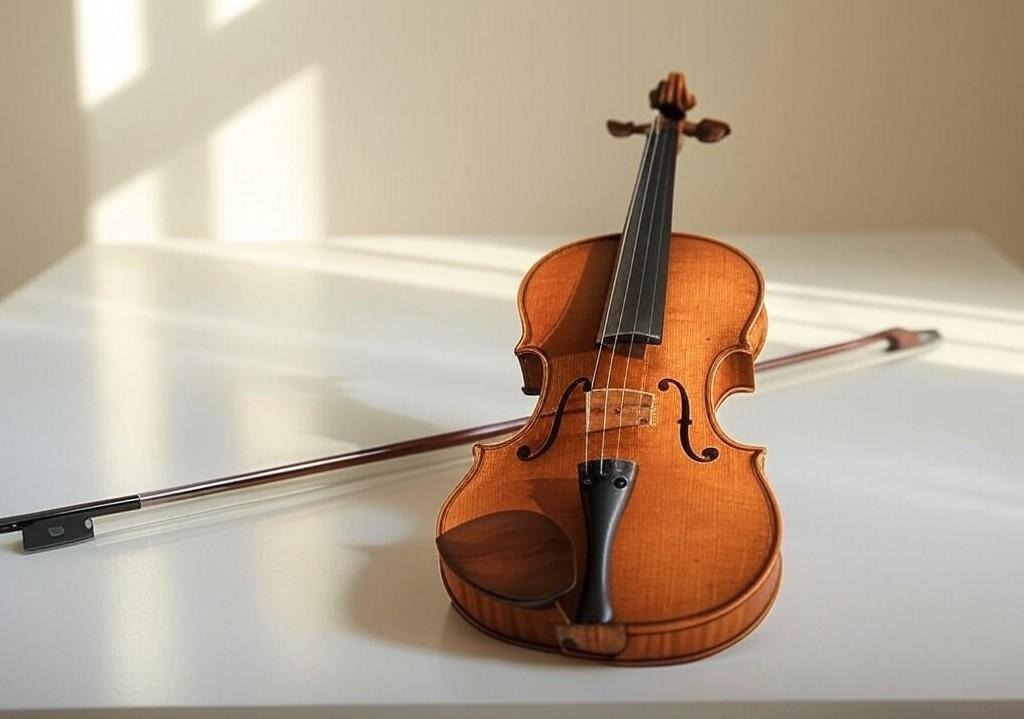
Violin
For the violin to produce a clear sound, the bow must be rubbed on the strings, and at the same time, the strings on the neck of the instrument must be pressed with the fingers. Applying rosins made from a tree's sap to the bow is one of the most basic requirements for the instrument to produce a clean note when the bow touches the violin.
The chin should be placed on the black and boat-shaped chin rest on the lower body of the violin in front. For the violin to not hurt the chin during long use, the violin's shoulder rest is placed at the behind side of the instrument. The aim is to close the gap between the violin and the shoulder with the violin shoulder rest so that the violin can be held horizontally and the musician does not slouch. The violin strings are individually wrapped and attached to the pegs located in the hole inside the section called the snail (peg box) on the violin. The other rounded ends of the strings should be passed over the middle bridge and attached to the gaps in the tail close to the chin-rest. The strings are tightened by turning the pegs at the top. This process should continue until the notes Sol (G), Re (D), La (A), and Mi (E) are reached. When the relevant notes are reached, the pegs are pushed strongly into the snail.
The bow is held with the right or left hand from the bottom of it. The thumb is positioned on the left side, the index finger, middle finger, and ring finger are on the right side, and the little finger is positioned near at the bottom of the bow. By applying rosin to the bow, it is ensured that the violin can produce a sound with the help of the rub of the bow on it.
The violin has 4 different sizes. Those sizes are chosen according to the age of the musician because there are differences in length and width as well as bow length between sizes. Violin sizes are as follows;
There are two distinct categories of violins: factory-made and handmade. Factory-made violins typically exhibit a coloration ranging from brown to dark orange. The principal differentiation between these two categories lies in the tonal qualities and sound output of the instruments. Handmade violins possess the capacity to generate a significantly louder sound in comparison to factory-made violins (depending on the quality of the strings and bow that are used), whereas factory-made violins generally produce a reduced sound output, as they are being used for basic training purposes.
The earliest instances of the smallest member of the string instrument family can be traced back to the 9th century. The initial violins were crafted in the Central Asian region, notably by Persian, Indian, and Chinese communities. The production techniques used in the creation of these early violin forms were relatively primitive and simple. For instance, the earliest violins emerged from the use of wood, coconut shells, or stones. During the domestication of horses within Central Asian societies, the violin bow was created by using long hairs from the tails of horses. Consequently, the violin contributed to the evolution of the musical melodies created and developed by these societies.
Karnaval Sanat Okulu. (2019). Kemanın Tarihçesi. Karnaval Sanat Okulu. https://karnavalsanat.com/blog/makaleler/kemanin-tarihcesi/
Keman Akademisi. (2024). Kemanın Tarihi Serüveni: Efsanevi Bir Müzik Enstrümanının Doğuşu. Keman Akademisi. https://kemanakademi.com.tr/keman/kemanin-tarihi

Holding the Violin and Bow
How to Play the Violin
How to Hold and Use the Bow
Violin Sizes and Styles
History of the Violin