


This article was automatically translated from the original Turkish version.
+1 More
Village Spectacle Plays, are traditional performances with dramatic elements, organized and enacted by rural communities, especially during the long winter months as well as at weddings and holidays, for entertainment and passing time. According to historical sources, these plays are based on a very ancient oral tradition and have continued in Anatolia since after 1071, parallel to the activities of ozans, maintaining their presence to the present day. They are considered older than the urban cultural products Karagöz (Shadow Play) and Orta Oyunu. Professor Dr. Şükrü Elçin has also used the term “Village Orta Oyunu” to define these plays.【1】
Village Spectacle Plays hold an important place within the tradition of Traditional Turkish Theatre. These performances, typically carried out by villagers under names such as “making a play” or “bringing out a play,” are distinguished above all by their anonymity—that is, their creators are unknown. The plays do not rely on a written text. Although they have a general structure, they are performed extemporaneously (tuluat), shaped by the performers’ skills and the audience’s reactions and participation. The frameworks of musical, dance-based, silent, and folk-song plays are more defined. In these plays, the actual managers or directors are tradition and custom. In regions where a managerial figure emerges, this person is called “Delikanlı başı,” “Köse,” “Meydancı,” or “Oyuncubaşı.” These individuals oversee the preservation of the plays in their original, authentic form.
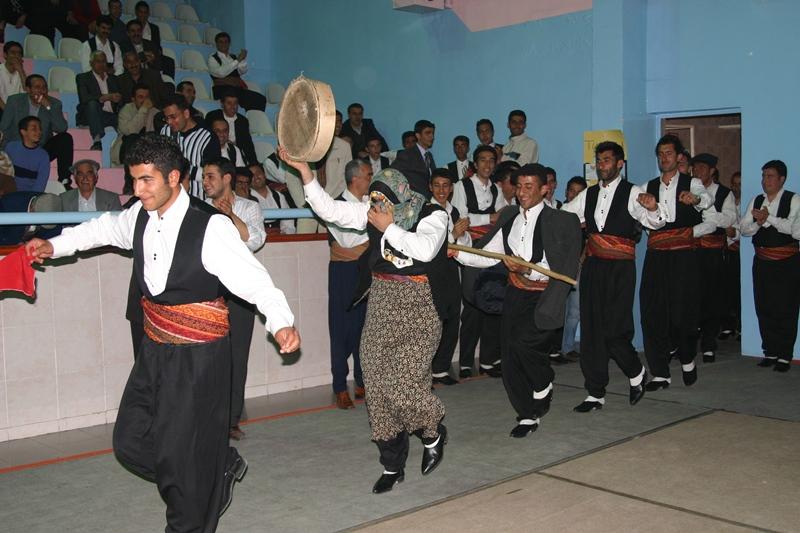
Village Spectacle Play (Elazığ Ministry of Culture and Tourism)
Village Spectacle Plays are a form of theatre that has survived from thousands of years ago to the present. They have persisted since antiquity. Their origins lie in the ritual practices of villagers, who dramatized ceremonies aimed at enhancing fertility in agriculture and animal husbandry. The villagers believed these rituals would bring blessings from the gods. Because its function stems from ritual ceremonies, the tradition of peasant theatre differs from the broader Folk Theatre tradition.
These plays have undergone a functional transformation: originally they were obligatory. Villagers consciously participated in them to ensure the productivity of their lives; the acts performed carried a sacred and worshipful character. However, over centuries, this obligation gradually faded, and spectacle plays came to be defined as a form of entertainment. Today, they are largely sustained for amusement, far removed from myths and spiritual states. Generally, Village Spectacle Plays are divided into two main categories: ritual plays and profane (secular) plays. Villagers further classify them into humorous, tragic, silent (samıt or lal), and puppet (baby) types.【2】
The plays typically coincide with the autumn and winter months, periods associated with farming and animal husbandry. They are also performed during ceremonies such as weddings, both day and night. Performances take place in two types of spaces: open (village square, threshing floors, courtyards) and enclosed (large village rooms or houses). The performance space must be large enough to accommodate both performers and audience. Performers and spectators are arranged in a circular formation, surrounding each other (performative space).
Performers are generally young or middle-aged non-professionals. The most capable among them assume the role of manager (director). In plays prepared by men, women are portrayed by men; in plays prepared by women, men are portrayed by women. The audience spans all ages from children to the elderly. Anyone may attend performances held in open spaces, whether invited or not. In areas with stronger religious observance, men and women may watch from separate locations. The audience actively participates and becomes a producer of the performance. In entertainment-oriented plays, spectators may converse with performers and even disrupt the play. At the end of ritual plays, performers are rewarded with food.
Village Spectacle Plays (YouTube / TRT Avaz)
In Village Spectacle Plays, elements common in modern theatre such as auditoriums, stages, sets, lighting, and special effects are rarely or never used. There is no fixed concept of set design; performers merely indicate their location verbally. Costumes and props are made from simple materials appropriate to the period. It is irrelevant whether a man portraying a woman has hair or a beard; this artificiality enhances the sense of otherness. Props may be false (a stick), real (a rifle), or living (a person). Makeup is applied in exaggerated and practical ways, using wood soot or pot black (Arab makeup) or flour (White people). Music and dance are indispensable and vital components of these plays. In ritual plays, music and dance have a devotional character; in entertainment-oriented plays, they are purely for amusement.
In the Isparta region, these plays are generally referred to as “Maşalama.” Some identified examples include: 【3】
These folk theatre plays, once widely performed in rural areas, are now on the verge of disappearing. The main reasons for this decline are the failure to train new performers and changes in tastes, entertainment preferences, and living conditions. For example, the lack of young performers for the Camel Play has caused it to lose its vitality. Village Spectacle Plays are not classified as Modern Theatre because they lack written texts. However, it is emphasized that this theatrical form, which encompasses all dramatic elements, must be archived and preserved through the efforts and support of researchers, and must be revitalized by integrating it into contemporary theatre.
Aydın İl Directorate of Culture and Tourism. "Halk Tiyatrosu." Accessed October 9, 2025.https://aydin.ktb.gov.tr/TR-64474/halk-tiyatrosu.html.
Elazığ İl Directorate of Culture and Tourism. "Seyirlik Oyunlar." Accessed October 9, 2025.https://elazig.ktb.gov.tr/TR-58543/seyirlik-oyunlar.html.
Isparta İl Directorate of Culture and Tourism. "Köy Seyirlik Oyunları." Accessed October 9, 2025.https://isparta.ktb.gov.tr/TR-71006/koy-seyirlik-oyunlari.html.
TRT Avaz. "Deve Oyunu - Akın Köyü / Tokat - Derin Kökler - TRT Avaz." YouTube. Date Published January 3, 2015. Accessed October 9, 2025.http://www.youtube.com/watch?v=jDAALm66hyA
Turk Edebiyatı. "Köy Seyirlik Oyunları." Turk Edebiyatı. Accessed October 9, 2025.https://www.turkedebiyati.org/koy-seyirlik-oyunlari/.
İçyar, Cem. “Köy Seyirlik Oyunları’nın Yapısal Özellikleri.” Dergipark / Atatürk Üniversitesi. Accessed October 9, 2025.https://dergipark.org.tr/tr/download/article-file/308582.
[1]
İçyar, Cem. “Köy Seyirlik Oyunları’nın Yapısal Özellikleri.” Dergipark / Atatürk Üniversitesi. Erişim 9 Ekim 2025. https://dergipark.org.tr/tr/download/article-file/308582
[2]
İçyar, Cem. “Köy Seyirlik Oyunları’nın Yapısal Özellikleri.” Dergipark / Atatürk Üniversitesi. Erişim 9 Ekim 2025. https://dergipark.org.tr/tr/download/article-file/308582
[3]
Isparta İl Kültür ve Turizm Müdürlüğü. “Köy Seyirlik Oyunları.” Isparta İl Kültür ve Turizm Müdürlüğü. Erişim 9 Ekim 2025. https://isparta.ktb.gov.tr/TR-71006/koy-seyirlik-oyunlari.html

No Discussion Added Yet
Start discussion for "Village Watching Games" article
General Characteristics and Nature
Historical Origins and Function
Structural and Technical Features
Time and Space of the Plays
Performers and Audience
Stage Elements
Examples from the Isparta Region
Current Situation