This article was automatically translated from the original Turkish version.
Developer | Canonical Ltd. and the Open Source Community | ||||||||
|---|---|---|---|---|---|---|---|---|---|
Base | Debian GNU/Linux (Unstable branch) | ||||||||
Initial Release | October 2004 (Warty Warthog) | ||||||||
Name Origin | From Nguni Philosophy ("I am because we are") | ||||||||
Supported Architectures | x86-64 (AMD64), ARM64, ppc64le, s390x | ||||||||
Installation Method | Live Image (Canlı Görüntü) / ISO | ||||||||
Package Format | .deb (Debian package) and Snap | ||||||||
Ubuntu is a comprehensive operating system distribution built primarily on the Debian GNU/Linux architecture and composed largely of free and open source software (FOSS) components. The development of this distribution is jointly managed by Canonical Ltd., a company headquartered in the United Kingdom, and a global community of developers. Canonical Ltd., founded by Mark Shuttleworth to ensure the financial sustainability of the project and to employ its development team, serves as the primary sponsor. The name "Ubuntu" is derived from the Nguni philosophy of Southern Africa and embodies ethical and humanistic values such as "humanity toward others" or "the individual's existence gains meaning through the community" (I am because we are). The first release of the operating system, "Warty Warthog," was introduced to the technology world in October 2004.
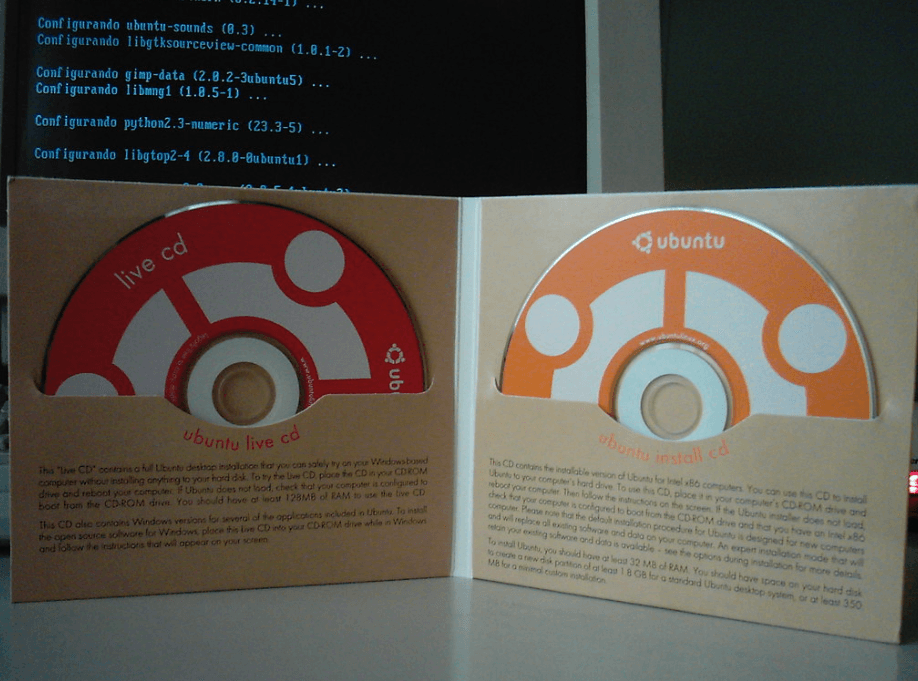
Ubuntu (Flickr)
Ubuntu adopts a six-month periodic release cycle to enhance predictability in the software world. Within this cycle, Long Term Support (LTS) releases are published every two years, emphasizing stability and continuity. Standard LTS releases receive official support for five years, including compatibility with new hardware architectures, security patches, and updates to the Ubuntu stack that forms the cloud infrastructure. With the release of Ubuntu 12.04 LTS, a strategic change aligned desktop user support duration with server support, extending both to five years.
Canonical offers a subscription service called Ubuntu Pro to meet enterprise needs. This service extends the security updates and patch support provided for LTS releases from five to ten years, and under specific conditions up to twelve years. Ubuntu Pro integrates Kernel Livepatch technology to maximize system availability, thereby eliminating the traditional conflict between uptime requirements and security needs. For enterprise ecosystems, Ubuntu Pro includes integrated security hardening tools that facilitate compliance with internationally recognized regulatory frameworks such as FIPS 140, DISA-STIG, CIS, FedRAMP, CMMC, and PCI-DSS. For managing distributed and large-scale infrastructures, the Landscape management platform is used. Landscape simplifies IT operations by enabling centralized monitoring, management, and automation of update processes across all Ubuntu inventory.
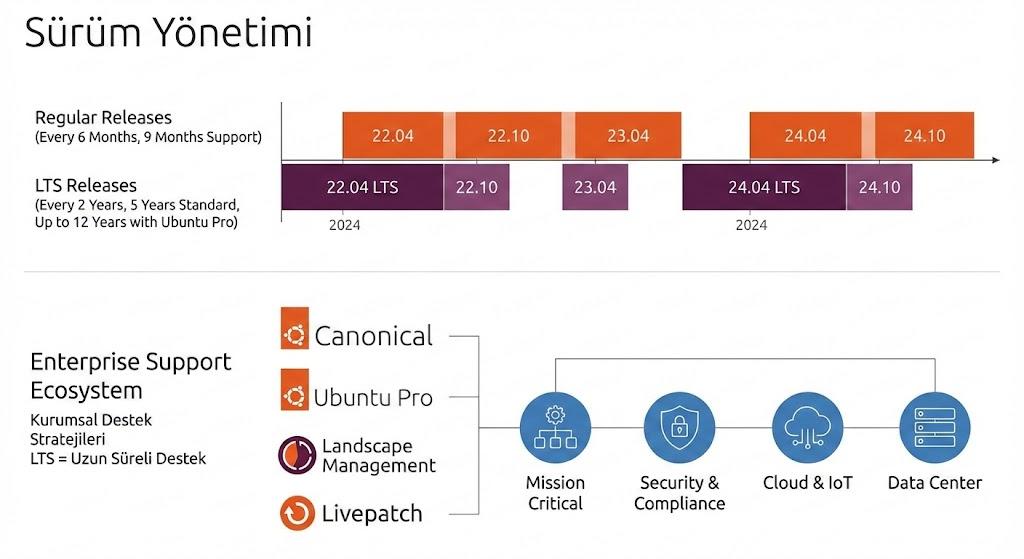
Ubuntu sürüm yönetimi (Yapay zeka ile oluşturulmuştur)
Ubuntu’s architectural foundation is built upon the infrastructure of Debian, one of the most established distributions in the Linux world. Packages are synchronized from Debian’s "unstable" branch into the Ubuntu ecosystem. However, there is no mandatory binary compatibility between Debian and Ubuntu packages; therefore, some Debian packages require recompilation to function stably within the Ubuntu environment.
Ubuntu uses the .deb package format along with Debian’s standard tools, dpkg and APT (Advanced Package Tool). To enhance the end-user experience, graphical interfaces such as GNOME Software (formerly Ubuntu Software Center) are provided. Additionally, the Snap packaging technology is actively employed in the system to minimize dependency issues and improve cross-distribution portability.
Ubuntu categorizes its software repository into four main groups based on licensing models and support levels:
Additionally, the Personal Package Archives (PPA) mechanism allows users to distribute their own compiled packages and serve them as an APT repository.
Ubuntu officially supports various 64-bit architectures including x86-64 (AMD64), ARM64, ppc64le (IBM POWER8 and above), and s390x (IBM Z systems) to accommodate hardware diversity. The installation process is typically carried out via a disk image (.iso). This image can be run as a "Live Session," allowing users to test hardware compatibility and user experience before permanently installing the operating system on their computer’s hard drive.
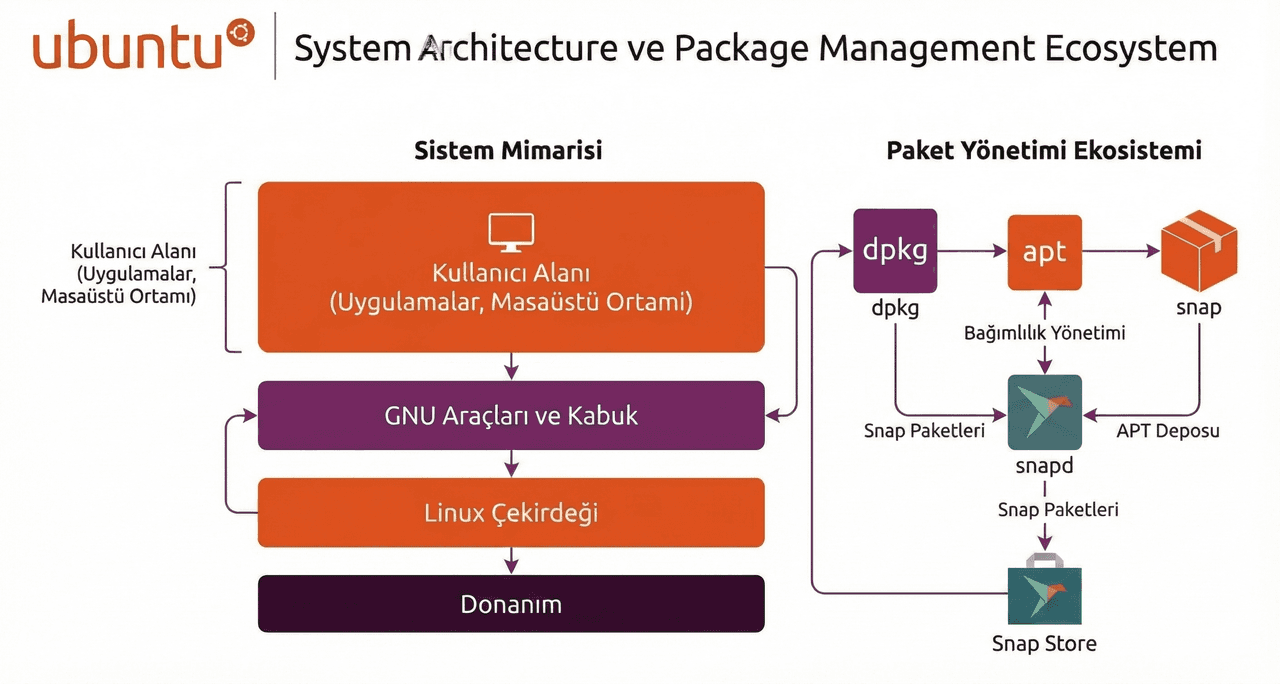
Sistem Mimarisi ve Paket Yönetimi Ekosistemi (Yapay zeka ile oluşturulmuştur)
Ubuntu treats security as a multi-layered defense strategy applied across the entire system rather than relying on a single point of protection.
At the core of Ubuntu’s security architecture is the Principle of Least Privilege. This principle mandates that user processes run by default with minimal permissions, preventing damage to the rest of the system or other users’ data in the event of a security breach. Instead of direct use of the "root" account for administrative tasks, the sudo mechanism is employed to grant temporary privilege escalation. This approach minimizes the risk of unauthorized access and critical system damage caused by human error by keeping the root account locked.
Beyond standard Discretionary Access Control (DAC) mechanisms, Ubuntu employs Mandatory Access Control (MAC) frameworks to enforce stricter process controls. The default MAC system is AppArmor. AppArmor restricts each application’s access to specific files or system calls based on predefined profiles. Thus, even if an application is compromised, the attacker’s movement is confined within the boundaries defined by that application’s profile.
The first step in securing a server is service minimization. Unencrypted and insecure protocols such as Telnet and FTP should be disabled and even removed entirely from the system, as every unnecessary service expands the attack surface.
The Linux kernel’s netfilter subsystem is used to monitor network traffic. Ubuntu provides the Uncomplicated Firewall (UFW) interface to simplify the configuration of iptables rules. The network hardening strategy follows the "default deny" principle: only ports essential for functionality, such as port 22 for SSH and port 443 for HTTPS, are permitted while all other traffic is blocked. Additionally, local support is provided for full disk encryption and encryption of user directories to ensure data confidentiality.
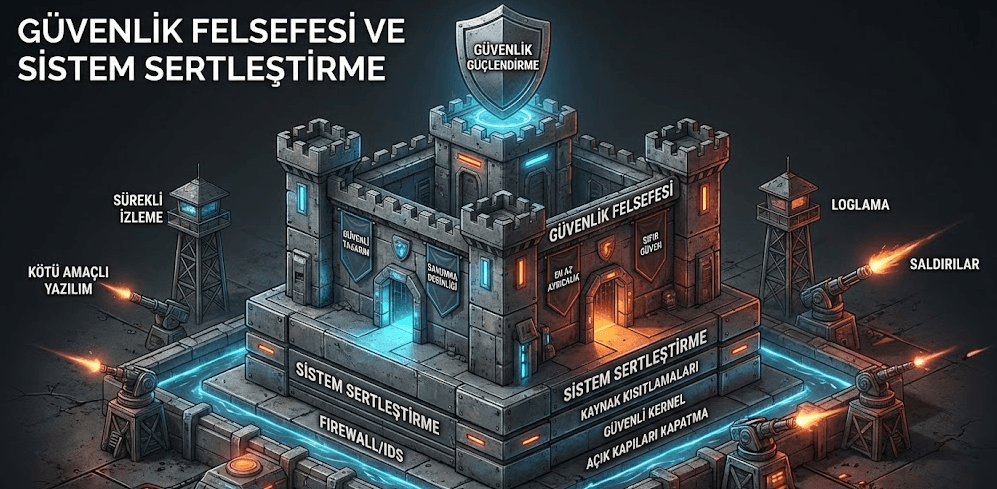
Güvenlik Felsefesi ve Sistem Sertleştirme (Yapay zeka ile oluşturulmuştur)
Canonical offers solutions optimized for containerization, the modern application deployment model. Ubuntu-based images labeled as "chiseled" or "distroless" contain only the minimum libraries required for an application to run. This minimalist approach significantly reduces the attack surface by eliminating unnecessary components.
Canonical provides an aggressive service level agreement (SLA) for container security: CVE (Common Vulnerabilities and Exposures) entries identified as high or critical within its images are guaranteed to be patched within 24 hours. These images are built atop the trusted base of the host operating system and are automatically rebuilt upon the release of security patches to maintain their currency.
Ubuntu provides an ideal foundation for Software Defined Networking (SDN) architectures, which revolutionize network management by decoupling the control plane (decision-making) from the data plane (packet forwarding), thereby making network administration hardware-independent and programmable.
SDN controllers manage data plane elements such as Open vSwitch (OVS) through southbound protocols like OpenFlow. OpenFlow enables controllers to dynamically define network traffic flow rules. The Ubuntu platform provides the necessary environment for stable operation of these SDN controllers. Academic research and field deployments have confirmed that OpenFlow-based dynamic traffic isolation and programmable network management are significantly faster and more effective than traditional methods, particularly in mitigating large-scale DDoS attacks.
Arges, Christopher John. “Data-mining the Ubuntu Linux Distribution for Bug Analysis and Resolution.” Master’s report, University of Texas at Austin, 2012.https://tdl-ir.tdl.org/items/88b22d47-bdcd-4a4c-9439-0a401f09a8e3
Bis, Dawid, Kryspin Baran, and Oliwia Kulawska. “Performance Comparison of Different Versions of Windows and Linux Operating Systems.” *Advances in Web Development Journal* 1, no. 8 (2023): 107–119.https://bibliotekanauki.pl/articles/31233605.pdf
Carranza, L., J. Harrison, and J. Aparicio. “Virtualization and Cloud Computing in Linux: A Case Study on Ubuntu.” *Marist College Enterprise Computing Community*. Accessed December 18, 2025.https://ecc.marist.edu/documents/384097/0/CarranzaHarrisonAparicioPaper.pdf.
Dawson, Maurice, Brittany DeWalt, and Simon Cleveland. “The Case for UBUNTU Linux Operating System Performance and Usability for Use in Higher Education in a Virtualized Environment.” *SAIS 2016 Proceedings* 23 (2016).https://aisel.aisnet.org/sais2016/23/.
Ketha, Krishna Sai, Guanqun Song, and Ting Zhu. “Analysis of Security in OS-Level Virtualization.” arXiv, 2025.https://arxiv.org/abs/2501.01334.
Purbo, Onno W. “Ubuntu Linux Server Security Analysis and Simulation With Port Knocking & Iptable.” International Journal of Basic and Applied Science 8, no. 2 (2019): 36–46.https://ijobas.pelnus.ac.id/index.php/ijobas/article/view/62.
Wu, Ming-Hung, et al. “Enhancing Linux System Security: A Kernel-Based Approach to Fileless Malware Detection and Mitigation.” *Electronics* 13, no. 17 (2024): 3569.https://doi.org/10.3390/electronics13173569.

Developer | Canonical Ltd. and the Open Source Community | ||||||||
|---|---|---|---|---|---|---|---|---|---|
Base | Debian GNU/Linux (Unstable branch) | ||||||||
Initial Release | October 2004 (Warty Warthog) | ||||||||
Name Origin | From Nguni Philosophy ("I am because we are") | ||||||||
Supported Architectures | x86-64 (AMD64), ARM64, ppc64le, s390x | ||||||||
Installation Method | Live Image (Canlı Görüntü) / ISO | ||||||||
Package Format | .deb (Debian package) and Snap | ||||||||
Version Management and Enterprise Support Strategies
Release Schedule and Long Term Support (LTS) Policy
Extended Security and Compatibility at the Enterprise Level
System Architecture and Package Management Ecosystem
Package Format and Distribution Tools
Repository Classification and Licensing Structure
Architecture Support and Installation Methodology
Security Philosophy and System Hardening
Privilege Management and Access Control
Network and Kernel Security
Advanced Enterprise Applications and Network Programmability
Container Architectures and Security Strategies
Software Defined Networks (SDN)