


This article was automatically translated from the original Turkish version.
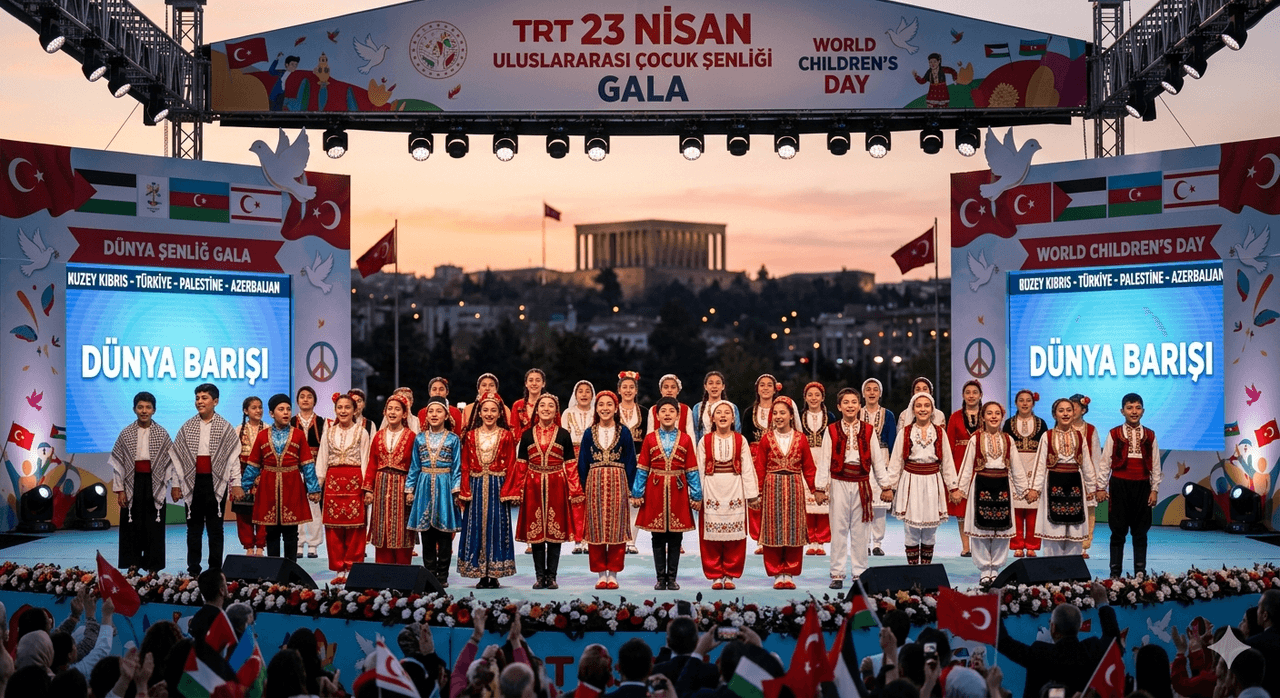
TRT International April 23 Children's Festival (Generated with Artificial Intelligence)
Year of Establishment | 1979 (on the occasion of UNESCO International Year of the Child) | ||||||||
|---|---|---|---|---|---|---|---|---|---|
Organizing Institution | Turkish Radio and Television Corporation (TRT) | ||||||||
Primary Objective | To strengthen feelings of love, respect, and friendship among children worldwide; to enhance cultural interaction. | ||||||||
Accommodation Model | Voluntary Family System (guest children being hosted by Turkish families). | ||||||||
Traditional Stops | Visit to Anıtkabir, acceptance at the Grand National Assembly of Türkiye, acceptance at the Presidency Complex, performances at Millet Bahçeleri, and the gala program. | ||||||||
TRT International 23 April Children's Festival is an international event organized annually by the Turkish Radio and Television Corporation (TRT) during the week of 23 April National Sovereignty and Children's Day. Initiated following UNESCO's declaration of 1979 as "International Year of the Child," the event aims to bring together children from around the world in Türkiye to strengthen mutual feelings of love, respect and friendship. The festival is conducted within a program framework in which children's groups from different countries showcase their cultural performances and are formally received by state authorities.
TRT 1st International 23 April Children
The institutionalization of 23 April as a national holiday is directly linked to the founding principles and modernization process of the Republic of Türkiye. This historical process began on 23 April 1920 with the opening of the Grand National Assembly of Türkiye (TBMM) and the proclamation of national sovereignty. Immediately thereafter, the "Law on Designating 23 April as a National Holiday," enacted on 23 April 1921, granted this date legal status as Türkiye's first national holiday.【1】 In the 1922 celebrations, the holiday was officially recorded in official documents as "National Sovereignty Day."【2】
The celebration of the holiday as a "Children's Day" materialized through Mustafa Kemal Atatürk's gesture of dedicating the day to children and the activities of Himaye-i Etfal Society (Child Protection Organization), the social services institution of the era. During the National Struggle period, to reintegrate orphaned and abandoned children into society and generate income for the society, Himaye-i Etfal declared 23 April 1927 as the first "Children's Day" and included children in the celebrations. Atatürk's direct support for these celebrations—including dedicating his automobile to children and offering his patronage—firmly associated the holiday with children at the societal level.【3】 In 1929, the celebrations were extended to a week and designated as "Children's Week."【4】 For many years, this special day was simultaneously celebrated under the dual names "National Sovereignty" and "Children's Day" in practice. In 1981, a legal amendment formally unified them under the official name "23 April National Sovereignty and Children's Day."【5】
TRT 23 April Children
The transformation of the event into an international initiative occurred following UNESCO's 1979 declaration of the year as "International Year of the Child," aimed at promoting children's rights and awareness worldwide. The Turkish Radio and Television Corporation (TRT), through a comprehensive project, decided to share Türkiye's national holiday with children around the world and launched its first international festival in 1979. Türkiye, seeking to elevate this initiative to a universal scale, submitted proposals through the Ministry of Foreign Affairs to the United Nations General Assembly advocating for 23 April to be recognized as an official "World Children's Day." Although the UN did not adopt any formal resolution in this direction, TRT's continuous invitations and expanding participant base have led the international community and states to recognize 23 April in practice as the day of global children's gathering and the sole international children's holiday.
The participant profile and organizational structure of the TRT International 23 April Children's Festival are based on positioning children not merely as performance groups but as cultural ambassadors. Over the 47-year period from 1979 to 2026, more than 30,000 children from 120 different countries have participated in the event.
The key elements defining the operational and social scope of the organization are as follows:
Hundreds of Children from 30 Countries in Ankara for the 47th TRT International 23 April Children's Festival (TRT News)
The TRT International 23 April Children's Festival is conducted within a comprehensive and systematic program spanning approximately one week, integrating elements of diplomacy, culture and art. Each phase of the organization aims to establish lasting bonds among children worldwide and maximize cultural exchange between the host country and participating nations.
The core components of the festival program are structured chronologically and thematically as follows:
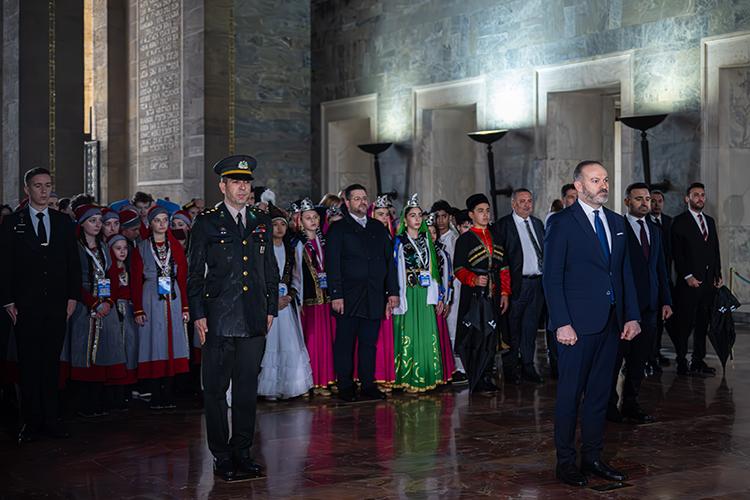
Children from Around the World Visiting Anıtkabir Before the Festival ((Anadolu Ajansı)
The TRT International 23 April Children's Festival is regarded in academic literature as a "mega event" due to its scale and the social value it generates.【6】 The impact of the organization is multi-layered, encompassing socialization, cultural diplomacy and regional development.
The festival contributes to the construction of childhood as a modern and universal concept. Children on this platform are not merely participants but are positioned as "political agents" carrying global messages of peace. The gathering of children from different nations provides a foundation for early development of multicultural awareness and the dismantling of prejudice. In particular, the inclusion of children from conflict or crisis regions (such as Palestine or earthquake-affected areas) affirms the organization's humanitarian solidarity and rehabilitative social responsibility function.
The cities hosting the festival—particularly Ankara and Istanbul—have become international centers of attraction. The tangible impacts of the festival on urban tourism and cultural fabric include:
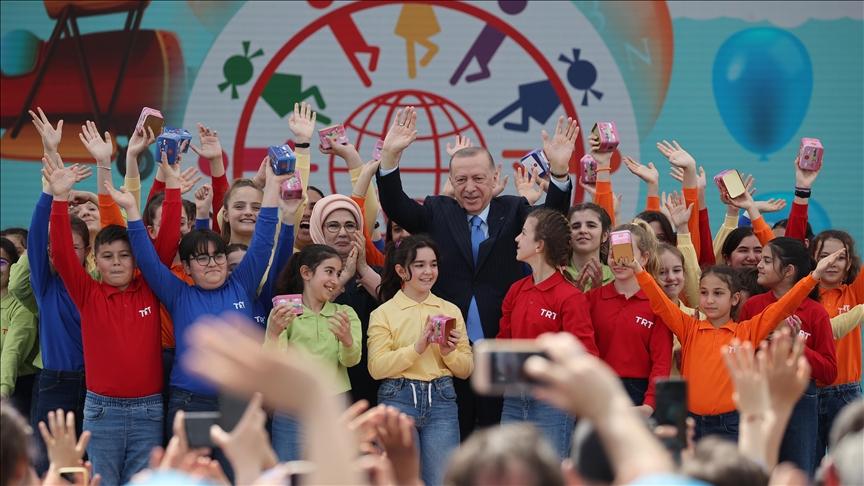
President Recep Tayyip Erdoğan and His Wife Emine Erdoğan with Children Coming to Türkiye for the Festival ((Anadolu Ajansı)
This organization, conducted by TRT, exemplifies public service broadcasting that enhances Türkiye's soft power capacity. The bonds established through the "volunteer family" model are regarded as long-term friendship investments that continue beyond the festival and strengthen international people-to-people diplomacy. TRT's continuous tradition of broadcasting and organizing this event has successfully branded 23 April as the world's sole international children's day.
Akoğlan Kozak, Meryem, and Dilek Mutlu. “Dünden Bugüne 23 Nisan Ulusal Egemenlik ve Çocuk Bayramı Etkinlikleri.” Afyon Kocatepe Üniversitesi Sosyal Bilimler Dergisi 22 (2020): 16–29. https://doi.org/10.32709/akusosbil.774822. Accessed April 19, 2026.
Akın, Veysi. “23 Nisan Millî Hakimiyet ve Çocuk Bayramı’nın Tarihçesi.” Pamukkale Üniversitesi Eğitim Fakültesi Dergisi 3, no. 3 (1997): 91–96. Accessed April 19, 2026. https://izlik.org/JA37TP54SW
Anadolu Ajansı. "Dünya Çocukları Anıtkabir ve TRT’yi Ziyaret Etti." Accessed April 19, 2026. https://www.aa.com.tr/tr/gundem/dunya-cocuklari-anitkabir-ve-trtyi-ziyaret-etti/3543142.
Dörtkol, Fahrettin. “23 Nisan Ulusal Egemenlik ve Çocuk Bayramı’nın Tarihçesi: Himaye-i Etfal Cemiyetinin Katkıları.” Gaziantep Üniversitesi Sosyal Bilimler Dergisi 22, no. 1 (2023): 145–158. https://doi.org/10.21547/jss.1223946. Accessed April 19, 2026.
Karaduman, Esra, and Gökhan Gökgöz. “TRT Yerli Çocuk Programlarında Çocukluğun İnşası: Eğitim, Toplumsallaşma, Politik Özne Biçimleri.” TRT Akademi 2, no. 4 (2017): 376–397. Accessed April 19, 2026. https://izlik.org/JA93ET53RJ
Mutlu Bayın, Dilek, and Meryem Akoğlan Kozak. “23 Nisan Ulusal Egemenlik ve Çocuk Bayramı’nın Ankara Turizmine Katkısı Üzerine Bir Araştırma.” Türk Turizm Araştırmaları Dergisi 5, no. 4 (2021): 2448–2465. https://doi.org/10.26677/TR1010.2021.880. Accessed April 19, 2026.
TRT Archive. "1. Uluslararası 23 Nisan Çocuk Şenliği." YouTube video. Accessed April 19, 2026. https://www.youtube.com/watch?v=u8ki_uD3TVQ.
TRT Arşiv. “23 Nisan Çocuk Şenlikleri.” YouTube video. Accessed April 19, 2026. https://www.youtube.com/watch?v=Z20lMDoUB3c.
TRT Haber. "TRT 27 Ülkeden 490 Çocuğu Ankara’da Ağırlayacak." Accessed April 19, 2026. https://www.trthaber.com/haber/turkiye/trt-27-ulkeden-490-cocugu-ankarada-agirlayacak-941965.html.
TRT Haber. “TRT 47. Uluslararası 23 Nisan Çocuk Şenliği İçin 30 Ülkeden Yüzlerce Çocuk Ankara’da.” YouTube video. Accessed April 19, 2026. https://www.youtube.com/watch?v=uJb0QOMcFNI
[1]
Fahrettin Dörtkol. “The History of 23 April National Sovereignty and Children
[2]
Fahrettin Dörtkol. “The History of 23 April National Sovereignty and Children
[3]
Meryem Akoğlan Kozak and Dilek Mutlu. “23 April National Sovereignty and Children
[4]
Meryem Akoğlan Kozak and Dilek Mutlu. “23 April National Sovereignty and Children
[5]
Fahrettin Dörtkol. “The History of 23 April National Sovereignty and Children
[6]
Meryem Akoğlan Kozak and Dilek Mutlu. “23 April National Sovereignty and Children


TRT International April 23 Children's Festival (Generated with Artificial Intelligence)
Year of Establishment | 1979 (on the occasion of UNESCO International Year of the Child) | ||||||||
|---|---|---|---|---|---|---|---|---|---|
Organizing Institution | Turkish Radio and Television Corporation (TRT) | ||||||||
Primary Objective | To strengthen feelings of love, respect, and friendship among children worldwide; to enhance cultural interaction. | ||||||||
Accommodation Model | Voluntary Family System (guest children being hosted by Turkish families). | ||||||||
Traditional Stops | Visit to Anıtkabir, acceptance at the Grand National Assembly of Türkiye, acceptance at the Presidency Complex, performances at Millet Bahçeleri, and the gala program. | ||||||||
No Discussion Added Yet
Start discussion for "TRT 23 April Children's Festival" article
Historical Background and Internationalization Process
Participation and Organizational Scope
Festival Program and Traditional Activities
Social, Cultural and Economic Impacts
Social and Political Impacts
Cultural and Touristic Contributions
Institutional and Diplomatic Value