


This article was automatically translated from the original Turkish version.
Trigonometry is a branch of mathematics that deals with the relationships between the angles and sides of triangles. The word trigonometry comes from the Greek words trigōnon (triangle) and metron (to measure). Trigonometry is particularly concerned with the side lengths of right triangles and is therefore highly practical. Tangent and cotangent are among the important functions of trigonometry and are used in calculations involving the side lengths of right triangles. Today, trigonometry is widely used in fields such as economics, physics, and engineering.
The origins of trigonometry date back to ancient civilizations. The earliest trigonometric calculations were made by ancient Greek and Babylonian astronomers. However, the true development of trigonometry began in the Hellenistic period and was further shaped by contributions from Indian, Islamic, and medieval European science scholars.
The mathematical development of trigonometry accelerated particularly in the 16th and 17th centuries. Trigonometric functions and concepts such as sine, cosine, and tangent gradually became more abstract and generalized.
16th Century: Regiomontanus used the fundamental concepts of trigonometry to perform complex astronomical calculations and discovered general properties of trigonometric functions.
17th Century: Mathematicians such as Pierre de Fermat and Isaac Newton helped trigonometry acquire an analytical perspective by developing differential calculus and function theory.
18th Century and Beyond: In the 18th century, mathematicians such as Leonhard Euler deepened the understanding of trigonometry and examined the relationships between trigonometric functions.
The application areas of trigonometry are extremely broad. The main fields of application are as follows:
1. Astronomy: Trigonometry is used to calculate the positions of stars and planets. For example, trigonometric calculations are employed when measuring stellar parallax.
2. Engineering and Physics: Trigonometric calculations are used in many branches of engineering, from electrical engineering to civil engineering. Calculations involving structures, machines, and circuits often rely on trigonometric formulas.
3. Geography and Cartography: Trigonometric techniques are of great importance in mapmaking and land measurements. Geographic coordinate systems and map projections are based on trigonometric calculations.
4. Computer Graphics and Animation: In 3D modeling and animation techniques, operations such as rotating, scaling, and positioning objects are performed using trigonometric functions.
5. Sound and Light: Phenomena such as the propagation of sound waves, refraction, and reflection of light are modeled using trigonometric calculations. Trigonometric functions are also used in optical engineering.
6. Music: The frequencies and amplitudes of sound waves can be expressed using trigonometric functions. In music theory, certain intervals can be analyzed using trigonometric calculations.
7. Robotics and Artificial Intelligence: Trigonometric calculations play an important role in controlling robot movements and in artificial intelligence applications.
The tangent function is defined as the ratio of the opposite side to the adjacent side in a right triangle. Mathematically:
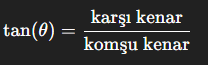
This illustrates the tangent formula. (Generated with AI assistance)
On the unit circle, the tangent function is defined as follows:
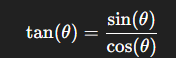
This figure shows the relationship between the tangent function and the sine and cosine functions. (Generated with AI assistance)
The concept of tangent was first associated with Indian astronomy around 500 CE, when Aryabhata defined it. Aryabhata developed the sine function and performed basic calculations related to the tangent, laying the foundations of trigonometry. In the 9th century, Islamic astronomers such as Al-Battani prepared more comprehensive tables of the tangent function and used them in astronomical calculations.
The cotangent function is the reciprocal of the tangent function. It is defined as the ratio of the adjacent side to the opposite side in a right triangle. Mathematically:
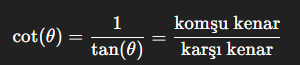
This figure shows the relationship and formula of the cotangent function with respect to the tangent function. (Generated with AI assistance)
On the unit circle, the cotangent function is defined as follows:
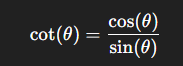
This figure shows the relationship between the cotangent function and the sine and cosine functions. (Generated with AI assistance)
Historically, the cotangent function developed alongside the tangent function. Its earliest development dates back to around 500 CE in India. Aryabhata considered the reciprocal of the tangent function and developed the fundamental properties of the cotangent. Later, in the Islamic world, particularly Al-Battani, created tables containing the mathematical properties of the cotangent function and used them in astronomical calculations. The concept of cotangent was introduced to medieval Europe during the Renaissance period through scholars such as Regiomontanus and Copernicus.
The tangent and cotangent functions are used in advanced mathematical operations such as solving trigonometric equations and computing limits. Cotangent is particularly important in the analysis of wave motion, optical engineering, and numerous engineering applications. In electrical engineering and acoustic engineering, the cotangent function plays a critical role in analyzing sound waves.
The tangent function also plays a critical role in solving and analyzing complex trigonometric equations. For example, solutions to operations such as differentiation and integration rely on the properties of the tangent function. In electrical engineering, the tangent function is commonly used in modeling wave motion and analyzing sinusoidal waves.
Apostol, Tom M. Calculus, Vol. 1: One-Variable Calculus with an Introduction to Linear Algebra. 2nd ed. Hoboken, NJ: Wiley, 2007.
Boyer, Carl B., and Uta C. Merzbach. A History of Mathematics. 3rd ed. Hoboken, NJ: Wiley, 2011.
Burton, David M. The History of Mathematics: An Introduction. Boston: McGraw-Hill, 2006.
Katz, Victor J. A History of Mathematics: An Introduction. 3rd ed. Boston: Addison-Wesley, 2009.
Kline, Morris. Mathematical Thought from Ancient to Modern Times. New York: Oxford University Press, 1972.
Stewart, James. Calculus: Early Transcendentals. 8th ed. Boston: Brooks/Cole, 2015.
Swetz, Frank. Mathematics and Culture. La Salle, IL: Open Court, 1987.
Weisstein, Eric W. "Tangent." *MathWorld – A Wolfram Web Resource*. Wolfram Research, 2021.https://mathworld.wolfram.com/Tangent.html

History of Trigonometry
Babylon and Ancient Greece
Indian Mathematics
Islamic Civilization
Medieval Europe
Development of Modern Trigonometry
Applications of Trigonometry
Tangent (tan) Function
History of the Tangent Function
Cotangent (cot) Function
History of the Cotangent Function
General Properties of Tangent and Cotangent
Graphical Representation and Periodic Structure
Applications of the Tangent and Cotangent Functions