


This article was automatically translated from the original Turkish version.
A transponder is an aircraft device that automatically transmits a signal when queried by radar. Through a panel in the cockpit, the pilot enters the assigned transponder code to enable air traffic control to identify the aircraft. Upon interrogation, the transponder transmits its identity and altitude information. The aircraft’s position is determined based on the signal’s round-trip time and the direction of the radar antenna. When an aircraft’s transponder is off, no information can be obtained and communication is not possible.
The term transponder is derived from the English words transmitter and responder in the 1940s.
The aviation transponder was first developed during the Second World War by the American and British armed forces as a system to distinguish between friendly and enemy aircraft on radar (Identification Friend or Foe, IFF).
The same system was adapted by civil air traffic control in the 1950s for use in secondary surveillance radar systems to provide traffic services for general and commercial aviation.
Several different RF (Radio Frequency) communication protocols have been standardized for civil aviation transponders. Depending on the interrogation mode, transponders provide identification codes, aircraft position, pressure altitude, call sign, and other data.
Definitions of different transponder modes:
The most commonly used transponder mode is Mode S.
A transponder switch typically has multiple positions:
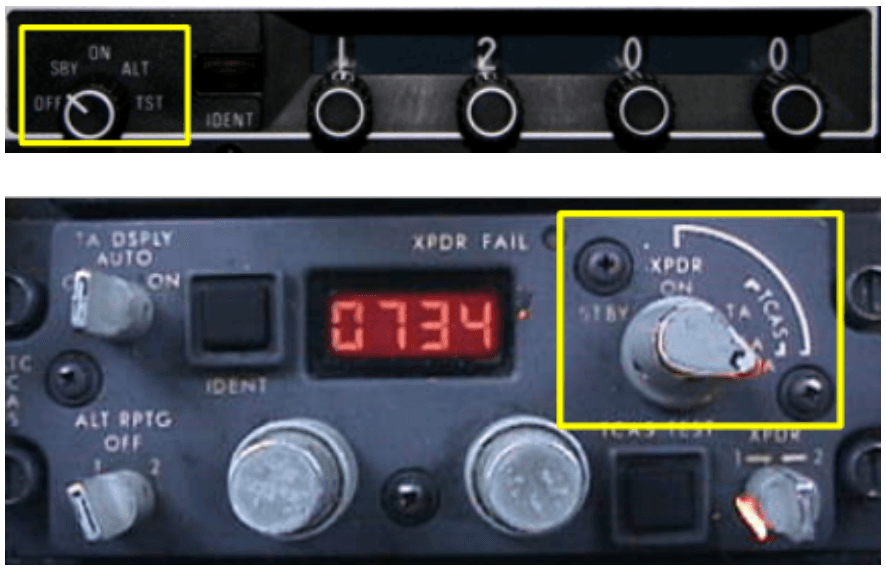
Example of transponder settings
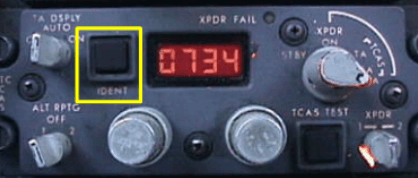
IDENT button
The transponder transmitter generally uses different codes to identify flights. Squawk codes consist of four-digit numbers. The dials on the transponder are marked from 0 to 7 digits.
Special squawk codes are assigned for specific conditions or flight situations.
Since a transponder is designed to respond to queries from a ground-based radar system, it generally operates as follows:
1- Radar Query: A ground-based radar system sends a query to a transponder to track an aircraft in the airspace. This query requests specific information from the aircraft.
2- Signal Transmission: The transponder responds to the radar query by transmitting the aircraft’s information. This information is encoded within a radio signal sent by the transponder.
3- Reception by Radar: The ground-based radar system receives and decodes the signal transmitted by the transponder to gather information about the aircraft.
4- Display: The ground-based radar system converts the information received from the transponder into a visual display for air traffic control operators.
ICAO Documentation 4444. (2016). Air Traffic Management. Chapter 8.5.
Koç, A. (2023). *Transponder Nedir?* https://herkesicinhavacilik.com/2023/05/23/transponder-nedir/. Accessed January 1, 2025.
Soyertem, H. (2022). Radar Theory.

History
Transponder Types
Transponder Settings
Transponder Codes
Transponder Operating Principle