


This article was automatically translated from the original Turkish version.
Tower of Babel, as one of the myths of the ancient world, draws attention through both its historical and mythological dimensions. According to the story in the Bible’s Genesis book, humanity decided to build a tower reaching up to the heavens in order to reach God. However, God interpreted this act as hubris and confused their languages, preventing them from understanding one another. As a result of this event, the tower was never completed and people dispersed into various regions. The myth of the Tower of Babel has become a symbol of humanity’s drive for progress, collective effort, and the conflicts that arise from it.
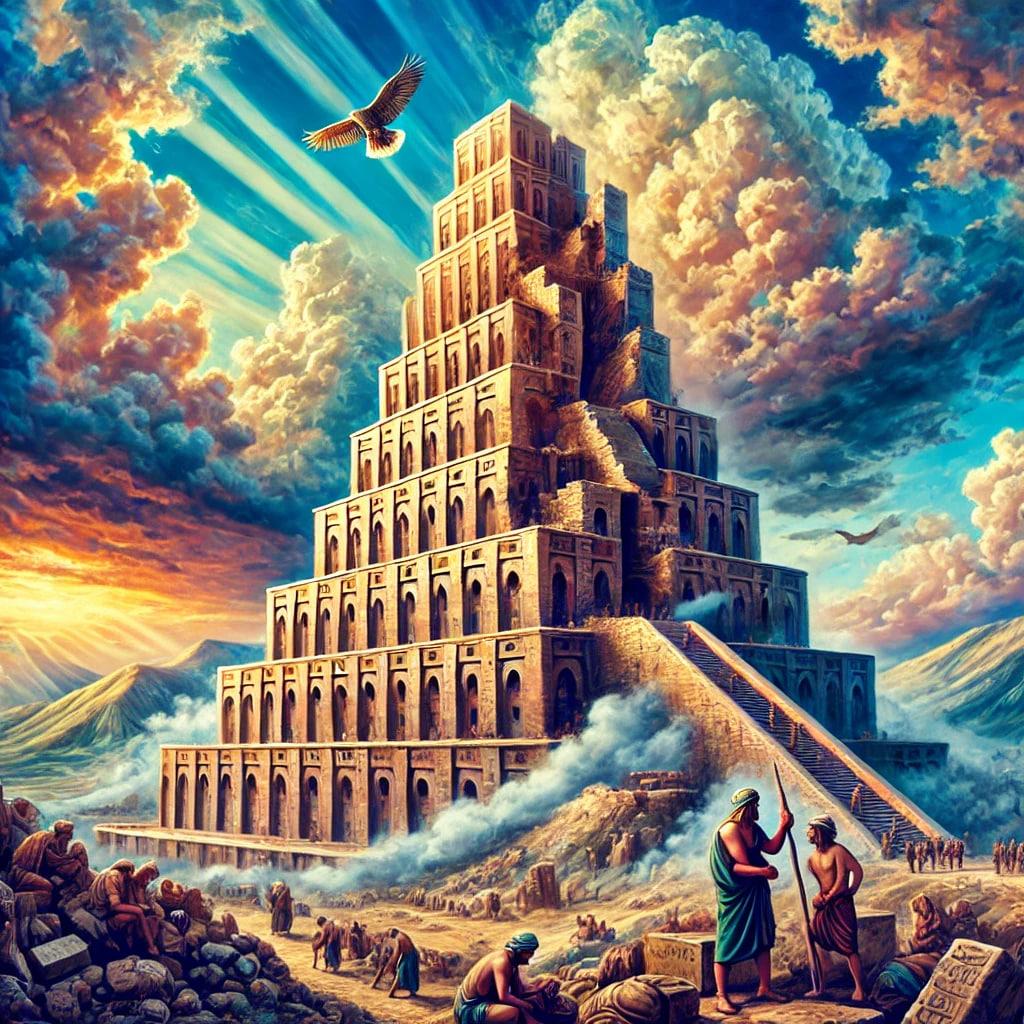
Tower of Babel from an Artificial Intelligence Perspective
Tower of Babel (Hebrew: מִגְדַל בַּבֶל Migdal Bavel), Bible’s account, as well as in the Qur’an’s an chapter and in local legends across many regions, refers to a tower built to reach God.
The story of the Tower of Babel is closely associated with the city of Babylon, as its name suggests. Babylon, located between the Tigris and Euphrates rivers in the fertile lands of Mesopotamia, became a major imperial center during the reign of Hammurabi in the 18th century BCE. This ancient city is renowned for its distinctive architecture and temple structures known as ziggurats.
The most famous structure of Babylon, Etemenanki, may have provided the historical basis for the Tower of Babel. Etemenanki is a seven-tiered ziggurat dedicated to the god Marduk. Believed to have been constructed in the 7th century BCE, this structure became one of the largest of its time, reaching a height of approximately 91 meters. The story of the Tower of Babel may have been inspired by this ziggurat; however, no definitive evidence confirms this connection.
The Akkadian word bāb-ilû means “Gate of God.” In Sumerian, the equivalent term is Kadingirra. In the Old Testament, the name Babylon appears as Babel, derived from the Hebrew Bavel. This word is interpreted in the Old Testament as meaning “confusion” or “chaos.”
At the heart of the Tower of Babel myth lies humanity’s desire to attain unlimited power and God’s punishment for this act of hubris. The biblical narrative serves to remind us of God’s supremacy and the limits of humanity.
According to the biblical account, after the flood, people gathered in the land of Shinar and decided to build a tower to reach God. But God was displeased by their arrogant behavior and confused their languages so that they could no longer understand one another. This event offers a religious explanation for the origin of different languages.
Whether the Tower of Babel actually existed remains a subject of debate among archaeologists and historians. Excavations in Babylon in the early 20th century uncovered the remains of the Etemenanki ziggurat, leading some to suggest it may have inspired the biblical tower. The ziggurat, constructed of brick, features seven tiers that progressively narrow.
Although this structure is impressive, the Tower of Babel described in the Bible carries a symbolic meaning far beyond this physical structure. Therefore, the existence of the Tower of Babel is considered both an archaeological and a mythological phenomenon.
The Tower of Babel was destroyed by the Persian king Xerxes in 479 BCE. Later, Alexander the Great sought to restore the ruined structure; however, his death prevented the project from being completed.
The Tower of Babel has been a major source of inspiration for artists and writers throughout history. Pieter Bruegel’s 1563 painting “The Tower of Babel” is one of the most significant artistic representations of this myth. Bruegel meticulously depicted the tower and transformed its universal message into visual form. This work emphasizes the Renaissance era’s focus on human cultural diversity and the reminder of God’s power.
Modern times have used the tower as a metaphor for intercultural communication difficulties, multilingualism, and humanity’s struggle to coexist. In the works of Franz Kafka and the stories of Jorge Luis Borges, the Tower of Babel appears as a metaphorical structure questioning the limits of humankind.
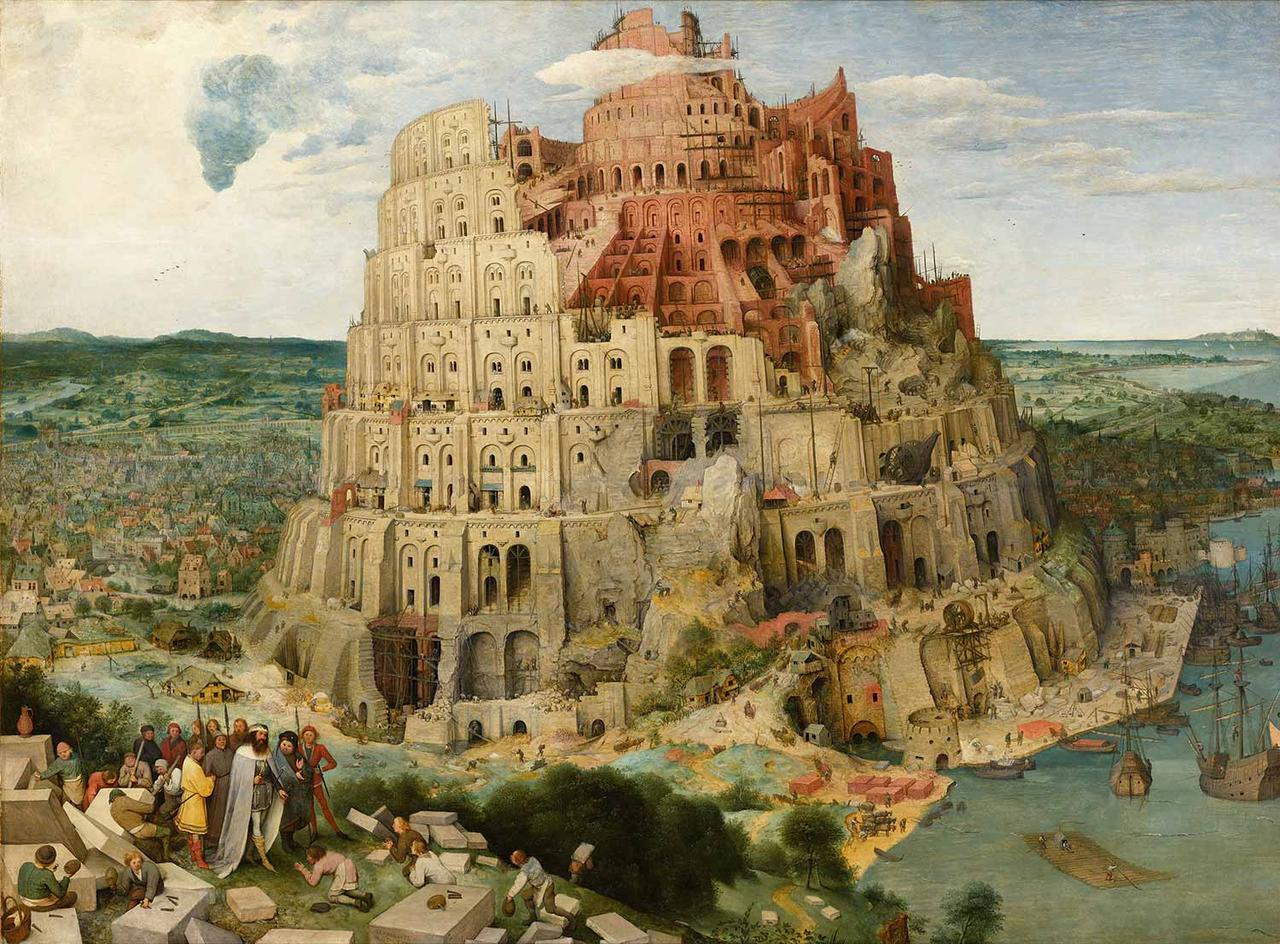
The Tower of Babel as Depicted by Pieter Bruegel
Tower of Babel is a multidimensional narrative situated at the intersection of history, mythology, and archaeology. The story reflects both humanity’s aspiration for progress and solidarity and the hubris inherent in seeking unlimited power. As a mythological entity carrying universal messages, the tower is linked to one of Mesopotamian civilization’s greatest architectural achievements. The Tower of Babel continues to hold its place in human history as a symbol that reminds us both of pride in our creations and of the need to recognize our own limits.
George, Andrew R. Babylonian Topographical Texts. Leuven: Peeters Publishers, 1992.
History Titans. Tower of Babel: The Biblical Legend of Babylon. Creek Ridge Publishing, 2020.
Nettle, Daniel. Linguistic Diversity: The Tower of Babel as a Historical Analogy. Oxford: Oxford University Press, 1999.
Çimen, Elif. "Bir Resim Okuması: Babil Kulesi." Sanat Dergisi 11 (2010): 17–19.

Historical and Geographical Context
Mythological Meaning and Theological Interpretations
Archaeological Findings
Tower of Babel in Art and Literature