


This article was automatically translated from the original Turkish version.

The relationship between creation myths and apocalypse myths operates in a far more “systematic” manner than we often assume. A community establishes its origin using certain symbols, and it concludes its end with those same symbols. Those who appear on stage at the beginning are also present in the final scene. Because mythology, even when it seems to be telling something new, works by transporting the core motifs of memory to different times or contexts. Therefore, whatever exists in creation myths leaves its trace in apocalypse myths.
One of these core motifs in Turkic mythological cosmology is the “wolf.” Revered as a totem among Proto-Turkic communities, it became part of the ancestor cult during the Huns and Göktürk eras; this figure, associated with the sky, rescues lineages from extinction and guides heroes in epics. In narratives concerning the end of the world—that is, eschatological accounts—it does not remain passive. This time, it is not the “initiator” but the “terminator,” not the “birthgiver” but the “one who brings the end,” or more subtly, “a component of the mechanism that initiates the conclusion.”
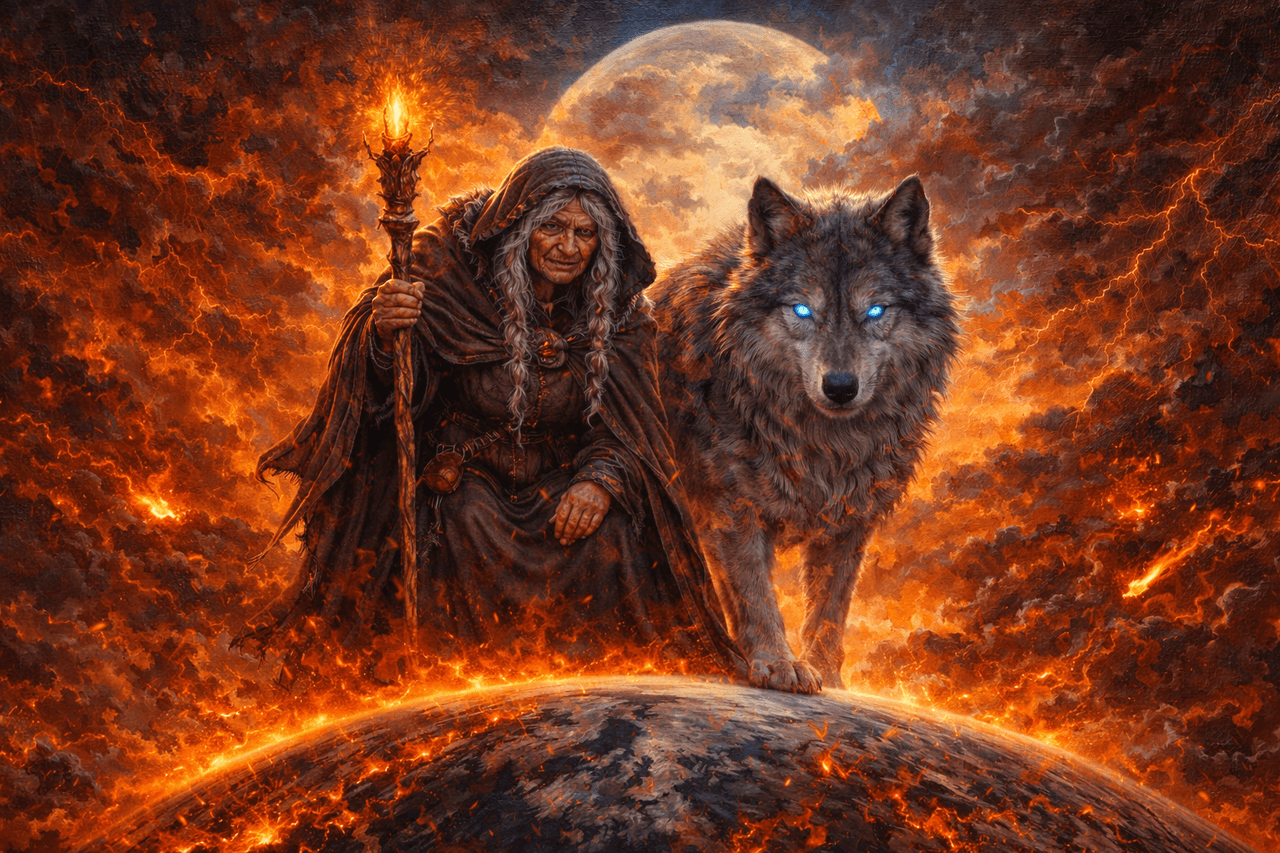
Waiting for the Apocalypse with the Wolf (Generated by Artificial Intelligence)
Moreover, this is not merely a “fairy-tale” continuity. Even when we look to the heavens, the language of myth speaks the same truth. The Big Dipper is imagined as seven wolves, and the Little Dipper as two horses, and their chase never ends in capture—it is described as a condition of cosmic order: If the wolves are caught, the cosmos descends into chaos and the apocalypse erupts. Thus, the wolf is not merely a being that accompanies the beginning of a lineage on earth; it is also a guardian at the threshold that defines the boundary of cosmic order.
In Turkic myths, legends, and epics, the wolf is a sacred animal distinguished by various attributes. Its recognition as a totem among Proto-Turkic communities, its integration into the ancestor cult during the Hun and Göktürk periods, and its transformation into a sacred symbol announce from the outset that this figure cannot be read as an ordinary animal. In Turkic origin myths, heroes descended from the gray wolf are well known. In the Oghuz Khagan Epic, the wolf appears as a sacred animal guiding the ruler. The presence of this motif in the Bashkir epics suggests that the wolf’s role as a “guide” formed a shared narrative language across different Turkic communities.
Here lies a critical detail: The wolf is not merely an “assistant”; in a sense, it is a figure who understands the order of the world. This is why its association with the heavens in Turkic astrology is unsurprising. Among the Yakut Turks, in their beliefs about lunar eclipses, the wolf (and the bear) take center stage: It is believed that during full moon, wolves and bears attack and devour the moon, after which God resurrects it. This narrative establishes a framework in which the wolf’s destructive power is contained within the sacred order. The moon is devoured but returns; the order is shaken but rebuilt.
The wolf’s functions—ensuring lineage continuity, rescuing from extinction, and guiding—signal its possession of divine power. The name “Bozkurt” (Gray Wolf) is also interpreted as one of the indicators of this divinity, since in ancient Turkic traditions, the colors “boz” (gray) and “gök” (blue) were used as markers of sacredness. In this context, the sacred wolf is the “Gök Kurt” or “Bozkurt.”
From here, the narrative language gradually leads us to the scene of the apocalypse. For once a figure is regarded as a “marked being of the sacred,” it is not expected to remain confined to origin stories; it is summoned to the threshold of the end.
The expression “kurtla kıyamete kalmak” (“to wait for the apocalypse with the wolf”), still alive in Anatolia today, appears in everyday speech, especially when young brides complain about their elderly mothers-in-law: “She didn’t die, she just left—does she have to wait for the apocalypse with the wolf?”
This usage, on one hand, exaggerates the notion of old age as something unending; on the other, it draws upon a much older mythic idea: Even if the apocalypse comes, something remains—and among those remnants is the wolf.
In the apocalypse narrative collected by Prof. Dr. Öcal Oğuz from Pınarkaya village in Sarıkaya district of Yozgat, this idea becomes explicitly narrative: When the apocalypse comes, only an old, frail woman remains; and a wolf eats her.
In the Azerbaijani version recounted by Oğuz, when the apocalypse arrives, a powerful wind begins; it destroys all living beings, but the Bozkurt withstands the wind and remains standing until the very end of the apocalypse.
In accounts collected by Gülcan Kızılören from Halhal, Iran, a similar structure appears: All beings created by God die, except for one old woman; she wrestles with a wolf. If the woman wins, the world is reborn and all return to life; if the wolf wins, nothing remains.
Now we must pause and ask: Why “old woman” and “wolf”?
Oğuz’s analysis provides a crucial clue: The mythic protagonists chosen in these narratives are beings that have lost their capacity for reproduction and procreation. This selection emphasizes that the narrative is indeed an apocalypse tale. The world is likened to an old woman because she is no longer fertile, no longer capable of producing “continuity.” The wolf, by contrast, is the actor at the threshold where continuity is severed.
At this point, the proverb transcends its function as everyday complaint; it carries a mythic vision of the end. The world grows old, humanity exhausts itself, life fades; the wolf either remains the last being standing or completes the end.
The phrase “kurtla kıyamete kalmak” appears prominently in a poem attributed to Kul Himmet within Alevi mythological tradition.
Ali mounted Dülül
The poet stands firm
Waiting for the apocalypse with the gray wolf
Is the world not still here?
The poem’s overall framework is built on the transience of the world, and each quatrain ends with expressions of complaint against the world. Here, the Bozkurt’s mention as a being that “remains until the apocalypse” simultaneously reveals the wolf’s eschatological role and the world’s impermanence. The world is not eternal, yet the image of “the world that waits for the apocalypse with the Bozkurt” creates an ironic reversal of permanence. The world is spoken of as if it has “seen and endured everything,” aged, exhausted—yet still endures until the apocalypse.
This poem is not a mythic narrative in itself, but it carries the imprint of mythic thought in poetic language. Here too, the wolf is a threshold figure: It accompanies the end of the world and settles at its boundary.
The most intensive treatment of the wolf and world motifs appears in the eschatological narrative drawn from the Alevi written tradition and recounted by Eğri in Kitab-ı Cabbar Kulu. The narrative begins with a conversation between Prophet Muhammad and Ali about the apocalypse. Muhammad gives Ali two green chains and instructs him to travel holding one end. Upon his return, Ali describes having seen four things. Among them is a wooden board inscribed with “Elif Be” and a woman with white hair seated upon the letter “Y”; the woman says she is “the world.”
As the narrative deepens, the symbolic dimension becomes clearer: Ali descends through seven layers of the earth, passing cosmic carriers such as the yellow ox, stone, wind, fish, and sea; he passes eleven veils beneath the stone. Then he sees a white wolf with only its head black. The wolf holds a white hair in its mouth, chewing it continuously. The end of the hair’s length is unknown—it has passed through the hole of a miller’s axe.
Muhammad explains these two symbols: The axe is the foundation of the world; the hair is its root. When the wolf chews through and finishes the hair, the apocalypse will come.
The narrative does not end here; the true “logic of the apocalypse” is established from this point. Twenty-eight additional hairs are created alongside the first; these twenty-eight hairs correspond to the twenty-eight letters of the Arabic alphabet. The hairs were originally created whole and given to the wolf as sustenance. Each time the wolf chews one hair, a drop of blood falls upon the world’s head. As the wolf begins chewing each hair representing a letter, the woman representing the world sits upon the dot of that letter. When the wolf chews the final letter, both the world’s and the wolf’s tasks will be complete.
In this narrative, traces of symbolic expression and Sufi thought are dominant. The world’s representation as an old woman is linked to the Sufi perspective that fertility has ceased and the world no longer serves humanity. The woman’s age signifies that life can no longer reproduce. Moreover, here not only “the end” but also “the limit of knowledge” is conveyed: The creation of twenty-eight hairs corresponding to the twenty-eight letters, and the existence of a twenty-ninth hair, emphasizes that knowledge of the apocalypse belongs solely to God and is absent from any written science.
The wolf’s consumption of the hair representing the world’s root and the letters representing knowledge suggests that the apocalypse emerges only after all knowledge has been exhausted. Here, the wolf may be read as a “destroyer of knowledge,” yet the narrative’s primary emphasis is that no one can know the time of the apocalypse. The letters are consumed, knowledge is depleted—but the final judgment rests with divine power.
And note: Although this narrative is framed within a Sufi interpretive context, its mythic origins reveal themselves. Here too, the wolf is a “sign of the sacred,” positioned as the being entrusted by God to bring about the apocalypse.
Gönül Yonar’s work Apocalypse Myths (Waiting for the Apocalypse with the Wolf) offers a comparative framework examining eschatologies across different traditions. In the section devoted to “Turkic eschatology,” it notes that interpretations from ancient Turkic inscriptions—such as “the sky falling” and “the nation’s destruction”—are evaluated within an eschatological context, while in Anatolian oral tradition, the end of the world is narrated as the extinction of all humanity except for the survival of a single wolf. Here, the wolf appears in Turkic creation mythology as a “source of lineage,” and in eschatology as the surviving figure.
Within Yonar’s framework, Turkic eschatology describes the breakdown of order—rising evil, loss of respect for fathers, disruption of cosmic harmony—as signs of the apocalypse. The end of the world is narrated as the battle between Erlik and Ülgen, with Ülgen ultimately victorious, establishing goodness as the world’s dominant force. This framework shows that the “end” is not merely annihilation but the final outcome of a clash of values.
Let us return to the beginning. We said: Whatever exists in a creation myth also appears in an apocalypse myth. Turkic mythology weaves this “rule of continuity” almost visibly around the wolf. In origin narratives, the rescue of lineage from extinction; in epics, guidance; in cosmic associations with the sky; the idea of the sacred’s manifestation—all these are reorganized in apocalypse narratives: This time, the wolf chews through the hair representing the world’s root; swallows the hairs symbolizing letters; wrestles with the aged world; withstands the apocalypse wind; remains in the final scene.
And the proverb “kurtla kıyamete kalmak” has become a small but powerful sentence that infiltrates everyday life with this entire mythic language. Sometimes it is a complaint, sometimes a joke, sometimes a lament—but behind it lies the same symbolic weave stretching from creation to apocalypse.
Thus, the wolf is not merely an animal to be feared or loved; it is a mechanism of mythic continuity. It reminds us of the beginning and announces the end. In the mythological lexicon of Turkish culture, the entry “wolf” gathers birth and end in a single sentence: It initiates the lineage, and it initiates the end.
Happy listening.
Walk, False World (Echoes from Anatolia)
Altay, Şeyda. YONAR, Gönül. *Kıyamet Mitolojileri (Kurtla Kıyamete Kalmak)*. İstanbul: Ötüken Neşriyat, 2019. 270 pp. *The Journal of Turkic Language and Literature Surveys (TULLIS)*, 5(1): 2020. Accessed January 6, 2025.https://dergipark.org.tr/en/download/article-file/1166924
Arslan, Mustafa. "Kültürel Belleğin Uzman Taşıyıcıları Olarak Âşıklar." *Türk Dünyası İncelemeleri Dergisi* 15, no. 1 (2015): 1–6. Accessed January 6, 2025.https://dergipark.org.tr/en/pub/egetdid/article/380779
YouTube. "Pir Sultan Abdal - Yürü Bre Yalan Dünya | Metal Cover | Anatolian Folk | AI Music" *Echoes from Anatolia,* Accessed January 6, 2025.https://www.youtube.com/@EchoesfromAnatolia
Şahin, Mehmet. Animals and Symbolic Values Attributed to Animals in Alevi Mythology. *Journal of Alevism-Bektashism Studies* 32 (2025): 76–122. Accessed January 6, 2025.https://abked.de/index.php/abked/article/view/539
From Beginning to End: The Gray Wolf
The Eschatology Behind a Proverb: Waiting for the Apocalypse with the Wolf
Bozkurt and the Complaint Against the World in Kul Himmet
Kitab-ı Cabbar Kulu's Apocalypse: Hair, Letter, Wolf
Conclusion